


This video is hosted on YouTube
This content is hosted by YouTube. The player loads only after you allow marketing cookies.
Industries / Security companies
Run B2B security sales pipelines and account coverage with clear ownership — without confusing CRM for guard management systems.
▶ See CRM workflows for security companies
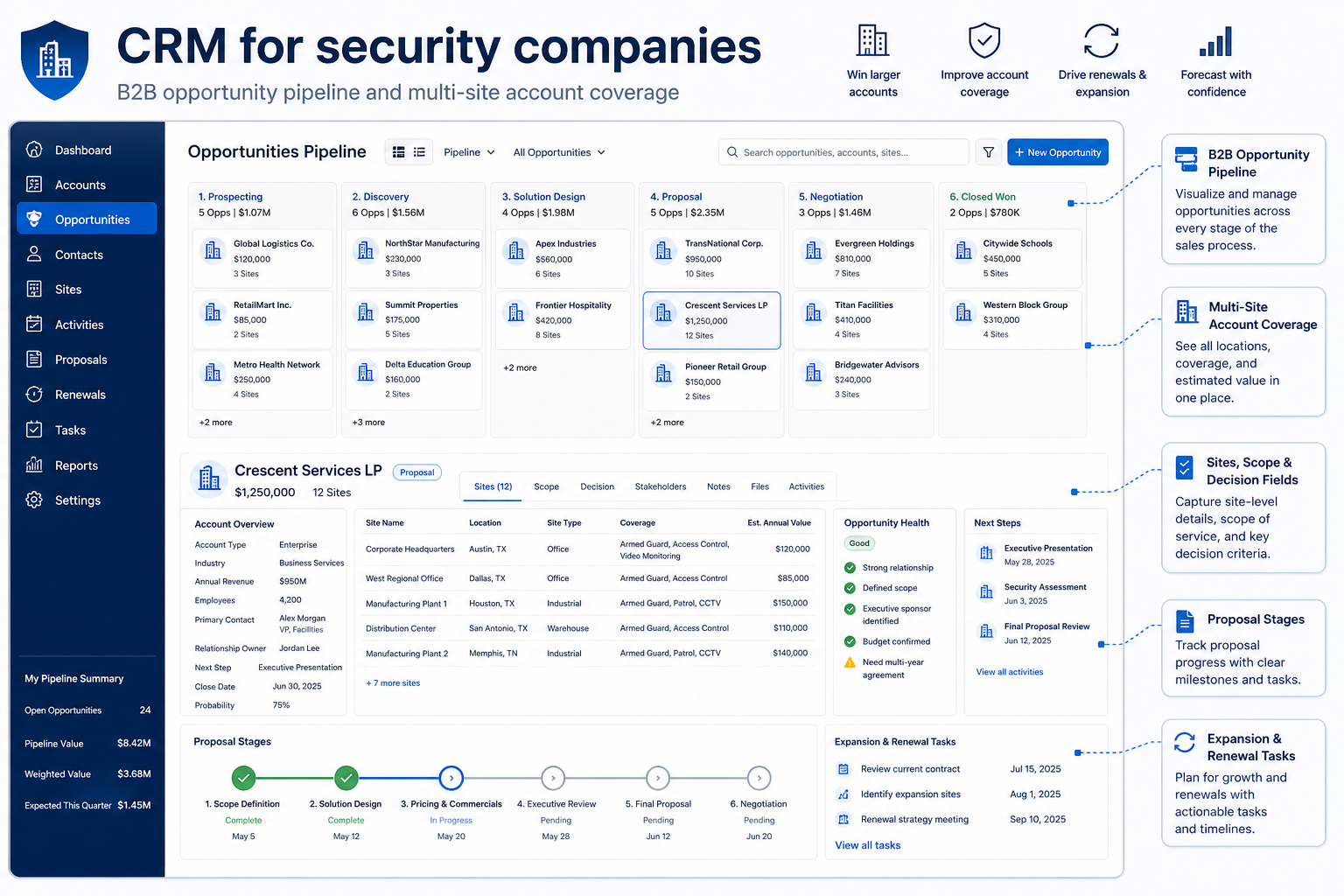
Security companies CRM at a glance
B2B pipeline and account coverage
Opportunity stages · Multi-site accounts · Activity ownership · Renewals / expansion · CRM vs ops systems
Sales · Account management · Sales ops · Leadership
37 catalogue CRM products
Aug 17, 2026
Fit snapshot
Security-company CRM supports B2B opportunity pipelines, multi-site account contacts, and renewal/expansion follow-up. Guard scheduling and incident systems remain operations tools.
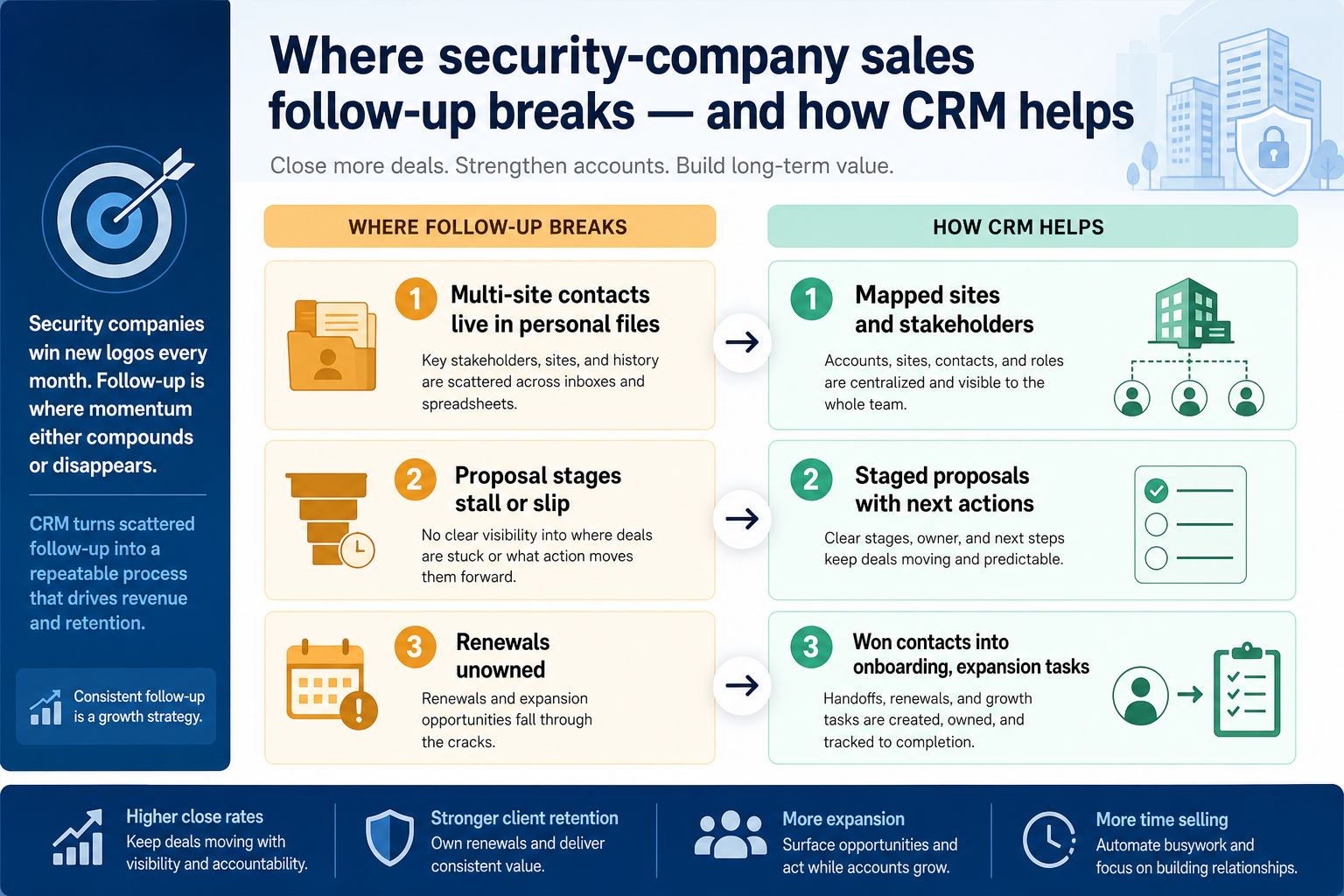
Security service companies selling guarding, systems, or monitoring to commercial accounts — sales managers and account executives who need pipeline and account discipline.
How Security companies teams put CRM to work
Example 1
a regional guarding sales team
Before CRM
RFP responses lived in email
After CRM
every pursuit has a stage, owner, and decision date
Example 2
an account manager covering multi-site clients
Before CRM
site contacts reset every renewal
After CRM
account maps show stakeholders and open expansions
These are the operating problems that usually push security companies teams toward CRM — not feature wish lists.
Without CRM discipline: Teams cannot see what is due without a meeting.
Without CRM discipline: Renewals miss the right stakeholder.
Without CRM discipline: Schedules and incidents get forced into CRM.
Without CRM discipline: Expansion conversations start too late.
A CRM only helps when the team keeps owners, history, and next steps current. Here is what “good” looks like in security companies.
With CRM discipline: Shared stages and due dates make pursuits reviewable.
With CRM discipline: Account hierarchies hold sites and roles.
With CRM discipline: Keep CRM for sales and accounts; keep workforce/incident tools for ops.
With CRM discipline: Renewal dates and tasks sit on the account.
Visible sales pipeline
Open pursuits have owners and stages.
Stronger account memory
Sites and stakeholders survive staff changes.
Better renewal discipline
Dates and next steps are reviewable.
Clearer system boundaries
Sales CRM and ops platforms stop overlapping.
Prioritize opportunity stages, account hierarchies (sites/contacts), activity ownership, and permissions. Keep workforce scheduling and incident management outside CRM unless integrated on purpose.
Bids and renewals have owners, stages, and next steps.
Explore capability →Multi-site clients and decision-makers stay mapped across contracts.
Procurement, security, and operations stakeholders share one opportunity.
Leaders see likely awards and renewals without verbal-only updates.
Sensitive client and site notes need clear permissions — verify with vendors.
Explore capability →Scheduling and incident systems stay operational; CRM owns commercial relationships.
Explore capability →Start with must-haves your team will use weekly. Treat nice-to-haves as later upgrades — not day-one blockers.
Must-have
Calls, meetings, and next steps logged.
Nice-to-have
Team and account visibility controls.
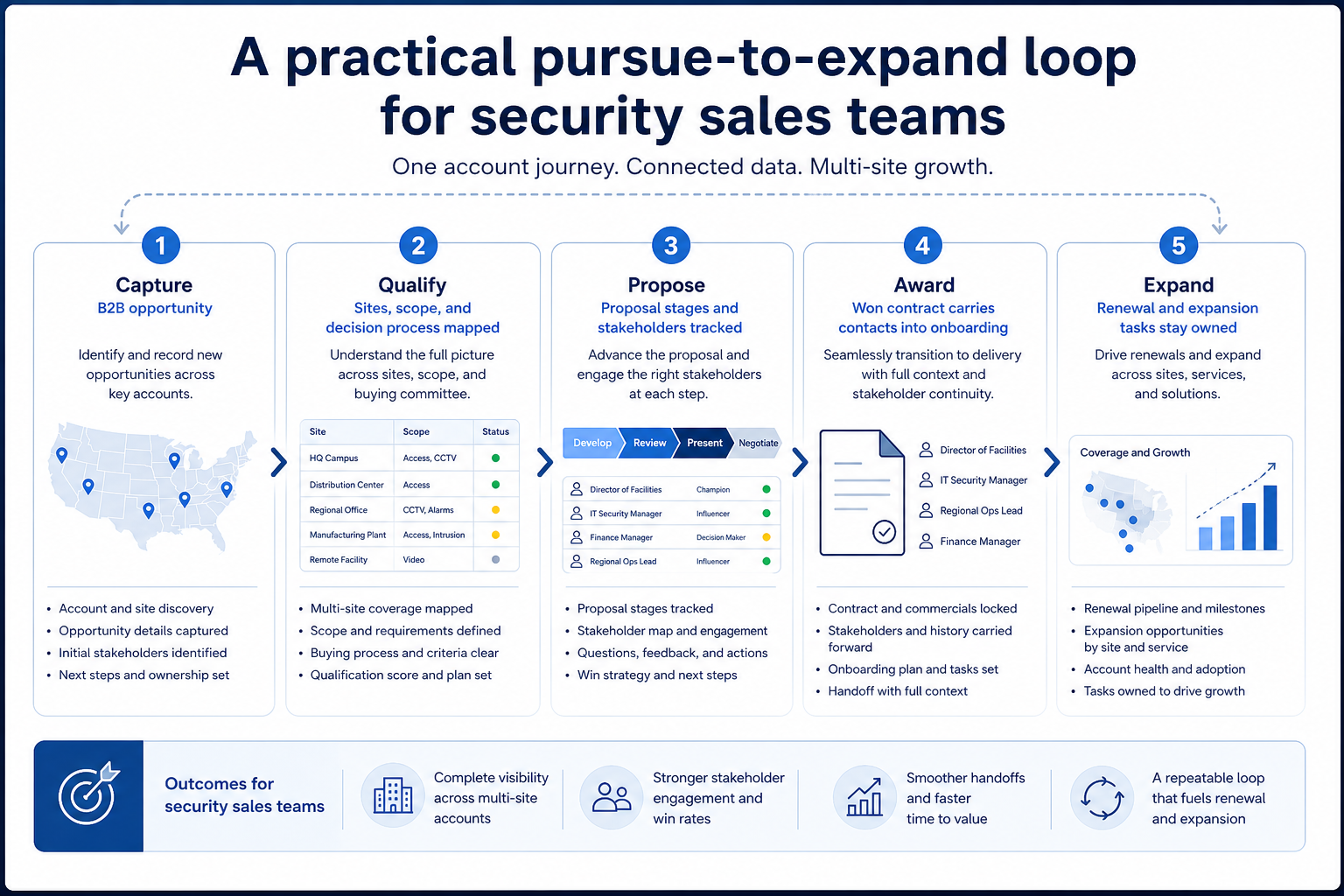
Understand this industry’s operating loop first. Product demonstrations are optional examples for each step — they do not change product rankings.
Support labels come from structured feature research — not from videos.
Objective
Turn leads and RFPs into opportunities with site and scope context.
In this step
Requirements
Next step
Next step
Next step
Next step
These are buyer scenarios — not product recommendations. Start from how your team works, then compare capabilities.
Best when Multiple pursuits compete for limited BD time.
Explore use case →Best when Procurement and site leaders share one deal.
Explore use case →Best when Clients span locations and renewals.
Explore use case →Best when BD and account managers meet on site.
Explore use case →Best when Staffing and margin planning need earlier signal.
Explore use case →Shortlist from our CRM catalogue with fit notes grounded in published positioning and editorial assessments — not invented rankings or prices.
Explore catalogue CRM products and compare their capabilities against your requirements.

Freshsales
SMB and mid-market teams wanting CRM + phone/email engagement
$9.00/user/month

HubSpot
SMB and mid-market teams wanting free CRM now and room to expand into hubs later
$15.00/user/month

Salesforce
Mid-market and enterprise sales orgs needing deep customization and reporting
$25.00/user/month

Attio
Startups and GTM teams wanting flexible CRM
$0.00/user/month

Pipedrive
SMB and mid-market sales teams prioritizing pipeline visibility
$14.00/user/month
Capsule
Small businesses wanting a simple CRM
$18.00/user/month
Official vendor demonstrations can help show how CRM products are used in security companies workflows. SoftwareGlimpse evaluates these alongside independent research, documentation and product evidence.
Official vendor videos illustrate industry workflow context. They do not change product rankings, industry fit, regulatory compliance conclusions, or pricing assessments. Vendor-published customer stories are not independent proof of typical outcomes.
Freshsales
How to create Multiple Sales Pipeline | Freshsales CRM
General CRM workflow relevant to security companies — not an industry-specific product demo.
This video is hosted on YouTube
This content is hosted by YouTube. The player loads only after you allow marketing cookies.
Industry context
What to notice for this industry
Capabilities demonstrated
HubSpot
Lead management workflow — capture through assignment and follow-up
General CRM workflow relevant to security companies — not an industry-specific product demo.

This video is hosted on YouTube
This content is hosted by YouTube. The player loads only after you allow marketing cookies.
Industry context
What to notice for this industry
Capabilities demonstrated
Requirements visible / relevant
Salesforce
How Salesforce explains lead management from capture through qualification.
General CRM workflow relevant to security companies — not an industry-specific product demo.
This video is hosted on YouTube
This content is hosted by YouTube. The player loads only after you allow marketing cookies.
Industry context
What to notice for this industry
Attio
Attio | How to build your sales pipelines
General CRM workflow relevant to security companies — not an industry-specific product demo.

This video is hosted on YouTube
This content is hosted by YouTube. The player loads only after you allow marketing cookies.
Industry context
What to notice for this industry
Capabilities demonstrated
Products we recommend evaluating for this industry’s workflows — based on editorial fit, not vendor demos or affiliate relationships.
18 evidence items backing this recommendation (features, screenshots, or documentation). Official video is optional context and does not change fit.
Workflows: Bid and renewal pipelineComplex multi-stakeholder salesMulti-site account management
Recommendation confidence: High. Industry fit reflects SoftwareGlimpse recommendations on use cases, capabilities, requirements, and product evidence. Official demos illustrate workflow context only — they do not determine rankings, compliance, or pricing.
18 evidence items backing this recommendation (features, screenshots, or documentation). Official video is optional context and does not change fit.
Workflows: Bid and renewal pipelineComplex multi-stakeholder salesMulti-site account management
Recommendation confidence: High. Industry fit reflects SoftwareGlimpse recommendations on use cases, capabilities, requirements, and product evidence. Official demos illustrate workflow context only — they do not determine rankings, compliance, or pricing.
18 evidence items backing this recommendation (features, screenshots, or documentation). Official video is optional context and does not change fit.
Workflows: Bid and renewal pipelineComplex multi-stakeholder salesMulti-site account management
Recommendation confidence: High. Industry fit reflects SoftwareGlimpse recommendations on use cases, capabilities, requirements, and product evidence. Official demos illustrate workflow context only — they do not determine rankings, compliance, or pricing.
Select products to compare
| Product | Starting price | Pipeline | Automation | Reporting | Integrations | Best suited to |
|---|---|---|---|---|---|---|
| $9.00/user/month | SMB and mid-market teams wanting CRM + phone/email engagement | |||||
| $15.00/user/month | SMB and mid-market teams wanting free CRM now and room to expand into hubs later | |||||
| $25.00/user/month | Mid-market and enterprise sales orgs needing deep customization and reporting | |||||
| $0.00/user/month | Startups and GTM teams wanting flexible CRM | |||||
| $14.00/user/month | ~ | SMB and mid-market sales teams prioritizing pipeline visibility |
Select two products to open a side-by-side comparison.
Answer a few questions about your team, requirements, integrations and budget to create a personalized shortlist.
Personalized shortlist
Finder uses structured answers and CRM evidence — not affiliate incentives — to build your shortlist.
Cells reflect product evidence. Unknown support is shown as a dash — never as a hard “no”.
Estimates use verified list prices for a sample team configuration. Adjust seats and billing in the calculator for a tailored view.
Team size
10 users
Billing
monthly
Estimated catalogue range
Lowest
$13.00
Typical
$380.00
Highest
$1,666.67
Verified USD catalogue range for this team size — midpoint is the catalogue median, not a market average.
Map bid-to-renewal
From pursuit through award and renewal.
Pipeline use case →Define security & access needs
Permissions and sensitive note handling.
Evaluation guide →Draw ops-tool boundaries
CRM vs guard and incident platforms.
Requirements guide →Estimate seats
BD, account managers, and leaders.
CRM Cost Calculator →Shortlist with Finder
Filter for pipeline, accounts, and admin needs.
Start CRM Finder →Use these prompts in vendor conversations. They are educational — not claims about any specific product.
Ask the vendor to demonstrate this with your workflow, plans, and data requirements — and request documentation where relevant.
Ask the vendor to demonstrate this with your workflow, plans, and data requirements — and request documentation where relevant.
Ask the vendor to demonstrate this with your workflow, plans, and data requirements — and request documentation where relevant.
Ask the vendor to demonstrate this with your workflow, plans, and data requirements — and request documentation where relevant.
Ask the vendor to demonstrate this with your workflow, plans, and data requirements — and request documentation where relevant.
Ask the vendor to demonstrate this with your workflow, plans, and data requirements — and request documentation where relevant.
Use these dimensions when evaluating vendors. We do not claim specific regulatory compliance unless verified evidence exists.
Data access controls
Who can see and change customer, deal, and activity records.
Explore requirement →
User permissions
Role-based permissions so reps, managers, and admins see different fields.
Explore requirement →
Auditability
Visibility into who changed records and when.
Explore requirement →
Data retention & export
How you retain, export, and delete customer data when you leave.
Explore requirement →
Identity / SSO
How users sign in — especially if IT requires SSO.
Explore requirement →
Integration security
How connected tools exchange data without leaking credentials.
Explore requirement →
Data residency
Where customer data is stored and processed.
Explore requirement →
Vendor security documentation
What the vendor publishes for a security review (trust center, SOC reports).
Explore requirement →
Stages that match bid and renewal gates
Include RFP, site walk, proposal, and renewal checkpoints you already run.
Sensitive site-note permissions
Define who can see client security-sensitive notes before migration.
CRM vs guard / ops platforms
Keep scheduling and incidents in ops systems; CRM owns commercial follow-through.
Won-to-ops handoff fields
Require site contacts and scope notes when opportunities close-won.
Vendor-published customer stories can show real-world context. They are not independent SoftwareGlimpse recommendations and do not prove typical outcomes, ROI, or product superiority.
Customer Spotlight: Blue Nile

This video is hosted on YouTube
This content is hosted by YouTube. The player loads only after you allow marketing cookies.
Official vendor video
What this story illustrates
 vs
vs
ACT! vs Affinity
Side-by-side comparison on shared CRM criteria.
Compare →vs
ACT! vs Agile CRM
Side-by-side comparison on shared CRM criteria.
Compare →vs
ACT! vs Apptivo
Side-by-side comparison on shared CRM criteria.
Compare →vsACT! vs Attio
Side-by-side comparison on shared CRM criteria.
Compare →vs
ACT! vs Bitrix24
Side-by-side comparison on shared CRM criteria.
Compare →vsACT! vs Capsule
Side-by-side comparison on shared CRM criteria.
Compare →A practical decision framework for picking CRM software: needs, features, size fit, integrations, true cost, adoption, and growth — without vendor hype.
Evaluate CRM options fairly with weighted criteria, a shared trial script, and a scorecard — so you compare evidence instead of demo theater.
Write demo-ready CRM requirements from 90-day outcomes, must vs nice features, stakeholders, and hard constraints — without feature-wishlist shopping.
Learn what CRM software is, how it works for sales and customer teams, and how to choose one without drowning in vendor marketing.
Evidence
Product capabilities and pricing are tied to recorded evidence.
Evaluation
Products are compared using consistent category criteria.
Independence
Affiliate relationships never determine rankings or recommendations.
Generally no. Use CRM for sales and account relationships; keep scheduling and incident management in operations systems.
Many security companies succeed with mid-market or enterprise general CRMs configured for multi-site accounts. Choose vertical ops suites when workforce management is the primary need — that is a different buying decision than CRM.
Sites, primary stakeholders, contract end dates, and open expansion opportunities — kept short enough the team will maintain them.
Continue from security companies CRM research with decision tools and related hubs. Affiliate relationships never change recommendations.
Compare catalogue CRM products based on your team size, requirements, integrations and budget.