
This video is hosted on YouTube
This content is hosted by YouTube. The player loads only after you allow marketing cookies.
Industries / Healthcare
Coordinate patient acquisition and referral relationships with care for sensitive data and clear ownership.
▶ See CRM workflows for healthcare
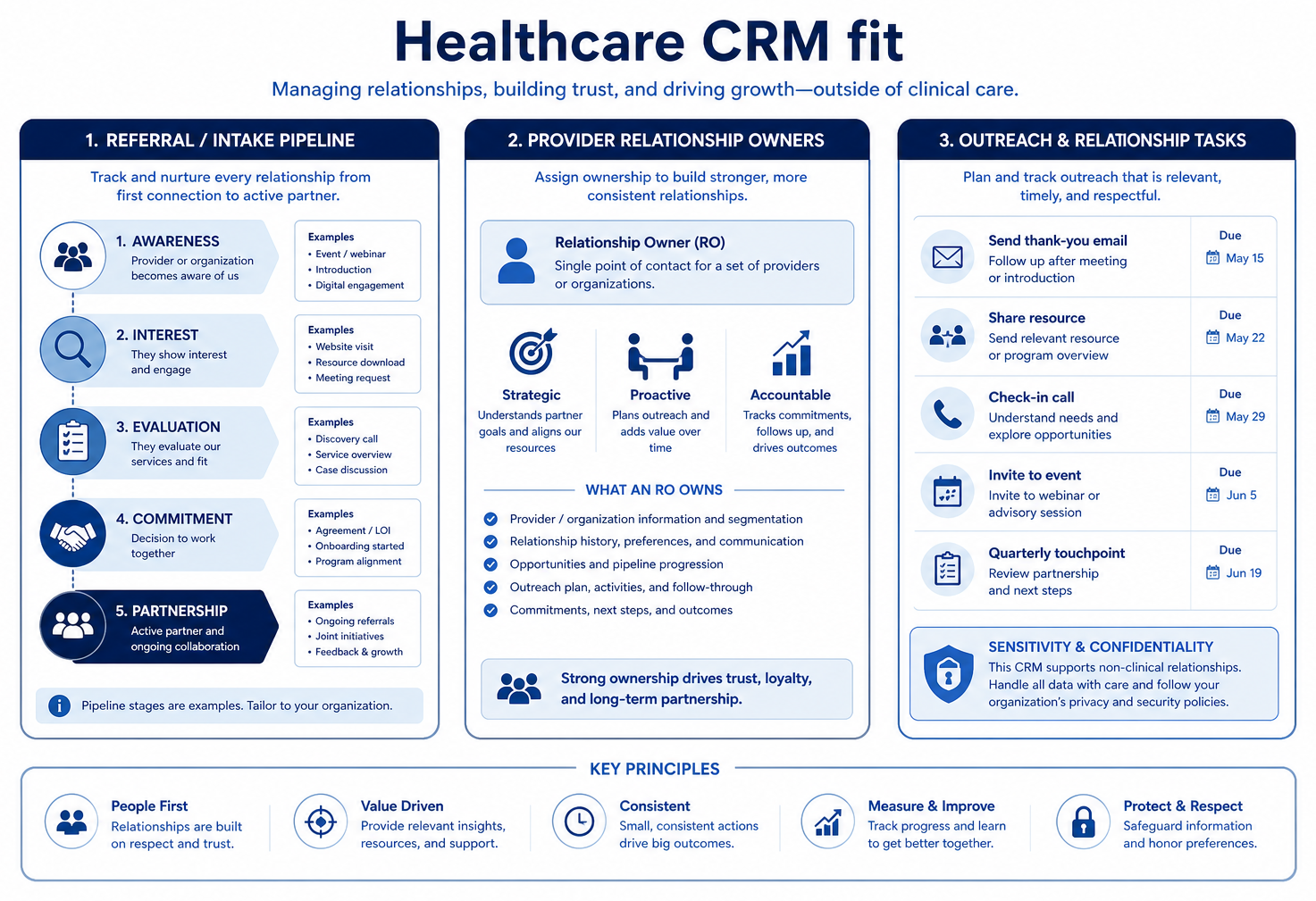
Healthcare CRM at a glance
Owned referrals and intake follow-up with careful data boundaries
Referral relationship tracking · Inquiry / intake ownership · Access controls · Handoffs to scheduling · Activity history
Practice administration · Referral development · Patient access / intake · Marketing operations
37 catalogue CRM products
Aug 17, 2026
Fit snapshot
Healthcare CRM (outside clinical systems of record) typically supports outreach, referral development, scheduling coordination, and relationship follow-up for practices and health organizations. It is not a substitute for clinical documentation — keep patient-care data boundaries clear and evaluate privacy requirements with your compliance owners.
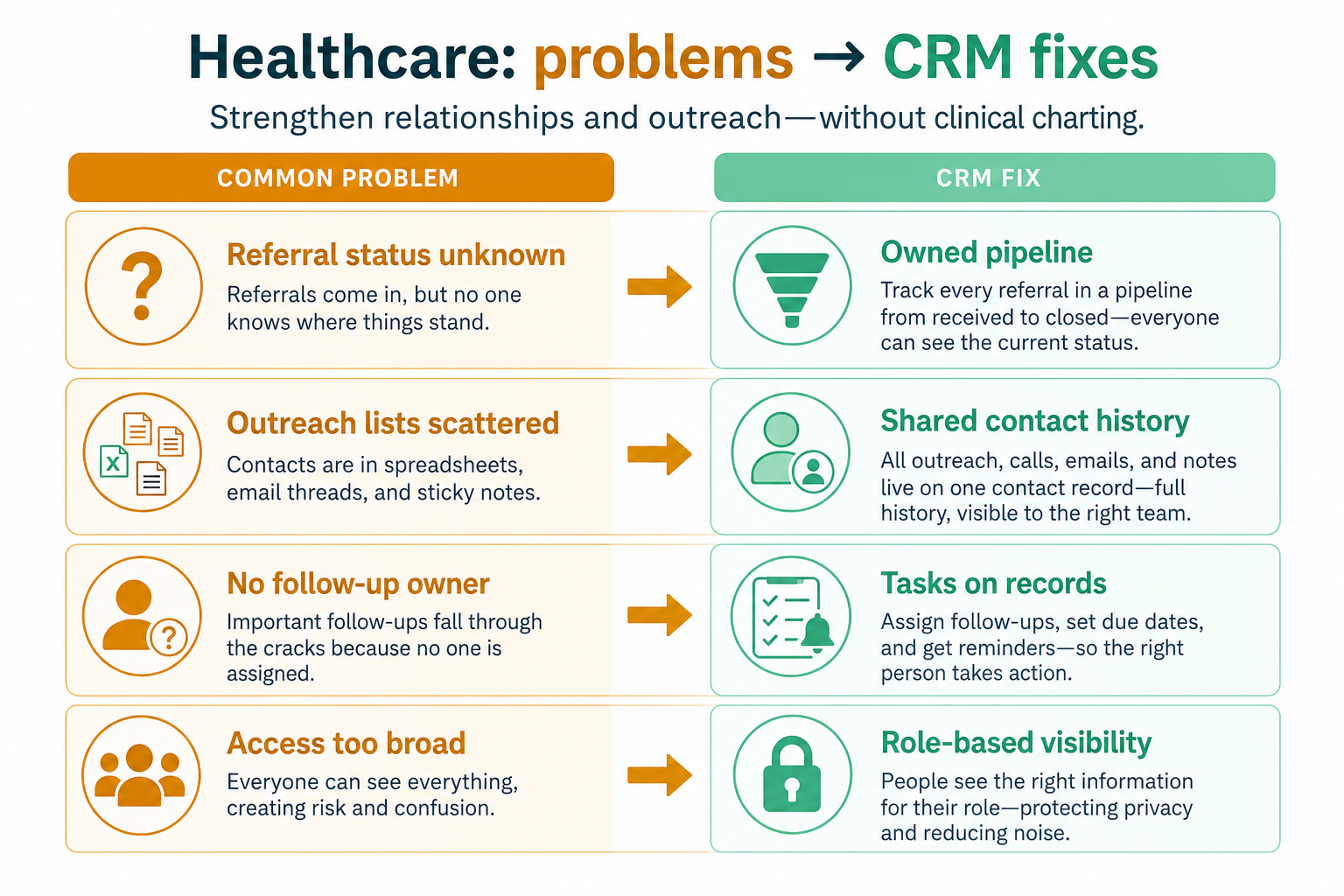
Practice administrators, referral development / physician liaison teams, patient access and marketing ops, and outpatient or specialty groups coordinating intake. Buyers need shared relationship history without turning CRM into an unauthorized clinical chart.
How Healthcare teams put CRM to work
Example 1
a multi-site specialty practice
Before CRM
referral outreach lived in liaison spreadsheets and personal email
After CRM
each referring office has an owner, last touch, and next visit plan — coverage survives staff turnover
Example 2
a patient-access team
Before CRM
web inquiries and call-backs were reconstructed from voicemail
After CRM
every inquiry has a stage and owner so abandoned intakes are visible in a weekly review
These are the operating problems that usually push healthcare teams toward CRM — not feature wish lists.
Without CRM discipline: When that person leaves, the practice loses who prefers what and who was promised follow-up.
Without CRM discipline: Web and phone inquiries stall between front desk, marketing, and clinical scheduling.
Without CRM discipline: Teams paste sensitive clinical detail into open notes or the wrong tool.
Without CRM discipline: Each location invents its own tracking sheet.
A CRM only helps when the team keeps owners, history, and next steps current. Here is what “good” looks like in healthcare.
With CRM discipline: Referring contacts, notes, and next visits sit on shared records with owners.
With CRM discipline: A simple intake pipeline with mandatory owners surfaces abandoned requests.
With CRM discipline: Define what belongs in CRM versus clinical systems; use permissions and field discipline accordingly — confirm policy with compliance owners.
With CRM discipline: Shared stages and reporting make outreach comparable across sites without forcing identical clinical workflows.
Durable referral memory
Liaison knowledge survives turnover and PTO.
Fewer abandoned inquiries
Intake follow-ups are owned and reviewable.
Clearer tool boundaries
Teams know what belongs in CRM versus clinical systems.
More consistent multi-site outreach
Shared stages replace one-off spreadsheets per location.
Prioritize referral and inquiry ownership, appointment or intake handoffs, and access controls appropriate to sensitive information. Do not invent certification claims — verify privacy, security, and integration requirements (including any EHR connections) directly with vendors and your organization.
Keep referral and relationship context without turning CRM into an EHR replacement.
Track BD, referrals, and institutional relationships with clear owners.
Explore capability →Role-based visibility matters when relationship data sits near sensitive operational context.
Outreach tasks and next reviews are visible — not buried in individual inboxes.
Leaders see coverage and stalled outreach without rebuilding sheets.
Explore capability →Connect only what governance allows; confirm vendor security docs before syncing.
Explore capability →Start with must-haves your team will use weekly. Treat nice-to-haves as later upgrades — not day-one blockers.
Must-have
Referring offices, patients-as-inquiries, and relationship notes with owners.
Learn more →Next touches and callbacks on the record.
Limit who sees sensitive fields; align with internal policy.
Nice-to-have
Volume, response time, and source visibility for ops reviews.
Learn more →Verify connections to scheduling or other systems with vendors — do not assume clinical interoperability.
Understand this industry’s operating loop first. Product demonstrations are optional examples for each step — they do not change product rankings.
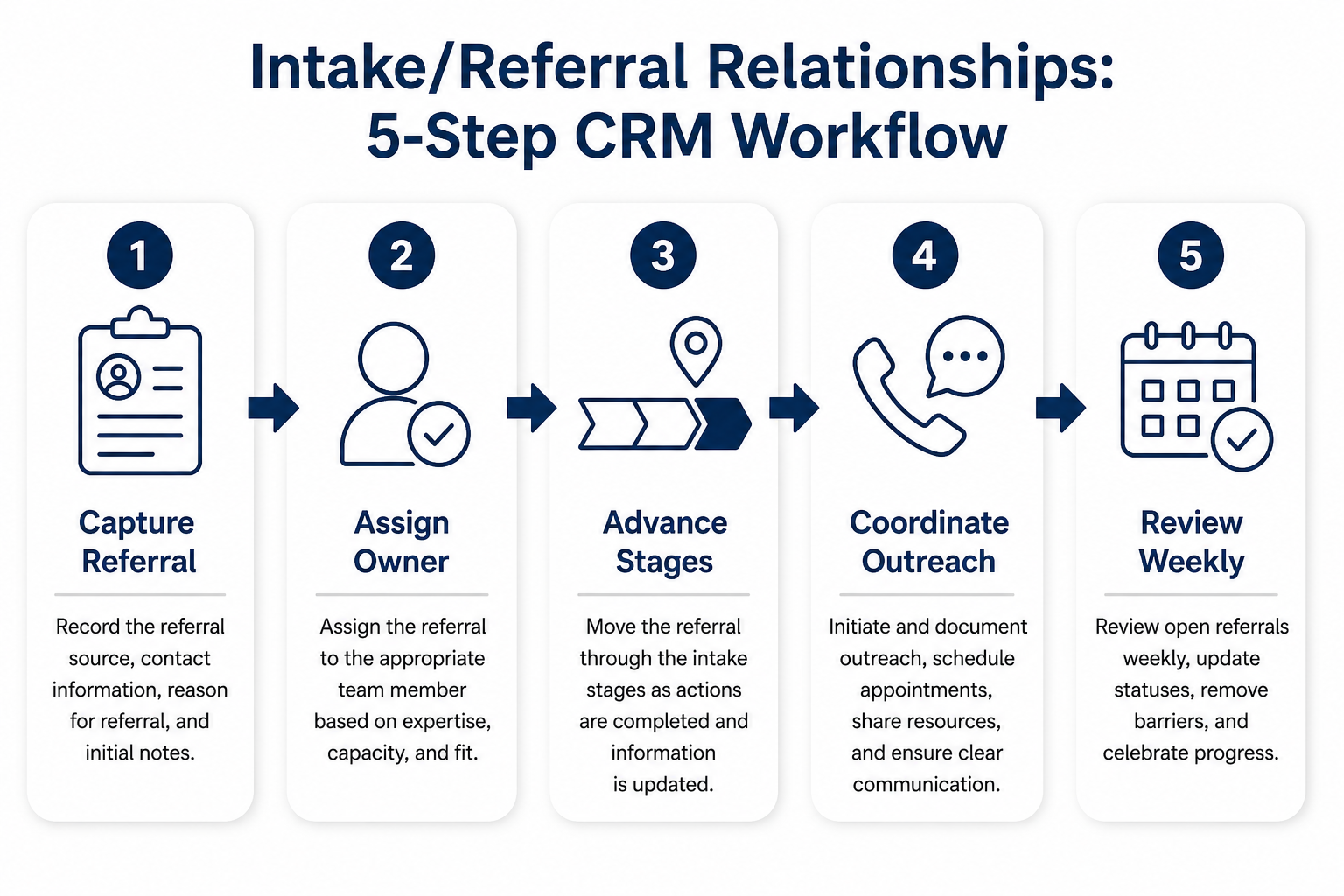
Support labels come from structured feature research — not from videos.
Objective
Capture referrals and inquiries with source and owner — without stuffing clinical detail into CRM.
In this step
Capabilities
Requirements
Next step
Next step
Next step
Next step
These are buyer scenarios — not product recommendations. Start from how your team works, then compare capabilities.
Best when Referring providers and partners need structured follow-up.
Explore use case →Best when Partnerships and outreach run like multi-stage sales.
Explore use case →Best when Multiple coordinators share the same relationship book.
Explore use case →Best when Weekly visibility into outreach health is required.
Explore use case →Best when IT/compliance must approve access and retention rules.
Explore use case →Explore catalogue CRM products and compare their capabilities against your requirements.

Freshsales
SMB and mid-market teams wanting CRM + phone/email engagement
$9.00/user/month

HubSpot
SMB and mid-market teams wanting free CRM now and room to expand into hubs later
$15.00/user/month

Salesforce
Mid-market and enterprise sales orgs needing deep customization and reporting
$25.00/user/month

Attio
Startups and GTM teams wanting flexible CRM
$0.00/user/month

Pipedrive
SMB and mid-market sales teams prioritizing pipeline visibility
$14.00/user/month

Capsule
Small businesses wanting a simple CRM
$18.00/user/month
Official vendor demonstrations can help show how CRM products are used in healthcare workflows. SoftwareGlimpse evaluates these alongside independent research, documentation and product evidence.
Official vendor videos illustrate industry workflow context. They do not change product rankings, industry fit, regulatory compliance conclusions, or pricing assessments. Vendor-published customer stories are not independent proof of typical outcomes.
Freshsales
How to create Multiple Sales Pipeline | Freshsales CRM
General CRM workflow relevant to healthcare — not an industry-specific product demo.
This video is hosted on YouTube
This content is hosted by YouTube. The player loads only after you allow marketing cookies.
Industry context
What to notice for this industry
Capabilities demonstrated
HubSpot
Lead management workflow — capture through assignment and follow-up
General CRM workflow relevant to healthcare — not an industry-specific product demo.

This video is hosted on YouTube
This content is hosted by YouTube. The player loads only after you allow marketing cookies.
Industry context
What to notice for this industry
Capabilities demonstrated
Requirements visible / relevant
Salesforce
How to Set Up Contracted Pricing with Salesforce CPQ
General CRM workflow relevant to healthcare — not an industry-specific product demo.

This video is hosted on YouTube
This content is hosted by YouTube. The player loads only after you allow marketing cookies.
Industry context
What to notice for this industry
Capabilities demonstrated
Attio
Attio | How to build your sales pipelines
General CRM workflow relevant to healthcare — not an industry-specific product demo.

This video is hosted on YouTube
This content is hosted by YouTube. The player loads only after you allow marketing cookies.
Industry context
What to notice for this industry
Capabilities demonstrated
Products we recommend evaluating for this industry’s workflows — based on editorial fit, not vendor demos or affiliate relationships.
18 evidence items backing this recommendation (features, screenshots, or documentation). Official video is optional context and does not change fit.
Workflows: Referral relationship managementInstitutional / BD pipelineCoordinated follow-up
Recommendation confidence: High. Industry fit reflects SoftwareGlimpse recommendations on use cases, capabilities, requirements, and product evidence. Official demos illustrate workflow context only — they do not determine rankings, compliance, or pricing.
18 evidence items backing this recommendation (features, screenshots, or documentation). Official video is optional context and does not change fit.
Workflows: Referral relationship managementInstitutional / BD pipelineCoordinated follow-up
Recommendation confidence: High. Industry fit reflects SoftwareGlimpse recommendations on use cases, capabilities, requirements, and product evidence. Official demos illustrate workflow context only — they do not determine rankings, compliance, or pricing.
18 evidence items backing this recommendation (features, screenshots, or documentation). Official video is optional context and does not change fit.
Workflows: Referral relationship managementInstitutional / BD pipelineCoordinated follow-up
Recommendation confidence: High. Industry fit reflects SoftwareGlimpse recommendations on use cases, capabilities, requirements, and product evidence. Official demos illustrate workflow context only — they do not determine rankings, compliance, or pricing.
Select products to compare
| Product | Starting price | Pipeline | Automation | Reporting | Integrations | Best suited to |
|---|---|---|---|---|---|---|
| $9.00/user/month | SMB and mid-market teams wanting CRM + phone/email engagement | |||||
| $15.00/user/month | SMB and mid-market teams wanting free CRM now and room to expand into hubs later | |||||
| $25.00/user/month | Mid-market and enterprise sales orgs needing deep customization and reporting | |||||
| $0.00/user/month | Startups and GTM teams wanting flexible CRM | |||||
| $14.00/user/month | ~ | SMB and mid-market sales teams prioritizing pipeline visibility |
Select two products to open a side-by-side comparison.
Answer a few questions about your team, requirements, integrations and budget to create a personalized shortlist.
Personalized shortlist
Finder uses structured answers and CRM evidence — not affiliate incentives — to build your shortlist.
Cells reflect product evidence. Unknown support is shown as a dash — never as a hard “no”.
Estimates use verified list prices for a sample team configuration. Adjust seats and billing in the calculator for a tailored view.
Team size
10 users
Billing
monthly
Estimated catalogue range
Lowest
$13.00
Typical
$380.00
Highest
$1,666.67
Verified USD catalogue range for this team size — midpoint is the catalogue median, not a market average.
Define CRM’s job
Write what CRM will and will not store relative to clinical systems.
Requirements guide →List must-have controls
Access, audit, retention, and SSO needs before feature shopping.
Security capability →Map outreach workflows
Referral and partnership stages with owners and SLAs.
Relationship use case →Review vendor security docs
Collect trust-center materials for shortlisted vendors.
Vendor security requirement →Shortlist with Finder
Filter on administration and relationship needs, then trial carefully.
Start CRM Finder →Use these prompts in vendor conversations. They are educational — not claims about any specific product.
Ask the vendor to demonstrate this with your workflow, plans, and data requirements — and request documentation where relevant.
Ask the vendor to demonstrate this with your workflow, plans, and data requirements — and request documentation where relevant.
Ask the vendor to demonstrate this with your workflow, plans, and data requirements — and request documentation where relevant.
Ask the vendor to demonstrate this with your workflow, plans, and data requirements — and request documentation where relevant.
Ask the vendor to demonstrate this with your workflow, plans, and data requirements — and request documentation where relevant.
Ask the vendor to demonstrate this with your workflow, plans, and data requirements — and request documentation where relevant.
Use these dimensions when evaluating vendors. We do not claim specific regulatory compliance unless verified evidence exists.
Data access controls
Who can see and change customer, deal, and activity records.
Explore requirement →
User permissions
Role-based permissions so reps, managers, and admins see different fields.
Explore requirement →
Auditability
Visibility into who changed records and when.
Explore requirement →
Data retention & export
How you retain, export, and delete customer data when you leave.
Explore requirement →
Identity / SSO
How users sign in — especially if IT requires SSO.
Explore requirement →
Integration security
How connected tools exchange data without leaking credentials.
Explore requirement →
Data residency
Where customer data is stored and processed.
Explore requirement →
Vendor security documentation
What the vendor publishes for a security review (trust center, SOC reports).
Explore requirement →
Draw the CRM vs EHR boundary
Example: CRM holds referral outreach; clinical records stay in systems designed for care documentation.
Plan access reviews
Schedule who can see which relationship books before importing contacts.
Minimum necessary fields
Collect only what outreach needs — avoid turning CRM into a shadow clinical chart.
Vendor security packet
Request trust-center docs early; do not rely on sales decks for assurance.
Vendor-published customer stories can show real-world context. They are not independent SoftwareGlimpse recommendations and do not prove typical outcomes, ROI, or product superiority.
Customer Spotlight: Blue Nile

This video is hosted on YouTube
This content is hosted by YouTube. The player loads only after you allow marketing cookies.
Official vendor video
What this story illustrates
 vs
vs
ACT! vs Affinity
Side-by-side comparison on shared CRM criteria.
Compare →vs
ACT! vs Agile CRM
Side-by-side comparison on shared CRM criteria.
Compare →vs
ACT! vs Apptivo
Side-by-side comparison on shared CRM criteria.
Compare →vsACT! vs Attio
Side-by-side comparison on shared CRM criteria.
Compare →vs
ACT! vs Bitrix24
Side-by-side comparison on shared CRM criteria.
Compare →vsACT! vs Capsule
Side-by-side comparison on shared CRM criteria.
Compare →A practical decision framework for picking CRM software: needs, features, size fit, integrations, true cost, adoption, and growth — without vendor hype.
Evaluate CRM options fairly with weighted criteria, a shared trial script, and a scorecard — so you compare evidence instead of demo theater.
Write demo-ready CRM requirements from 90-day outcomes, must vs nice features, stakeholders, and hard constraints — without feature-wishlist shopping.
Learn what CRM software is, how it works for sales and customer teams, and how to choose one without drowning in vendor marketing.
Evidence
Product capabilities and pricing are tied to recorded evidence.
Evaluation
Products are compared using consistent category criteria.
Independence
Affiliate relationships never determine rankings or recommendations.
No. Clinical and practice-management systems document care and operations. CRM typically supports outreach, referrals, and relationship follow-up. Keep boundaries clear and confirm integrations with vendors and compliance owners.
Privacy and security requirements vary by organization and use case. Treat them as evaluation criteria to verify with vendors and your compliance team — this content is educational and is not a certification or legal claim.
Referring organizations, inquiry owners, a short intake or outreach pipeline, and permission rules. Add automation only after follow-ups are consistently logged.
Often yes for campaign-sourced inquiries, if access controls and field definitions prevent inappropriate sharing of sensitive details.
Continue from healthcare CRM research with decision tools and related hubs. Affiliate relationships never change recommendations.
Compare catalogue CRM products based on your team size, requirements, integrations and budget.