
Crm
Pipeline-first sales CRM for visual deal management, activity-based selling, and growing sales teams.
Business type / Startups
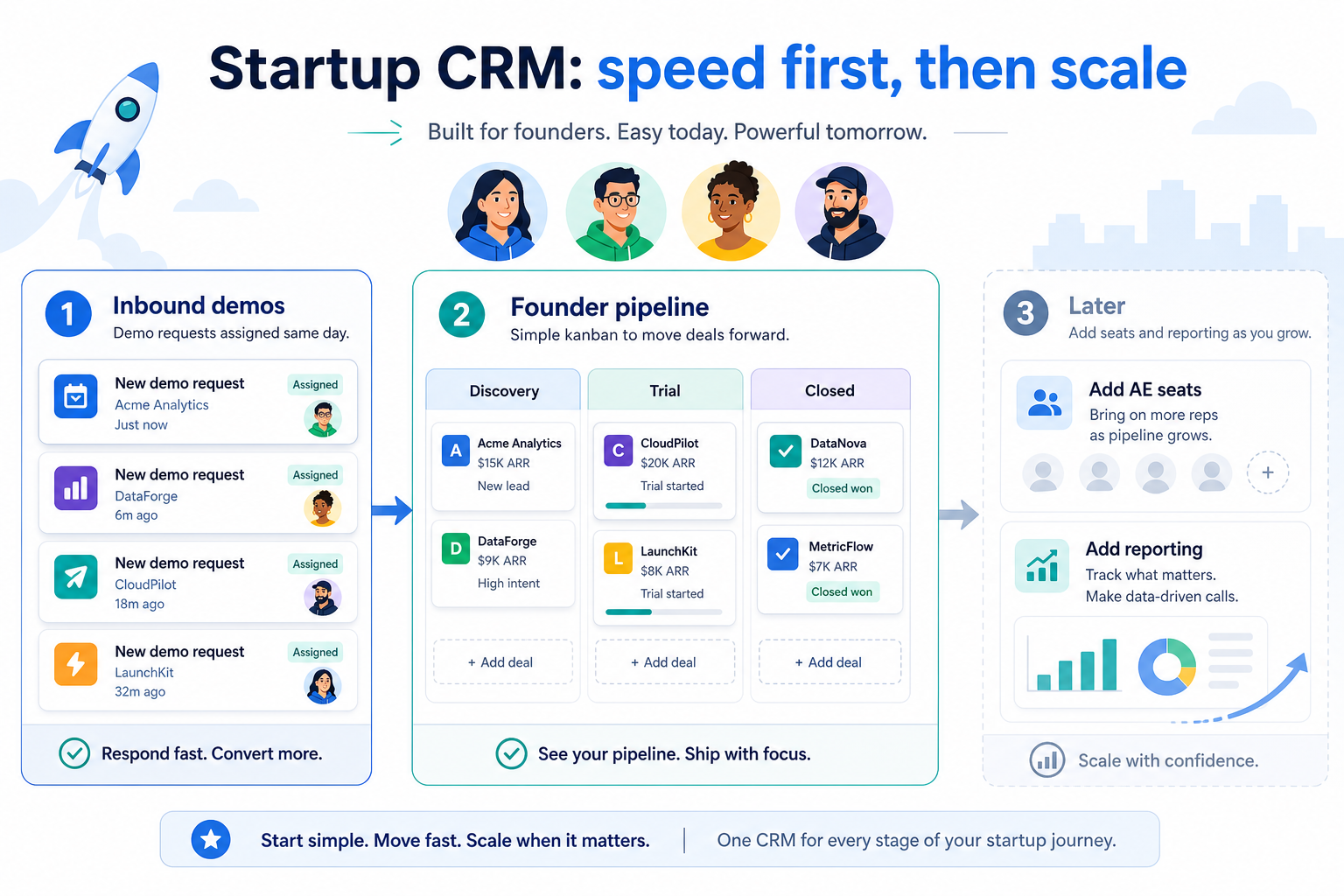
Move fast with a pipeline the founding team will use — then scale process without a painful rip-and-replace.
At a glance
Speed + pipeline truth
Founders and early AEs
Fast setup · Lead capture · Pipeline · Growth headroom
9 products to explore
Fit snapshot
Startup CRM fit is about speed and honesty: capture opportunities, keep ownership clear, and avoid tools that demand a RevOps team you do not have yet.
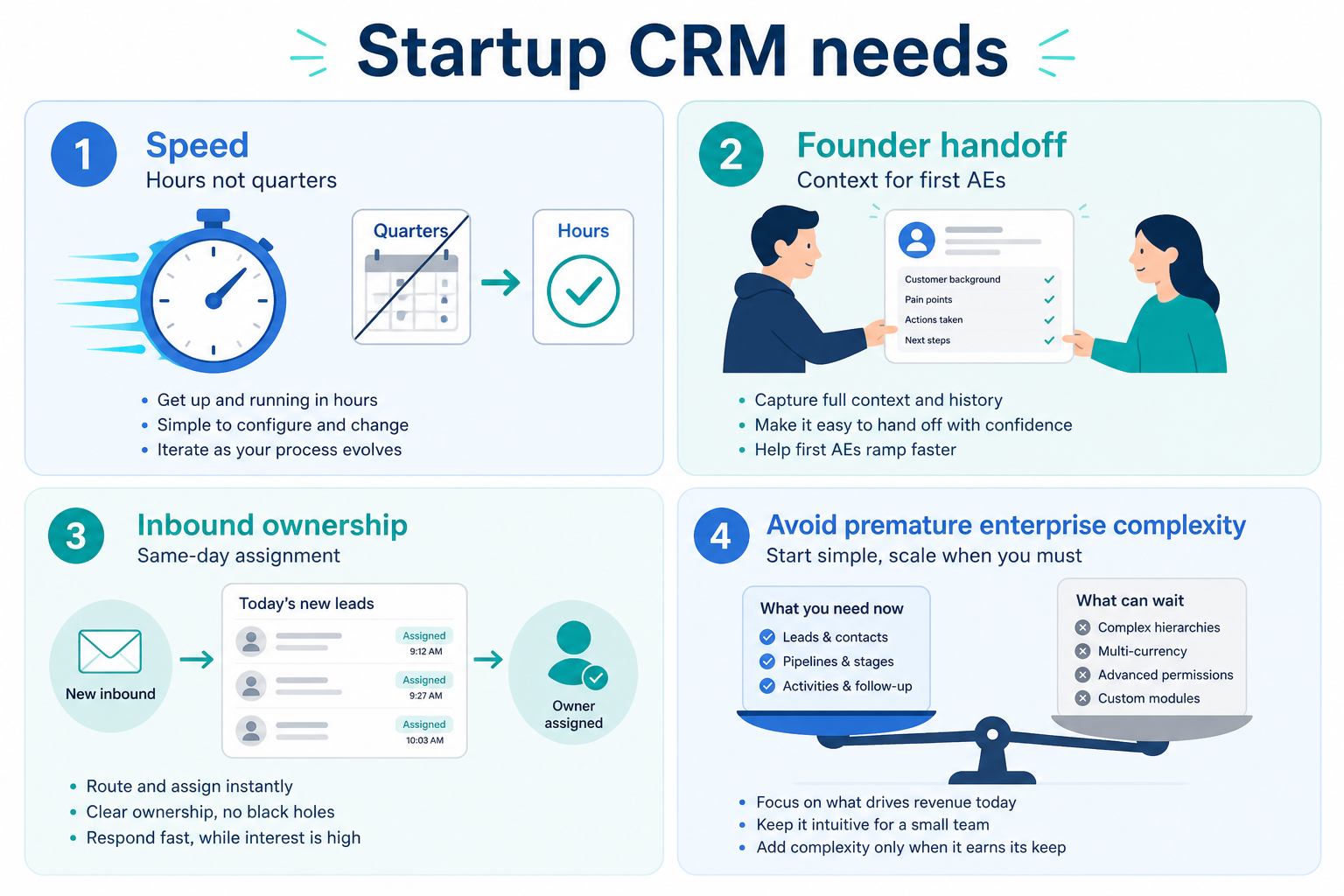
Early-stage teams (founders through first AEs) that need pipeline truth without enterprise process weight. You move fast, change the offer often, and cannot afford a CRM that needs a full-time admin before you have product-market fit.
How startups put CRM to work
Example 1
a seed-stage SaaS team of three founders
Before CRM
inbound demos lived in Notion tables and founder inboxes
After CRM
stages and fields already exist when two AEs join — they add reporting instead of rebuilding the pipeline
Example 2
a seed SaaS team
Before CRM
founders closed from scattered inboxes
After CRM
demo requests route the same day and AE coaching starts from the board instead of Notion tables
These are the operating problems that usually push startups toward CRM — not feature wish lists.
Without CRM discipline: Heavy CRM projects stall while founders should be selling.
Without CRM discipline: Hiring the first AE means recreating context from memory.
Without CRM discipline: Demo requests pile up; nobody sees SLA or ownership clearly.
Without CRM discipline: Complex permissions and empty fields create shelfware.
A CRM only helps when the team keeps owners, history, and next steps current. Here is what “good” looks like for startups.
With a maintained CRM: A fast path to contacts + stages + email sync delivers value in days, not quarters.
With a maintained CRM: Logging demos, notes, and next steps creates a handoff package for new sellers.
With a maintained CRM: Lead capture with assignment rules keeps response times honest.
With a maintained CRM: Start simple, then deepen reporting and permissions when hiring proves the need.
Every demo request has an owner and a next step.
Deal context survives hiring and vacation.
Process deepens in place as the team grows.
Early-stage teams should optimize for adoption and migration headroom — not for enterprise permission matrices on day one.
Import leads and run pipeline reviews in the first week.
Stages that match how you actually sell today.
Explore →
Permissions, custom fields, and reporting you can deepen later.
Connect the tools that already generate pipeline.
Avoid plans that punish early hiring spikes.
Explore →
Owners + next steps beat elaborate playbooks nobody follows.
Start with must-haves that match day-to-day work. Nice-to-haves can wait until the basics are trusted.
Hours to first useful review — not a six-week project.
Email, calendar, and your main acquisition tools.
How an early-stage startup captures demos, owners, and next steps without enterprise process weight.
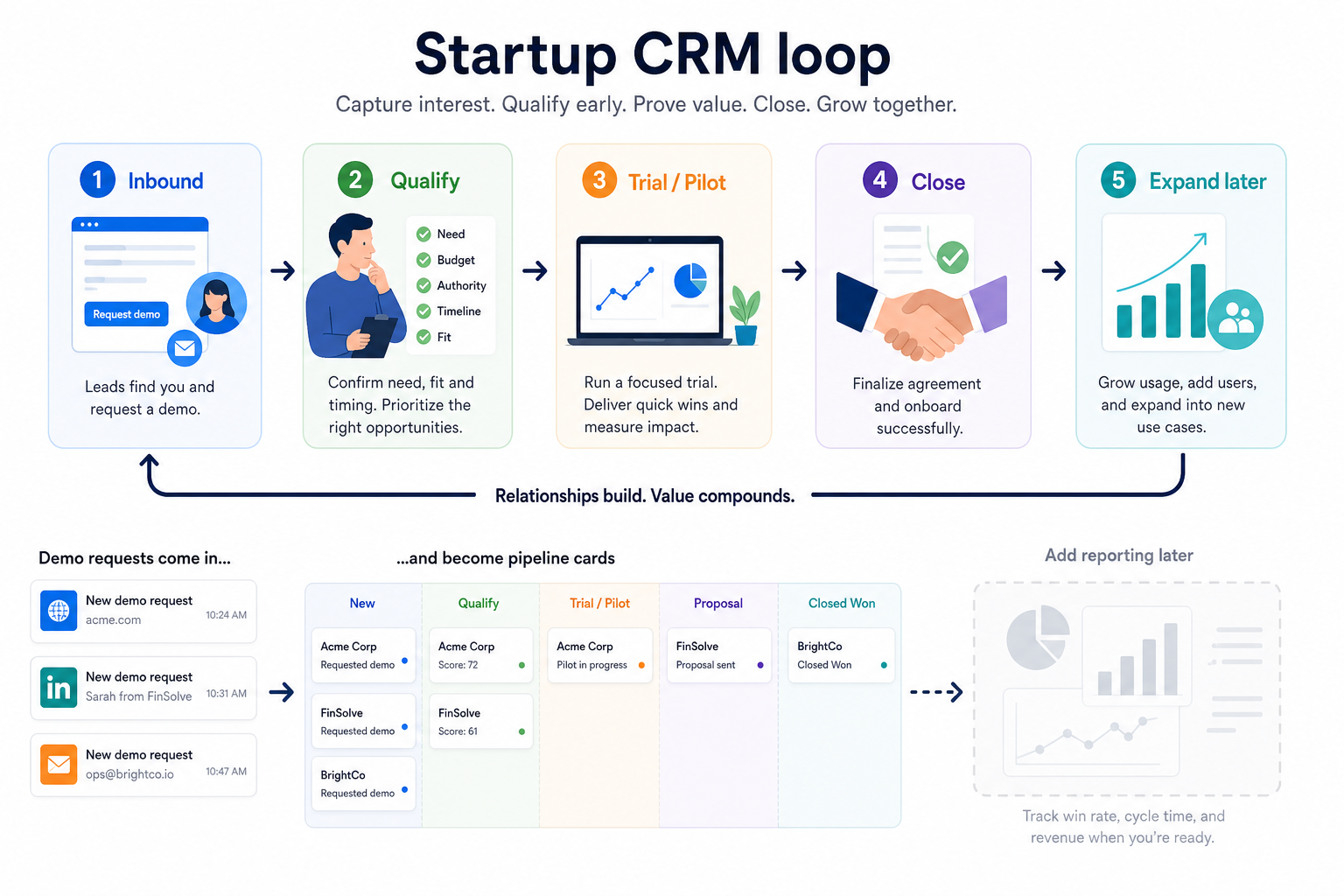
Demo or signup intent is captured automatically.
Owner books discovery; disqualify reasons are logged.
Stage reflects real product usage or evaluation progress.
Won/lost reasons feed learning — not vanity dashboards.
Add AE capacity, then forecasting discipline.
Use these as decision checks — not as product rankings.
Good fit when
Will define stages in the first sprint
Good fit when
Expect hiring to change who owns deals soon
Watch out
Process still changes weekly — keep stages short
Usually avoid
Buying enterprise CRM ‘for later’ with no admin
Best when: Founders still run demos and need a shared opportunity list.
Best when: You need coaching visibility without building a RevOps org.
Best when: Demo requests outgrow inbox triage.
These CRM products commonly fit startups. This is a starting shortlist to review — not a ranked best-of list. Affiliate relationships never change what appears here.
Crm
Pipeline-first sales CRM for visual deal management, activity-based selling, and growing sales teams.

Crm
AI-powered customer platform with free forever CRM, plus paid Smart CRM seats and Sales/Marketing/Service hubs for growing teams.

Crm
Affordable multi-edition sales CRM with free tier, automation, and Zia AI across Standard through Ultimate.

Crm
Modern, flexible CRM for startups and GTM teams with a data-model-first workspace and AI assistance.

Crm
Google Workspace-native CRM for pipeline and relationship management inside Gmail and Google apps.
Work OS–style sales CRM from monday.com for visual pipelines, automations, and team collaboration.

Crm
Small-business CRM with pipelines, marketing add-ons, and AI assistance on a clear per-user ladder.

Crm
CRM plus project management for service-oriented SMBs, with automation and AI on higher plans.

Crm
Free-tier all-in-one CRM and collaboration suite with organization-based paid cloud plans.
Lost follow-ups, unclear ownership, or forecast chaos — pick one primary pain.
Contacts, pipeline stages, email/calendar sync, reporting — skip vanity features.
Someone must own fields, users, and hygiene weekly. No owner → no CRM value.
Import a slice of live data and run a week of actual follow-ups — not a demo script.
Trial evaluation guide →Straightforward CRM for owners and small teams who need shared contacts and a simple pipeline.
CRM for teams outgrowing spreadsheets and informal ownership of follow-ups.
CRM for distributed sales teams that need shared pipeline visibility and activity discipline.
Track deals through stages, keep ownership clear, and see where opportunities stall.
Capture, qualify, and route leads before they become pipeline deals.
Coordinate calling, messaging, and cadence tools around CRM records.
Next steps for startups evaluating CRM — decision tools and pages. Affiliate relationships never change recommendations.
Use Finder for a fit-based shortlist, compare catalogue products, or build a requirements checklist before demos. Affiliate relationships never change order.
Want clearer software shortlists? Get buying guides and comparisons by email.
Newsletter coming soon.