
This video is hosted on YouTube
This content is hosted by YouTube. The player loads only after you allow marketing cookies.
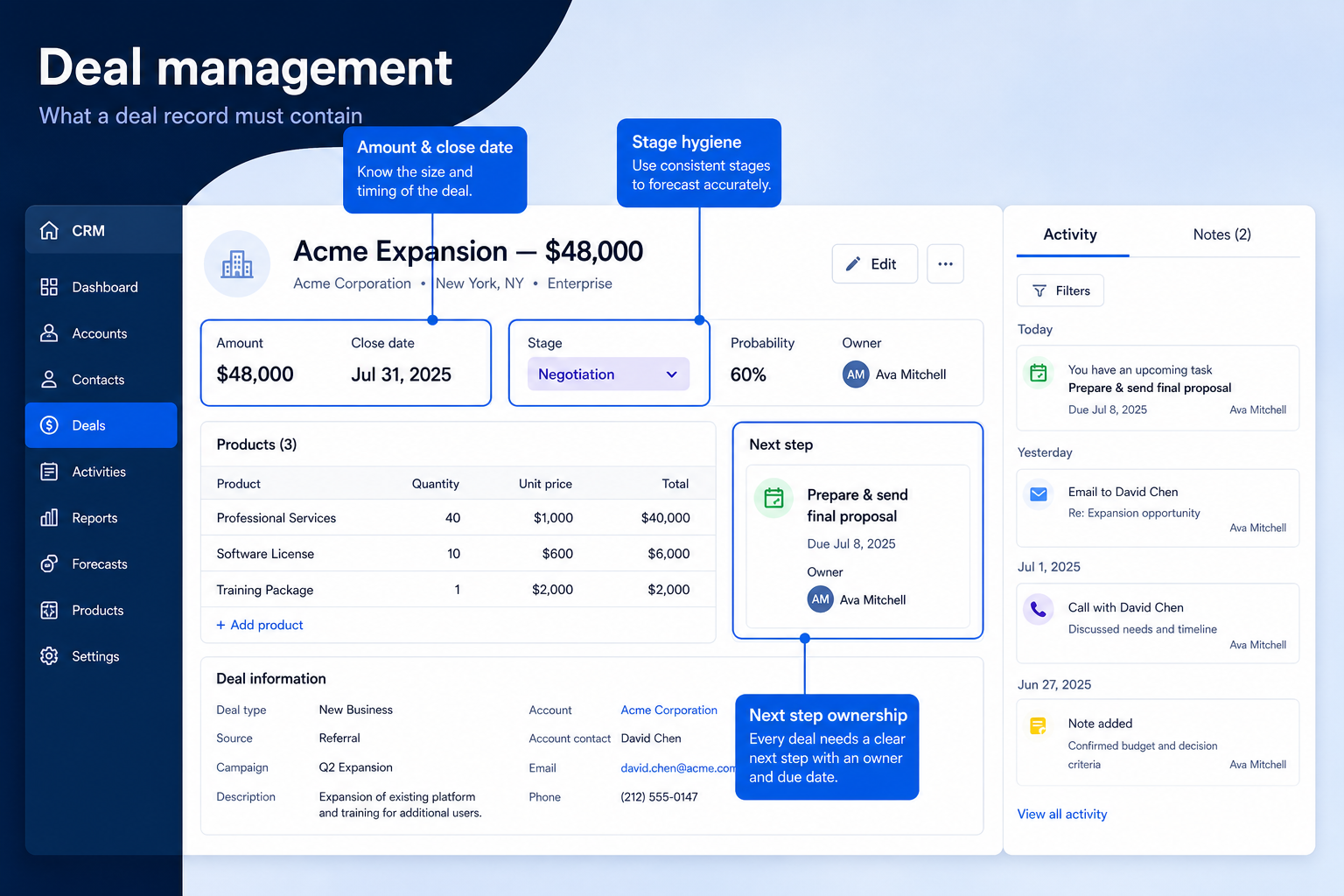
The opportunity record itself — value, close date, products, and the fields a real deal needs to be tracked honestly.
At a glance
A deal record that captures what your process actually needs to know about each opportunity
Sales ops, RevOps, and finance stakeholders who consume deal data
Core deal fields · Line items / products · Multiple contacts per deal · Structured win/loss reasons
9 products to explore
Fit snapshot
Deal management is the CRM capability covering the opportunity record: value, expected close date, linked contacts and accounts, products or line items, and the custom fields a real deal needs. It's distinct from pipeline management, which is the stage engine the deal moves through — deal management is what's actually recorded on each deal.
Sales ops and RevOps evaluating whether a CRM's deal record can hold what your process actually needs — line items, multiple contacts per deal, custom close-reason fields — versus a generic name-value-date row.
How teams put CRM to work for deals
Example 1
a company selling multi-product packages. Deal management as a capability needs to support line items with individual pricing, not just a single deal total — otherwise every package sale gets summarized into one number that hides the mix.
Example 2
a firm that tracks why deals are lost. The deal record needs a structured lost-reason field, not a free-text note nobody fills in consistently — otherwise loss analysis becomes guesswork.
These are the operating problems that usually push teams toward CRM for deals — not feature wish lists.
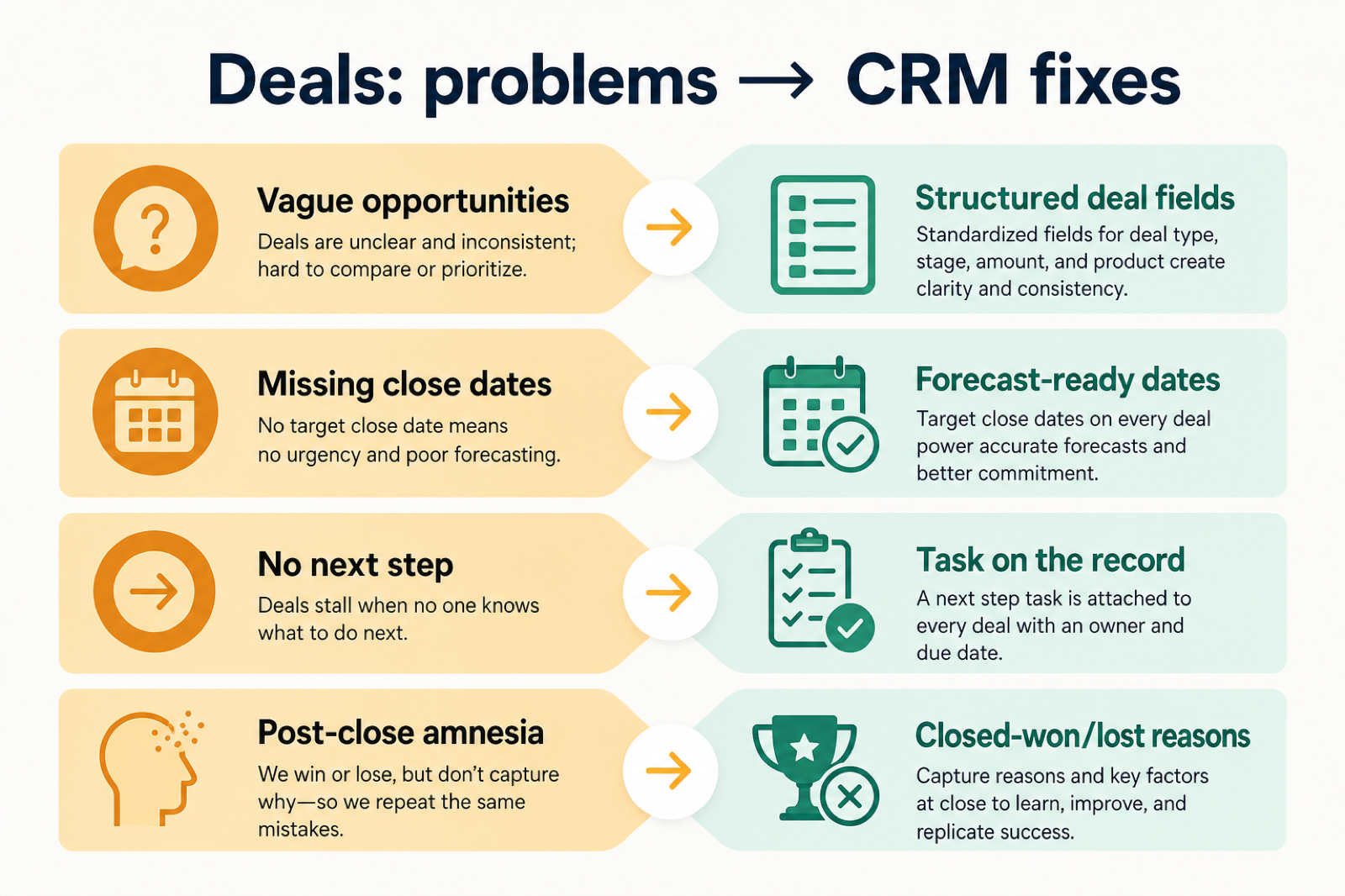
Without CRM discipline: Anything more specific — products, approvers, loss reason — has nowhere to live.
Without CRM discipline: You can't see the product mix that made up a deal's value.
Without CRM discipline: Complex sales involve multiple stakeholders, but the record only has room for one.
Without CRM discipline: Loss analysis is impossible without a consistent, structured reason field.
A CRM only helps when the team keeps owners, history, and next steps current. Here is what “good” looks like for deals.
With CRM discipline: Custom fields and, where supported, line items extend the deal record to match your process.
With CRM discipline: Line-item support models individual products and pricing within a deal.
With CRM discipline: Multi-contact linking on the deal reflects real buying-committee structures.
With CRM discipline: Structured close-reason fields make loss analysis a report, not a guess.
Deal data that reflects reality
Custom fields and line items capture what actually happened, not an approximation.
Visibility into product mix
Line items show what's actually driving deal value.
Records that reflect real buying committees
Multiple stakeholders per deal are visible, not flattened to one contact.
Real loss-reason analysis
Structured fields make win/loss patterns reportable.
Evaluate what fields a deal record supports natively versus what needs custom fields, and whether products or line items are modeled at all. A CRM that treats a deal as name plus value plus date is a poor fit for anything with multiple line items or approval fields.
Don't force a complex deal into a flat name-value-date record.
See the product mix, not just a total.
Reflect real buying committees, not a single point of contact.
Loss reasons and similar fields should be reportable.
Learn more →Start with must-haves your team will use weekly. Treat nice-to-haves as later upgrades — not day-one blockers.
Must-have
Connect a deal to the people and organization it belongs to.
Learn more →Nice-to-have
Model multi-product deals with individual pricing.
A simple operating loop beats a complex board nobody updates.
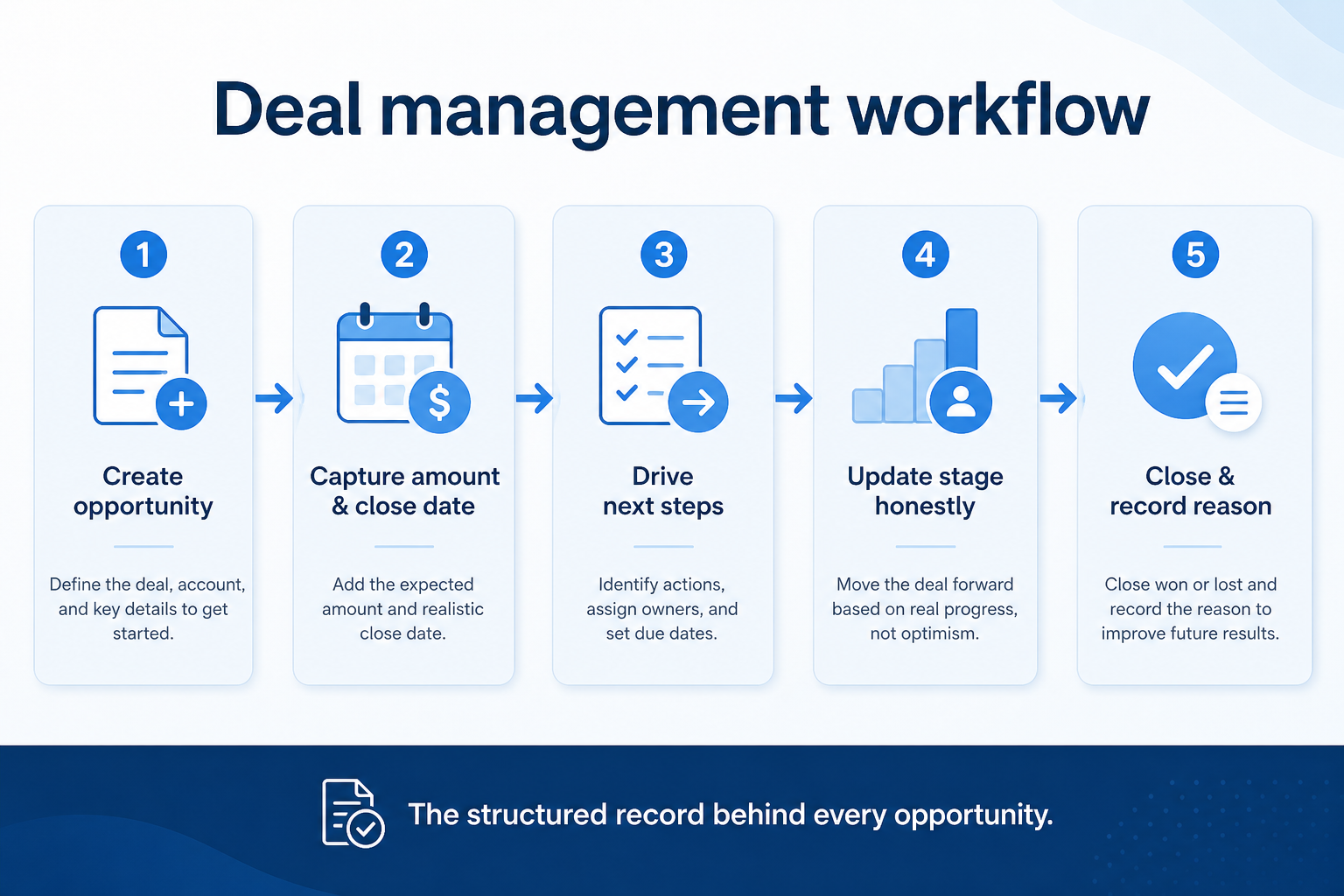
A deal record is created with value, close date, and linked account.
Products, custom fields, and additional contacts are added.
Value and close date are revised as the opportunity develops.
Deal closes won or lost with a structured reason recorded.
Deal data feeds pipeline, forecasting, and win/loss reporting.
Broader capability workflow demos for deals — distinct from narrow feature walkthroughs.
Official vendor demonstrations help show how different CRM platforms approach the workflows, features and interactions that make up deals. Absence of a video does not mean a product lacks the capability.

Pipedrive
Pipedrive Is The Single Source Of Truth About Our Sales Pipeline
Focus: How Pipedrive presents pipeline as the shared sales system of record.
This video is hosted on YouTube
This content is hosted by YouTube. The player loads only after you allow marketing cookies.
What this shows
What to notice
What this does not establish
Features visible in this demo
Particularly relevant to
Source: Pipedrive · Verified 15 Aug 2026

Dynamics 365
Supercharge your pipeline with Sales Development Agent
Focus: How Dynamics 365 Sales Development Agent supports pipeline and lead development workflows.

This video is hosted on YouTube
This content is hosted by YouTube. The player loads only after you allow marketing cookies.
What this shows
What to notice
What this does not establish
Features visible in this demo
Particularly relevant to
Source: Microsoft · Verified 15 Aug 2026

Salesforce
What is Lead Management & How Does It Work? | Salesforce Explained
Focus: How Salesforce explains lead management from capture through qualification.

This video is hosted on YouTube
This content is hosted by YouTube. The player loads only after you allow marketing cookies.
What this shows
What to notice
What this does not establish
Features visible in this demo
Particularly relevant to
Source: Salesforce · Verified 15 Aug 2026

Zoho CRM
Lead Management in Zoho CRM
Focus: How Zoho CRM manages leads from capture through conversion.

This video is hosted on YouTube
This content is hosted by YouTube. The player loads only after you allow marketing cookies.
What this shows
What to notice
What this does not establish
Features visible in this demo
Particularly relevant to
Source: Zoho · Verified 15 Aug 2026
Evidence-backed workflow comparison using official vendor demos and screenshots — not a ranking or entertainment gallery. Absence of media does not mean a product lacks the capability.
Pipedrive
Pipedrive emphasizes
Dynamics 365
Dynamics 365 emphasizes
SoftwareGlimpse take
Pipedrive evidence emphasizes Pipeline board and deal movement as Pipedrive markets them; Dynamics 365 evidence emphasizes Sales Development Agent surfaces as Microsoft presents them for Dynamics 365 Sales. These are observations from official sources, not inferred brand philosophy.
Best when
Deals routinely include more than one product or SKU.
Best when
More than one stakeholder is involved in a single deal.
Related page →Best when
Leadership wants patterns in why deals are lost, not anecdotes.
Related page →Products, contacts, custom fields — write down the real shape of a deal.
Confirm whether products or line items are native or require a workaround.
Requirements guide →Build your messiest recent deal in a trial account, not a simple demo one.
Trial evaluation →Check how many custom fields and field types each plan allows.
Catalogue products tagged to related use cases for deal management. Inclusion here is not a ranking.
Crm
Pipeline-first sales CRM for visual deal management, activity-based selling, and growing sales teams.

Crm
Freshworks sales CRM for lead management and pipeline workflows.

Crm
Sales-focused CRM for pipeline management and sales engagement workflows.

Crm

Crm
Simple small-business CRM for contacts, sales pipelines, tasks, and lightweight automation without enterprise complexity.
Crm
Enterprise CRM platform for sales, service, marketing, and customer data across large and mid-market teams.

Crm
AI-powered customer platform with free forever CRM, plus paid Smart CRM seats and Sales/Marketing/Service hubs for growing teams.
Crm
Microsoft Dynamics 365 Sales CRM for pipeline management, forecasting, and Microsoft 365 / Copilot workflows.
Crm
Affordable multi-edition sales CRM with free tier, automation, and Zia AI across Standard through Ultimate.
Loading evidence explorer…
It's the capability covering what's recorded on an opportunity — value, close date, linked contacts, products, and custom fields — as distinct from the stages a deal moves through.
Pipeline management is the stages a deal moves through. Deal management is what's actually recorded on the deal itself.
Only if deals routinely include multiple products or SKUs with separate pricing.
They turn loss analysis into a report you can trust, instead of anecdote.
No. Fit depends on how your team works, which requirements are must-haves, and what the CRM has to integrate with. Use the requirement matrix and CRM Finder to build a shortlist rather than starting from a ranking.
Track opportunities through defined stages with owners and next steps.
Build pipeline-based forecasts teams can defend in weekly reviews.
Fields, layouts, and objects that match how your team actually sells.
Next steps after evaluating deal management — decision tools and pages. Affiliate relationships never change recommendations.
Use Finder for a fit-based shortlist, compare products, or build a requirements checklist before demos.
Part of CRM capabilities · CRM Software hub
Want clearer software shortlists? Get buying guides and comparisons by email.
Newsletter coming soon.
Explore the official documentation, screenshots and product demonstrations used to understand how each CRM implements deals.
5 items
Official video · Dynamics 365
Supports
Demonstrates
This video is hosted on YouTube
This content is hosted by YouTube. The player loads only after you allow marketing cookies.
Official vendor video
How Dynamics 365 Sales Development Agent supports pipeline and lead development workflows.
Verified: 15 Aug 2026
Open source ↗Official video · Pipedrive
Supports
Demonstrates
This video is hosted on YouTube
This content is hosted by YouTube. The player loads only after you allow marketing cookies.
Official vendor video
How Pipedrive presents pipeline as the shared sales system of record.
Verified: 15 Aug 2026
Open source ↗Official video · Pipedrive
Supports
Demonstrates
This video is hosted on YouTube
This content is hosted by YouTube. The player loads only after you allow marketing cookies.
Official vendor tutorial
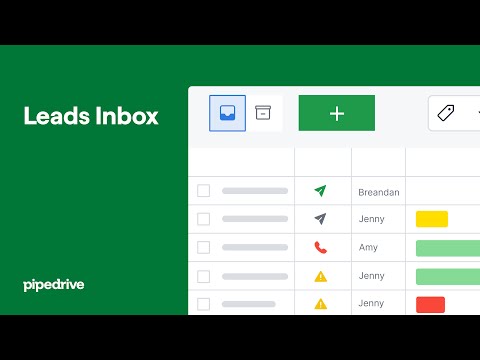
How Pipedrive Leads Inbox qualifies inbound leads before creating deals.
Verified: 15 Aug 2026
Open source ↗Official video · Salesforce
Supports
Demonstrates
This video is hosted on YouTube
This content is hosted by YouTube. The player loads only after you allow marketing cookies.
Official vendor tutorial
How Salesforce explains lead management from capture through qualification.
Verified: 15 Aug 2026
Open source ↗Official video · Zoho CRM
Supports
Demonstrates
This video is hosted on YouTube
This content is hosted by YouTube. The player loads only after you allow marketing cookies.
Official vendor tutorial
How Zoho CRM manages leads from capture through conversion.
Verified: 15 Aug 2026
Open source ↗