Concrete CRM examples for small B2B pipelines, inbound desks, advisory relationships, and outbound teams — illustrative scenarios that clarify fit without invented case-study metrics.
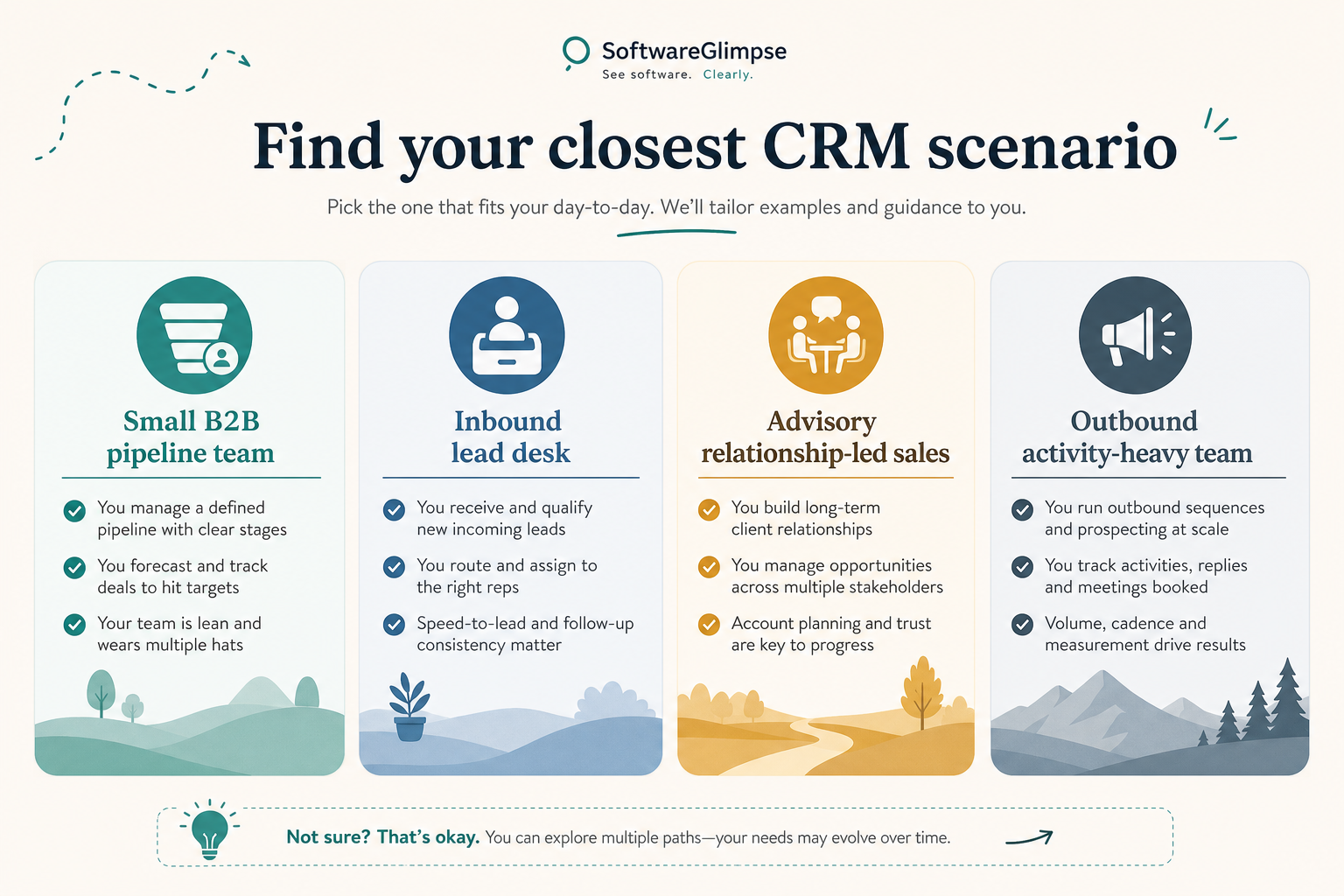
CRM examples are easiest to understand as named team scenarios: a small B2B pipeline team, an inbound desk with SLAs, an advisory firm on long cycles, or an outbound desk with high activity volume. Decision rule: pick the scenario that matches your week, then compare tools against that process — not against a generic “CRM” brochure.
Small B2B pipeline team
Inbound lead desk
Advisory / relationship sales
Outbound activity-heavy team
Handoff to customer success
What good logging looks like
Key takeaways
Examples reveal process fit — The right CRM shape depends on whether your week looks like pipeline coaching, inbound SLA, or high-volume outreach.
Same objects, different emphasis — All examples use contacts/deals/activities — but stage design, activity volume, and reporting differ.
Illustrative ≠ endorsement — These scenarios explain patterns. They are not ranked vendor case studies or invented ROI results.
Map your scenario before demos — Bring your stages and handoff rules to demos so vendors cannot redefine your process mid-pitch.
Match the scenario to your week before you compare product shapes.
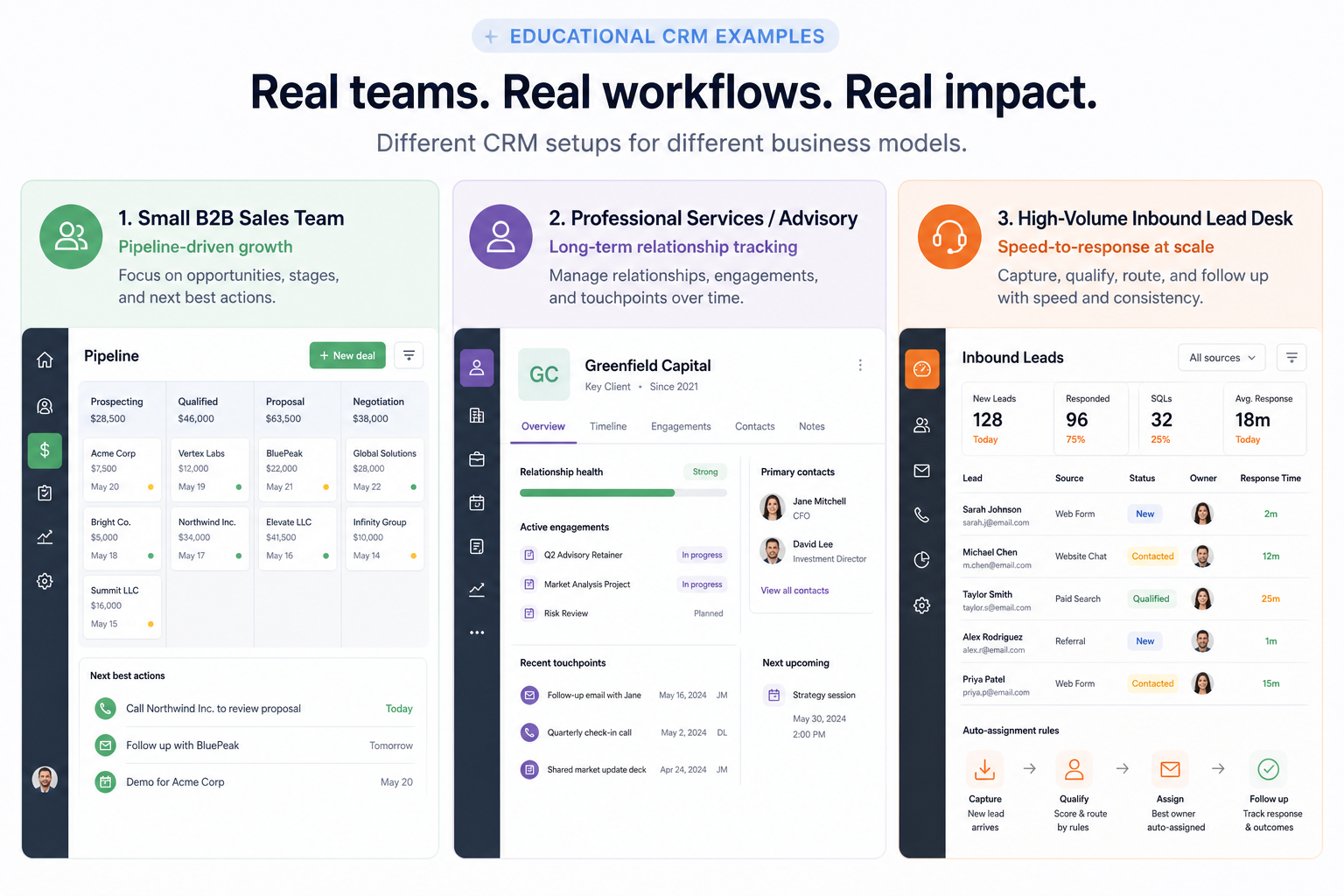
Three common CRM example setups
Start with the scenario that matches your week — then compare tools.
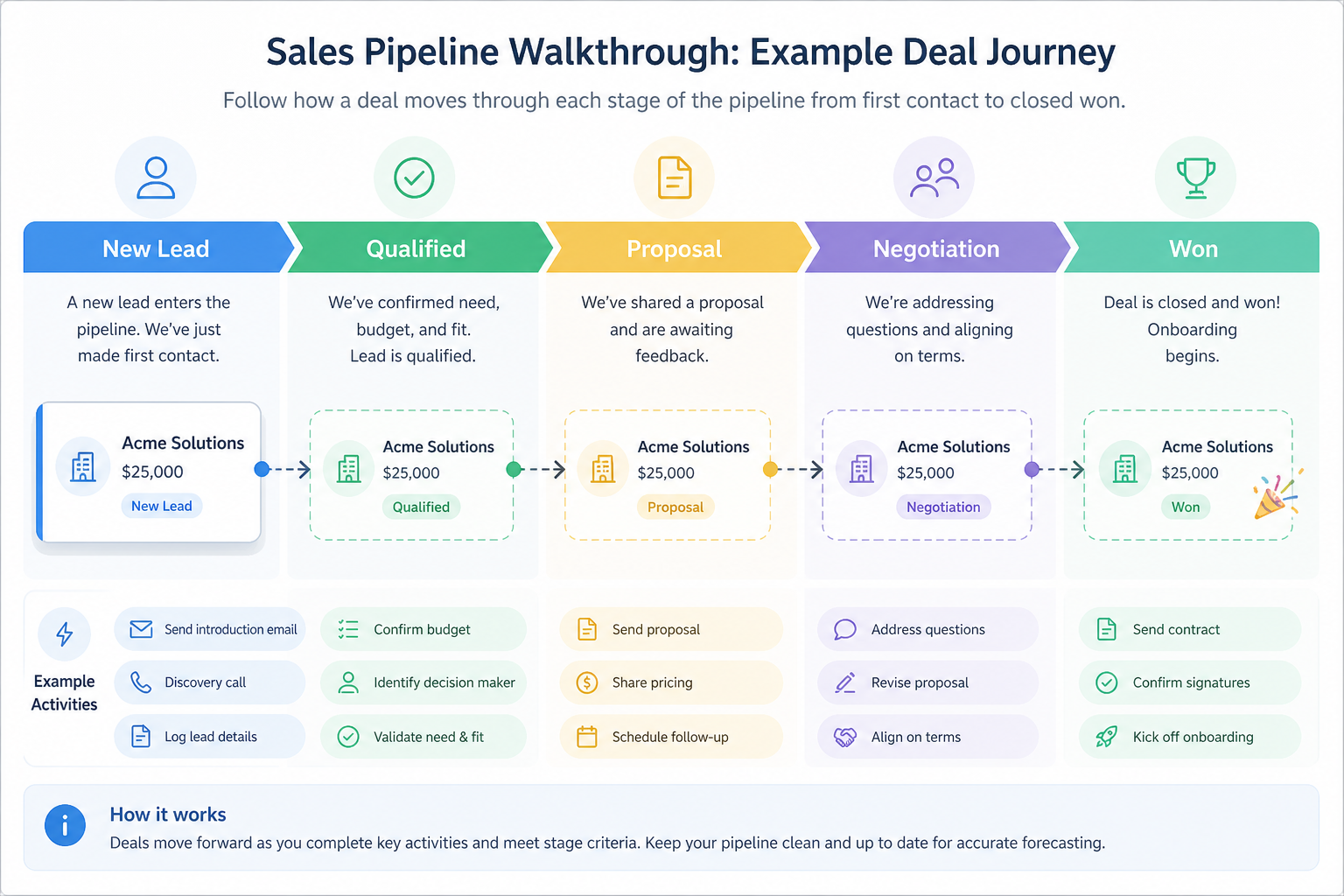
1. Example: small B2B sales team pipeline
Illustrative walkthrough — stages should match your real motion.
Capture
Form submissions create leads; referrals are entered manually with a source field.
Qualify
An owner converts qualified leads into deals with an estimated value and close date.
Advance & log
Proposal emails and calls are logged on the deal so anyone can cover PTO without losing context.
Review
Friday review filters deals by stage and owner — no spreadsheet rebuild.
A five-person sales team sells a service with a 3–6 week cycle. Leads come from referrals and a website form. They need shared ownership, a short pipeline, and a Friday pipeline review — not enterprise governance on day one.
Example: at Harbor Analytics, AE Maya owns “Acme — Q3 rollout,” advances it from Qualified to Proposal after a discovery call, logs the proposal send, and the Friday review filters open deals by owner — nobody rebuilds a spreadsheet the night before.
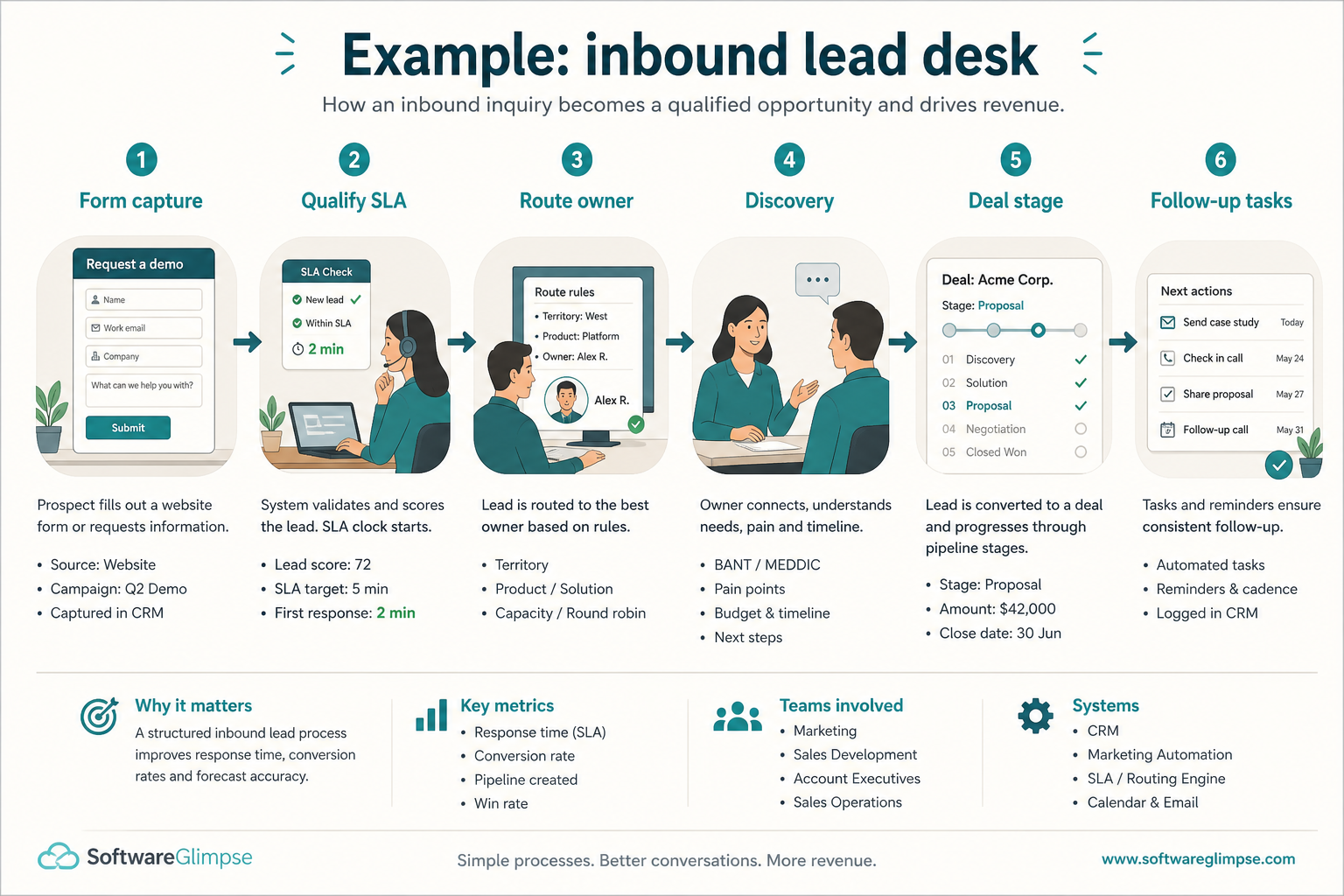
2. Example: inbound lead desk
Inbound CRM jobs emphasize speed-to-lead and clean qualification gates.
Routing
New form leads auto-assign by territory or round-robin.
SLA tasks
Tasks fire if a lead is untouched past an agreed threshold.
Conversion
Qualified leads become deals; disqualified leads get a reason code for marketing feedback.
A team receives a steady flow of meeting requests. The CRM job is speed-to-lead and clean qualification: assign owners quickly, track SLA breaches, and only create deals that meet criteria.
Example: Pulse Onboarding’s SDR desk auto-assigns form leads by territory; if a lead sits untouched past two hours, a task fires; only leads that pass BANT create deals — the rest stay as leads with a recycle reason.
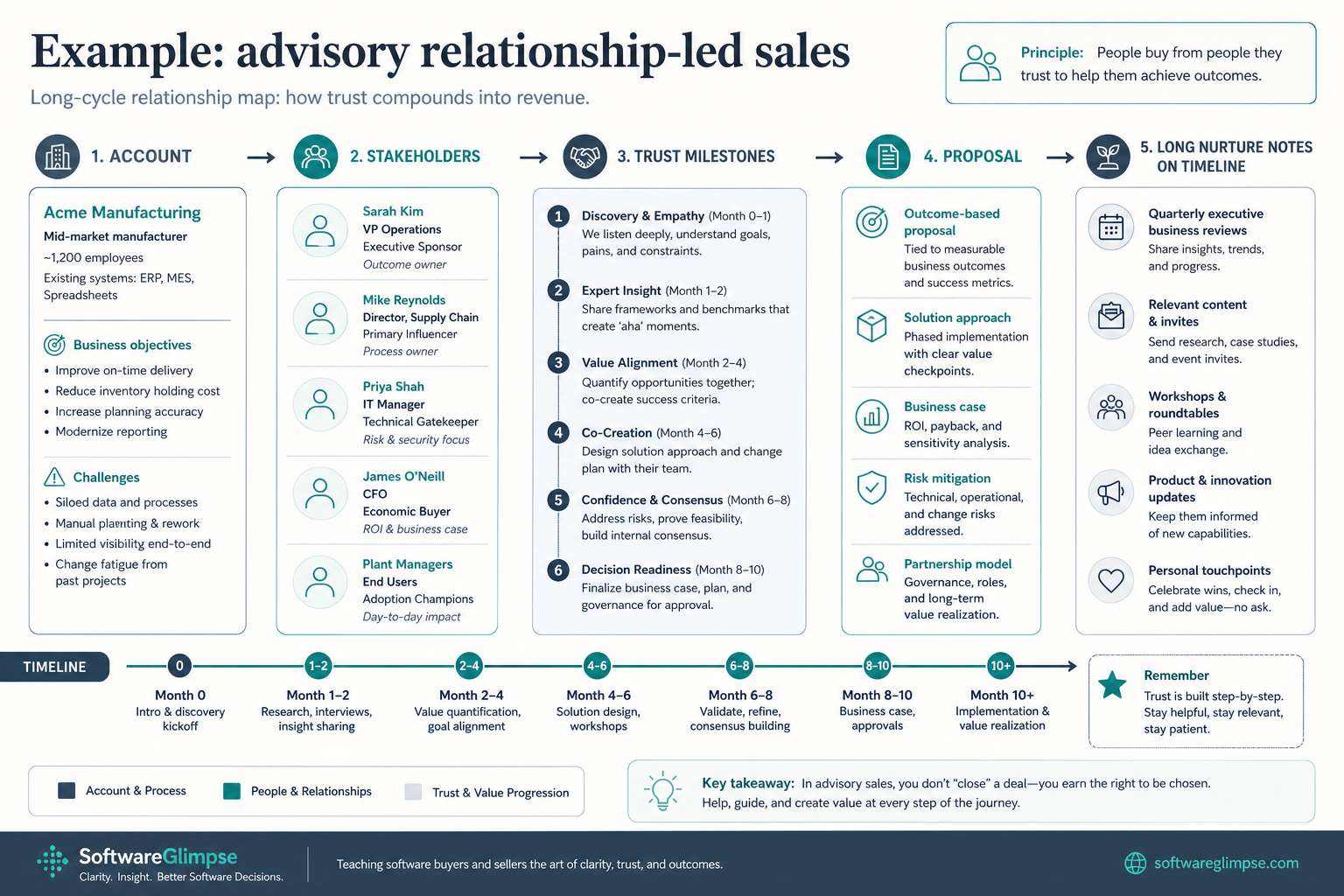
3. Example: advisory / relationship-led sales
Long-cycle advisory sales need relationship history more than sequence volume.
Relationship record
Multiple stakeholders at one company are linked; notes capture preferences and risk.
Long cycle stages
Stages reflect discovery, scoping, proposal, and contracting — not daily dialer metrics.
Handoff
When won, success receives the full history instead of a one-line “new client” email.
An advisory or professional-services firm sells through long trust cycles. Deals may be fewer, but activity history and relationship mapping matter more than sequence volume.
Example: at Meridian Advisory, partner Lena tracks three stakeholders at “Riverbank Holdings” on one company record; the deal stays in Scoping for months with logged notes — when won, delivery inherits the full history instead of a one-line handoff email.
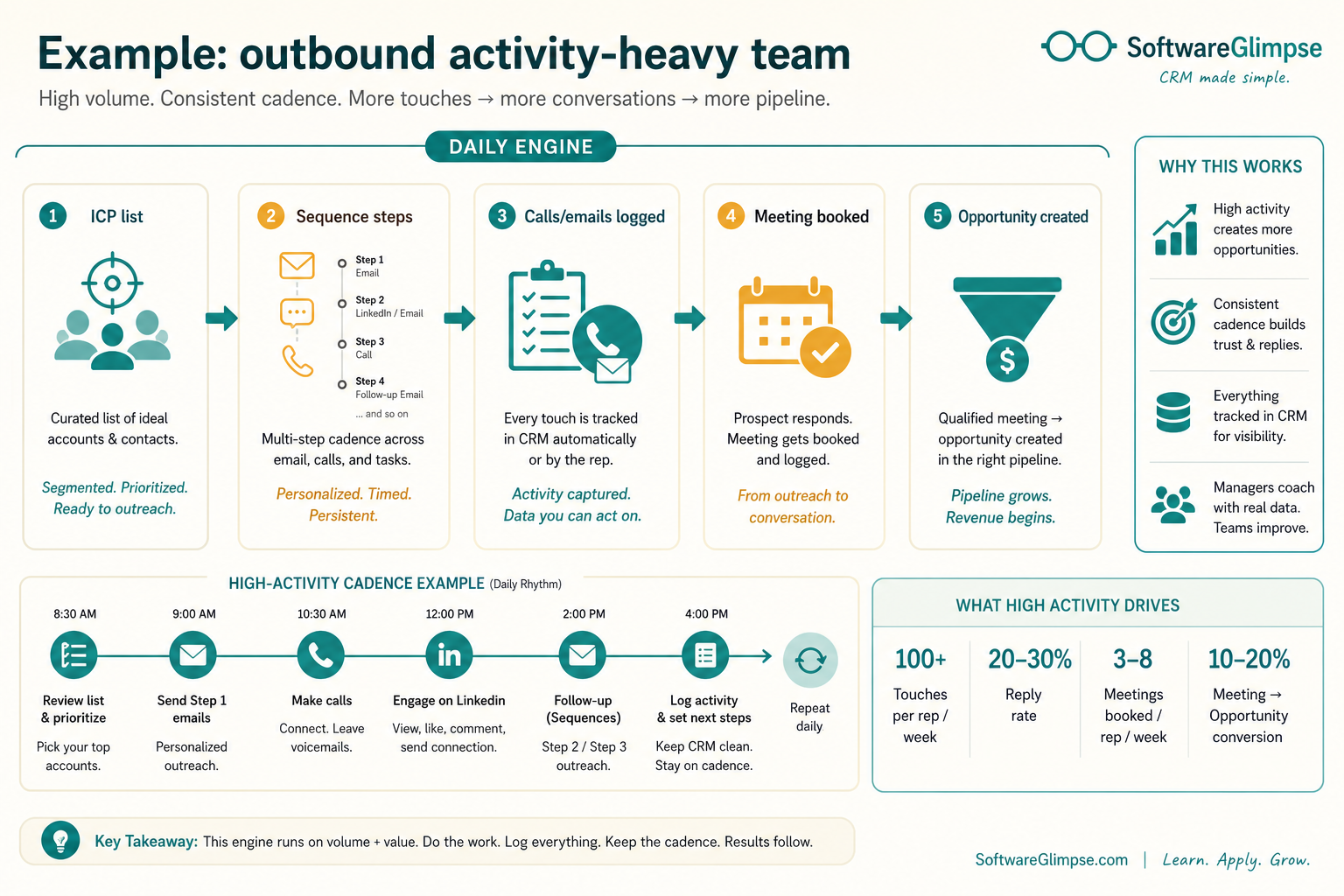
4. Example: outbound activity-heavy team
Outbound CRM jobs emphasize activity quality attached to records — not vanity send counts.
List → outreach
Prospects enter as leads/contacts; sequences enroll with clear exit rules.
Logging
Calls and replies update the same record the pipeline uses.
Promotion
Interested prospects become deals with owners and next meetings.
Reps run structured outreach across many prospects. The CRM (or CRM + engagement layer) must keep sequences, calls, and outcomes attached to records so managers can coach on activity quality — not vanity send counts alone.
Example: at Brightline Outbound, SDRs enroll prospects into sequences; every call outcome writes back to the contact; managers coach on connected conversations and stage promotions — not raw email sends alone.
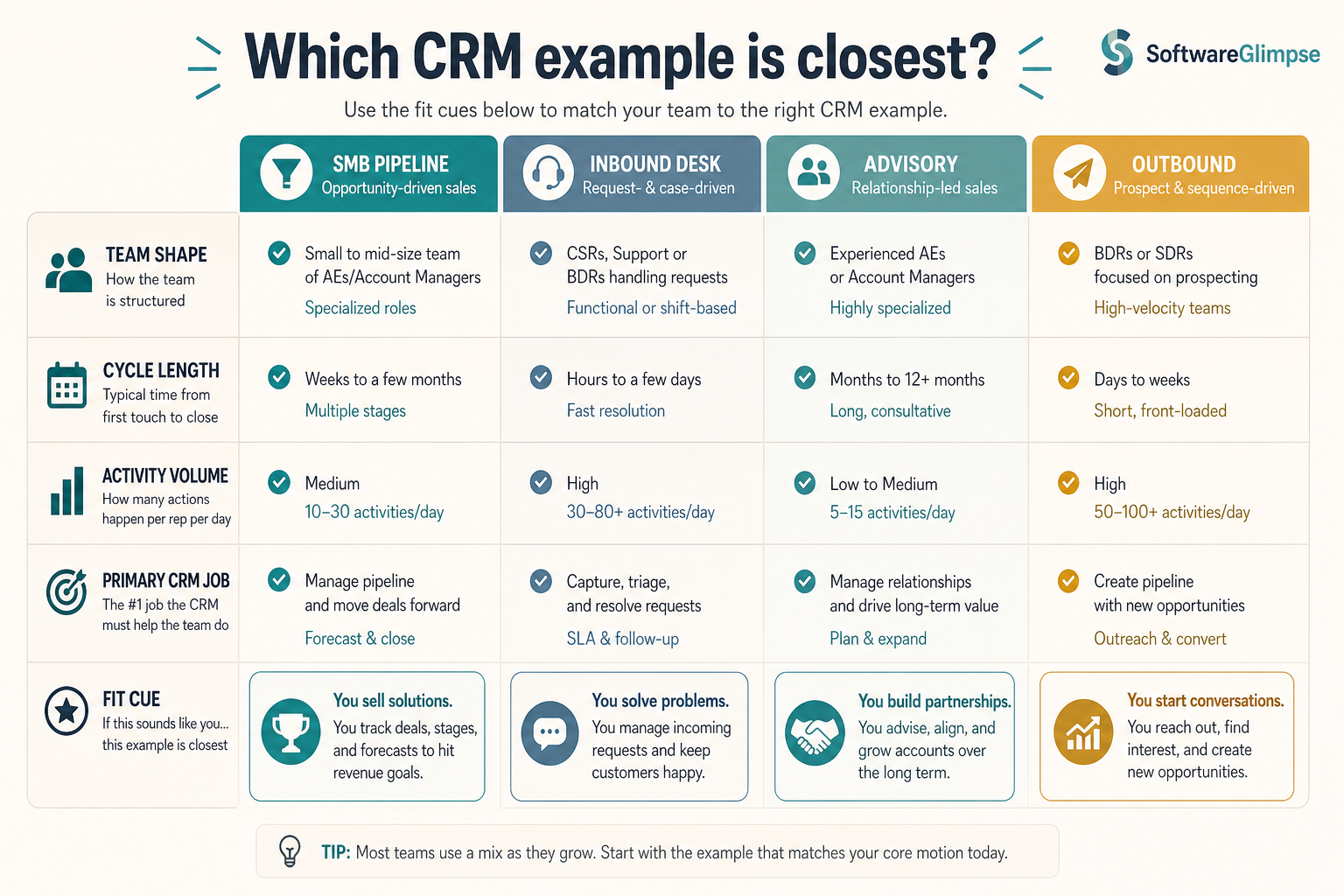
Which example is closest?
Pick the closest scenario — then validate with your real weekly motion.
01
Small pipeline team
Simple sales CRM shape; emphasize stages and weekly review.
Shared owners
Short pipeline
02
Inbound desk
Routing + SLA tasks; light automation before heavy suites.
Speed-to-lead
Reason codes
03
Relationship / advisory
History and stakeholders over sequence volume.
Multi-contact accounts
Long cycles
04
Outbound desk
Engagement-heavy tooling with a clear system of record.
Sequences
Activity coaching
Example pitfalls
Copying another company’s stages
Borrow patterns, then rewrite stages to match your real exit criteria.
Treating vendor “customer stories” as proof
Ask what process and data quality produced the outcome — not just the logo slide.
Optimizing for demo wow
A flashy sequence demo does not help an advisory firm that needed relationship history.
5. Name the job this category should own
Describe the weekly output this category must improve before comparing vendors.
6. Next: freeze requirements and compare fairly
Move to /guides/crm-benefits/ once the job cluster is clear. Compare finalists with the same assumptions — not affiliate-ordered lists.
Example official CRM product videos
Optional · 2 examples · collapse if you don’t need them
Verified vendor product videos from the CRM catalogue for context while you read. They are examples only — not a ranked shortlist — and they do not replace SoftwareGlimpse recommendations on this page.
Official vendor video · example
Attio — Attio | How to build your sales pipelines
This video is hosted on YouTube
This content is hosted by YouTube. The player loads only after you allow marketing cookies.