Learn how CRM and customer data platforms differ — relationships and deals versus identity, events, and audiences — and why activation often flows CDP → CRM instead of replacing either system.
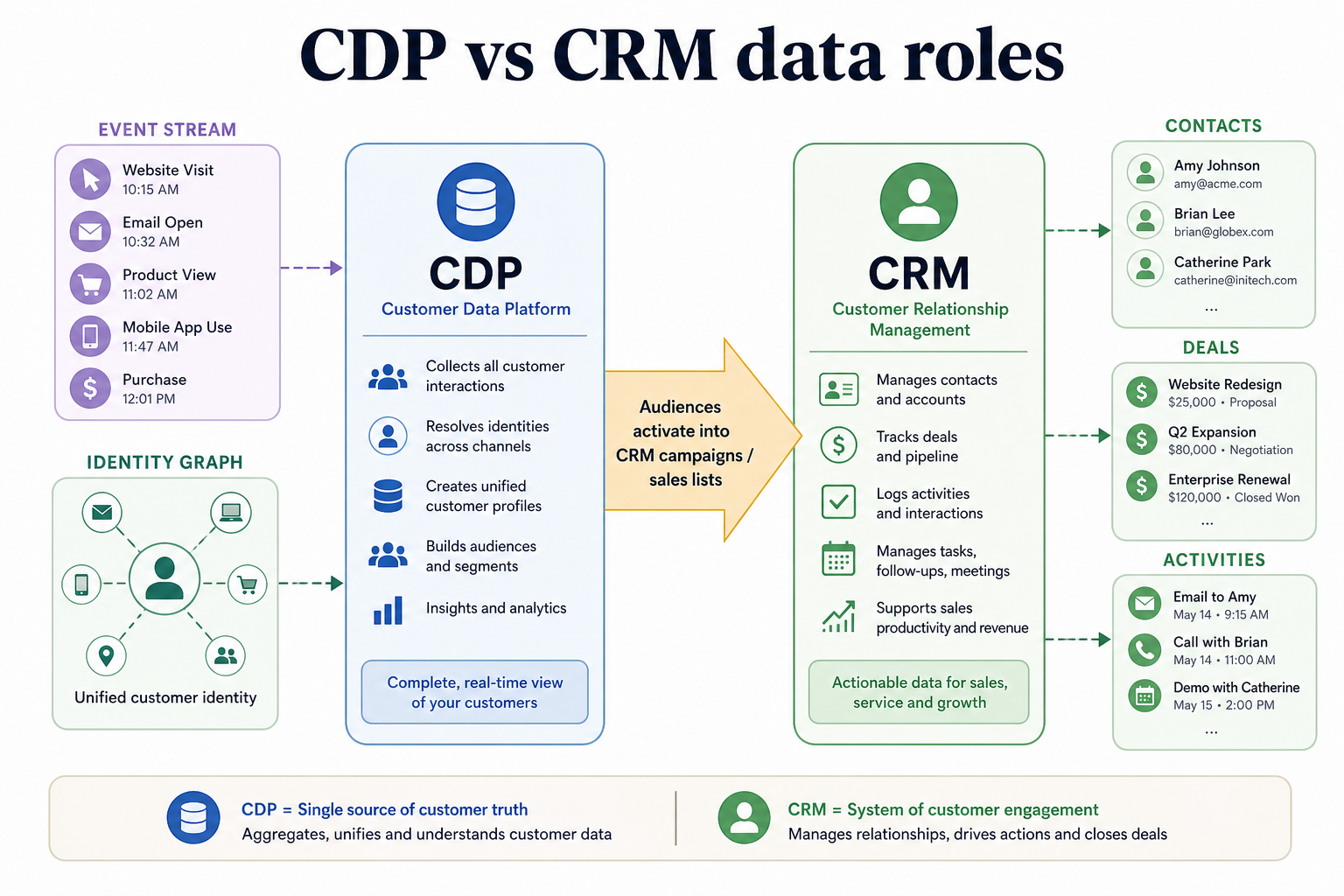
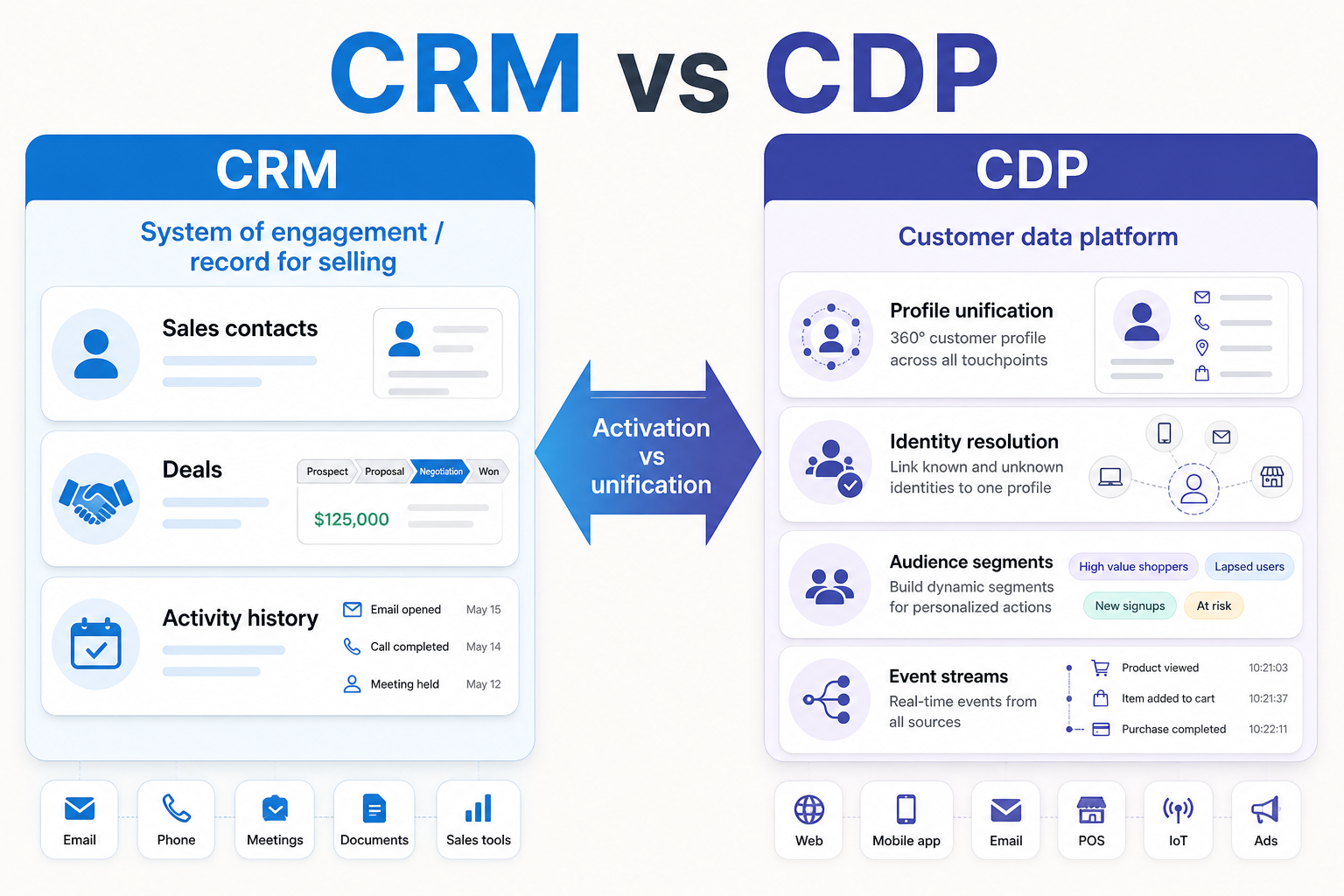
A CRM is the operational system for selling and serving relationships — contacts, deals, owners, tasks, and history. A CDP unifies identity, events, and audiences across channels for marketing and product activation. Decision rule: buy CRM when humans need to own follow-ups and pipeline; buy CDP when you need a durable identity/event layer — often both, with activation flowing CDP → CRM.
CRM = relationships & deals
CDP = identity & events
Not substitutes
Activation: CDP → CRM
Different primary users
Buy for the job, not the acronym
Key takeaways
Different jobs — CRM runs day-to-day selling and service. CDP builds a unified customer profile from behavioral and channel data.
Not a replacement pair — Replacing a CRM with a CDP (or vice versa) usually leaves a critical workflow uncovered.
Data flows one way more often — Audience segments and enriched profiles commonly push into CRM for sales and service action.
Buyers confuse labels — Some suites blur marketing, CRM, and CDP features — ask which system of record owns deals vs which owns identity graphs.
Complementary systems — activation often pushes from CDP into CRM.
1. What CRM is for
Sales execution
Pipeline stages, next steps, and activity history for reps and managers.
Service continuity
Shared account context so handoffs do not reset the relationship.
Operational ownership
Clear owners and workflows for human action on accounts and deals.
CRM is the operational system of record for relationships: who the customer is in a sales or service context, who owns follow-up, what stage a deal is in, and what happened last. Its value is execution — tasks, pipelines, handoffs — not building a cross-channel identity graph.
Example: a DTC brand’s growth team uses a CDP to stitch web + email + app events into audiences. Sales still needs CRM so AEs can own wholesale opportunities, log calls, and run a Friday pipeline review. The CDP pushes a “high-intent wholesale” audience into CRM; it does not replace deal stages or owners.
2. What CDP is for
Same customer — different systems of record for different jobs.
Identity resolution
Stitch known and anonymous identifiers into durable profiles.
Event & behavioral data
Capture product and channel events that CRM rarely models well.
Audience activation
Push segments into ads, email, and CRM for coordinated action.
A CDP unifies customer identity and event streams (web, product, ads, email) into profiles and audiences. Marketing, product, and data teams use it to segment, personalize, and activate — often by syncing audiences or attributes into tools that execute outreach, including CRM.
Signal matrix: CRM vs CDP
Must-have
✓Shared deal ownership & pipeline stages
✓Cross-channel identity graph
✓Rep tasks, sequences, forecasts
✓Behavioral event streams & audiences
Nice-to-have
•Push segments into sales follow-up
•Buying CDP “instead of” CRM for sales teams
Who typically needs which
01
Small sales team
CRM first. CDP is rarely the first buy unless marketing already runs multi-channel identity work.
Pipeline
Owners
Follow-ups
02
Marketing + growth org
CDP (or strong marketing data layer) for audiences; CRM still needed if sales closes and owns accounts.
Segments
Activation
Handoff
03
Product-led / high event volume
CDP or warehouse-centric stack for product events; CRM for human-owned expansion and support.
Events
Identity
Sales assist
04
Multi-team enterprise
Often both — with clear ownership: who governs deals vs who governs the identity graph.
Governance
Integrations
Admin owners
Common CRM vs CDP mistakes
Treating them as substitutes
A CDP does not give reps a working pipeline; a CRM does not unify anonymous cross-channel identity.
Buying CDP to “fix” sales hygiene
Missed follow-ups and unclean owners are CRM process problems — more profile data will not fix them.
Ignoring activation design
Without a clear path from audience → owner → next step, CDP segments never become sales action.
Duplicate systems of record
Letting both tools “own” the same customer fields without rules creates conflicting truths.
3. Use a when-this / when-other decision rule
Write one sentence for when each product category is the primary purchase.
4. Worked example: same company, two purchases
Harbor Ops buys customer-service software for ticket SLAs and a separate CRM for pipeline — they integrate, but neither replaces the other's core job.
5. Use a one-page checklist before demos
For CRM vs CDP: Different Jobs, Complementary Systems, list must-haves, owners, integrations, and the weekly ritual this purchase must improve. Share the sheet with finance and IT before you schedule a second demo.
Name the primary job in one sentence.
List must-have gates (plans, SSO, data residency, usage caps).
Name integrations that must work on day one.
Assign an admin owner and a weekly user champion.
Define non-admin proof — what a sceptic completes without rescue.
Worked example: Harbor Ops refuses demos until the checklist is signed — cutting evaluation time in half.
6. Avoid the usual buying mistakes
Common failures in crm: buying for brand familiarity, comparing entry tiles across different usage units, skipping a fair trial script, and adding scope before adoption proves out.
Run one trial script on every finalist the same week. Score on the same card. Write a one-paragraph decision memo that names what you are not buying yet.
7. Hand off to the category shortlist
When assumptions are frozen, continue on /best/crm-software/ with the same headcount, usage band, and must-have gates on every quote.
Example official CRM product videos
Optional · 2 examples · collapse if you don’t need them
Verified vendor product videos from the CRM catalogue for context while you read. They are examples only — not a ranked shortlist — and they do not replace SoftwareGlimpse recommendations on this page.
Official vendor video · example
Attio — Attio | How to build your sales pipelines
This video is hosted on YouTube
This content is hosted by YouTube. The player loads only after you allow marketing cookies.
No. CRM centers on operational relationship management; CDP centers on unified customer data and activation. Some vendors bundle features, but the jobs remain distinct. Decision rule: buy CRM for owners and pipeline; buy CDP for identity and events — often both, with CDP activating into CRM.
Do I need a CDP if I already have a CRM?
Only if you need cross-channel identity, event unification, or audience activation beyond what your CRM and marketing tools already provide reliably.
Can CRM and CDP work together?
Yes — a common pattern is CDP enriching profiles and syncing audiences into CRM so sales and service act on the right accounts.
What should I read next?
If you are deciding whether sales needs a system of record, start with Do I Need a CRM? Then use CRM Finder when you are ready to shortlist.