SoftwareGlimpse
CRM Software

CRM Reporting Best Practices: Trustworthy Friday Reviews

Build CRM reporting trust with stage honesty, forecast hygiene, and canonical Friday views — not dashboard theater or vendor feature tours.

By Lee M.Updated Aug 14, 20267 min readFact-checked

Quick answer

Trustworthy CRM reporting is stage-honest pipeline, forecast hygiene, and a Friday review that starts from CRM views — not a dashboard gallery. Decision rule: if managers rebuild numbers in Sheets, stages jump without evidence, or forecast categories are theater, freeze new reports and fix ownership, stage definitions, and hygiene until two consecutive CRM-native Fridays need no side sheet.

  • Friday trust
  • Stage honesty
  • Forecast hygiene
  • Few canonical views
  • Freeze sprawl
  • Not feature tours

Key takeaways

  • Reports follow process truth Pretty charts on dishonest stages teach leadership the wrong story.
  • Friday is the test If the review needs a rebuild sheet, reporting is not trusted yet.
  • Fewer canonical views win A small set of owned reports beats twenty orphan dashboards.
  • Hygiene before vanity metrics Owner + next-step fill and stage honesty unlock forecast trust.

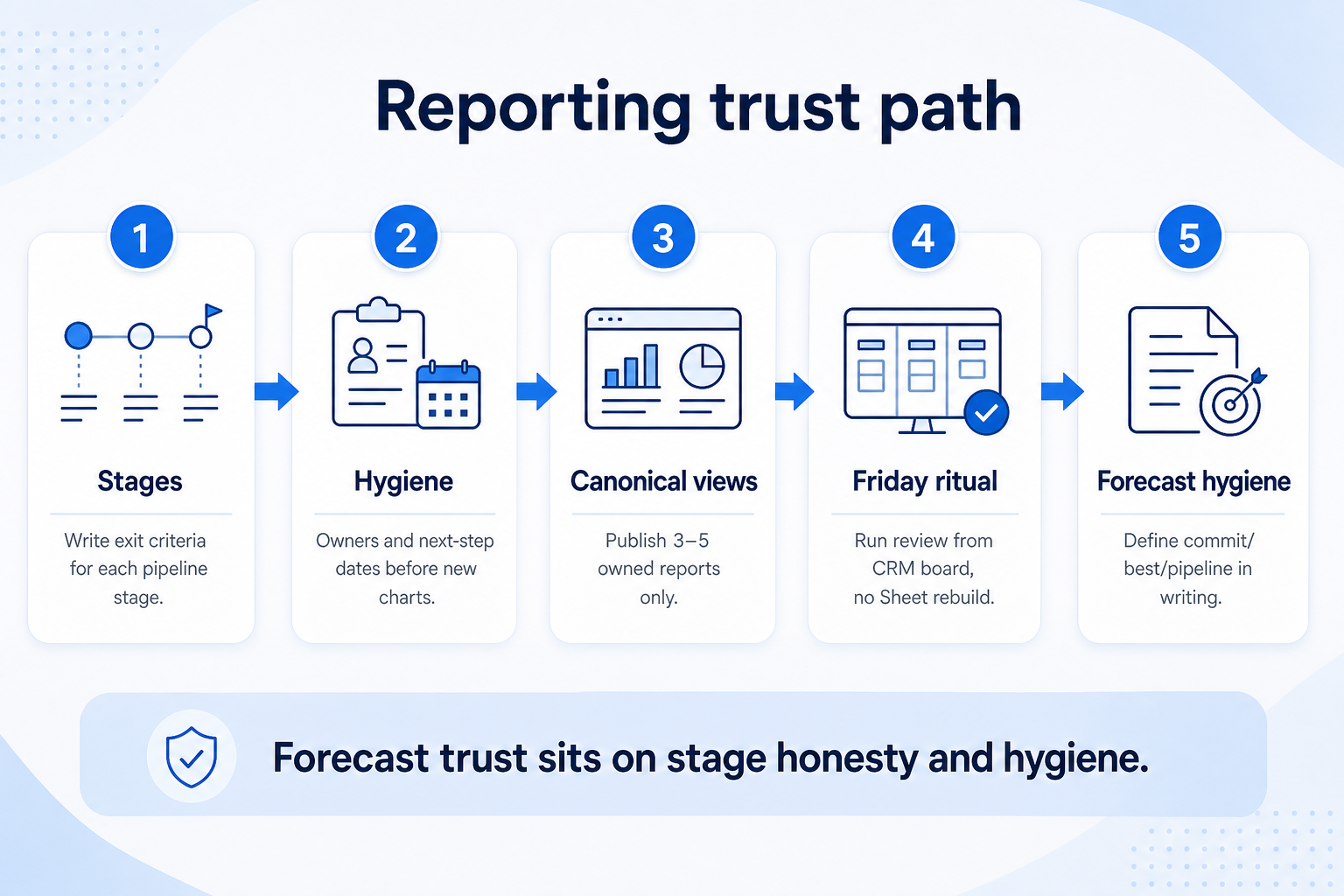
Reporting trust path

  1. 1Exit criteria
  2. 2Owner + next step
  3. 3Owned reports
  4. 4CRM-native
  5. 5Honest categories
Reporting trust path: define stages, hygiene first, canonical views, Friday CRM-native ritual, forecast hygiene.
Forecast trust sits on stage honesty and hygiene — dashboards alone cannot carry Friday.

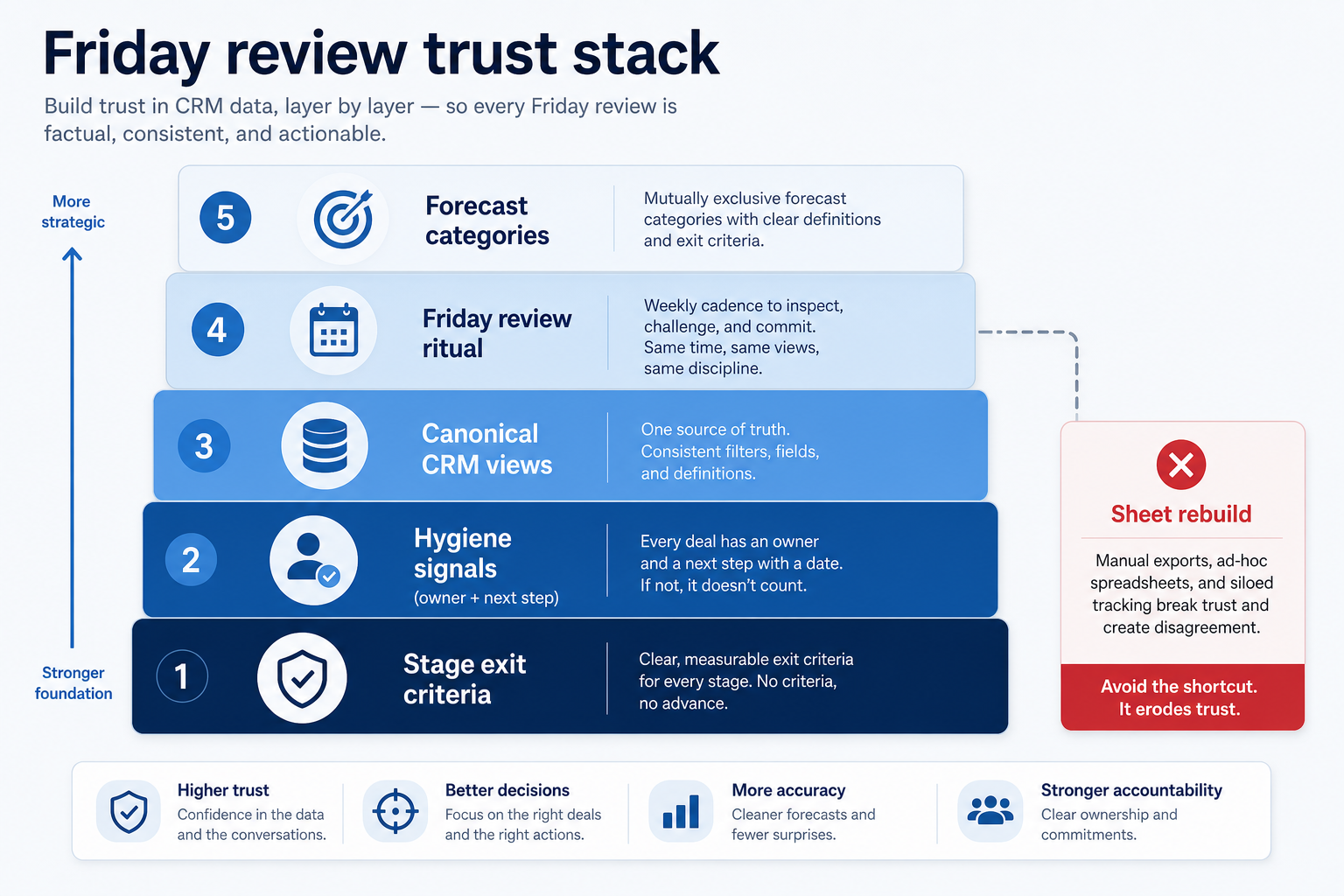
Friday review trust stack

Layered diagram for CRM reporting trust: stage exit criteria at the base, hygiene signals, canonical CRM views, Friday review ritual, and forecast categories at the top — with a blocked Sheet rebuild path.
Forecast trust sits on stage honesty and hygiene — dashboards alone cannot carry Friday.

Make Friday reports trustworthy

Bring these questions to every demo

Ask vendors to show the workflow live, not just describe it.

  • 1Write stage exit criteriaWhat evidence moves a deal — no silent jumps.
  • 2Name 3–5 canonical viewsPipeline, stuck, forecast, coverage — each with an owner.
  • 3Publish Friday agenda from CRMSame filters every week; no side sheet as source of truth.
  • 4Define forecast categoriesCommit / best case / pipeline meanings in writing.
  • 5Freeze orphan dashboard creationNew reports require a decision question + owner.

1. Start with stage honesty, not charts

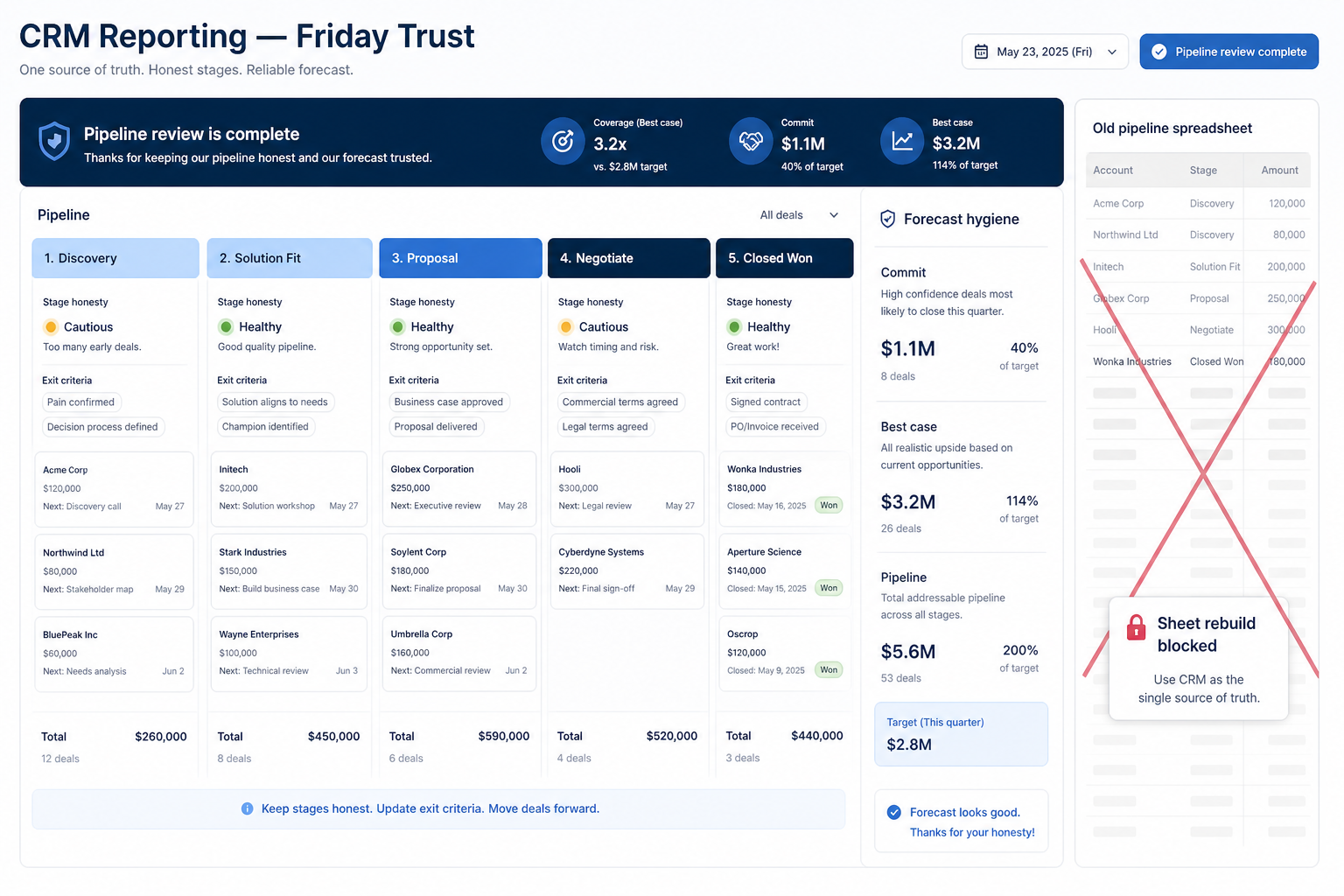
CRM reporting best practices hero: Friday pipeline review UI with stage-honesty callouts, forecast hygiene panel, and a crossed-out side spreadsheet rebuild.
Trustworthy reporting is a Friday ritual on honest stages — not a vendor dashboard tour.
  • Stage theater

    Collapse unused stages; publish exits; coach jumps.

  • Regress fear

    Allow honest regresses; punish silent fiction instead.

  • Multi-pod drift

    One stage dictionary; pod leads share the same exits.

Reporting cannot fix vague stages. Write exit criteria for each stage (evidence required to advance or regress). Sample deals weekly for jumps without logged evidence. Until stage definitions are coachable, dashboards amplify fiction.

Example: Northwind Estimators had seven stages but partners skipped three. Ops lead Priya collapsed to five stages with written exits and banned “update stage in the meeting without a logged next step.” Friday board debates shortened because the numbers meant something again.

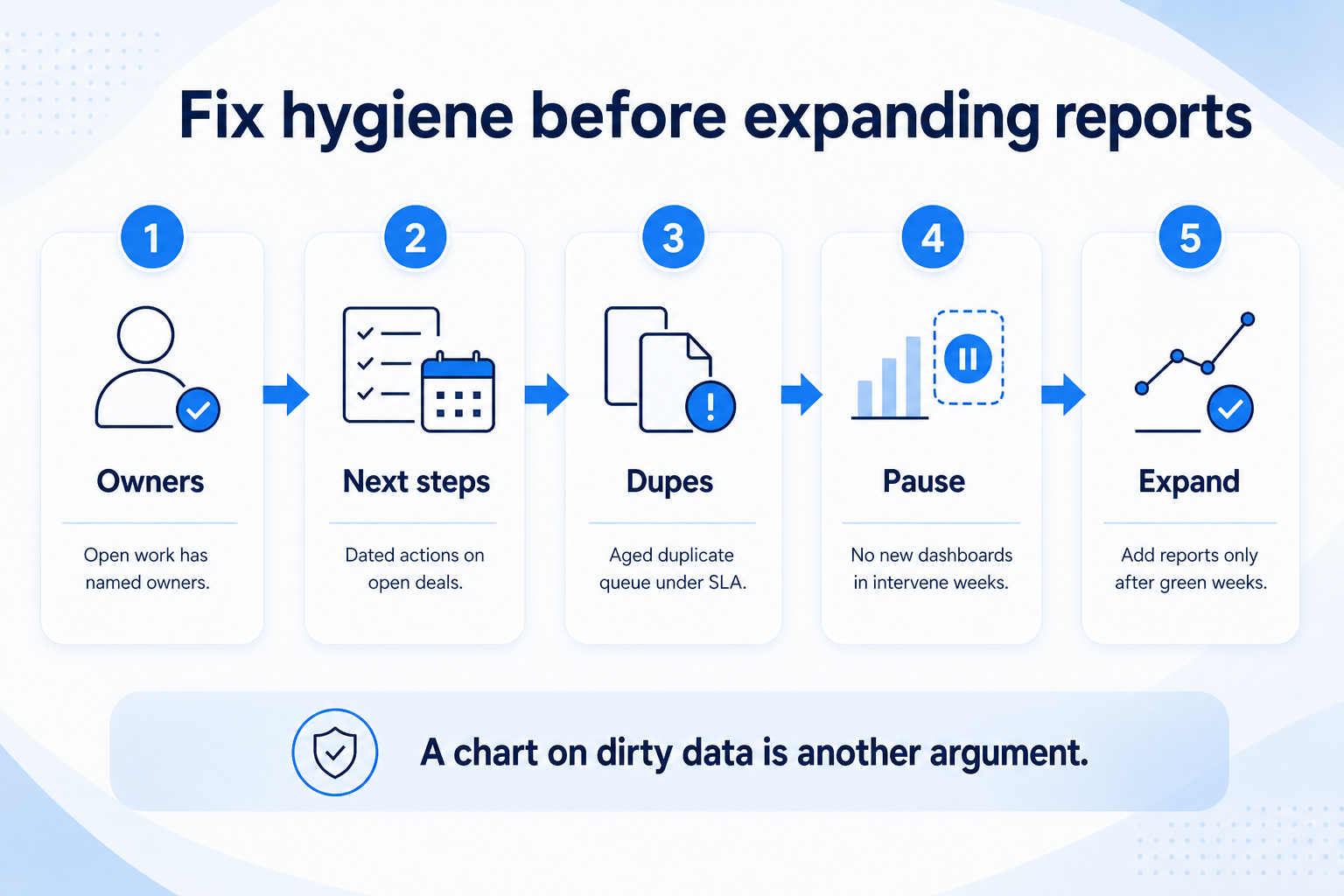
2. Fix hygiene before expanding reports

Fix CRM hygiene before expanding reports: owners filled, next steps dated, dupes aged, pause new dashboards, then expand.
A new chart on dirty data is a second source of arguments — not a decision tool.
  • Sheet Friday

    Hygiene + CRM-only agenda before any new report.

  • Duplicate inflation

    Clear match/merge first; then recount pipeline.

  • Automation spam

    Disable noisy tasks; restore update quality.

Empty owners, missing next steps, and aged duplicates make every report negotiable. Run hygiene SLAs until open work is owned and dated. Pause new dashboard requests during intervene weeks.

Example: Meridian Specialty Finance’s forecast looked optimistic because closed-lost never updated and next steps were blank. After two hygiene weeks (owner + next-step fill), the same canonical forecast view became usable — without adding widgets.

3. Publish a small set of canonical views

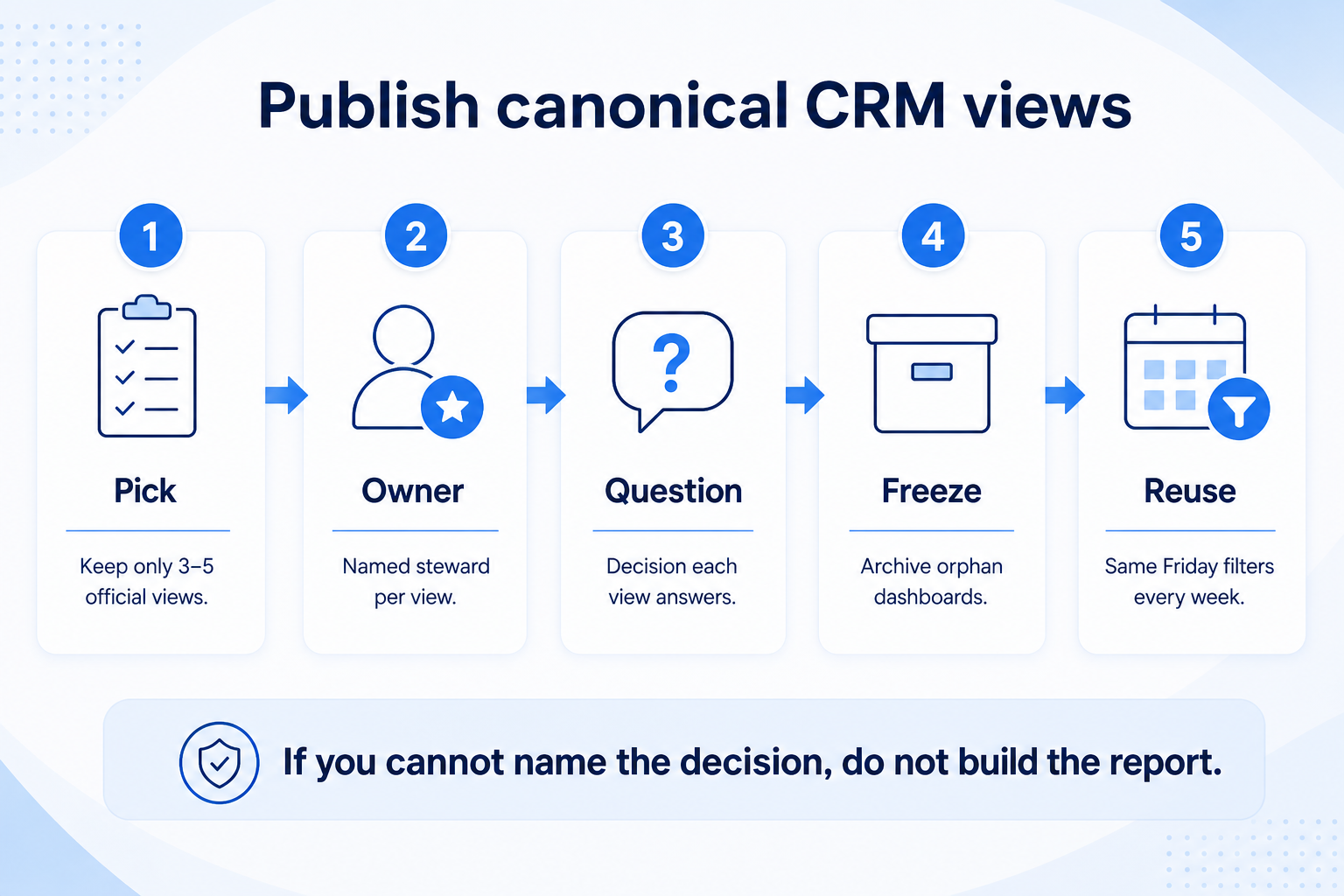
Publish a small set of canonical CRM views: pick 3–5, name owners, state the decision question, freeze orphans, reuse Friday filters.
Every new report needs a decision question and an owner — or it is decoration.
  • Dashboard sprawl

    Inventory → keep 3–5 → archive the rest.

  • Exec vanity set

    Map each exec question to one canonical view.

  • Pod variants

    Same structure, filtered by pod — not divergent stage logic.

Limit the official set: open pipeline by stage, stuck/no-next-step, forecast by category, and coverage/activity for coaching. Each view has an owner, a purpose sentence, and a refresh rule. Archive or unpublish orphan dashboards that nobody can explain.

Example: Harborline Advisory keeps four saved views. Maya owns stuck deals; Ana owns forecast. Leadership stopped accepting screenshots from personal filters because they were not in the canonical set.

4. Run Friday from CRM — no rebuild sheet

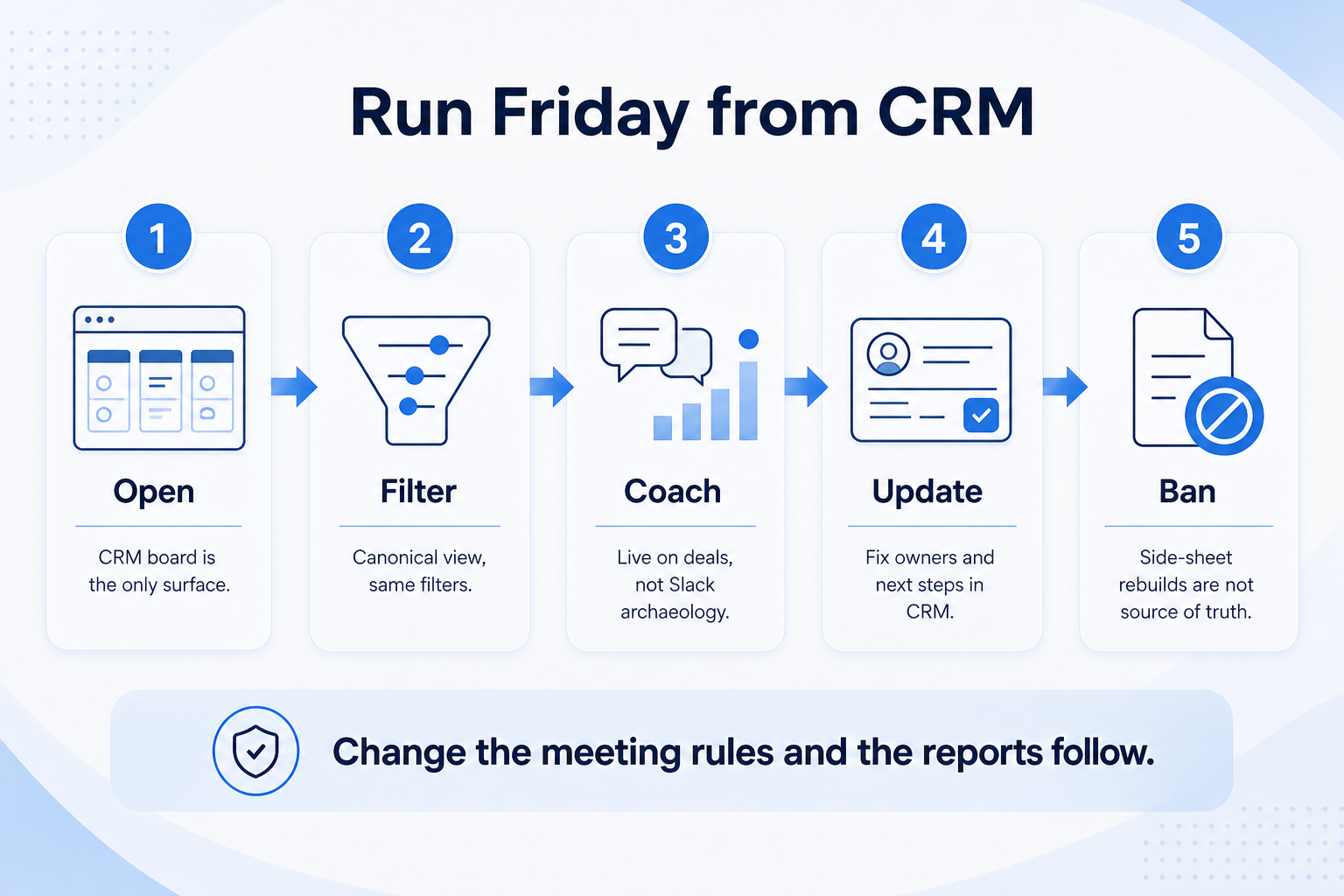
Run Friday from CRM with no rebuild sheet: open board, canonical filters, coach live, update in CRM, ban side-sheet source of truth.
Change the meeting rules and the reports follow — charts alone rarely kill the Sheet.
  • New manager

    Shadow one CRM-native Friday, then lead with the same agenda.

  • Founder override

    Founder models CRM-only answers in exec reviews.

  • Remote team

    Screen-share canonical views; ban pasted Sheet tables.

The weekly review is the reporting product. Agenda: stuck items, empty next steps, stage changes needing evidence, and forecast movement. Managers prepare from canonical views before the meeting. Side sheets may be personal scratch pads — never the coaching source of truth.

Example: Crestview Wealth’s Friday opens on Maya’s board filter. Partners who bring printed lists are asked to update CRM live. After three weeks the Sheet stops influencing forecast conversations.

5. Practice forecast hygiene

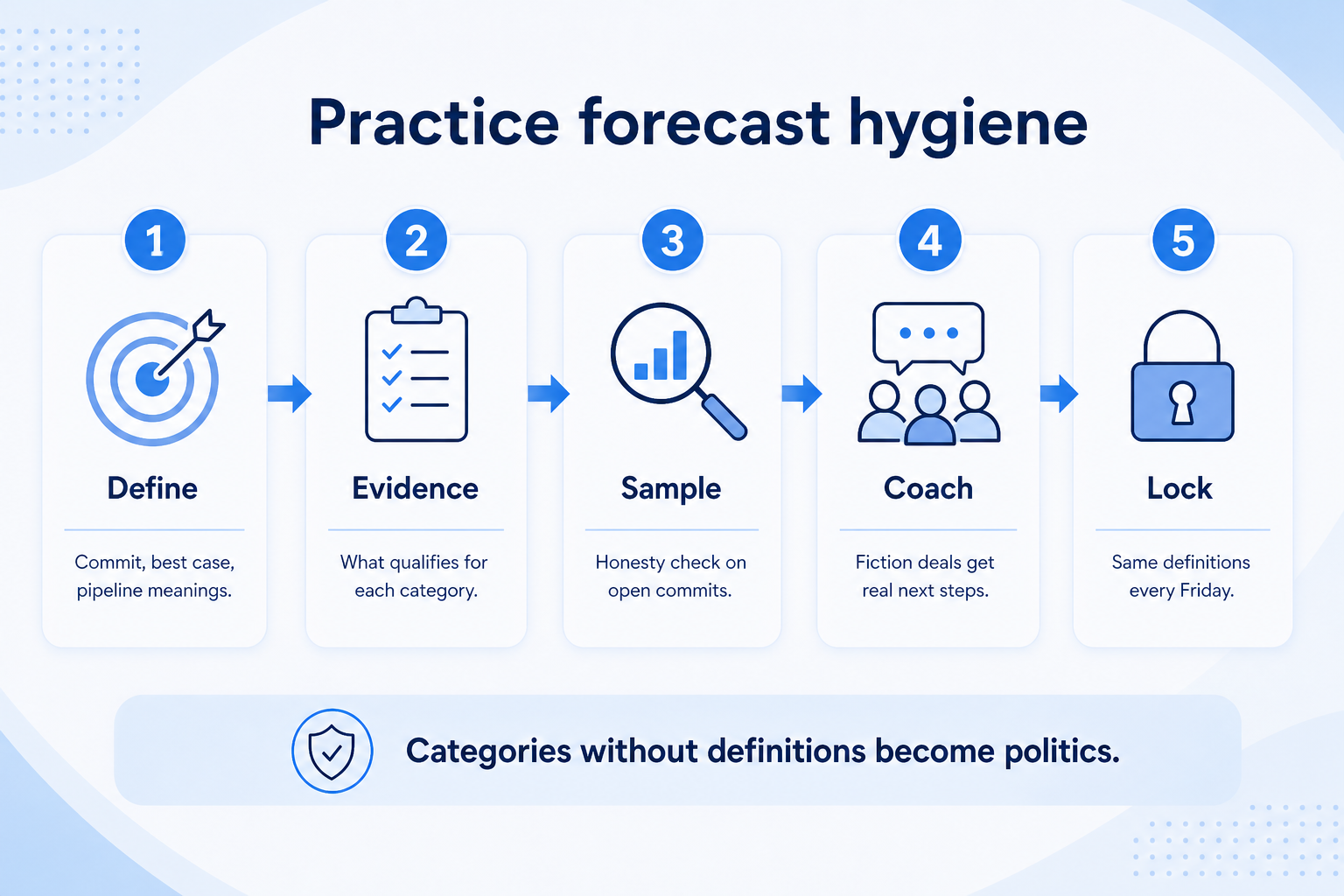
Practice CRM forecast hygiene: define categories, evidence rules, sample honesty, coach fiction, lock definitions weekly.
Forecast categories without written meanings become negotiation — not a forecast.
  • Sandbagging

    Coach evidence for category — do not punish honesty.

  • Happy ears

    Pull commit when next step is missing; make the rule visible.

  • Long cycles

    Add milestone exits; keep categories few and stable.

Define commit, best case, and pipeline (or your categories) in writing. Require a dated next step and honest stage for anything in commit. Review category changes weekly as coaching moments — not as silent edits after the meeting.

Example: Lakeside B2B required commit deals to have a next step within seven days and a manager-visible close plan note. Inflated commit shrank without inventing a dollar ROI story — just clearer category rules.

Trusted reporting vs dashboard theater

Must-have
  • Stage exit criteria written
  • Friday starts in CRM
  • Forecast categories defined
  • Report owners named
Nice-to-have

    Reporting mistakes

    • Building dashboards on dishonest stages

      You automate fiction and teach leadership the wrong story.

    • Accepting Sheet Fridays

      Side sheets as coaching truth make CRM optional.

    • Orphan dashboard sprawl

      Twenty unexplained charts destroy a single source of truth.

    • Forecast theater

      Categories without definitions become political labels.

    • Invented benchmark conversion rates

      Use your funnel samples — do not paste fake industry stats as facts.

    • Reporting before hygiene

      Fix owners and next steps first; then expand views.

    Example official CRM product videos

    Optional · 2 examples · collapse if you don’t need them

    Verified vendor product videos from the CRM catalogue for context while you read. They are examples only — not a ranked shortlist — and they do not replace SoftwareGlimpse recommendations on this page.

    • Official vendor video · example

      Attio — Attio | How to build your sales pipelines

      This video is hosted on YouTube

      This content is hosted by YouTube. The player loads only after you allow marketing cookies.

      Official vendor tutorial

      Attio | How to build your sales pipelines

      What this shows

      • Attio sales pipeline setup
      • pipeline building as presented by Attio
      Attio research →
    • Official vendor video · example

      folk — How to use folk for Deal management & Closing?

      This video is hosted on YouTube

      This content is hosted by YouTube. The player loads only after you allow marketing cookies.

      Official vendor tutorial

      How to use folk for Deal management & Closing?

      What this shows

      • folk deal management workflow
      • closing process as presented by folk
      folk research →

    Frequently asked questions

    • What makes a CRM report trustworthy?

      Honest stages with exit criteria, owned canonical views, hygiene on open work, and a Friday ritual that starts in CRM. Decision rule: if you still rebuild in Sheets for coaching, trust is incomplete.

    • How many dashboards should we have?

      Usually three to five canonical views with named owners. More is fine only when each answers a written decision question. Archive orphans.

    • How do we fix forecast distrust?

      Define categories in writing, require next steps on commit, coach category changes weekly, and stop accepting off-CRM forecast tables.

    • Should we buy a BI tool?

      Not until CRM-native Friday trust works for the core loop. BI on dirty stages exports the same arguments to a prettier canvas.

    • How does this differ from implementation KPIs?

      Implementation KPIs cover leading/lagging rollout signals and intervene rules. This guide focuses on ongoing reporting trust: stage honesty, canonical views, Friday ritual, and forecast hygiene after go-live.

    • What about activity dashboards?

      Use them for coaching coverage gaps — not as adoption success. Prefer next-step and ownership signals over vanity login charts.

    • What should I do next?

      Write stage exits, name canonical views, publish a CRM-only Friday agenda, and align hygiene SLAs. Cross-read Data Hygiene, Improve Adoption, and Implementation KPIs; plan the ritual in the Implementation Planner.

    Was this article helpful?

    Have more questions? Contact our support team.

    SoftwareGlimpse Updates

    Want clearer software shortlists? Get buying guides and comparisons by email.

    Newsletter coming soon.