CRM Governance Guide: Ownership and Change Control
Govern CRM with field ownership, stage/field change control, access reviews, and a finite admin backlog — so configuration does not quietly destroy trust.
CRM governance is named ownership for fields, stages, permissions, and the admin backlog — with change control before configuration drifts. Decision rule: do not add or change stages, required fields, roles, or automations without a written request, impact review, and communicate step. If nobody owns a field or the admin queue is unlimited, freeze new config until RACI and review cadence exist.
Field ownership
Change control
Access reviews
Admin backlog
Freeze on drift
Communicate changes
Key takeaways
Every field needs an owner — Unowned fields become optional noise and break reporting trust.
Stages are policy, not preference — Stage and required-field changes go through change control.
Access is reviewed, not assumed — Quarterly (or more often) access reviews catch privilege creep.
Admin backlog is finite — Prioritize by risk to hygiene and adoption — not by who yelled last.
5Cap admin WIPFinite in-progress tickets; park nice-to-haves.
1. Assign field and stage ownership
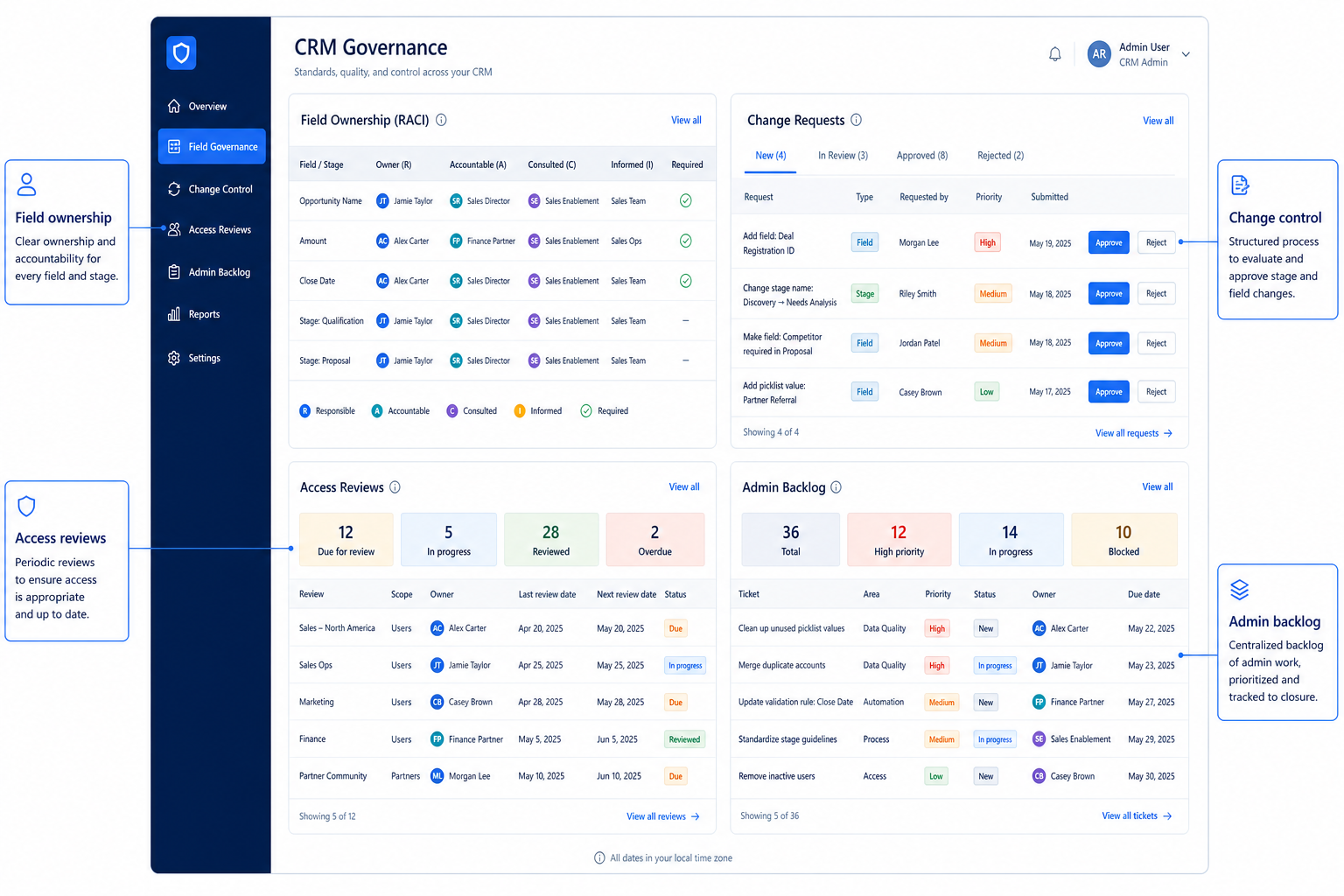
Governance is visible operating work — ownership, control, reviews, and a finite backlog.
Required fields
Owner + next step + stage always have business owners.
Reporting fields
Anything on an exec dashboard needs a data steward.
Optional clutter
Unused for two review cycles → archive or delete via change control.
List required and reporting-critical fields. Each needs a business owner (defines meaning and when it must be filled) and an admin implementer (configures validation and views). Stage definitions get the same treatment: exit criteria written, owner named, managers trained to reject dishonest jumps.
Example: Blue Harbor Logistics discovers fourteen custom fields with no owner after six months. Ops lead Devon deletes nine unused fields, assigns owners to five that feed Friday reviews, and freezes new fields until a change request exists.
Prove who fills it; train before enforcement goes hard.
Automation
Only after hygiene holds — noisy automations undermine governance.
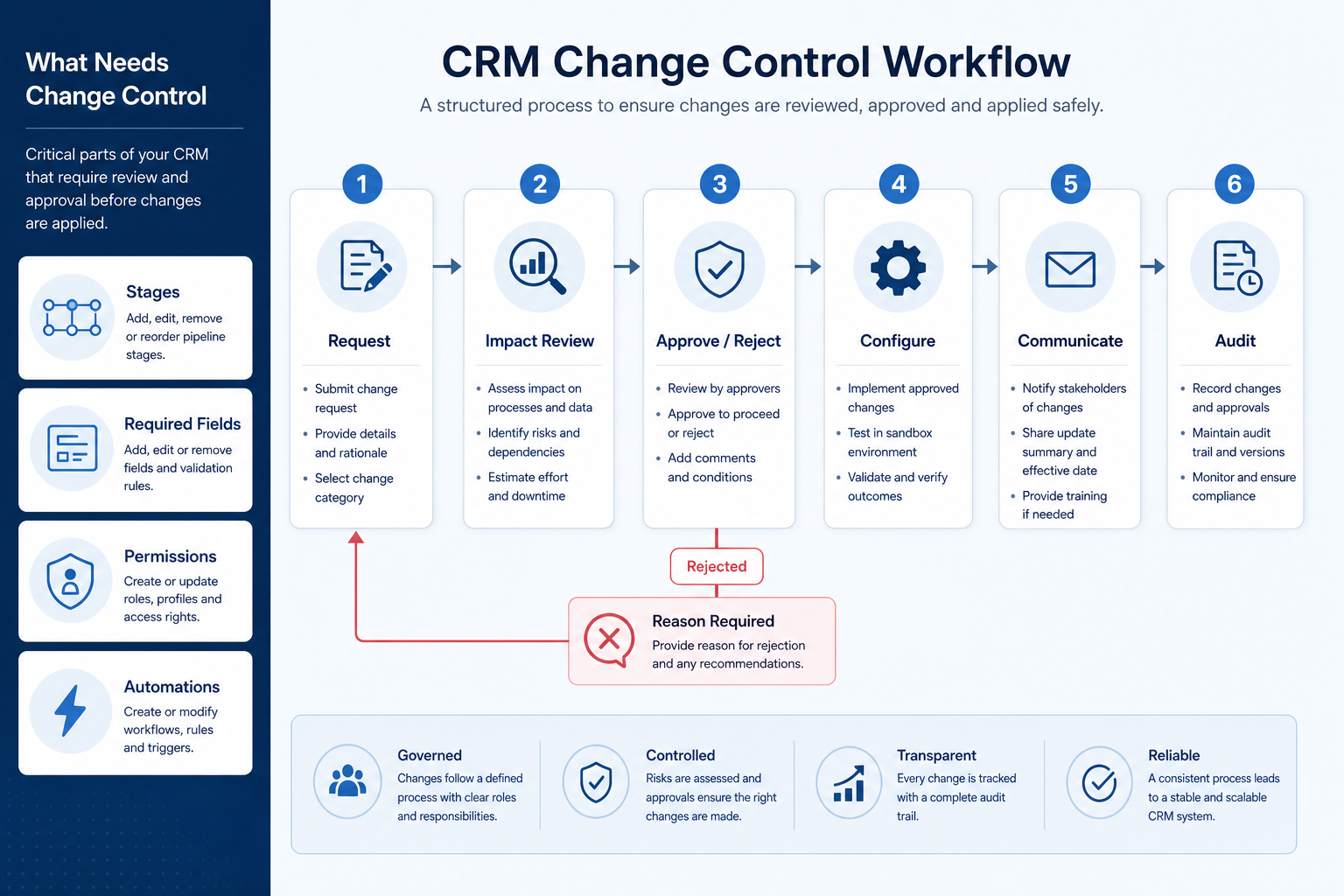
Treat stage edits, required-field changes, permission model changes, and automations as controlled changes. Flow: request → impact review (who breaks, what reports change) → approve/reject → configure in a controlled window → communicate → short audit that the change behaved.
Example: Meridian Specialty Finance wants a new “Credit Review” stage. Ana rejects a same-day config ask, runs a fifteen-minute impact review with sales and credit, updates exit criteria docs, then configures and announces in the Monday briefing before the stage appears.
3. Run access reviews on a cadence
Role drift
Compare actual permissions to the access matrix; close gaps.
Inactive users
Disable seats that have not worked the core loop for your defined window.
Sensitive fields
Confirm who can see financial or personal fields after org changes.
Privilege creep is normal: contractors linger, managers inherit broad roles, export rights spread. Schedule reviews of roles, exception grants, inactive seats, and sensitive-field visibility. Document exceptions with expiry and approver.
Example: Harborline Advisory’s quarterly review finds two former contractors still in a reporting role and a temporary “see all households” grant without expiry. Keisha revokes both, adds expiry to future exceptions, and logs the review date on the governance checklist.
Manager coaching views and next-step enforcement next.
Nice-to-haves
Park until gates pass; revisit monthly.
Unlimited “can you add a field?” queues destroy focus. Cap work-in-progress, triage weekly, and prioritize items that protect hygiene, adoption, or security over cosmetic requests. Publish what is parked and why.
Example: Crestview Wealth’s admin backlog had forty-two open asks. Priya caps WIP at five, groups duplicates, and parks AI-scoring experiments until Day-60 adoption gates pass. Requesters see the queue status in a shared note.
5. Keep a light governance cadence
Small team
Same person may wear admin + ops — still write the RACI.
Multi-pod
Local champions propose; central admin approves controlled changes.
Regulated context
Align access reviews with your policy owners; do not invent certification claims.
Weekly: admin triage + hygiene glance. Monthly: field/stage audit and backlog reorder. Quarterly: access review and RACI refresh. Tie governance to adoption and data-quality rituals so it stays operational, not ceremonial.
Example: Blue Harbor’s monthly audit finds three stages nobody can define. They merge two via change control and retrain managers — governance preventing another quarter of dishonest forecasts.
Governance mistakes
Anyone can edit stages
Pipeline meaning collapses; forecasts become theater.
Fields without owners
Required checkboxes nobody believes train people to skip updates.
Infinite admin yes-queue
Configuration sprawl outruns training and hygiene.
Access set once at go-live
Privilege creep is inevitable without scheduled reviews.
Silent hotfixes
Uncommunicated changes break habits and trust overnight.
Governance as paperwork only
If reviews never change config or access, skip the theater and fix the WIP system.
Example official vendor setup videos
Optional · 2 examples · collapse if you don’t need them
These are verified vendor tutorials and product demos from the CRM catalogue — examples of how vendors present setup and workflows. They are not SoftwareGlimpse rankings, and they do not replace the independent guidance on this page.
Official vendor tutorial · example
Attio — Attio | How to build your sales pipelines
This video is hosted on YouTube
This content is hosted by YouTube. The player loads only after you allow marketing cookies.
Named ownership and decision rights for fields, stages, permissions, and admin work — plus change control so configuration does not drift. It is how you keep the system trustworthy after go-live.
Who should own CRM governance?
An admin (or ops) lead with calendar hours, plus business owners for critical fields and stages. Executives sponsor; they do not approve every field rename.
Do small teams need change control?
Yes, lightly. A one-page request and a weekly triage still prevent silent stage edits. Formal committees are optional; written decisions are not.
How often should we review access?
At least on a quarterly cadence for most teams, and after role changes or contractor exits. Set your own interval — do not invent a universal benchmark as a fact.
How does governance relate to data quality?
Governance decides who owns fields and what may change; data quality runs the hygiene SLAs and weekly reviews. Use both — ownership without hygiene still decays.
What should I do next?
Name admin R/A, assign owners for required fields, publish a change-request page, and cap admin WIP. Then connect to Data Quality and Adoption gates.