CRM change management is a stakeholder map, resistance playbook, communications cadence, and pilot champions — not a go-live email. Decision rule: do not expand seats until sponsors, managers, and champions can explain the core loop, the review ritual, and what happens to shadow sheets. If resistance shows up as silent non-use or dual-running, intervene with coaching and simplify before adding configuration.
Stakeholder map
Resistance patterns
Comms cadence
Pilot champions
Ritual over features
Expand on buy-in
Key takeaways
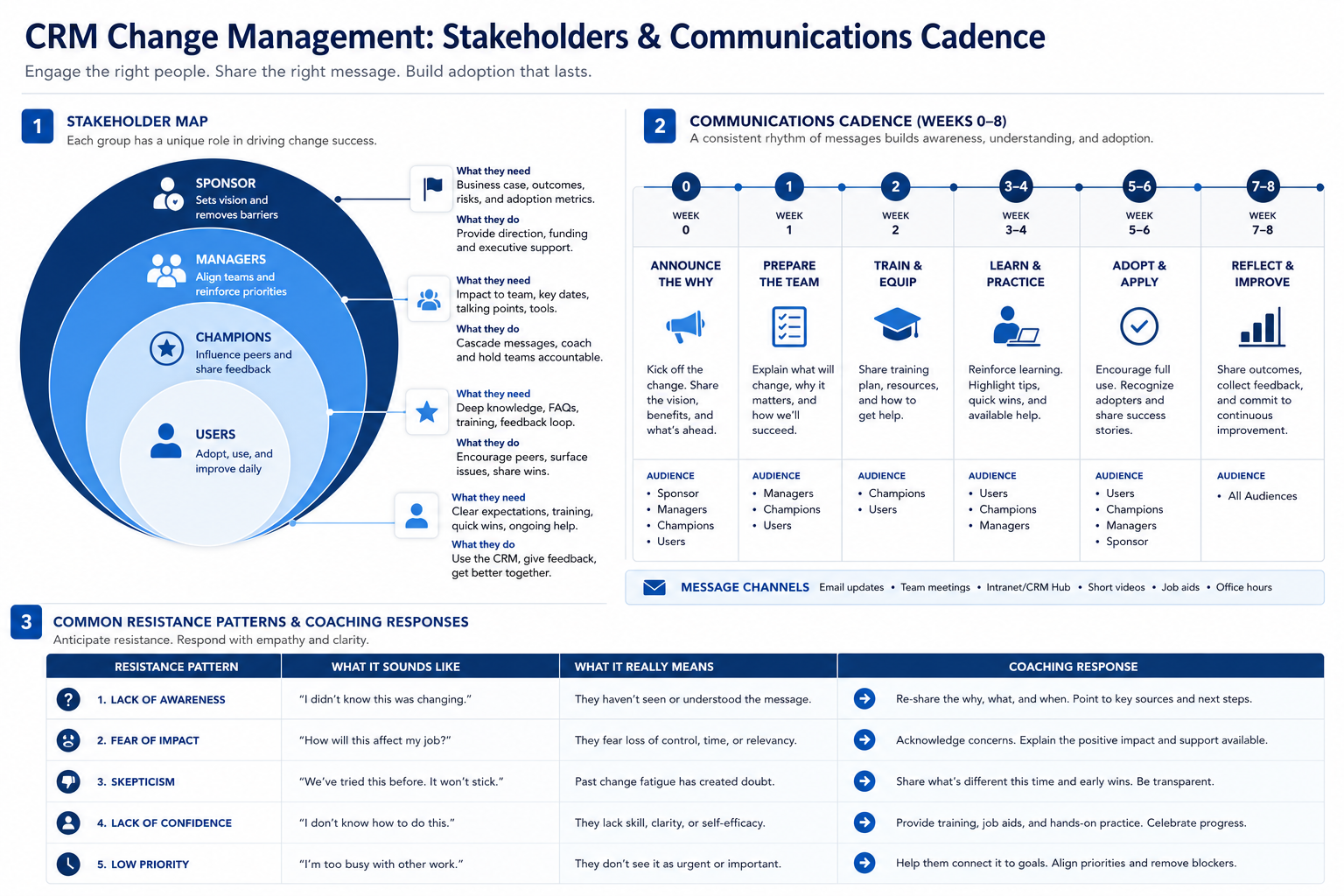
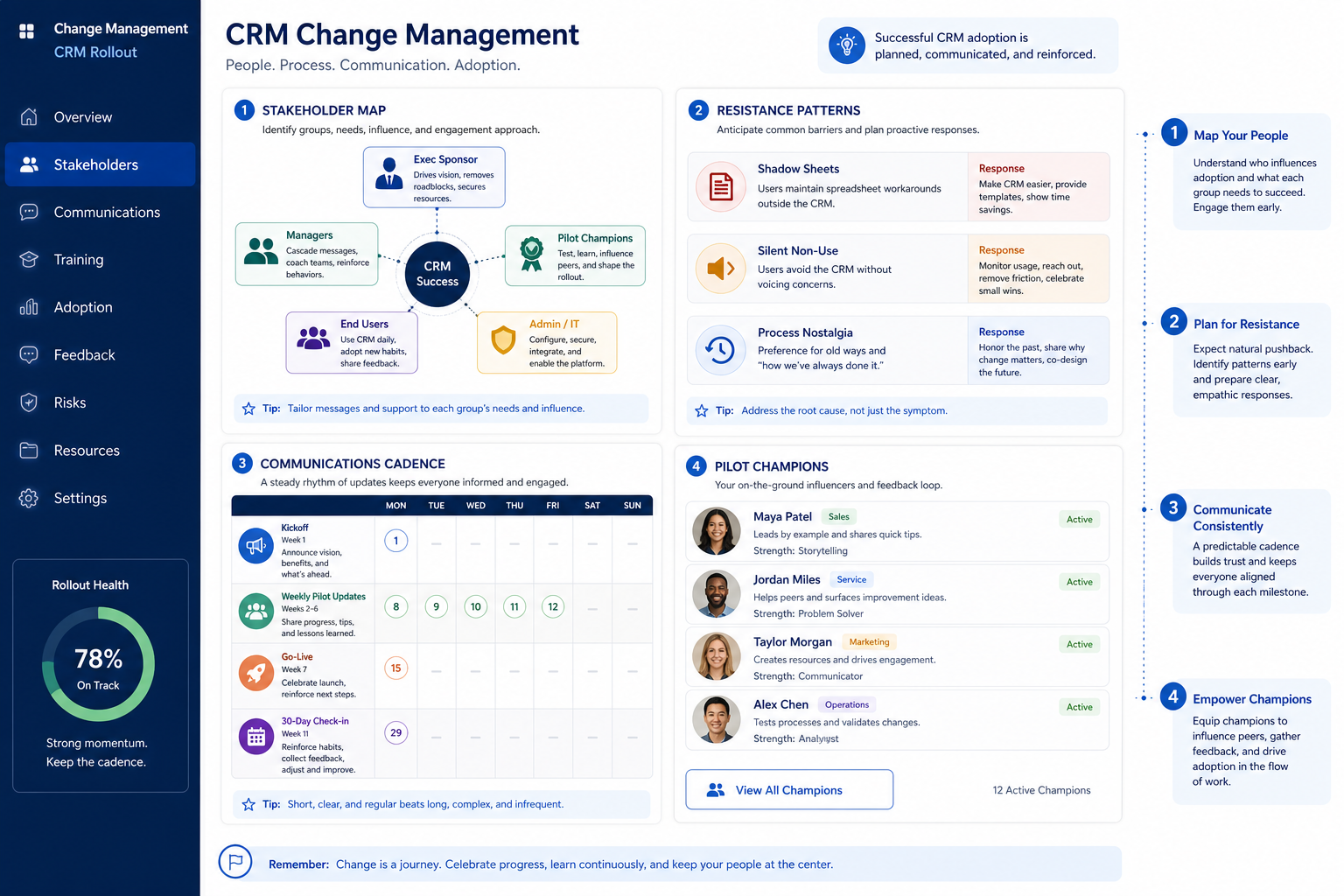
Map people before config — Sponsor, managers, champions, users, admin — each has a job in the change.
Resistance is diagnostic — Shadow sheets and nostalgia point to ritual gaps, not “bad users.”
Cadence beats one announcement — Kickoff, weekly pilot notes, go-live, 30-day follow-up.
Champions carry the middle — Peer help on live records outperforms vendor webinars alone.
Who hears what, when — plus a playbook for the resistance you will actually see.
Change-ready before invite storm
Bring these questions to every demo
Ask vendors to show the workflow live, not just describe it.
1Exec sponsor namedVisible support for CRM-native reviews — not just budget.
2Managers briefed on coaching ritualThey will lead from CRM views.
3Pilot champions selectedRespected peers with office-hours capacity.
4Comms calendar draftedKickoff → weekly pilot → go-live → 30-day.
5Shadow-sheet policy writtenWhat retires, when, and who enforces.
1. Build the stakeholder map
Change work is visible: who owns buy-in, who coaches, and how often you communicate.
Founder-led
Founder is sponsor and sometimes manager — still separate the jobs on paper.
Multi-site
Local champions + central admin; managers aligned on one agenda.
Advisory / FS
Partners as managers; coverage partners need explicit loop jobs.
List roles and the change job each must do: sponsor removes ambiguity and backs the ritual; managers coach from CRM; champions answer peer questions; users complete the core loop; admin owns config and hygiene queues. Write what “good” looks like for each role in one sentence.
Example: Blue Harbor Logistics maps VP Sales as sponsor, three pod leads as managers, two senior estimators as champions, and Devon as admin. The sponsor’s sentence: “I will not accept forecast answers that are not on the board.”
2. Name resistance patterns and responses
Shadow sheets
Deadline + field mapping + manager refusal to use the sheet.
Sponsor backs CRM-only status answers in public forums.
Expect patterns: shadow sheets, silent non-use (login without loop), process nostalgia (“our old way was fine”), and manager bypass (accepting verbal-only updates). Pair each with a response: retire the sheet on a date, coach the loop on live records, capture what to keep from the old process, and hold managers to CRM-native reviews.
Example: Harborline’s planners keep a household spreadsheet “just in case.” Keisha and the practice lead set a two-week dual-run end date, move the must-have columns into CRM fields with owners, and stop referencing the Sheet in Monday coverage.
3. Run a communications cadence
Kickoff
Why now, core loop, what retires, who to ask.
Weekly pilot
Practice focus + known issues + parked requests.
30/60/90
Gate outcome: expand, coach, or simplify — with owners.
Plan messages by week: purpose and non-goals at kickoff; weekly pilot notes (what changed, what to practice, what is parked); go-live “how we work now”; 30-day gate results and next steps. Keep messages short, role-specific, and tied to the ritual — not feature dumps.
Example: Meridian’s Ana sends a Friday pilot note: three wins, one stuck pattern (empty next steps), and the manager agenda for Monday. Sellers know what “good” looks like without a forty-slide deck.
4. Equip pilot champions
Selecting champions
High peer trust + willing to learn the loop early.
Champion toolkit
Loop card, mistakes list, how to file change requests.
Scaling
Graduate pilot champions to coach the next pod’s champions.
Champions are respected practitioners with time for office hours, not unpaid full-time admins. Give them a mistakes checklist, merge/escalation paths, and a direct line to admin. Recognize their work in sponsor communications so the role stays staffed.
Example: Crestview names two partner-track advisors as champions. They run two thirty-minute office hours weekly using live household records. When Day-60 wobbles, they co-lead the retraining lab instead of blaming “adoption.”
5. Expand only with demonstrated buy-in
Ready to expand
Gates green; champions staffed; sponsor still visible.
Not ready
Hold seats; run resistance playbook and simplify.
Partial expand
Add one pod that already shares the pilot’s ritual.
Seat expansion is a change event. Require: managers already coaching from CRM, champions available for the new cohort, shadow-sheet policy holding, and adoption/quality gates not in intervene mode. Re-run a compressed kickoff for each new group.
Example: Northwind pauses a company-wide invite after pod two still dual-runs. They fix manager bypass first, then expand — change management as a gate, not a slide.
Change management mistakes
Go-live email as the plan
Without cadence and champions, habits do not move.
Ignoring manager bypass
If leaders accept Slack-only status, users correctly ignore CRM.
Champions without time
Title-only champions burn out or go quiet.
Punishing shadow sheets only
Retire sheets after the CRM ritual can carry the work.
Feature-first communications
People need the loop and the review rules, not every module.
Expanding during intervene
More seats amplify resistance patterns you have not fixed.
Example official vendor setup videos
Optional · 2 examples · collapse if you don’t need them
These are verified vendor tutorials and product demos from the CRM catalogue — examples of how vendors present setup and workflows. They are not SoftwareGlimpse rankings, and they do not replace the independent guidance on this page.
Official vendor tutorial · example
Attio — Attio | How to build your sales pipelines
This video is hosted on YouTube
This content is hosted by YouTube. The player loads only after you allow marketing cookies.
The people system around rollout: stakeholder jobs, communications cadence, pilot champions, and a resistance playbook — so the core loop and review ritual stick. Configuration alone is not change management.
Who should be a pilot champion?
A respected practitioner with peer trust and calendar time for office hours — not only the loudest power user or the sole admin. Give them escalation paths and recognition.
How do we handle people who refuse the CRM?
Diagnose the pattern (shadow sheet, silent non-use, manager bypass), fix the ritual and incentives, coach on live records, and have the sponsor back CRM-native reviews. Do not only send more reminder emails.
How long should dual-running last?
As short as you can defend with a written end date. Dual-running without a retirement date becomes permanent. Gate expansion on sheet retirement for the review ritual.
How does this connect to adoption?
Change management creates the conditions; adoption measures core-loop usage and manager coaching. Use both with 30/60/90 gates.
What should I do next?
Draft the stakeholder map, name champions, publish a four-touch comms calendar, and write the shadow-sheet policy. Then align with Adoption and Governance.