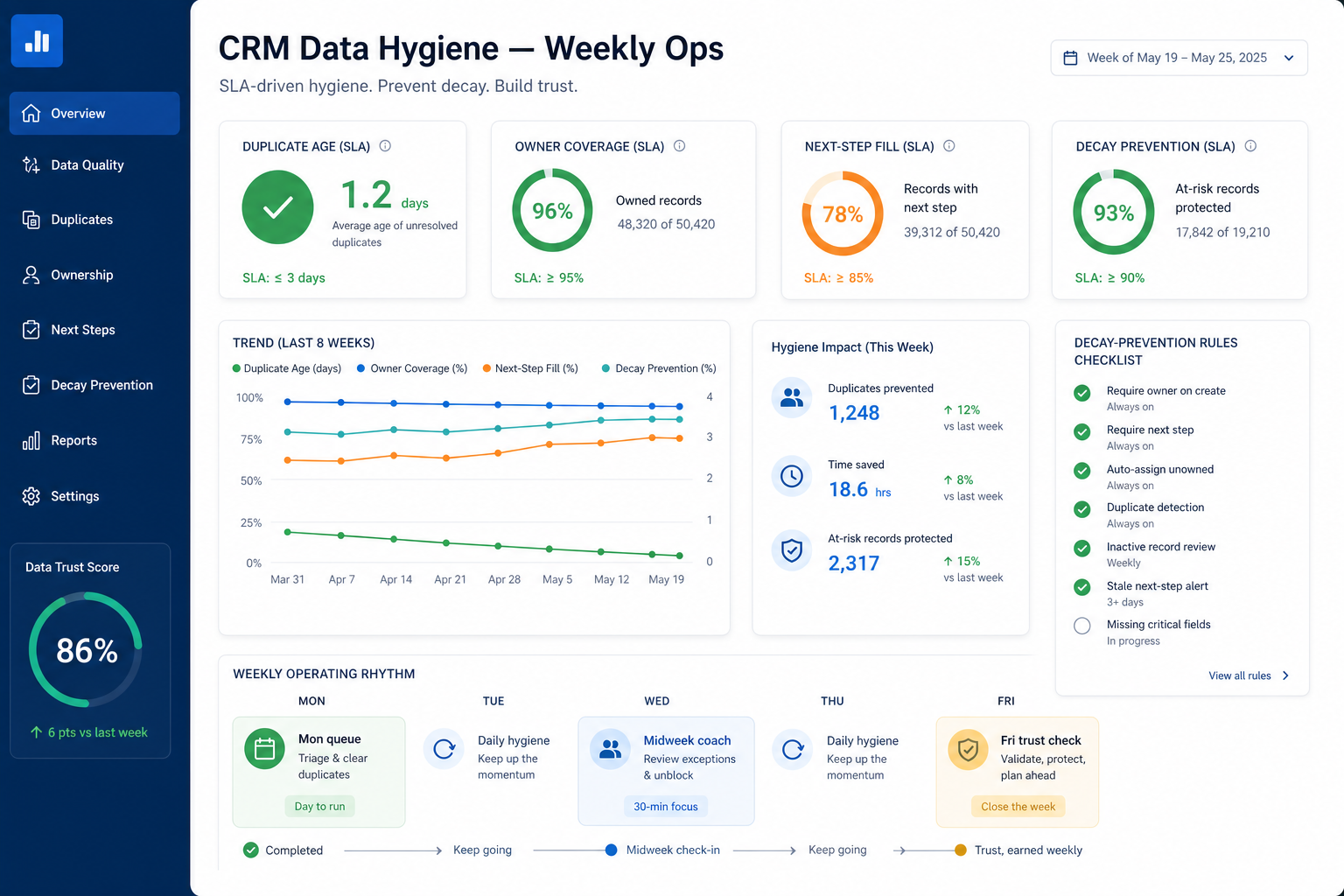
CRM data hygiene is a weekly operating rhythm with named owners, SLAs, and decay-prevention rules — not a quarterly cleanup project. Decision rule: if duplicates age in a queue, open work lacks owners or next steps, or Friday still needs a rebuild sheet, pause new automation and hold the weekly hygiene ritual until team-defined signals meet target for two consecutive weeks.
Weekly rhythm
Named owners
Hygiene SLAs
Decay prevention
Pause automation
Not one-time clean
Key takeaways
Hygiene ≠ cleanup event — A migration cleanse without weekly ownership decays within weeks.
SLAs need people — Every signal needs an owner, a queue, and a coaching response.
Hygiene is a calendar with owners — not a one-off data day on the backlog.
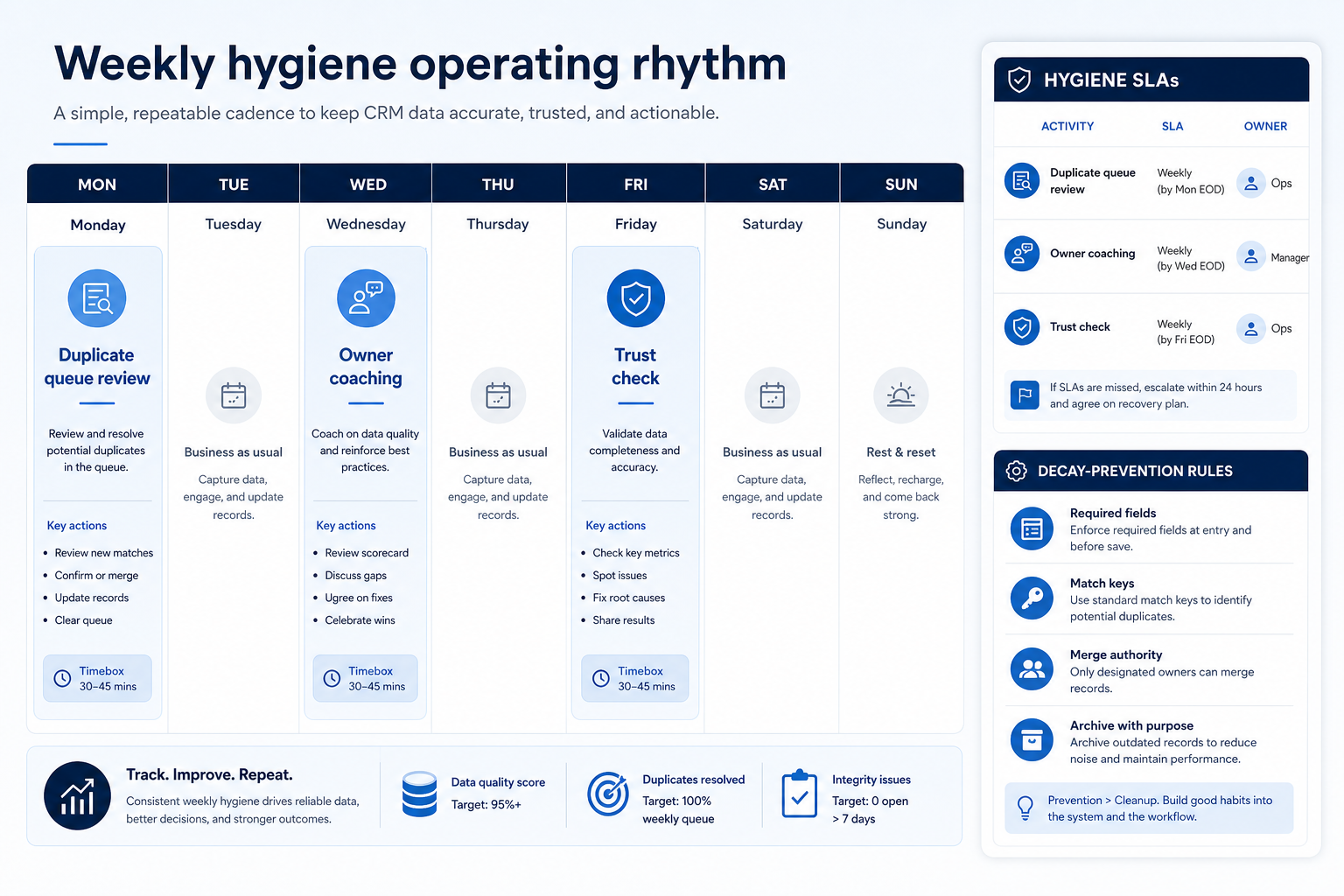
Weekly hygiene operating rhythm
Hygiene is a calendar with owners — not a one-off “data day” on the backlog.
Stand up hygiene ops
Bring these questions to every demo
Ask vendors to show the workflow live, not just describe it.
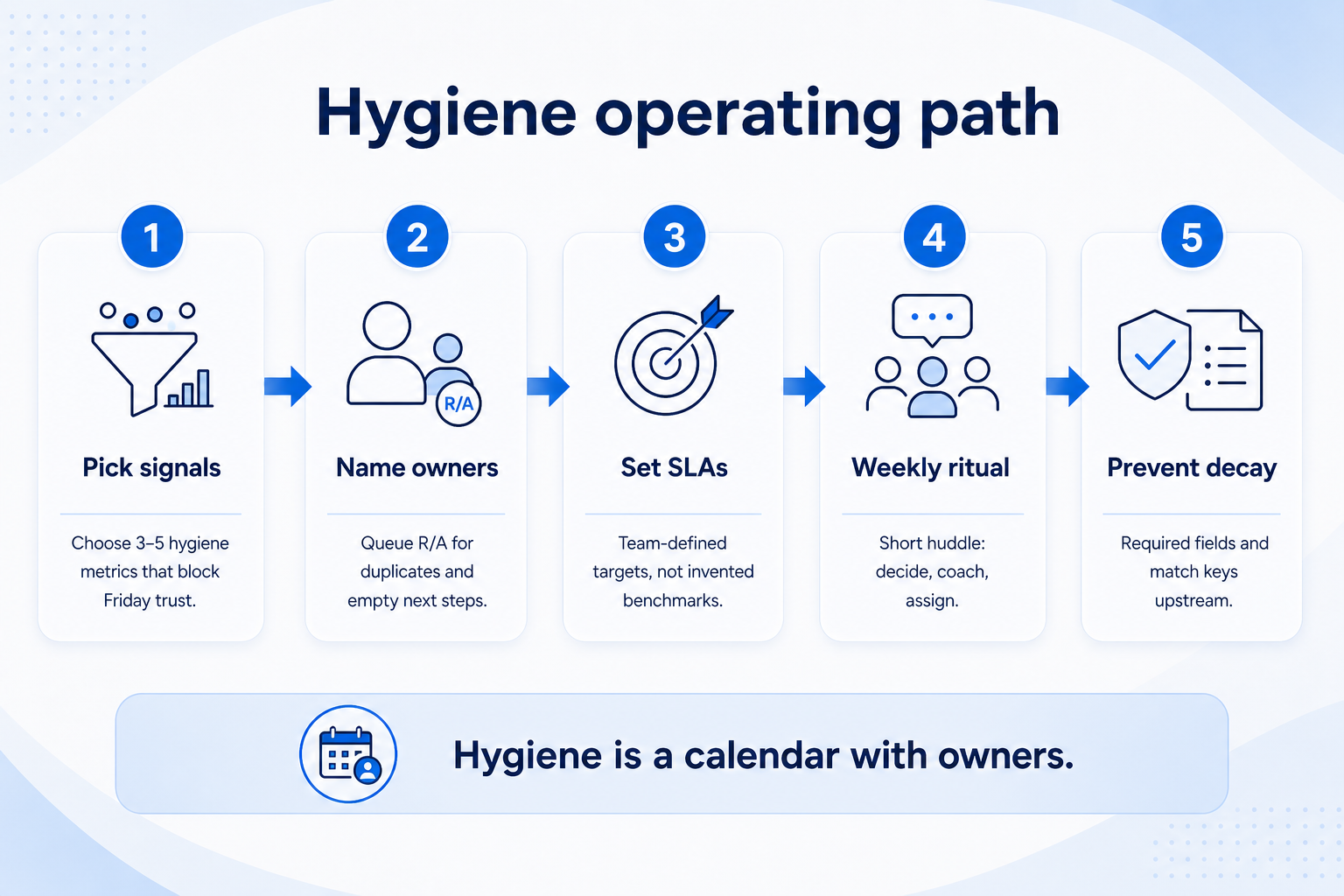
1Pick 3–5 hygiene signalse.g. owner filled, next-step dated, duplicate age, stale open deals, stage honesty sample.
2Name queue ownersWho clears duplicates, who coaches empty next steps, who archives.
3Write team-defined SLAsInternal targets only — no invented industry benchmarks.
4Book the weekly hygiene slotShort huddle with saved views — not a quarterly mega-cleanse.
5Document decay-prevention rulesRequired fields, match keys, merge authority, archive policy.
1. Treat hygiene as ops, not a project
Hygiene looks like a weekly ops board — cleanup is a separate workstream when backlog spikes.
Post-migration decay
Stand up weekly SLAs within two weeks of go-live.
Report distrust
Pause vanity dashboards; fix ownership and next steps first.
Automation blocked
Do not automate on dirty queues — restore hygiene first.
One-time cleaning clears a backlog; hygiene keeps trust between Fridays. Separate the migration/cleanup workstream from the weekly operating system. If your team only “does data” when reports break, you are in project mode — switch to a recurring ritual with exit criteria for intervene weeks.
Example: Lakeside B2B Services finished a migration cleanse in March. By June, duplicates aged past two weeks and forecast Fridays needed a Sheet again. Ops lead Ana stopped scheduling quarterly “data days,” named a Monday queue owner, and defined three signals with team targets. Trust returned without another full cleanse.
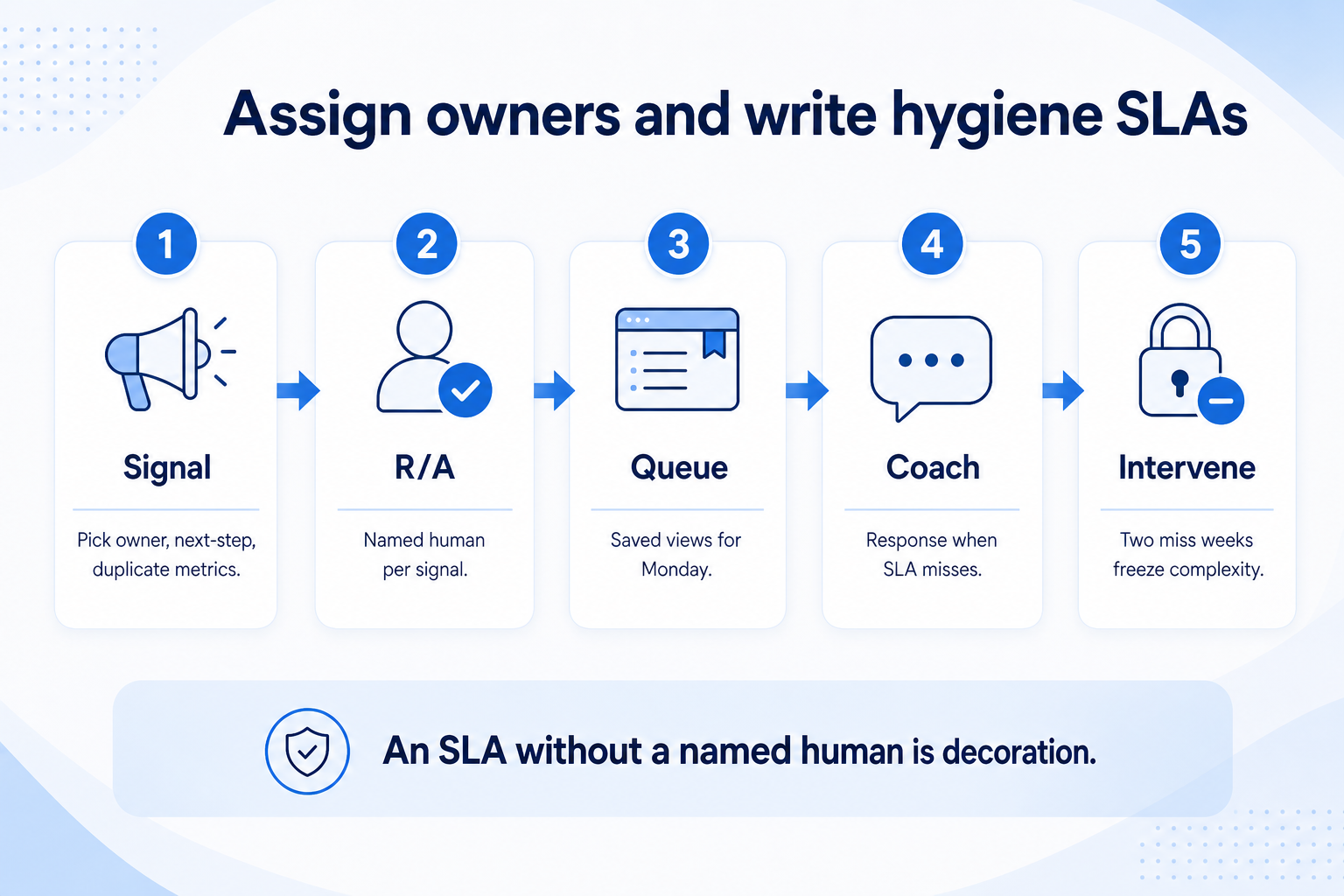
2. Assign owners and write hygiene SLAs
Every signal needs a responsible human, a queue, and a coaching response on miss.
Small team
One ops owner + pod lead share the Monday queue.
Multi-pod
Central duplicate queue; each pod lead owns next-step coaching.
Service + sales
Separate signals per object; same weekly slot.
Every signal needs a responsible owner, a clear queue, and a coaching response when the SLA misses. Typical signals: open records without owners, next-step fill on open work, duplicate age, stale opportunities past a team-defined idle window, and a small stage-honesty sample. Targets are internal — never paste invented industry percentages as facts.
Example: Meridian Specialty Finance sets “duplicate age ≤ 5 business days” and “open deals with dated next step” as team goals. Admin Jordan owns the duplicate queue; managers own empty next-step coaching. Two consecutive weekly misses trigger an intervene huddle, not a silent dashboard red tile.
3. Run the weekly hygiene ritual
Keep the ritual short and decision-oriented — not a silent merge marathon.
Light week
Queue clear; sample stage honesty and close early.
Spike week
Protect the slot; defer non-hygiene admin work.
Missed SLA
Run intervene: freeze new fields/automations until two green weeks.
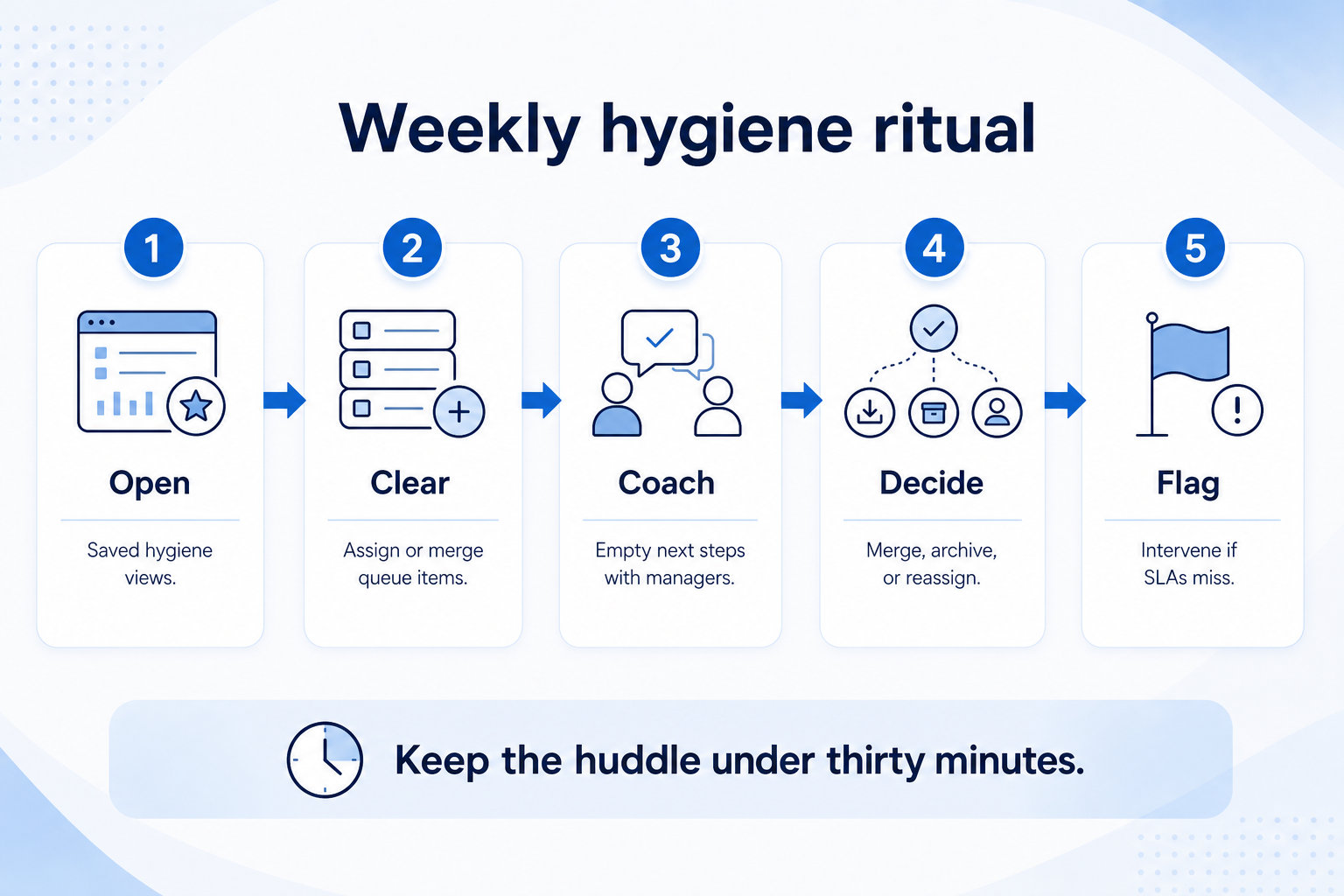
Keep the ritual short and decision-oriented: open the saved hygiene views, clear or assign queue items, coach empty next steps, and note intervene flags. Do not turn Monday into a silent merge marathon without coaching. Capture decisions (merge survivor, archive, reassign) so the same debate does not recur.
Example: Harborline’s fifteen-minute Monday huddle opens three saved lists. Maya assigns five empty next-step deals to coaching, Jordan merges two clear duplicates, and they flag one stage-honesty sample for Friday review. No Sheet rebuild follows.
4. Prevent decay upstream
Creation-path rules shrink the weekly queue — merge capacity alone never catches up.
Import spikes
Hold imports behind match rules; sample before full load.
Integration noise
Map which sync creates duplicates; fix the source key.
Field sprawl
Route new fields through governance — see Governance guide.
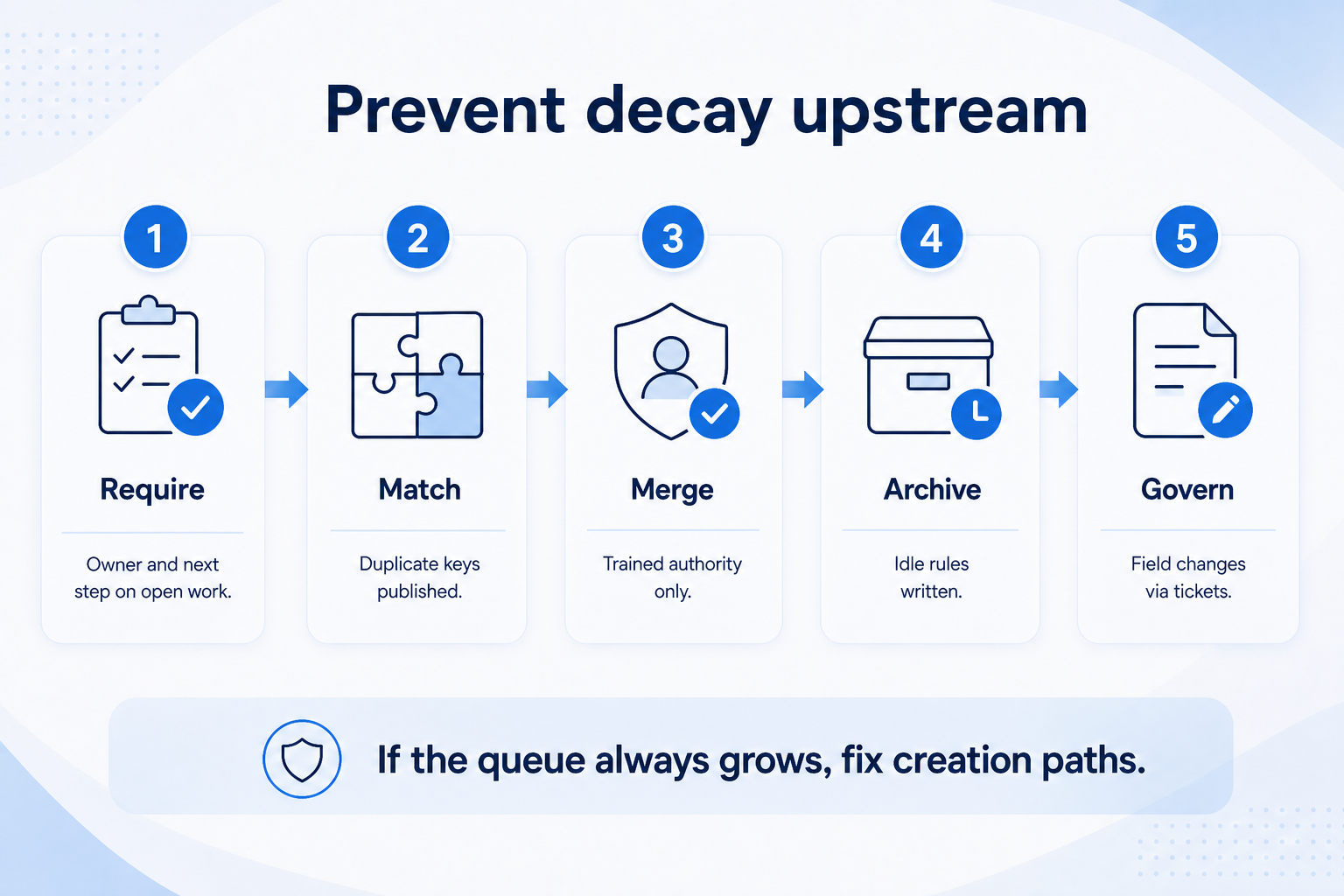
Hygiene fails when creation paths allow junk. Enforce required owner + next-step on open work, publish duplicate match keys and merge authority, and define archive/close rules for idle records. Pair with governance so field changes do not silently break reports.
Example: Crestview Wealth required next-step dates on open opportunities and banned self-serve custom fields. Duplicate match used email + company domain with Jordan as sole merge authority. Decay slowed before the next cleanup project was even scoped.
5. Know when to run a cleanup project
Bounded cleanse, then return to the weekly rhythm — projects do not replace ops.
Import incident
Bounded cleanse + tighten match keys + resume weekly SLAs.
Pre-automation gate
Clear owner/next-step debt before enabling workflows.
Pre-migration
Hygiene first; migration mapping second.
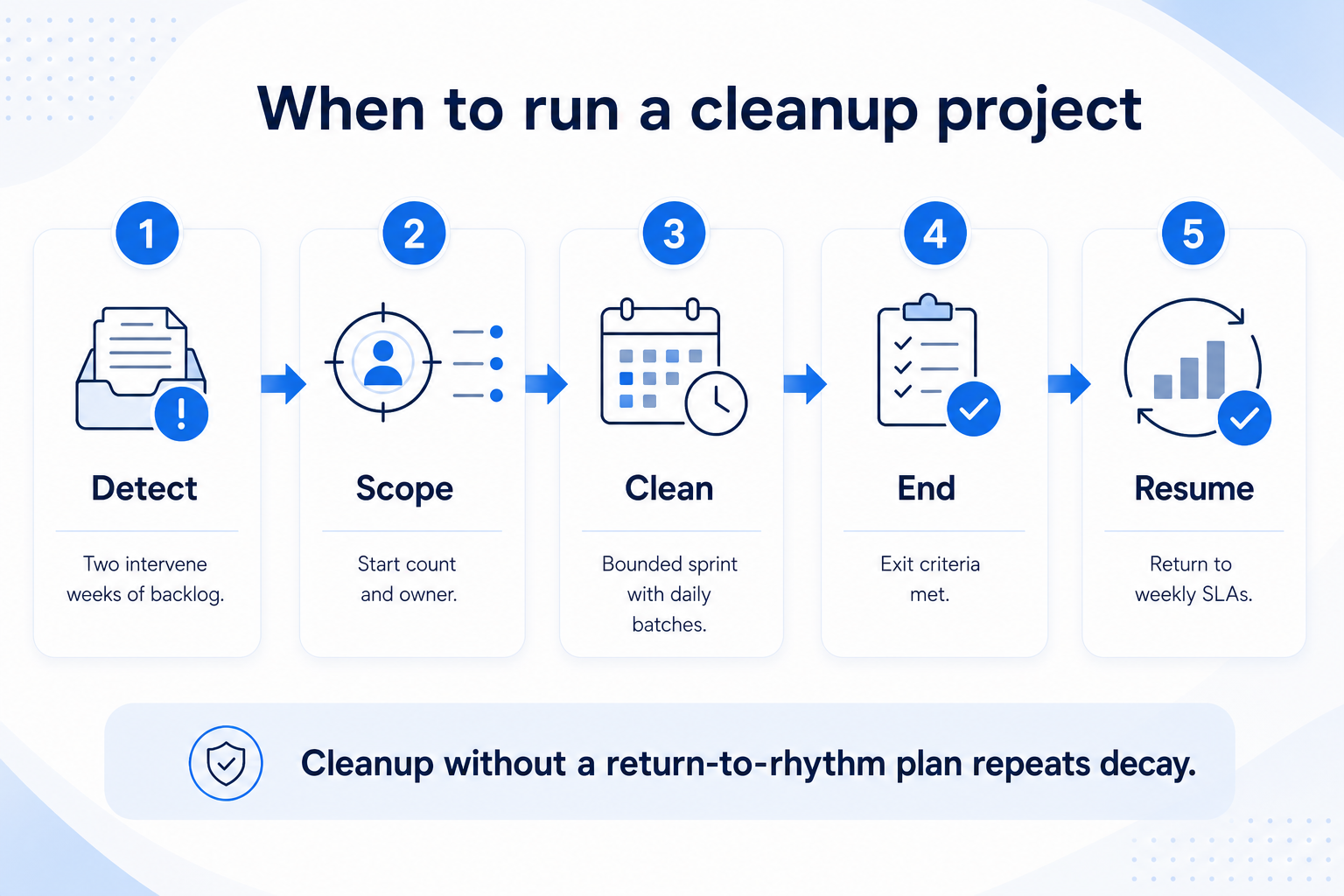
Sometimes backlog exceeds the weekly ritual. Run a bounded cleaning project when duplicate age or stale volume blocks reporting for more than two intervene weeks — with a start count, owner, and end criteria. Then return to the weekly rhythm. Do not replace ops with endless projects.
Example: Lakeside’s June intervene found 400 aged duplicates after a list import. Ana scoped a two-week cleaning sprint with daily batch counts, then resumed Monday SLAs. She linked the Data Cleaning guide for merge mechanics and kept this hygiene guide as the permanent calendar.
Hygiene ops vs cleaning projects
Must-have
✓Cadence
✓Primary goal
✓Owners
✓Success signal
Nice-to-have
Hygiene mistakes
Quarterly data days only
Trust collapses between events; install a weekly ritual.
SLAs without owners
Red tiles nobody owns train the team to ignore dashboards.
Invented benchmark percentages
Use team-defined targets and batch counts — not fake industry stats.
Automating on dirty data
Workflows amplify junk tasks and false stage moves.
Everyone can merge
Unclear merge authority creates worse duplicates and lost history.
Cleaning forever
Endless projects without upstream rules never become ops.
Example official CRM product videos
Optional · 2 examples · collapse if you don’t need them
Verified vendor product videos from the CRM catalogue for context while you read. They are examples only — not a ranked shortlist — and they do not replace SoftwareGlimpse recommendations on this page.
Official vendor video · example
Attio — Attio | How to build your sales pipelines
This video is hosted on YouTube
This content is hosted by YouTube. The player loads only after you allow marketing cookies.
How is data hygiene different from data quality or cleaning?
Data quality designs the rules and signals. Data cleaning is a bounded project to clear backlog. Data hygiene is the weekly operating rhythm — owners, SLAs, and decay prevention — that keeps quality between cleanses. Use all three in that order of permanence.
How often should we run hygiene?
Weekly for most SMB/mid-market teams that rely on Friday pipeline trust. Daily only for high-volume queues with a dedicated owner. Decision rule: if Friday still needs a rebuild sheet, your cadence is too weak.
What should our hygiene SLAs be?
Team-defined only — e.g. duplicate age, owner fill, next-step fill on open work. Do not cite invented industry percentages as facts. Intervene after two consecutive weekly misses.
Who should own hygiene?
Ops or admin typically owns duplicate/archive queues; managers own next-step and stage-honesty coaching. Write R/A explicitly. Vacuums kill SLAs.
When do we pause automation?
When open work routinely lacks owners/next steps, duplicates age past SLA, or Friday trust fails. Restore two green hygiene weeks before re-enabling noisy workflows.
Can we skip hygiene if we just cleaned?
No. Cleaning without a return-to-rhythm plan decays quickly. Book the weekly slot before the cleanup sprint ends.
What should I do next?
Pick 3–5 signals, name owners, book the weekly slot, and write decay-prevention rules. Cross-read Data Quality, Data Cleaning, and Governance; use the Implementation Planner to put the ritual on the calendar.