CRM ROI Guide: Justify Value Without Fake Percentages
Frame CRM return as observable operational gains tied to 90-day outcomes — time saved, fewer dropped leads, cleaner forecasts — without inventing ROI percentages.
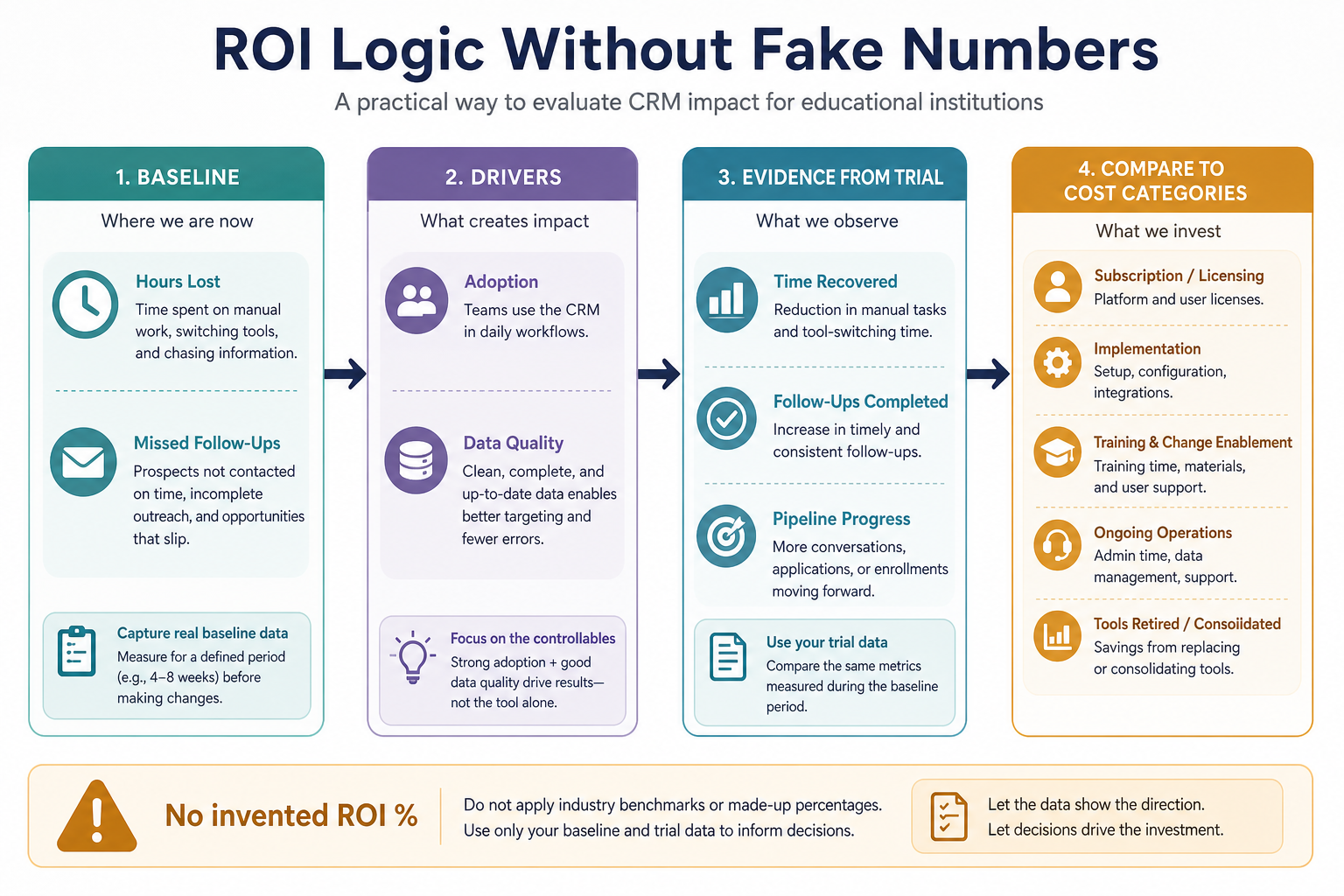
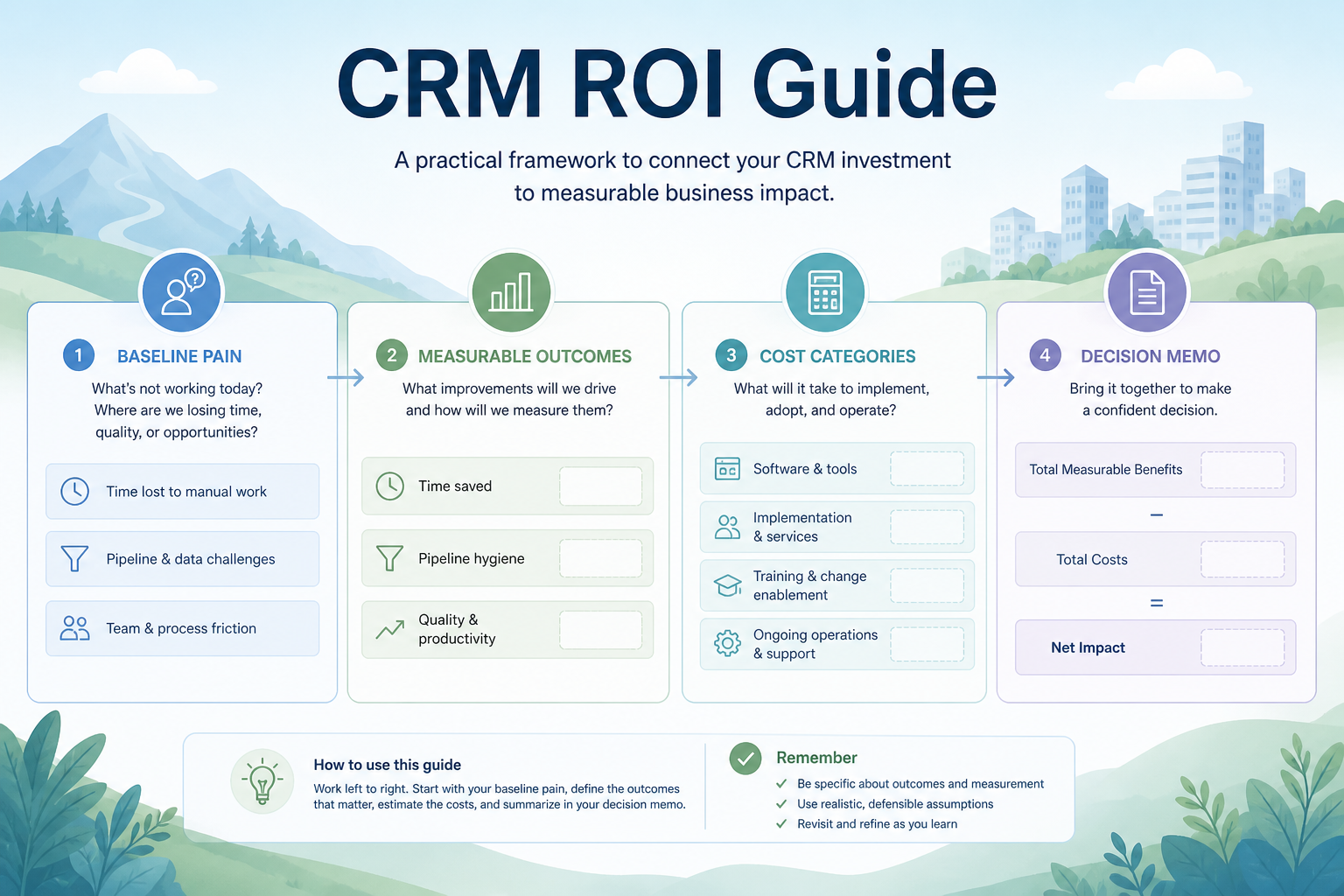
CRM ROI is the gap between today’s messy operating cost (dropped leads, rebuilds, missed handoffs) and a system that makes your 90-day outcomes observable — not a vendor slide with a made-up percentage. Decision rule: if you cannot name a baseline metric and an after-CRM check for each benefit claim, delete the claim; never invent ROI % or revenue uplift.
Baselines first
Outcome-tied benefits
Cost categories known
No fake %
Evidence from trial
Memo-ready
Goals
Features
Integrations
Cost
Ease of use
Growth
Key takeaways
Operational ROI is enough — Faster logging and cleaner boards are valid without fantasy revenue math.
Baselines make benefits real — “We rebuild pipeline in spreadsheets each Friday” is a cost you can describe.
Every benefit arrow must start from a baseline you can observe today.
1. Write baselines, then benefit hypotheses
ROI is a comparison of operating realities — not a badge percentage.
Time back
Minutes saved on logging and weekly rebuilds.
Leak reduction
Fewer unowned leads past SLA.
Handoff quality
Fewer delivery rework loops.
Describe today’s failure modes in plain language. Convert each 90-day outcome into a benefit hypothesis (“inbound leads get owners same day → fewer cold follow-ups lost”). Keep revenue claims out unless you already track conversion with trustworthy data.
Example: a 12-person B2B advisory team baselines: leads sit in a shared inbox; Friday pipeline is a rebuilt sheet; delivery asks for context in Slack. Benefit hypotheses: owner field SLA, board replaces rebuild, handoff note required before “won.”
2. Attach evidence and a post-go-live review
Weak ROI story
Only vendor % slides, no baselines.
Strong ROI story
Baselines + trial times + TCO categories.
After go-live
Re-check outcomes; adjust process, not mythology.
Pull task times from the trial scorecard and subscription bands from the Cost Calculator. Schedule a 30-day review against the same outcome checks. If a vendor ROI calculator shows a large percentage with no inputs you recognize, discard it.
Example: after trial, sellers complete log-activity faster on Tool B; the team cites that evidence in the memo instead of a “3× pipeline visibility” slogan.
ROI mistakes
Inventing uplift percentages
Unverifiable numbers destroy trust with finance.
Counting benefits twice
Same outcome described as time and revenue without linkage.
Ignoring adoption risk
ROI assumes sellers actually log — usability matters.
Stopping at purchase
Without a review date, claims never get tested.
3. Shortlist only inside the same job cluster
Compare tools whose core product matches the weekly output you named. Adjacent tools can integrate later — they should not hijack the primary shortlist because of brand familiarity.
Worked example: A team that needs meeting transcripts shortlists Otter-class tools, not a general chat assistant, even if the chat tool also “does meetings.”
4. Trial the named workflow before signatures
Run the same script on two or three finalists. Success is a non-admin completing the weekly output without a rescue — not a polished vendor tour.
5. Use a one-page checklist before demos
For CRM ROI Guide: Justify Value Without Fake Percentages, list must-haves, owners, integrations, and the weekly ritual this purchase must improve. Share the sheet with finance and IT before you schedule a second demo.
Name the primary job in one sentence.
List must-have gates (plans, SSO, data residency, usage caps).
Name integrations that must work on day one.
Assign an admin owner and a weekly user champion.
Define non-admin proof — what a sceptic completes without rescue.
Worked example: Harbor Ops refuses demos until the checklist is signed — cutting evaluation time in half.
6. Avoid the usual buying mistakes
Common failures in crm: buying for brand familiarity, comparing entry tiles across different usage units, skipping a fair trial script, and adding scope before adoption proves out.
Run one trial script on every finalist the same week. Score on the same card. Write a one-paragraph decision memo that names what you are not buying yet.
7. Hand off to the category shortlist
When assumptions are frozen, continue on /best/crm-software/ with the same headcount, usage band, and must-have gates on every quote.
8. Use a one-page checklist before demos
For CRM ROI Guide: Justify Value Without Fake Percentages, list must-haves, owners, integrations, and the weekly ritual this purchase must improve. Share the sheet with finance and IT before you schedule a second demo.
Name the primary job in one sentence.
List must-have gates (plans, SSO, data residency, usage caps).
Name integrations that must work on day one.
Assign an admin owner and a weekly user champion.
Define non-admin proof — what a sceptic completes without rescue.
Worked example: Harbor Ops refuses demos until the checklist is signed — cutting evaluation time in half.
9. Avoid the usual buying mistakes
Common failures in crm: buying for brand familiarity, comparing entry tiles across different usage units, skipping a fair trial script, and adding scope before adoption proves out.
Run one trial script on every finalist the same week. Score on the same card. Write a one-paragraph decision memo that names what you are not buying yet.
10. Hand off to the category shortlist
When assumptions are frozen, continue on /best/crm-software/ with the same headcount, usage band, and must-have gates on every quote.
Example official CRM product videos
Optional · 2 examples · collapse if you don’t need them
Verified vendor product videos from the CRM catalogue for context while you read. They are examples only — not a ranked shortlist — and they do not replace SoftwareGlimpse recommendations on this page.
Official vendor video · example
Attio — Attio | How to build your sales pipelines
This video is hosted on YouTube
This content is hosted by YouTube. The player loads only after you allow marketing cookies.
Compare named baselines and outcome checks to cost categories (subscription via Calculator, time/change qualitatively or via quotes). Decision rule: no claim without a baseline and a review method — never invent ROI %.
What if leadership wants a percentage?
Offer a sensitivity range only when inputs are real (seat estimate, measured hours). Otherwise show operational ROI and refuse fabricated precision.
Is softer “visibility” a valid benefit?
Yes if you define the Friday check that proves it (board used vs sheet rebuild).
Where does pricing fit?
Costs come from Pricing + Total Cost guides and the Calculator; benefits come from outcomes and trial evidence.
What should I do next?
Fold this logic into the Business Case memo and keep Finder/Calculator links for appendices.