Close Plans: Free vs Paid and Qualifying Tiers
Close cost guide: researched plan structure, free/trial flags, who each tier suits, cost scenarios, and value tradeoffs — no invented prices.
Quick answer
Close pricing is plan-gated across 4 researched tiers. No free plan confirmed in SoftwareGlimpse research. 14-day trial documented. Compare seat/capacity gates and unlocks — not list-price folklore.
- Free plan: not confirmed in SG data
- 14-day trial documented
- Entry paid tier researched: Solo
Close plan takeaways
- Starting tier ≠ buying tier — Plan-gated in research: pipeline management (Essentials, Growth, Scale); workflow automation (Growth, Scale); sales automation (Growth, Scale).
- What each Close plan is for — Solo, Essentials, Growth, and Scale — the vendor highlights Essentials, which is a marketing choice, not your requirement.
- Free vs paid is a capability decision — Our snapshot lists no free Close plan — verify on the pricing page rather than assuming one.
- Capacity limits bite before features do — Our snapshot does not publish Close seat or record caps — confirm them before you commit a team size.
- Trial before term — Our pricing snapshot records a 14-day trial on Solo, Essentials, and Growth — confirm current terms on the Close pricing page before you build a schedule around it.
- Numbers live on pricing tools — Use /pricing/close/ and the Cost Calculator for amounts. This guide deliberately carries no prices, so nothing here goes stale or gets quoted wrongly.
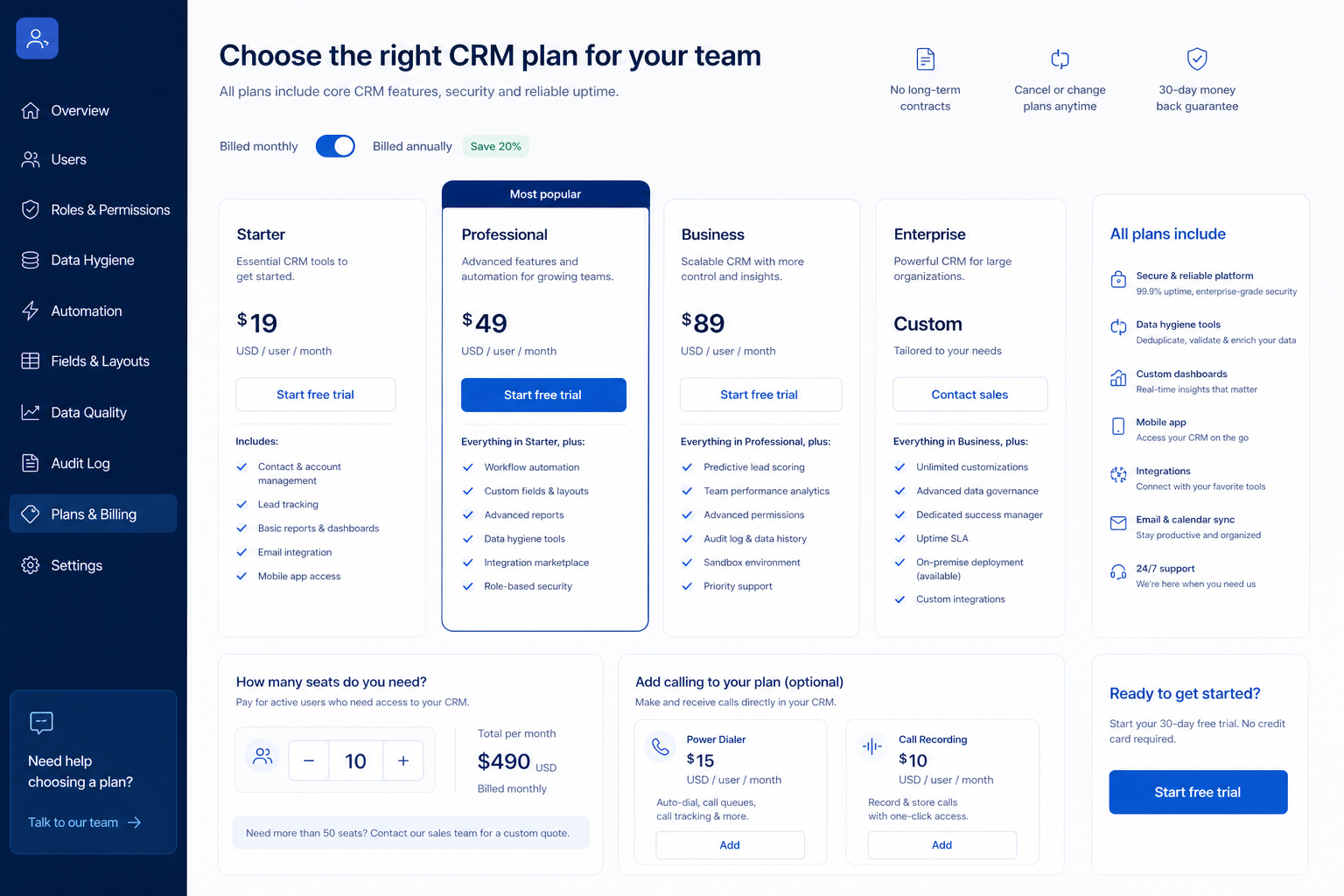
Close plan anatomy
Close checklist
Bring these questions to every demo
Ask vendors to show the workflow live, not just describe it.
- 1List day-one must-havesOutcome language, not feature tours.
- 2Map each must to a researched planLowest tier that clears every gate.
- 3Confirm seats and capacity notesLimits are part of the plan decision.
- 4Estimate with Cost CalculatorThen confirm on the pricing page.
Frequently asked questions
What Close plans exist?
Our researched snapshot lists Solo, Essentials, Growth, Scale. Essentials is highlighted by the vendor — treat that as marketing, not as your requirement. Re-check /pricing/close/ for current packaging.
Is there a free Close plan?
No free plan appears in our Close snapshot, so the researched 14-day trial is how you evaluate before paying. Confirm current packaging on /pricing/close/.
Which Close plan should a small team choose?
Run the algorithm: lowest plan per must-have, take the highest, check capacity, then count seats. Plan-gated in research: pipeline management (Essentials, Growth, Scale); workflow automation (Growth, Scale); sales automation (Growth, Scale).
What is plan-gated in Close?
Plan-gated in research: pipeline management (Essentials, Growth, Scale); workflow automation (Growth, Scale); sales automation (Growth, Scale).
How do I estimate cost safely?
Must-haves → qualifying plan name → Cost Calculator seats → TCO categories for admin, migration, and training. Do not invent implementation fees or ROI percentages.
Does Close offer a free trial?
Our pricing snapshot records a 14-day trial on Solo, Essentials, and Growth — confirm current terms on the Close pricing page before you build a schedule around it.
Is annual billing worth it?
Annual versus monthly is a term and cash-flow choice, not a capability one. While you are still proving adoption, the ability to fail cheaply for one quarter is often worth more than the annual discount.
What should I do next?
Open /pricing/close/, run the Cost Calculator on your qualifying plan, and read the Close worth-it guide before signature.
Close plan matrix and who each tier suits
Structure and trial/free flags come from SoftwareGlimpse pricing research. Dollar amounts appear only when verified — never invent list prices.
- Seats61%
- Add-ons18%
- Implementation12%
- Training5%
- Other4%
Solo
14-day trial · Unlocks: contact management, lead management, deal management · Suits: teams whose must-have gates appear on this tier
Essentials
14-day trial · Unlocks: pipeline management · Suits: teams whose must-have gates appear on this tier
Growth
14-day trial · Unlocks: workflow automation, sales automation · Suits: teams whose must-have gates appear on this tier
Scale
14-day trial · Suits: teams whose must-have gates appear on this tier
1. Close cost scenarios to pressure-test
Lean team / free-or-trial first
Scope a time-boxed pilot; 14-day trial documented.
Growing team with gated workflows
Map must-have workflows (contact management, lead management, pipeline management) to plan unlocks before expanding seats.
Hidden / extra cost watch
Budget risk: Growth (list price annual) and Scale (list price annual) per-user pricing is high versus pipeline-only CRMs; calling usage and premium phone lines add cost.. Also check add-ons, overages, and admin time outside the sticker plan.
Price Close against how you actually buy seats and unlocks — not against a competitor's homepage headline.
Close value rule
- 1Pay up when Inside sales and outbound teams that live on phone/email/SMS requires a paid unlock you will use weekly
- 2Do not overbuy if this limitation dominates: Growth (list price annual) and Scale (list price annual) per-user pricing is high versus pipeline-only CRMs; calling usage and premium phone lines add cost.
- 3Side-by-side cost with Pipedrive on the same seat count
Close cost mistakes to avoid
Cost trap 1
Growth (list price annual) and Scale (list price annual) per-user pricing is high versus pipeline-only CRMs; calling usage and premium phone lines add cost.
Cost trap 2
Advanced Chloe automation/workflows and predictive dialing depth are concentrated on Growth and Scale.
Cost trap 3
Calling is usage-based; AI credits are pooled monthly with plan caps and no rollover.
Cost trap 4
Growth/Scale seat pricing is expensive versus pipeline-first CRMs
Cost trap 5
Calling usage and premium phone add-ons increase total cost of ownership
Cheaper or clearer alternatives to pressure-test
Compare total cost of ownership vs Close on identical constraints.
- View CRM profile
 Pipedrive
Pipeline-first sales CRM for visual deal management, activity-based selling, and growing sales teams.
- View CRM profile
 Freshsales
Freshworks sales CRM for lead management and pipeline workflows.
- View CRM profile
 Salesflare
Relationship-focused CRM for small sales teams and founders.
Catalogue peers only — not commission-ranked.
Close pricing checklist
0/3 dimensions noted — saved in this browser only.
Plan gates you must unlock
Trial / free proof
TCO extras
Was this article helpful?
Have more questions? Contact our support team.
Part of CRM hub · Close review
Related guides
Supporting reading in this topic — not a generic related-posts dump.
- How to Choose the Right CRM for Your BusinessA practical decision framework for picking CRM software: needs, features, size fit, integrations, true cost, adoption, and growth — without vendor hype.
- CRM Pricing Guide: How Plans, Seats, and Add-Ons Really WorkLearn CRM pricing models — per-seat tiers, feature gates, add-ons, and annual vs monthly — with bands and qualifiers, then estimate with the Cost Calculator.
- CRM ROI Guide: Justify Value Without Fake PercentagesFrame CRM return as observable operational gains tied to 90-day outcomes — time saved, fewer dropped leads, cleaner forecasts — without inventing ROI percentages.
- CRM Total Cost Guide: See Beyond Per-Seat SubscriptionMap CRM total cost categories — subscription, admin time, migration, training, add-ons, and switching risk — without inventing dollar totals.
- Is Close Worth It? Fit Scenarios Before You BuyDecide if Close is worth it for your team — fit scenarios, tradeoffs, and when to keep looking — without invented ROI percentages.
Related products
Related comparisons
Related resources
SoftwareGlimpse Updates
Want clearer software shortlists? Get buying guides and comparisons by email.
Newsletter coming soon.