
This video is hosted on YouTube
This content is hosted by YouTube. The player loads only after you allow marketing cookies.
Business numbers, softphones, and calling over the internet — without on-premise PBX hardware.
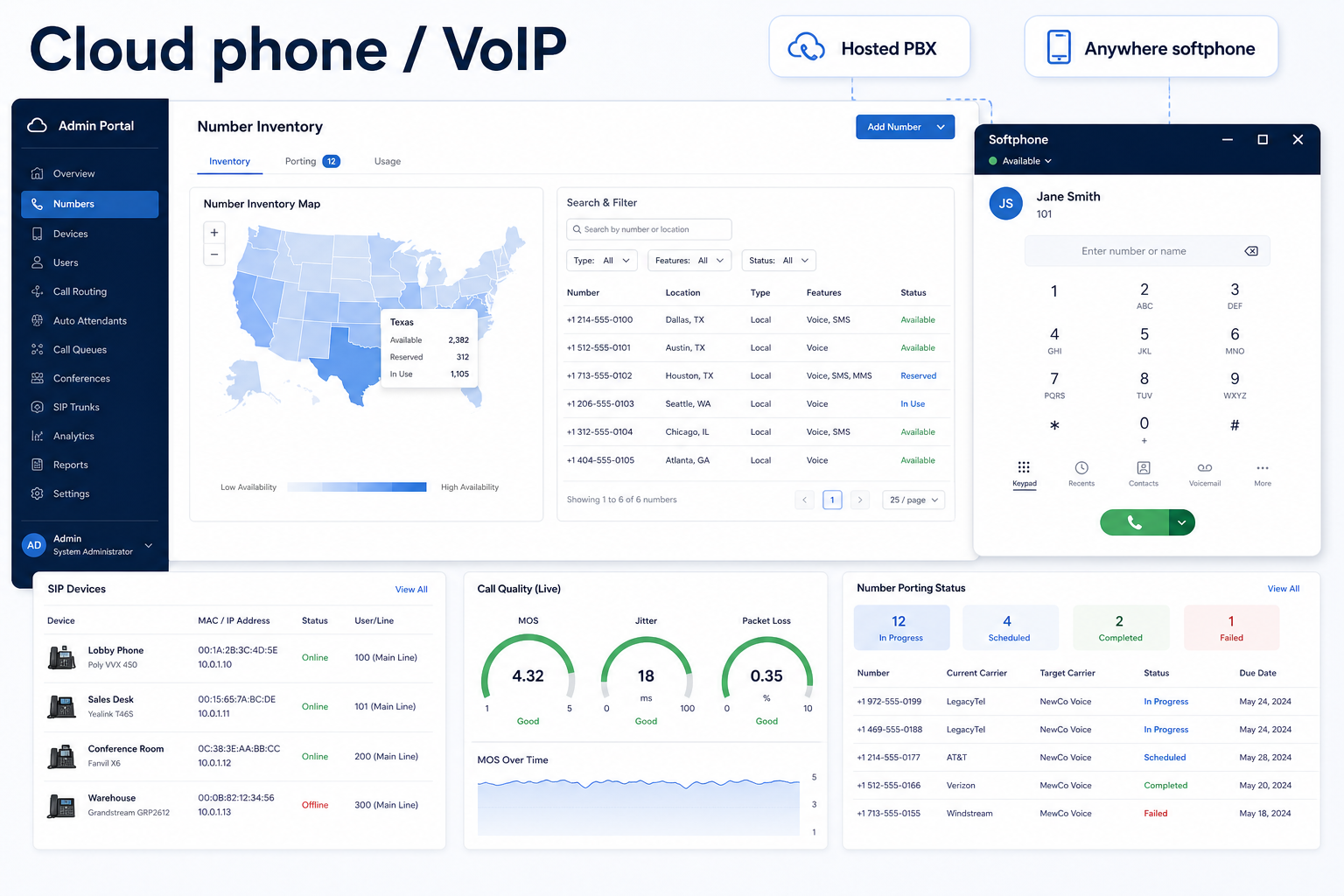
At a glance
Reliable company calling identity with shared coverage
Ops, support, sales, and SMB operators running business voice or messaging
Number provisioning & porting · Softphone / mobile apps · Shared answering · Call logging
9 products to explore
Fit snapshot
Cloud phone is the capability for provisioning company numbers, placing and receiving calls via softphone or mobile apps, and keeping basic call handling in one hosted system. It is the foundation most voice-led business communications stacks build on.
Founders, office managers, and teams replacing personal mobiles or aging desk PBXs with company numbers and apps.
How teams put CRM to work for cloud phone
Example 1
a five-person firm ports its main number to a cloud phone. Softphones on laptops and mobiles share one branded identity, and missed calls appear in a shared log.
Example 2
a two-site clinic publishes one set of numbers answered by either front desk with hours rules — no second PBX to maintain.
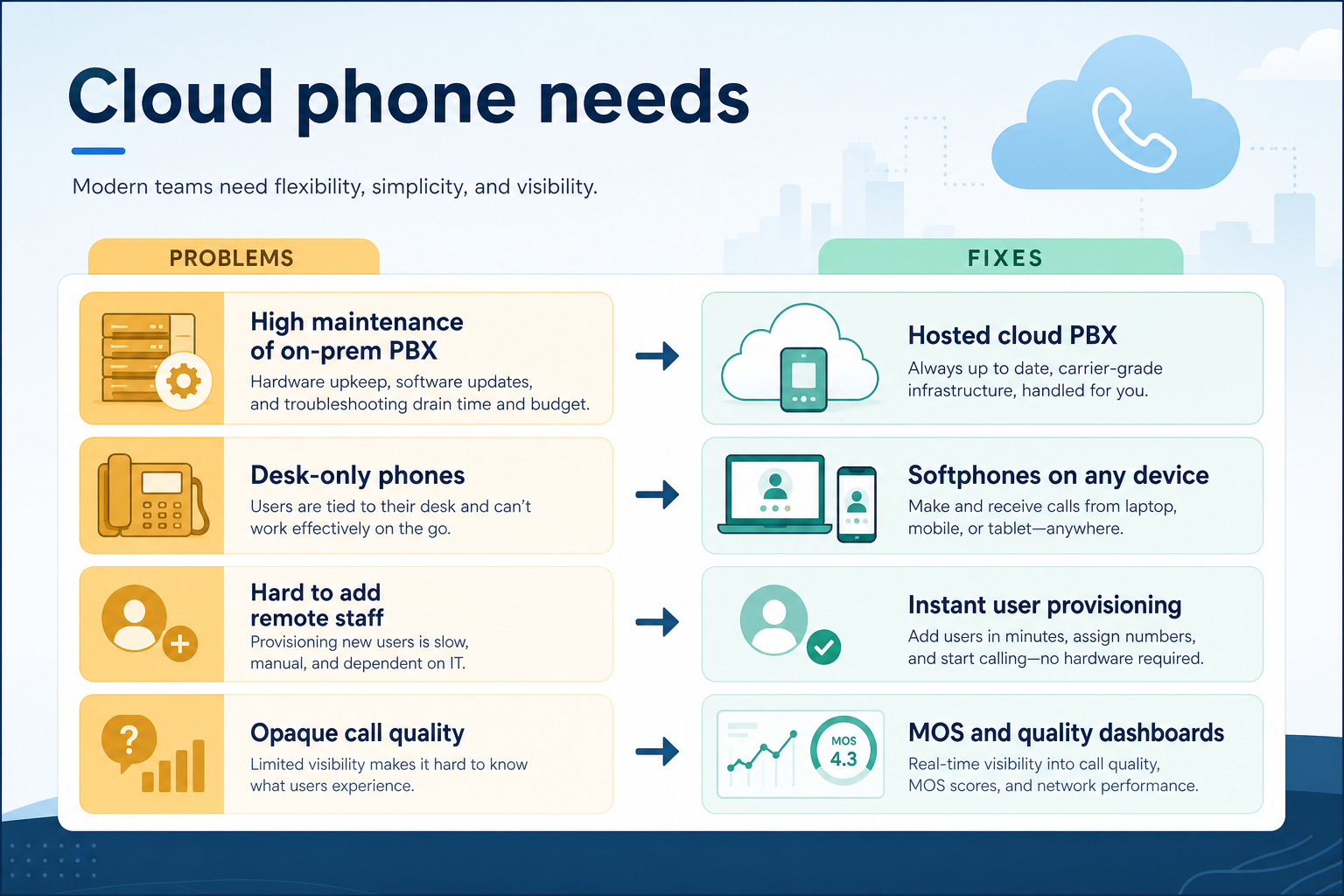
These are the operating problems that usually push teams toward CRM for cloud phone — not feature wish lists.
Without CRM discipline: History and coverage leave with people.
Without CRM discipline: Hybrid work cannot share the same number cleanly.
Without CRM discipline: Follow-ups depend on memory.
Without CRM discipline: Printed materials and habit block the move.
A CRM only helps when the team keeps owners, history, and next steps current. Here is what “good” looks like for cloud phone.
With CRM discipline: Company numbers and apps keep identity with the business.
With CRM discipline: Softphones put the business line on the devices people use.
With CRM discipline: Call logs make missed and completed calls reviewable.
With CRM discipline: A porting plan and dual-run period reduce cutover risk.
Durable business numbers
Customers reach the company, not a pocket.
Calling from anywhere
Softphones support desk, laptop, and mobile.
Shared answering
Ring groups keep the line staffed.
Usable call history
Logs support follow-up and ops review.
Evaluate number coverage and porting, softphone reliability, shared answering basics, and logging — not unused contact-center modules if volume is still light.
Number provisioning & porting as a buying lens for this capability.
Softphone / mobile apps as a buying lens for this capability.
Shared answering as a buying lens for this capability.
Start with must-haves your team will use weekly. Treat nice-to-haves as later upgrades — not day-one blockers.
Must-have
Nice-to-have
A simple operating loop beats a complex board nobody updates.
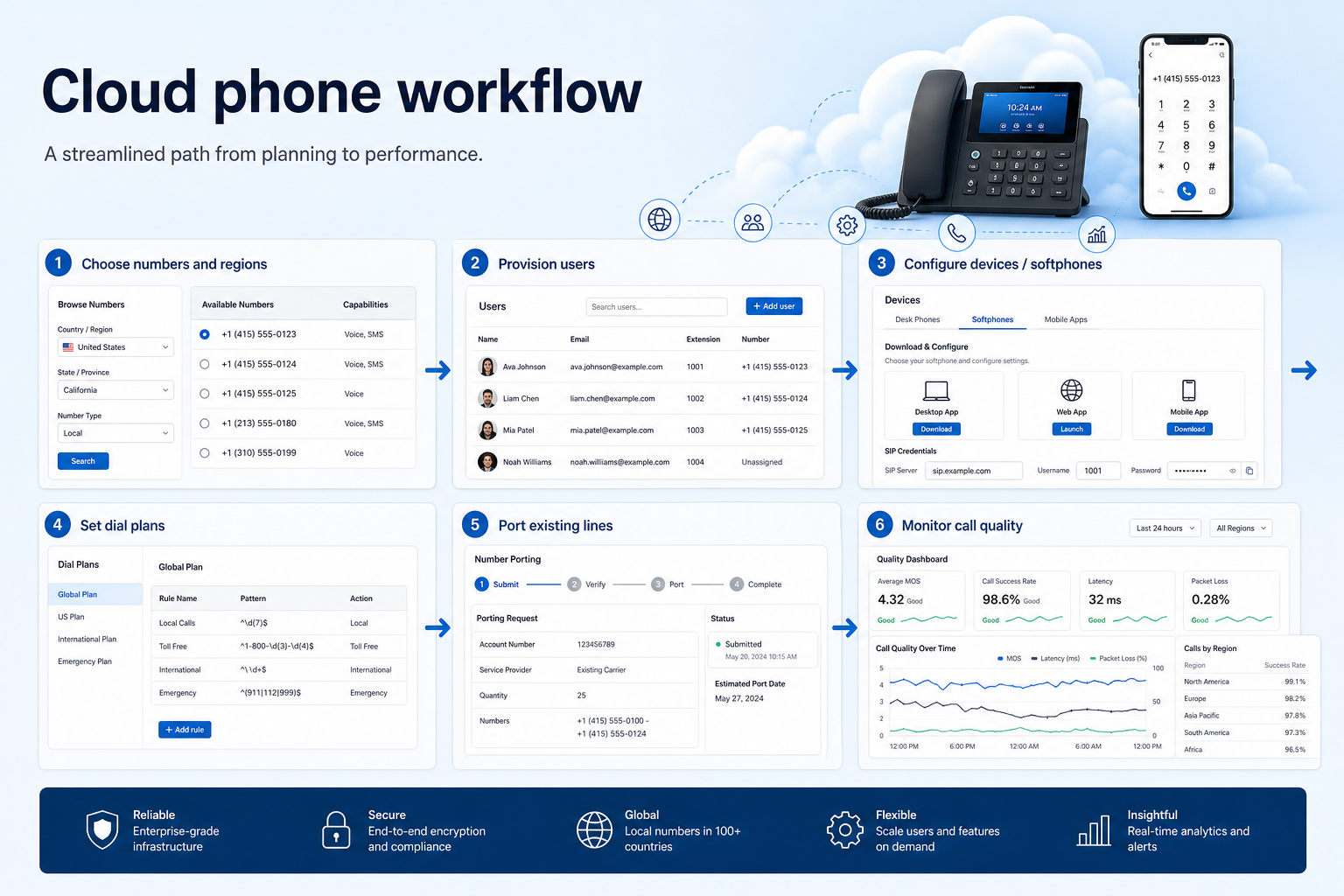
Main, local, department; note ports.
Softphones, greetings, devices.
Ring groups and hours.
Confirm history visibility.
Missed calls and coverage gaps.
Broader capability workflow demos for cloud phone — distinct from narrow feature walkthroughs.
Official vendor demonstrations help show how different CRM platforms approach the workflows, features and interactions that make up cloud phone. Absence of a video does not mean a product lacks the capability.

Aircall
Aircall Workspace
Focus: How Aircall presents the product in an official vendor video.
This video is hosted on YouTube
This content is hosted by YouTube. The player loads only after you allow marketing cookies.
What this shows
What this does not establish
Features visible in this demo
Source: Aircall · Verified 17 Aug 2026
Evidence-backed workflow comparison using official vendor demos and screenshots — not a ranking or entertainment gallery. Absence of media does not mean a product lacks the capability.
Aircall
Aircall emphasizes
Best when
You need this capability without enterprise complexity.
Best when
Volume or multi-agent coverage makes this capability blocking.
Catalogue products tagged to related use cases for cloud phone. Inclusion here is not a ranking.

Voip Business Phone
AI-powered sales dialer and business phone platform for CRM-connected outbound calling, SMS, and coaching.
Voip Business Phone
Mid-market cloud phone and customer-conversation platform with deep CRM/helpdesk CTI, IVR, power dialer on Professional, and paid AI add-ons — 3-licence minimum.

Voip Business Phone
SMB cloud phone system with a $0 starter rung, Starter from $18/user/month annual (2-user minimum), call recording and IVR from Professional, plus a separate call-centre plan ladder.
Voip Business Phone
Budget global cloud telephony with virtual numbers across 100+ countries and a unified callbox — Essential from $12/user/month annual (up to 5 users); calls and SMS are pay-as-you-go.

Voip Business Phone
Freshworks cloud PBX for inbound voice support: a $0 agent plan plus pay-per-minute, Growth from $15/agent/month annual with 2,000 included incoming minutes, and routing automation higher up.
Business Communications
Enterprise-grade UCaaS / cloud phone platform (RingEX) with deep call routing, video, team messaging and contact-centre options — Core from ~$20/user/month annual.

Business Communications
AI-first cloud phone (Dialpad Connect) with included transcription/summaries — Standard from $15/user/month annual; Sell and Support are separate product ladders.

Business Communications
Meetings-first Workplace suite plus Zoom Phone UCaaS — Phone US/CA Unlimited research floor ~$15–16/user/month; free meetings/chat exist but Phone is paid.

Business Communications
SMB-friendly unified business communications — Core $15, Engage $25, Scale $75 per user/month annual, with messaging apps including WhatsApp and a Contact Center ladder from $75/agent.
Loading evidence explorer…
No. Fit depends on your primary communications job (phone, dialing, messaging, WhatsApp, or contact center), seat count, and which requirements are must-haves. Use the Best Business Communications shortlist and requirements guide rather than starting from a single ranking.
CRM capabilities store relationships and pipeline on records. Business communications capabilities place and route calls or messages — often writing activity back into CRM via CTI. Many teams need both connected; buy for the communications job that is blocking first.
Menus, queues, and business-hours rules that decide who answers each call.
Recording, storage, and playback controls for coaching and compliance.
Click-to-dial, screen pops, and automatic call logging in the system your team already uses.
Call and message volume, wait times, and agent activity in reports managers act on.
Scheduled and ad-hoc video meetings with screen share, recording, and calendar join — often paired with cloud phone in UCaaS stacks.
Part of CRM capabilities · CRM Software hub
Want clearer software shortlists? Get buying guides and comparisons by email.
Newsletter coming soon.
Explore the official documentation, screenshots and product demonstrations used to understand how each CRM implements cloud phone.
1 item
Official video · Aircall
Supports
Demonstrates
This video is hosted on YouTube
This content is hosted by YouTube. The player loads only after you allow marketing cookies.
Official vendor video
How Aircall presents the product in an official vendor video.
Verified: 17 Aug 2026
Open source ↗