Sales Intelligence Glossary: Credits, Match Rate, Intent & More
A plain-language sales intelligence glossary covering credits, match rate, waterfall enrichment, intent data, deliverability, CRM sync, and compliance terms buyers actually need.
Quick answer
Sales intelligence terminology describes how you find and refresh contact data (coverage, match rate, waterfall enrichment), how you pay for it (credits, unlocks, exports), how you act on it (sequences, dialer, dispositions), and how you stay deliverable and compliant (verification, warm-up, lawful basis). Decision rule: if you can map a real outbound sentence onto those terms, vendor pitches stop sounding more different than they are.
- Credits & unlocks
- Match rate
- Waterfall enrichment
- Intent data
- Deliverability
- CRM sync / overwrite
Key takeaways
- Credits are the real unit of cost — Ask what one credit buys (email, mobile, export) and whether unused credits roll over.
- Match rate is local — A vendor’s global fill percentage means little until you test your own account list.
- Waterfall ≠ magic — Chaining providers can raise fill rates — and also raise cost, latency, and compliance complexity.
- Vendors rename the same ideas — Credits, points, unlocks, and “lookups” may map to the same consumption model — ask for the unit economics.
Glossary map
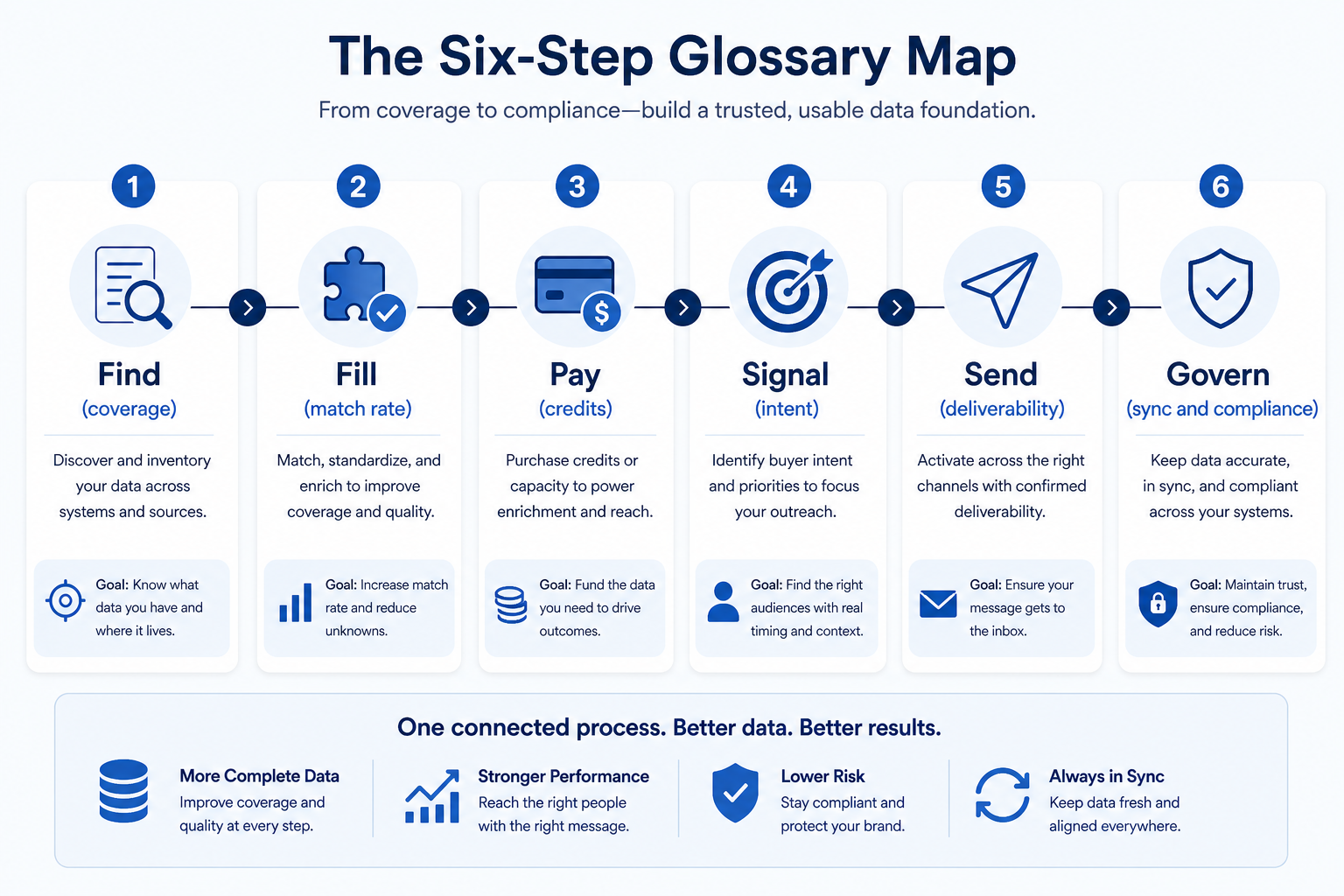
How the core terms connect
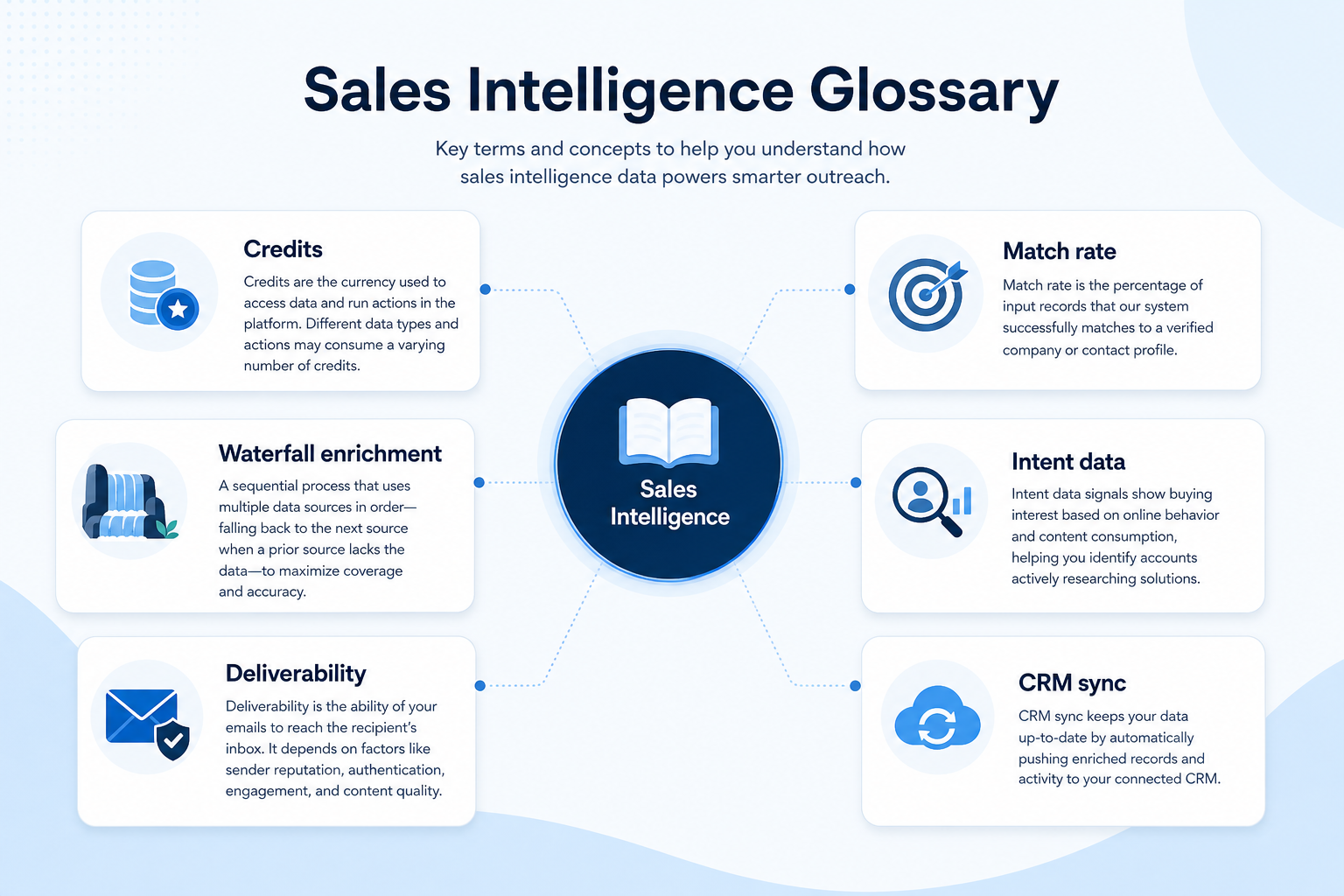
1. Data, enrichment, and coverage terms
Coverage
How well a database represents your ICP (titles, regions, company sizes) — not total global records.
Match rate
Share of your input accounts or contacts that return a usable email, phone, or firmographic field.
Waterfall enrichment
Querying multiple data providers in sequence until a field is filled — higher fill, higher complexity.
Verification
Checking whether an email or phone is likely valid before you send or dial.
These terms describe how you find people and complete records.
Example: “We searched 200 of our mid-market IT accounts and got a 62% email match rate, then ran waterfall enrichment on the misses” maps to Coverage sample → Match rate → Waterfall enrichment — not three unrelated buzzwords.
2. Credits, intent, and outreach vocabulary
Credit / unlock
The unit you spend to reveal or export a contact field. Confirm email vs mobile pricing separately.
Intent data
Signals that an account may be researching a topic — useful for prioritization, not a substitute for a real ICP.
Sequence / cadence
A multistep outreach plan (email, LinkedIn, call) with exit rules when someone replies.
Disposition
The logged outcome of a call attempt (connected, voicemail, wrong number) — critical for dialer coaching.
Buying and acting language is where product pitches get noisy. Keep definitions boring and precise.
Example: “We burned 3,000 credits unlocking mobiles, then used intent spikes to prioritize the sequence” maps to Credits = consumption unit, Unlock = reveal contact field, Intent data = buying-signal layer — not a single mysterious AI score.
3. Deliverability, sync, and compliance terms
Deliverability
Whether your emails reach inboxes — domain reputation, authentication, warm-up, and list quality all contribute.
CRM sync / overwrite rules
How fields flow into the CRM and which source wins when values conflict — decide before bulk enrich.
Lawful basis / opt-out
Your legal ground for processing and contacting people, plus how unsubscribes and suppressions are honored.
Suppression list
Contacts who must not be emailed or dialed — customers, competitors, do-not-contact, and opt-outs.
These terms describe how outreach stays healthy and how data lands in the CRM without destroying trust.
Example: after a bounce spike, the team paused sequences, checked warm-up and SPF/DKIM, tightened verification, and set CRM overwrite rules so enrichment could not wipe owner notes — deliverability and governance, not “buy more credits.”
Often-confused term pairs
- Coverage vs database size
- Credit vs seat price
- Match rate vs “accuracy” slide
- Enrichment vs CRM system of record
- Intent vs ICP
Glossary mistakes in buying conversations
Assuming identical labels mean identical credit models
Ask what object a credit unlocks — email, mobile, or full export — and whether verification costs extra.
Treating “AI” as a noun with no object
Ask which fields or recommendations change, and who verifies them before outreach.
Ignoring overwrite vocabulary
Sync without field-level rules can wipe owner notes and custom CRM data.
4. Name the job this category should own
Describe the weekly output this category must improve before comparing vendors.
5. Next: freeze requirements and compare fairly
Move to /guides/types-of-sales-intelligence/ once the job cluster is clear. Compare finalists with the same assumptions — not affiliate-ordered lists.
6. Use a one-page checklist before demos
For Sales Intelligence Glossary: Credits, Match Rate, Intent & More, list must-haves, owners, integrations, and the weekly ritual this purchase must improve. Share the sheet with finance and IT before you schedule a second demo.
- Name the primary job in one sentence.
- List must-have gates (plans, SSO, data residency, usage caps).
- Name integrations that must work on day one.
- Assign an admin owner and a weekly user champion.
- Define non-admin proof — what a sceptic completes without rescue.
Worked example: Harbor Ops refuses demos until the checklist is signed — cutting evaluation time in half.
7. Avoid the usual buying mistakes
Common failures in sales-intelligence: buying for brand familiarity, comparing entry tiles across different usage units, skipping a fair trial script, and adding scope before adoption proves out.
Run one trial script on every finalist the same week. Score on the same card. Write a one-paragraph decision memo that names what you are not buying yet.
8. Hand off to the category shortlist
When assumptions are frozen, continue on /best/sales-intelligence-software/ with the same headcount, usage band, and must-have gates on every quote.
Frequently asked questions
What do the main sales intelligence terms mean?
Coverage and match rate describe how well data fits your accounts; credits and unlocks describe how you pay to reveal fields; waterfall enrichment chains providers to fill gaps; intent prioritizes accounts; deliverability and CRM sync keep outreach and records healthy. Map real outbound talk onto those terms and demos get clearer.
What is a credit in sales intelligence software?
A credit is usually the unit spent to unlock or export a contact field (often email or mobile). Confirm what one credit buys, whether mobiles cost more, and whether unused credits roll over.
What is waterfall enrichment?
Waterfall enrichment queries multiple data sources in order until a field is filled. It can raise match rates but also cost, latency, and compliance complexity — test fill rate and cost on your sample.
What is intent data?
Intent data are signals that an account may be researching a topic. Use it to prioritize outreach within your ICP — not as a substitute for knowing who you sell to.
What should I read next?
Types of Sales Intelligence shows how these terms map to product shapes; How to Choose Sales Intelligence applies them in evaluation.
Was this article helpful?
Have more questions? Contact our support team.
Part of Software buying guides · Types of Sales Intelligence: Data, Enrichment, Engagement & Dialers
Related guides
Supporting reading in this topic — not a generic related-posts dump.
- Sales Intelligence Benefits: What Teams Actually GainSee the practical benefits of sales intelligence for SDRs, RevOps, AEs, and managers — faster lists, higher match rates, cleaner CRM data, and fewer wasted touches — without invented ROI percentages.
- Sales Intelligence Examples: SDR, RevOps, Phone & Founder ScenariosConcrete sales intelligence examples for SDR pods, RevOps enrichment, phone teams, and founder-led outbound — illustrative scenarios that clarify fit without invented case-study metrics.
- Sales Intelligence vs Spreadsheet & Bought Lists: When to SwitchLearn when a spreadsheet or bought CSV is enough for contacts — and when live sales intelligence becomes the better source for current emails, phones, verification, and CRM sync.
- Lusha Plans: Seats, Credits, and Qualifying TiersChoose your Lusha plan by mapping must-haves to seats, credits, and qualifying tiers — not homepage “from” tiles — then confirm on the pricing page.
- Is Lusha Worth It? Fit Scenarios Before You BuyDecide if Lusha is worth it for your outbound pod — fit scenarios, credit economics, and when to keep looking — without invented ROI percentages.
- Amplemarket Plans: Seats, Credits, and Qualifying TiersChoose your Amplemarket plan by mapping must-haves to seats, credits, and qualifying tiers — not homepage “from” tiles — then confirm on the pricing page.
- Closely Plans: Seats, Credits, and Qualifying TiersChoose your Closely plan by mapping must-haves to seats, credits, and qualifying tiers — not homepage “from” tiles — then confirm on the pricing page.
SoftwareGlimpse Updates
Want clearer software shortlists? Get buying guides and comparisons by email.
Newsletter coming soon.