SoftwareGlimpse
Sales Intelligence Software

Is Lusha Worth It? Fit Scenarios Before You Buy

There is one honest metric for a contact-data purchase, and it is not accuracy rate: it is cost per connected conversation. Take the credits a conversation consumes end to end — the reveals that went nowhere included — and compare that against what a conversation is worth to you. Lusha is worth it when that ratio is comfortable and getting better as reps learn restraint. It is not worth it when contact data was never the bottleneck, and it is not a substitute for a pipeline: Not a full CRM pipeline/deal system — buyers still need a CRM of record for pipeline hygiene.

By Lee MeyeridricksUpdated Aug 17, 20266 min readFact-checked

Quick answer

Lusha is worth it when a bounded pilot shows a cost per connected conversation you would happily pay again — it is not worth it if your reps already have lists they never finish working.

  • Ideal when reps stall because they cannot reach the right person
  • Weak fit when capacity or messaging, not data, is the constraint
  • Not a full CRM pipeline/deal system — buyers still need a CRM of record for pipeline hygiene.
Goals
Features
Integrations
Cost
Ease of use
Growth

See Lusha before you decide

Core product overview media for a fit check — still not a substitute for the decision criteria on this page.

See Lusha in action

Official product overview for a fit check — not scoring, pricing, or comparative superiority.

This video is hosted on YouTube

This content is hosted by YouTube. The player loads only after you allow marketing cookies.

Official vendor video

Lusha - Search less. Sell more.

How Lusha presents prospect search and contact discovery in one workspace.

What this shows

  • Lusha product overview and primary prospecting surfaces as marketed
  • Contact discovery entry points shown in the official video
Product screenshots

Verified captures from Lusha's product interface.

Lusha product UI from official documentation

Official Lusha documentation screenshot.

Full product screenshots and evidence live on the Lusha research page.

Is Lusha worth it?

  • What it is — B2B data intelligence platform for verified contact/company data, enrichment, signals, and Engage outreach sequences.
  • Best for — SDR/BDR teams needing verified emails/dials and enrichment; RevOps cleaning CRM records and automating enrichment; Teams already standardized on Salesforce/HubSpot/Pipedrive
  • Not ideal for — Buyers seeking an all-in-one pipeline CRM; Teams that need transparent verified public price cards before shortlisting; Orgs wanting dialer-first telephony CRM suites
  • Commercial clarity — Researched plans: Free, Starter, Pro, Premium, Scale. Never invent list prices here — confirm seats, credits, and quote terms on /pricing/lusha/.
  • Editorial verdict snapshot — Lusha is a strong B2B contact-data and enrichment layer with Engage sequences and CRM sync — not a pipeline CRM. Score it as sales intelligence plugged into your CRM of record. This review is based on first-party Lusha documentation — not hands-on product testing. Public dollar pricing was not verified from lusha.com/p…

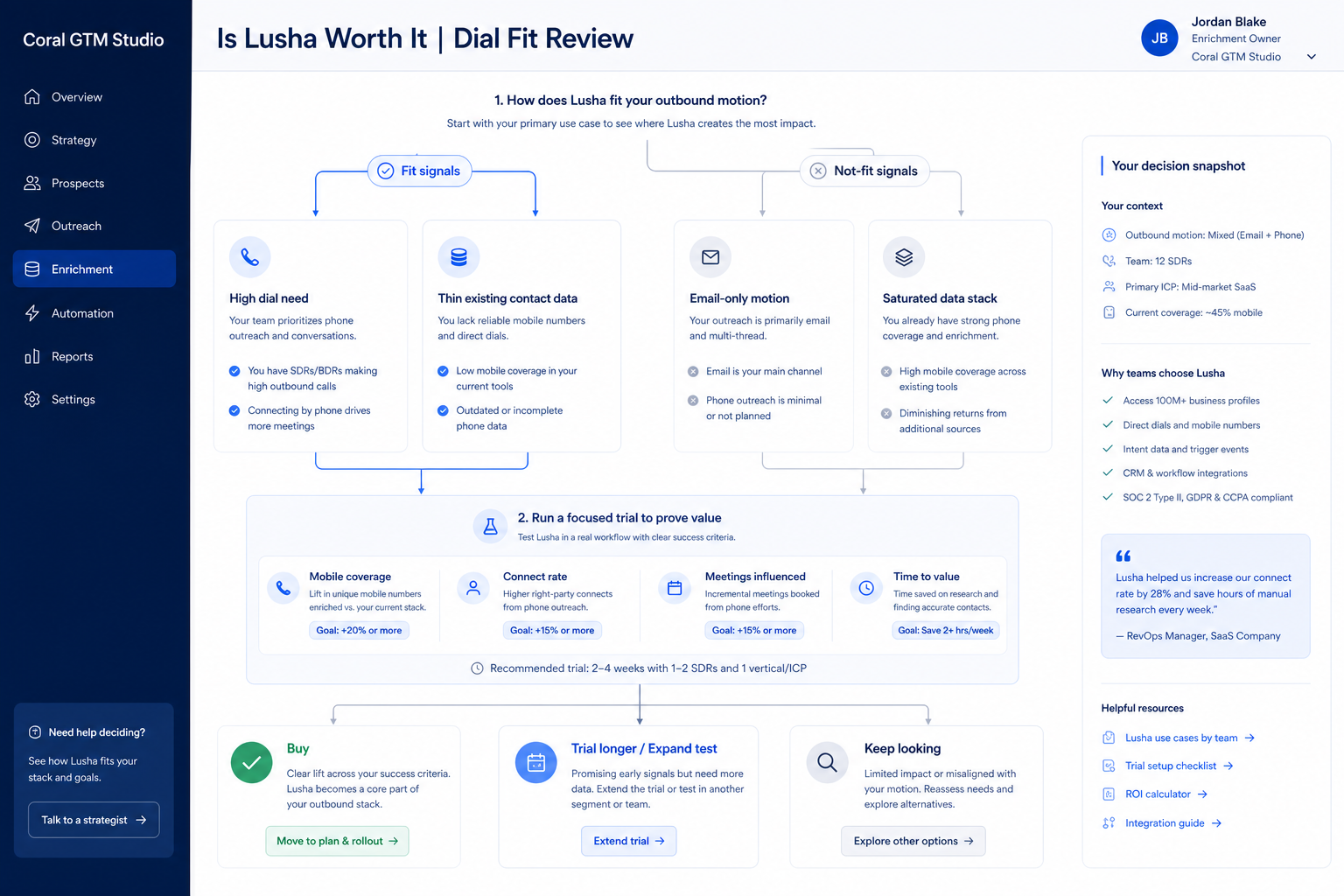
Lusha worth-it framework

Lusha worth-it framework diagram.
Lusha is “worth it” when fit, trial proof, and qualifying cost align.

Frequently asked questions

  • Can we decide from a demo alone?

    No. Require non-admin proof of list → outreach → CRM logging on the package you will actually buy.

  • What if credits look cheap but seats are expensive?

    Model the constraint you will hit first. Many pods exhaust credits before seats — confirm both on the pricing page.

  • When should we walk away?

    When fit, trial proof, or written packaging fails. Keeping looking is cheaper than forcing Lusha into the wrong motion.

The bounded pilot

  1. 1Fix a credit allowance, one rep, two weeks, one segment
  2. 2Count real conversations, not sends or deliveries
  3. 3Divide credits consumed by conversations achieved
  4. 4Compare that unit cost against the value of a conversation

How data-tool purchases disappoint

  • Judging on accuracy claims instead of unit cost

    Accuracy is an input. Cost per connected conversation is the outcome you are actually buying.

  • Buying data when capacity was the constraint

    A longer list does not help a rep who could not finish the last one.

  • Letting reveal habits run unmanaged

    Phone reveals cost more credits than emails; high-volume phone prospecting can burn credits quickly.

Before you decide

Bring these questions to every demo

Ask vendors to show the workflow live, not just describe it.

  • 1Bounded pilot run with a fixed credit allowanceOne rep, one segment, two weeks, hard stop.
  • 2Cost per connected conversation computed and recordedHuman replies only — the strict definition is what makes it useful.
  • 3Reveal rule agreed and a ninety-day re-measure diarisedConsumption pricing makes this a management metric, not a procurement one.

1. Run the two-week bounded pilot

One rep, one segment, a fixed allowance, and a hard stop. Bounded pilots produce a number; open-ended trials produce opinions. Write the allowance down before starting so nobody is tempted to top it up mid-pilot and quietly ruin the measurement.

2. Count conversations, and be strict about the definition

A conversation is a human responding. Not a delivered email, not a connection accepted, not a voicemail. Strictness here is what makes the unit cost trustworthy. Then divide, and write the number somewhere you will find it again in ninety days.

3. Set the reveal rule and re-measure at ninety days

Agree the rule with the team: phone reveals happen when a call is scheduled, email reveals for sequences. Then recompute unit cost at ninety days. If the number is improving, the purchase is working as intended and reps are learning restraint. If it is flat and the pipeline has not moved, you have a clean, evidence-based reason to stop.

Was this article helpful?

Have more questions? Contact our support team.

SoftwareGlimpse Updates

Want clearer software shortlists? Get buying guides and comparisons by email.

Newsletter coming soon.