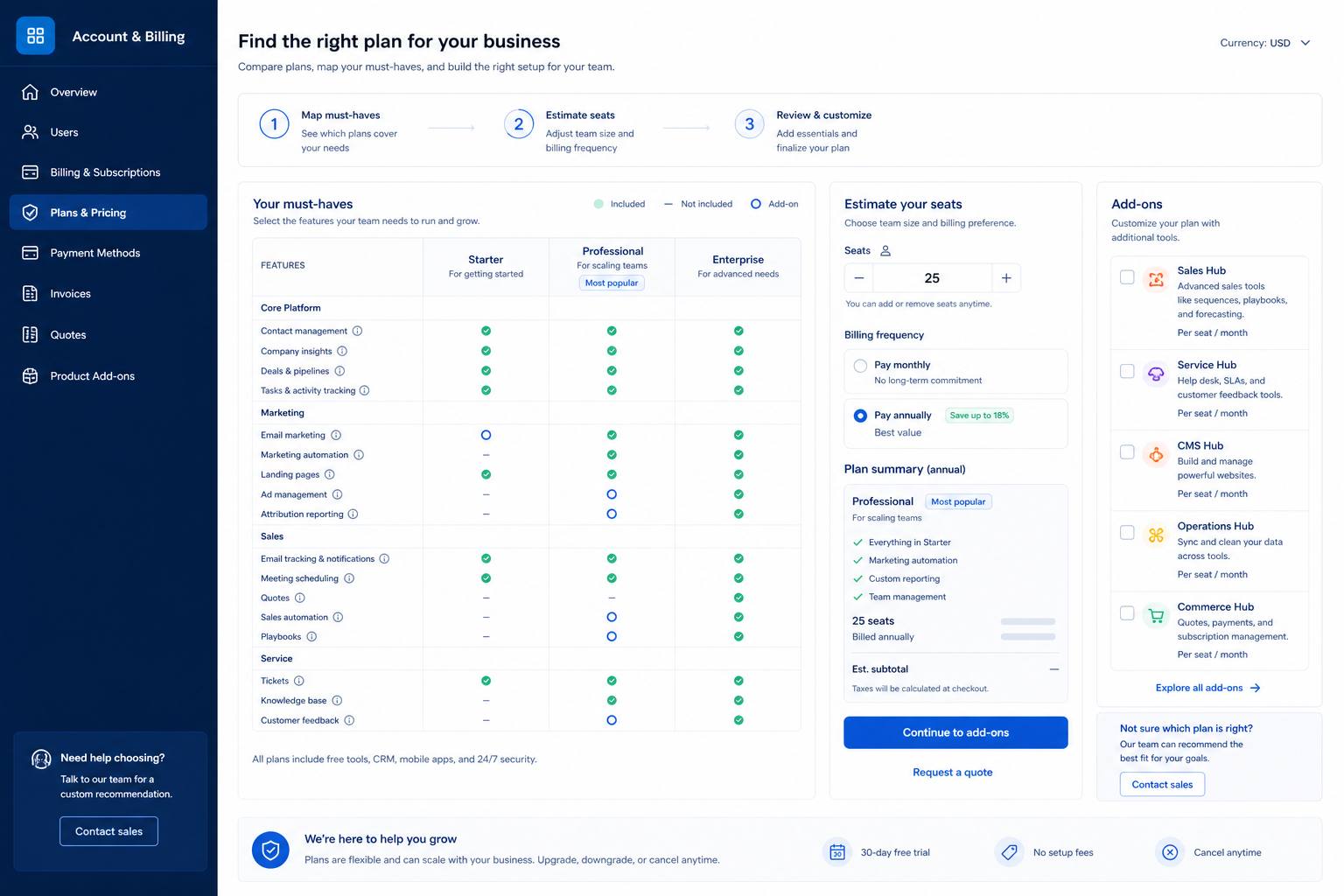
Pick the cheapest HubSpot plan that covers every day-one must-have, then estimate seats with the Cost Calculator. Confirm custom fields (Starter+) and email sequences (Starter+) are on the plan you will actually buy. Your highest gated need sets the plan — not the homepage starting price.
List must-haves first
Find the highest gate
Cheapest plan that clears it
Count seats honestly
14-day trial
Estimate, then verify
HubSpot plans media
Pricing/plan surfaces and vendor plan explainers for HubSpot when research has them — general product demos stay on the research page.
Official HubSpot plans walkthrough
Vendor plan/pricing explainer when available. Confirm current seats and limits on the vendor site.
This video is hosted on YouTube
This content is hosted by YouTube. The player loads only after you allow marketing cookies.
What each HubSpot plan is for — Free CRM, Starter (Smart CRM / Customer Platform), Professional (Smart CRM / Customer Platform), and Enterprise (Smart CRM / Customer Platform) — the vendor highlights Starter (Smart CRM / Customer Platform), which is a marketing choice, not your requirement.
Free vs paid is a capability decision — Free or entry options in our snapshot: Free CRM.
Capacity limits bite before features do — Our snapshot does not publish HubSpot seat or record caps — confirm them before you commit a team size.
Trial before term — Our pricing snapshot records a 14-day trial on Starter (Smart CRM / Customer Platform), Professional (Smart CRM / Customer Platform), and Enterprise (Smart CRM / Customer Platform) — confirm current terms on the HubSpot pricing page before you build a schedule around it.
Numbers live on pricing tools — Use /pricing/hubspot/ and the Cost Calculator for amounts. This guide deliberately carries no prices, so nothing here goes stale or gets quoted wrongly.
Treat as a separate cost line and confirm before you sign.
Map must-haves to HubSpot plan names before you compare starting tiles.
Write your day-one must-haves as a list, in outcome language.
Beside each one, write the lowest HubSpot plan that research shows carries it. Plan-gated in research: custom fields (Starter (Smart CRM / Customer Platform), Professional (Smart CRM / Customer Platform), Enterprise (Smart CRM / Customer Platform)); email sequences (Starter (Smart CRM / Customer Platform), Professional (Smart CRM / Customer Platform), Enterprise (Smart CRM / Customer Platform)); workflow automation (Starter (Smart CRM / Customer Platform), Professional (Smart CRM / Customer Platform), Enterprise (Smart CRM / Customer Platform)); sales automation (Starter (Smart CRM / Customer Platform), Professional (Smart CRM / Customer Platform), Enterprise (Smart CRM / Customer Platform)).
Highlight anything unclear and check it on /pricing/hubspot/ or in the trial.
Note add-ons separately.
Ask which plan any demo runs on before you use it as evidence.
Worked example: a 12-person B2B advisory team needs contact management and lead management, email sync, and weekly reporting from HubSpot. Two of those sit on the entry tier in research; the highest-gated one sets the plan, so they stop comparing anything cheaper.
2. What each HubSpot plan is actually for
Read each HubSpot plan as a capability tier, not a marketing ladder.
Free CRM
Unlocks contact management, lead management, and pipeline management in research.
Starter (Smart CRM / Customer Platform)
Unlocks custom fields, email sequences, and workflow automation in research.
Professional (Smart CRM / Customer Platform)
Unlocks forecasting and lead scoring in research.
Enterprise (Smart CRM / Customer Platform)
Unlocks sso and role permissions in research.
Read these as capability tiers — not good / better / best marketing.
Free CRM — Free start for a pilot pod or a solo operator. Research shows it carries contact management, lead management, and pipeline management. Outgrow it when you need custom fields and email sequences.
Starter (Smart CRM / Customer Platform) — Adds custom fields, email sequences, workflow automation, and sales automation in our research on top of Free CRM. Choose it when at least one of those is a day-one must-have — not because it sits comfortably in the middle. Snapshot records a 14-day trial.
Professional (Smart CRM / Customer Platform) — Adds forecasting and lead scoring in our research on top of Starter (Smart CRM / Customer Platform). Choose it when at least one of those is a day-one must-have — not because it sits comfortably in the middle. Snapshot records a 14-day trial.
Enterprise (Smart CRM / Customer Platform) — Adds sso and role permissions in our research on top of Professional (Smart CRM / Customer Platform). Choose it when at least one of those is a day-one must-have — not because it sits comfortably in the middle. Snapshot records a 14-day trial.
Worked example: a 12-person B2B advisory team drops Free CRM once must-haves sit higher, and compares only the HubSpot plans that clear every gate.
3. Free vs paid: the HubSpot decision tree
Decide free vs paid for HubSpot from must-haves and capacity — not the landing tile.
Free works
All must-haves and seats fit inside Free CRM.
Free as sandbox
Use it to evaluate, then upgrade on a named date with a named trigger.
Paid from day one
A gated must-have or a seat cap decides it.
Do all day-one must-haves sit on Free CRM? If no → paid.
Do seats fit? Confirm Free CRM capacity.
Will you hit a record/object cap within two quarters? If yes → paid now.
Using free to defer a decision? Run a scoped trial with a decide-by date instead.
Worked example: a 12-person B2B advisory team cannot fit 12 people into Free CRM, so free becomes a two-week sandbox — not the plan they run on.
4. Run the qualifying-plan algorithm
Run the HubSpot qualifying-plan algorithm before you open the Cost Calculator.
Seat count
Include managers, ops, and viewers who consume paid seats.
Add-ons
Ask which capabilities are separate SKUs and price them as recurring lines.
Evidence
Keep /pricing/hubspot/ open beside the Calculator while you work.
Hand this five-line algorithm to anyone on the buying team.
List must-haves (M1…Mn).
For each Mi, find the lowest HubSpot plan that carries it.
Take the highest of those — that is the qualifying plan.
Check capacity. Confirm HubSpot seat/record caps on the pricing page. If you do not fit, move up one tier.
Then estimate that plan in the Cost Calculator; add admin / migration / training as categories, not invented totals.
Worked example: a 12-person B2B advisory team lands on a HubSpot qualifying plan set by their highest-gated must-have, counts 12 seats plus ops, and prices only that combination.
5. Decide: stay, step up, or walk away
Stay, step up, or walk from the HubSpot qualifying plan — not the entry tile.
Stay
Qualifying plan fits budget posture and trial evidence.
Step up
Buy the tier that includes the must-have; skip the workaround.
Walk
Must-haves only on an unacceptable tier — compare Pipedrive and Salesforce instead.
Stay on the cheapest qualifying plan when must-haves and seats fit.
Step up when one must-have sits higher — buy the tier, skip the forever workaround.
Walk when the qualifying HubSpot plan breaks a written constraint. Research: stronger for SMB and mid-market teams wanting free CRM now and room to expand into hubs later and Organizations aligning marketing + sales + service on one customer platform; weaker for Teams that need a simple single-price sales CRM without hub/seat complexity (consider Pipedrive) and Buyers who want native dialer-first workflows as the primary product story (consider Close/Freshsales).
Write plan name, must-have that set it, and re-check date.
Use the worth-it guide for fit — not invented payback maths.
Worked example: when the cheap HubSpot tier missed a must-have, a 12-person B2B advisory team bought the qualifying plan or shortlisted Pipedrive and Salesforce — they did not pretend the workaround was free.
HubSpot plan mistakes
Comparing homepage “from” tiles
Your must-haves often sit above the cheapest HubSpot tile. Compare qualifying plans only.
Pasting invented totals into a memo
Use the Cost Calculator and /pricing/hubspot/. Numbers you made up will be the first thing challenged in the approval meeting.
Ignoring which plan the demo ran on
Demo tenants are often richer than what you buy — ask, and write the answer down.
Buying free when must-haves are paid
Free or entry options in our snapshot: Free CRM. Free is only a win when the sheet actually fits.
Missing capacity caps
Confirm HubSpot seat and record caps before committing. Caps stop rollouts more often than missing features do.
Discounting a documented tradeoff
Research flags: Multi-hub + seat-type packaging is harder to budget than single-product CRMs. Price that in before you sign an annual term.
Frequently asked questions
What HubSpot plans exist?
Our researched snapshot lists Free CRM, Starter (Smart CRM / Customer Platform), Professional (Smart CRM / Customer Platform), Enterprise (Smart CRM / Customer Platform). Starter (Smart CRM / Customer Platform) is highlighted by the vendor — treat that as marketing, not as your requirement. Re-check /pricing/hubspot/ for current packaging.
Is there a free HubSpot plan?
Snapshot free or entry plan names: Free CRM. Confirm limits and gates before you build on it.
Which HubSpot plan should a small team choose?
Run the algorithm: lowest plan per must-have, take the highest, check capacity, then count seats. Plan-gated in research: custom fields (Starter (Smart CRM / Customer Platform), Professional (Smart CRM / Customer Platform), Enterprise (Smart CRM / Customer Platform)); email sequences (Starter (Smart CRM / Customer Platform), Professional (Smart CRM / Customer Platform), Enterprise (Smart CRM / Customer Platform)); workflow automation (Starter (Smart CRM / Customer Platform), Professional (Smart CRM / Customer Platform), Enterprise (Smart CRM / Customer Platform)); sales automation (Starter (Smart CRM / Customer Platform), Professional (Smart CRM / Customer Platform), Enterprise (Smart CRM / Customer Platform)).
Must-haves → qualifying plan name → Cost Calculator seats → TCO categories for admin, migration, and training. Do not invent implementation fees or ROI percentages.
Does HubSpot offer a free trial?
Our pricing snapshot records a 14-day trial on Starter (Smart CRM / Customer Platform), Professional (Smart CRM / Customer Platform), and Enterprise (Smart CRM / Customer Platform) — confirm current terms on the HubSpot pricing page before you build a schedule around it.
Is annual billing worth it?
Annual versus monthly is a term and cash-flow choice, not a capability one. While you are still proving adoption, the ability to fail cheaply for one quarter is often worth more than the annual discount.
What should I do next?
Open /pricing/hubspot/, run the Cost Calculator on your qualifying plan, and read the HubSpot worth-it guide before signature.