Sales Intelligence vs Sales Engagement: Data vs Sequencing
See how sales intelligence (data layer) differs from sales engagement (sequencing layer) — and how list→cadence handoffs, bundles, and CRM ownership should work together.
Quick answer
Sales intelligence owns the data layer — finding, verifying, and enriching contacts. Sales engagement owns the sequencing layer — cadences, mailbox sending, reply handling, and (often) dialing. Decision rule: if the work is “who should we contact and with what verified details,” you need intelligence; if the work is “run and measure multichannel follow-up at volume,” you need engagement — many platforms blur both, but buy for the primary job.
- SI = data layer
- Engagement = sequencing layer
- Bundles blur, jobs differ
- Coverage vs cadence fit
- Shared CRM truth
- Buy for the primary job
Key takeaways
- Different failure modes — Intelligence fails on thin ICP coverage and credit burn; engagement fails on deliverability, reply handling, and rep workflow.
- All-in-one is not automatically better — Bundled data + sequences helps when one admin model is real — not when you only need one job done well.
- CRM remains the system of record — Neither layer should become the place ownership, stages, and forecast truth live.
- Handoff is list → cadence — Agree how verified contacts enter sequences and how replies/log activity write back to CRM.
How to choose (or combine)
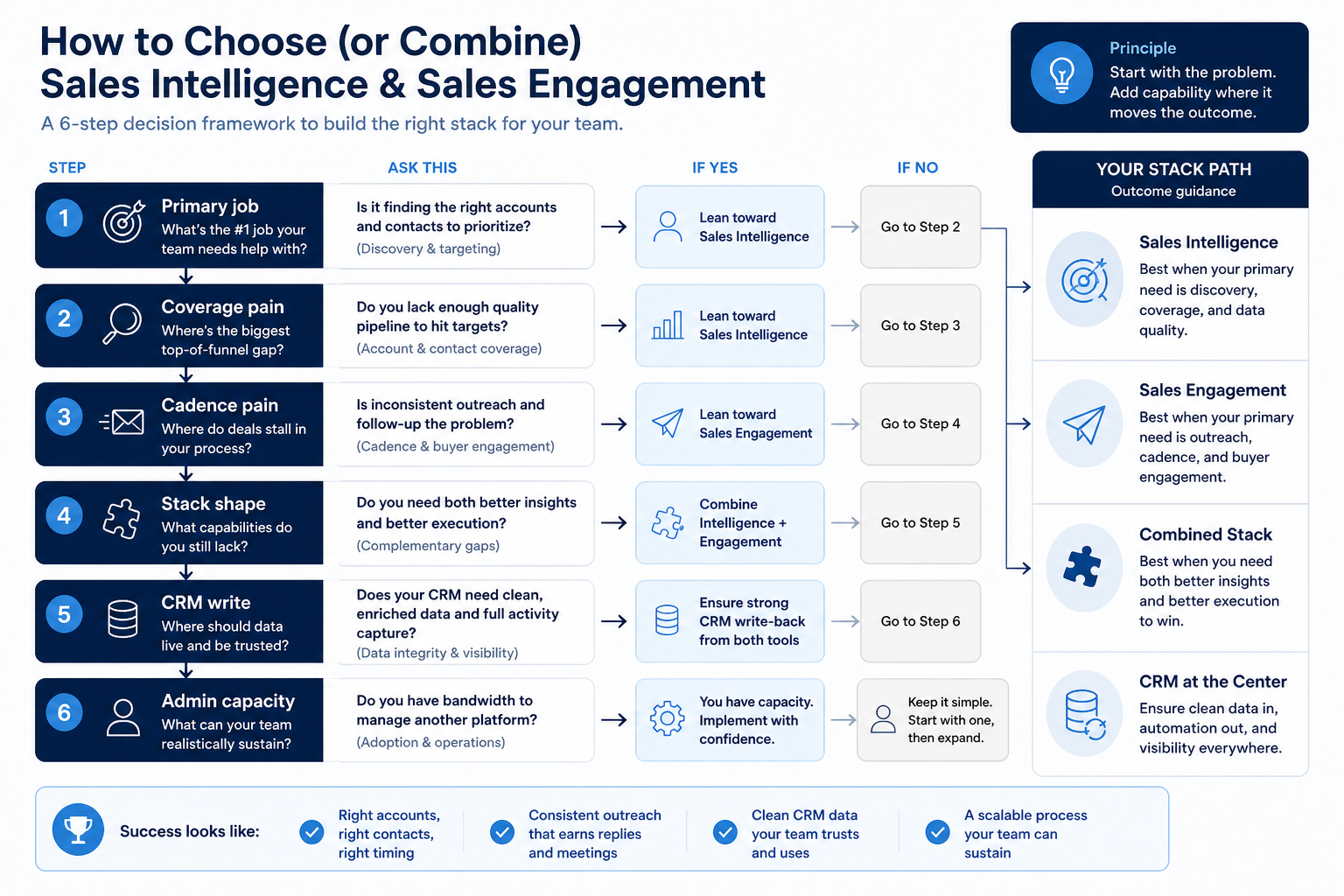
Data layer vs sequencing layer
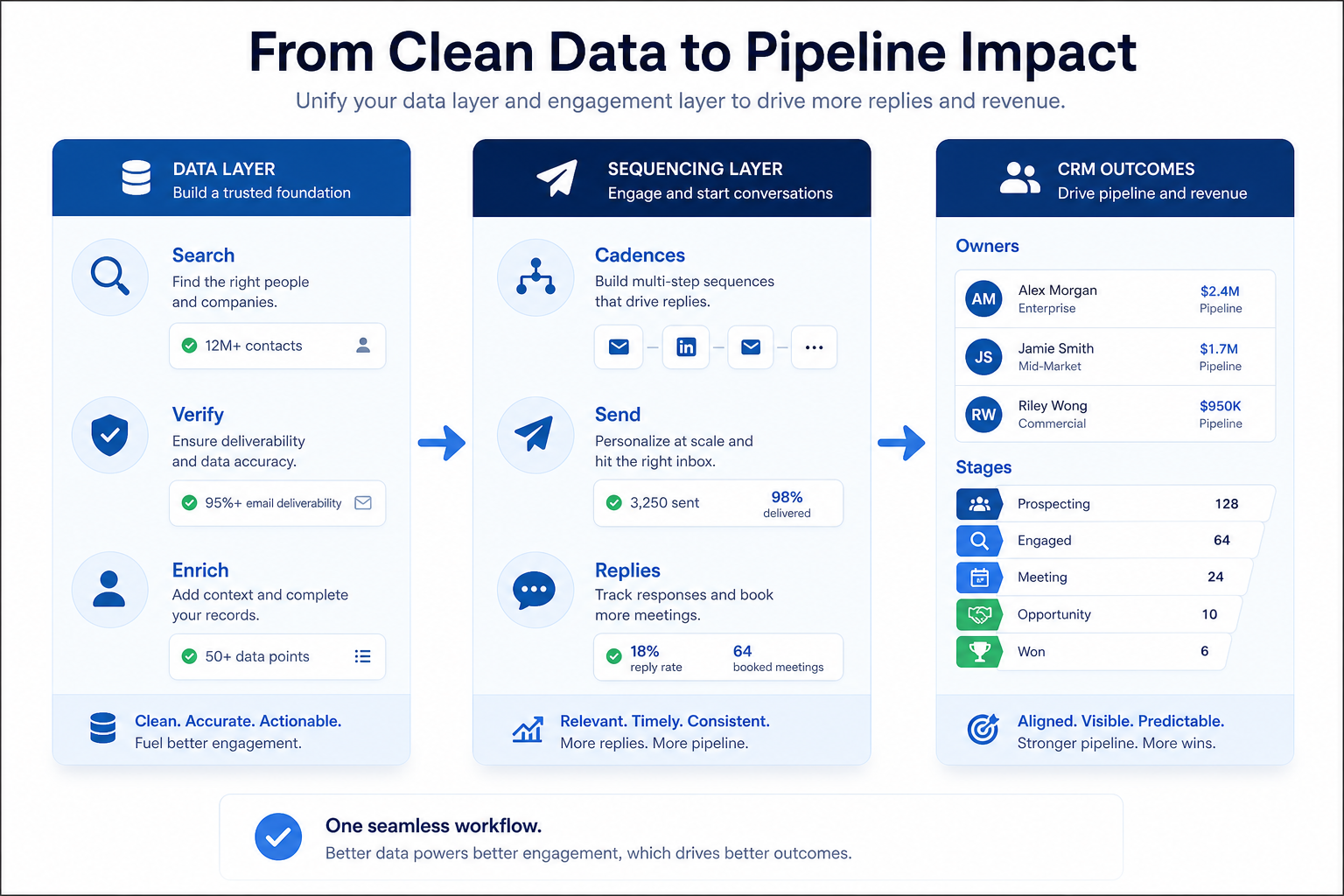
1. The list → cadence handoff
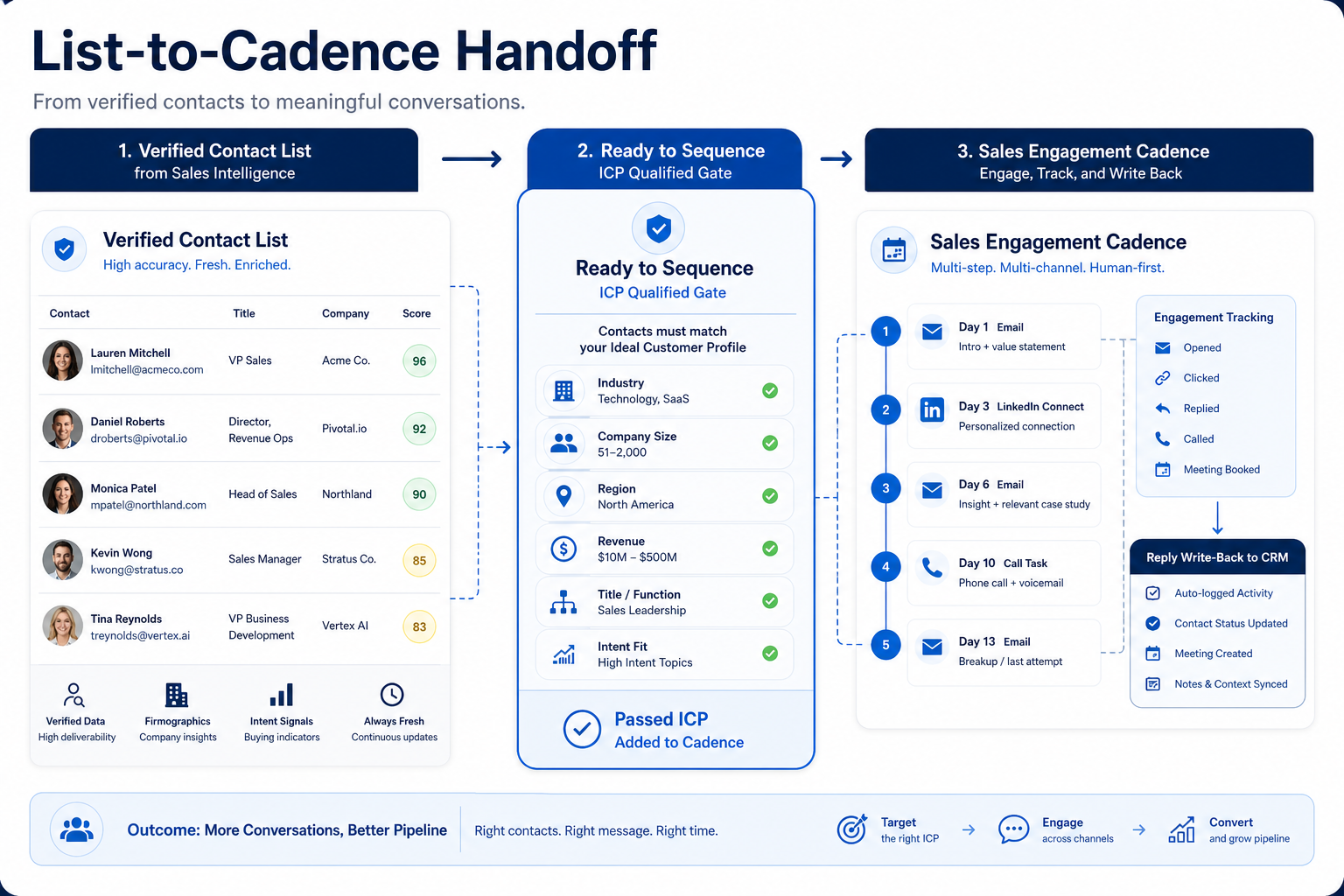
Intelligence side
Search, filter, verify, enrich, export/push — data quality and credits.
Engagement side
Cadences, mailbox limits, reply detection, dialing, activity logging.
Shared CRM fields
Owner, lifecycle, last touch, and disposition must mean the same thing.
Boundary clarity fails most often when verified contacts never enter a disciplined sequence — or when a sequencer becomes a second contact database. Agree what “ready to sequence” means, which tool owns verification, and how replies and dispositions write to CRM.
Example: a five-seat outbound pod uses a contact database (catalogue examples include BookYourData or Lusha) to build Monday lists, then enrolls only verified emails into a sequencer (catalogue examples include Reply.io or Amplemarket). CRM owns owners and stages; the sequencer may log activities but never overwrite Owner. Without that sentence, reps rebuild lists in Sheets and blame “the data tool” for follow-up failures.
Stack shapes (educational, not rankings)
Intelligence with light outreach
Best for: Teams whose bottleneck is finding verified contacts; follow-up already works in CRM or a simple mail client.
Avoid when: You need multichannel cadences, deliverability tooling, and reply workflows at volume.
Engagement with thin data
Best for: Teams that already have lists or enrichment elsewhere and need sequencing discipline.
Avoid when: Weekly list building is empty — a sequencer will not invent ICP coverage.
Separate SI + engagement
Best for: Teams that want best-fit depth per layer and can maintain CRM write rules between them.
Avoid when: No one owns sync, suppression, or which tool is contact truth.
Combined data + engagement platform
Best for: Pods that will use both layers daily and prefer one vendor for list→cadence admin.
Avoid when: You only need one job and would ignore the other module after purchase.
Job matrix: intelligence vs engagement
- ICP search, verification, enrichment
- Multichannel cadences & reply handling
- Agreed list → cadence handoff
- CRM ownership & pipeline stages
- Intent widgets / AI research agents
- Buying a bundle “to grow into later”
Fit by team shape
- 01
Founder-led outbound
Intelligence first if lists are thin; add engagement when follow-up volume exceeds inbox discipline.
- Credits over seats
- Light cadence
- 02
SDR pod (1–5)
Separate or bundle can work — only if ready-to-sequence and CRM write rules are written down.
- Monday list ritual
- Shared suppression
- 03
Outbound-heavy / multi-pod
Engagement depth and deliverability dominate; intelligence must still clear ICP coverage tests.
- Mailbox governance
- Credit budgets
- 04
Enterprise / regulated
Sourcing docs, SSO, and write-rule governance dominate — bundles help only with real shared admin.
- Privacy review
- Field-level sync
Common boundary mistakes
Using a sequencer as the contact database
Engagement tools are poor systems of truth for verification, enrichment refresh, and credit-efficient list building.
Buying data and never sequencing
Verified contacts without a cadence ritual become another stale CSV.
Assuming a suite replaces process design
Shared software still needs shared definitions for ready-to-sequence, suppression, and CRM ownership.
Blaming “bad data” for deliverability debt
Mailbox warm-up, limits, and content hygiene are engagement-layer problems.
2. Use a when-this / when-other decision rule
Write one sentence for when each product category is the primary purchase.
3. Worked example: same company, two purchases
Harbor Ops buys customer-service software for ticket SLAs and a separate CRM for pipeline — they integrate, but neither replaces the other's core job.
4. Use a one-page checklist before demos
For Sales Intelligence vs Sales Engagement: Data vs Sequencing, list must-haves, owners, integrations, and the weekly ritual this purchase must improve. Share the sheet with finance and IT before you schedule a second demo.
- Name the primary job in one sentence.
- List must-have gates (plans, SSO, data residency, usage caps).
- Name integrations that must work on day one.
- Assign an admin owner and a weekly user champion.
- Define non-admin proof — what a sceptic completes without rescue.
Worked example: Harbor Ops refuses demos until the checklist is signed — cutting evaluation time in half.
5. Avoid the usual buying mistakes
Common failures in sales-intelligence: buying for brand familiarity, comparing entry tiles across different usage units, skipping a fair trial script, and adding scope before adoption proves out.
Run one trial script on every finalist the same week. Score on the same card. Write a one-paragraph decision memo that names what you are not buying yet.
6. Hand off to the category shortlist
When assumptions are frozen, continue on /best/sales-intelligence-software/ with the same headcount, usage band, and must-have gates on every quote.
Frequently asked questions
Is sales intelligence the same as sales engagement?
No. Sales intelligence focuses on finding, verifying, and enriching contacts (data layer). Sales engagement focuses on cadences, sending, replies, and often dialing (sequencing layer). Decision rule: who to contact vs how to follow up at volume.
Do we need both?
Only if both jobs are real. Many teams start with intelligence and light email; add engagement when follow-up volume and multichannel discipline justify another system (or suite module).
Should we buy a combined platform?
Consider a bundle when you will use both layers daily and want one list→cadence admin model. If you only need data or only need sequences, a simpler shape usually reduces cost and complexity.
Where does LinkedIn Sales Navigator fit?
Sales Navigator is closer to a social-graph prospecting layer than a verified contact database or sequencer — see Sales Intelligence vs LinkedIn Sales Navigator.
What should I read next?
Review How to Choose Sales Intelligence, then the Requirements and Evaluation guides — or shortlist on Best Sales Intelligence Software.
Was this article helpful?
Have more questions? Contact our support team.
Part of Software buying guides · How to Choose Sales Intelligence Software
Related guides
Supporting reading in this topic — not a generic related-posts dump.
- How to Choose the Right CRM for Your BusinessA practical decision framework for picking CRM software: needs, features, size fit, integrations, true cost, adoption, and growth — without vendor hype.
- Sales Intelligence Evaluation Guide: Two-Week Trial ScorecardEvaluate sales intelligence options fairly with weighted criteria and a shared two-week trial — coverage sample, credit burn, CRM sync, and deliverability — so you compare evidence instead of demo theater.
- Sales Intelligence Requirements Guide: Must-Haves, Compliance & CRM Write RulesWrite demo-ready sales intelligence requirements from the primary job, must vs nice features, compliance posture, and CRM write rules — without feature-wishlist shopping.
- Sales Intelligence vs LinkedIn Sales Navigator: Social Graph vs Contact DataSee how LinkedIn Sales Navigator (social graph / InMail) differs from sales intelligence platforms (verified contact databases, CRM sync, dialer, sequences) — and when to use one or both.
SoftwareGlimpse Updates
Want clearer software shortlists? Get buying guides and comparisons by email.
Newsletter coming soon.