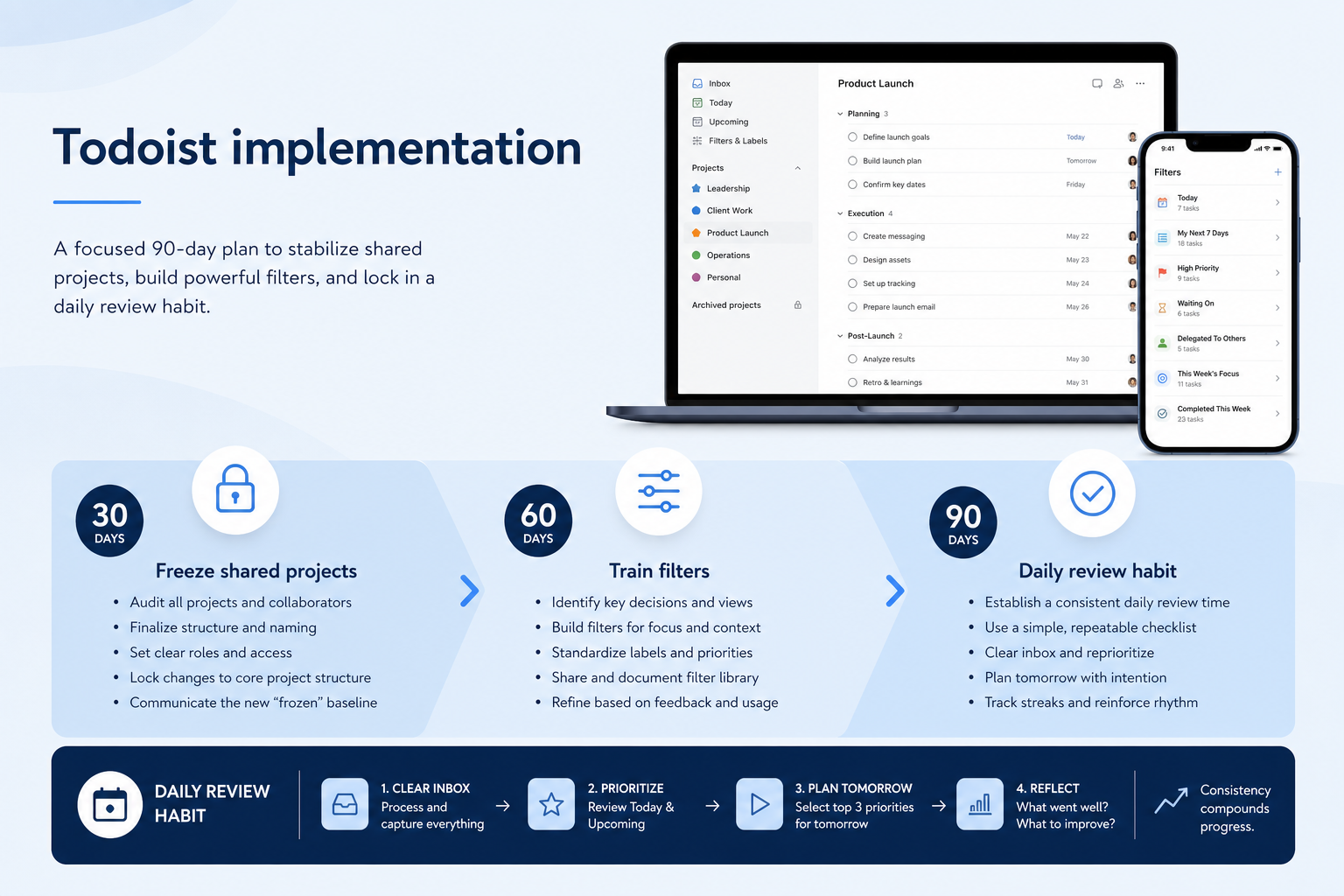
Todoist Implementation: 30/60/90 Rollout That Sticks
Plan a practical Todoist rollout — owners, core work loop, training, and adoption checkpoints — so the product becomes how the team actually ships work.
LMBy Lee M.Updated Aug 18, 20267 min readFact-checked
Quick answer
Roll out Todoist in gated phases: freeze 90-day outcomes for personal and small-team task lists, name an owner, configure the core loop, train the people who must update it weekly, then review adoption before adding automations or extra hubs. Treat Todoist implementation as phases — not a feature dump in week one.
Freeze 90-day outcomes in writing
Name an admin owner with hours
Days 1–30: core loop only
Days 31–60: train weekly users + sceptics
Days 61–90: adoption review, then extras
Do not implement it as the wrong job cluster
Todoist rollout media
Official setup walkthroughs and product surfaces that matter while you roll out Todoist — not a full product gallery.
Official Todoist setup walkthrough
Vendor tutorial for onboarding and configuration. It is not a SoftwareGlimpse rollout plan — use this guide for judgment.
This video is hosted on YouTube
This content is hosted by YouTube. The player loads only after you allow marketing cookies.
Official vendor tutorial
Getting Started with Todoist
How Todoist presents the product in an official vendor video.
What this shows
✓Todoist product surfaces as shown in the official vendor video
Job cluster first — Todoist is personal and small-team task lists. Do not implement it as a company work OS or a Gantt portfolio.
Adoption before add-ons — If Northline Founders will not open the product weekly, extra hubs will not save the rollout.
Integrations are a phase — Research names Slack, Google Calendar, Microsoft Teams, and Zapier on the Todoist side — confirm the connectors your work loop depends on.
AI is optional — Research lists AI assistant, AI summaries, AI automation, and AI recommendations for Todoist. Research places AI assistance on Beginner, Pro, and Business.
Measure the ritual — Success is capture tasks, assign one shared project, and complete a daily review without a second tool — not a kickoff deck.
Treat Todoist implementation as gated phases — not a feature dump in week one.
Todoist must vs nice
Must-have
✓Weekly update ritual
✓Sceptic user in training
✓Named admin hours
Nice-to-have
•Automations and AI
1. Freeze 90-day outcomes before configuration sprawl
Freeze Todoist outcomes before anyone installs extra views.
Clear outcomes
Three rituals, named owner, written exclusions.
Feature dump
Kickoff lists every hub — pause and cut to the core loop.
Wrong cluster
If the real job is a company work OS or a Gantt portfolio, stop this rollout and pick a different product.
Write three outcomes Todoist must change — status visibility, owner accountability, or time-to-update — and who owns each. 1. Name the job: personal and small-team task lists. Explicitly exclude a company work OS or a Gantt portfolio.
Pick three measurable rituals (example: Friday status lives in Todoist, not Slack).
Name the admin owner and the weekly users.
List nice-to-haves you will refuse until day 61. Worked example: Northline Founders (a five-person leadership list) freeze “replace the status spreadsheet” as the only 90-day outcome. Portfolio dashboards wait.
2. Days 1–30: core loop only
Days 1–30 of Todoist: one loop in production, everything else parked.
On track
Weekly users update without nagging; managers look in-product.
Shadow tool
Slack or Sheets still hold status — do not start phase two.
Admin-only
If only the owner can update items, fix permissions before training.
Configure one shared project, labels you will filter, and a daily review habit. Success looks like: capture tasks, assign one shared project, and complete a daily review without a second tool. 1. One live container of work with real owners.
No marketplace apps except the connectors the loop needs. Research names Slack, Google Calendar, Microsoft Teams, and Zapier on the Todoist side — confirm the connectors your work loop depends on.
A manager can see status without asking for a screenshot.
Log every “can we also…” request for day 61. Worked example: Northline Founders (a five-person leadership list) delays optional AI and extra hubs until the core loop has a week of real use. Week-one marketplace apps are treated as a failure mode.
3. Days 31–60: train weekly users — include a sceptic
Train Todoist as a weekly ritual, not a kickoff webinar.
Ritual sticks
Sceptics update without a chase list.
Training theatre
Attendance was high; updates were not — rerun with live work.
Guest confusion
Clients or execs need a viewer path that is not a full seat.
Train the people who must update Todoist every week — not a one-time all-hands. Our snapshot flags a trial on Pro and Business without a published length — confirm the window on the Todoist pricing page. 1. Role-based sessions: contributors vs managers vs guests.
Include one sceptic so adoption risk shows up before speeches.
Practice a teammate completes an assigned task and you see it without being the project admin live — no slideware-only training.
Capture every question as a training-cost line, not a feature request. Worked example: Northline Founders (a five-person leadership list) includes one sceptic user in training so “I still ping the owner in Slack” shows up while you can still fix the ritual.
4. Days 61–90: adoption review, then extras
Day 90 of Todoist: prove adoption, then add automations — never the reverse.
Adopted
Core loop is boring and reliable — extras are earned.
Partial
One team lives in it; others do not — do not buy enterprise hubs yet.
Failed ritual
Reset to setup: fewer seats, clearer owner, one board.
Check whether the core loop is actually used. Only then add automations, extra hubs, or AI. 1. Count weekly active updaters vs invited seats.
Confirm managers stopped asking for spreadsheet status.
Review watch-outs. Research flags: Not a Work OS; Thin reporting; Limited team depth vs Asana.
Unlock one extra: automations or a dashboard — not both in the same week. Worked example: Northline Founders (a five-person leadership list) reviews whether capture tasks, assign one shared project, and complete a daily review without a second tool happened for four consecutive weeks before expanding scope. Empty dashboards mean the rollout is not done.
Common Todoist implementation mistakes
Feature dump in week one
Turning on every view trains nobody. Freeze the core loop for 30 days.
All-hands instead of weekly users
A kickoff webinar is not a ritual. Train the people who must update the board.
No sceptic in the room
Cheerleaders will nod. A sceptic will show you the Slack workaround.
Implementing the wrong cluster
Todoist should not be stretched into a company work OS or a Gantt portfolio. Buy the second job as a second product or a later wave.
Automations as a substitute for ownership
If humans will not update items, rules will just move stale cards faster.
Todoist checklist
Bring these questions to every demo
Ask vendors to show the workflow live, not just describe it.
1Freeze 90-day outcomesMust-haves and owners before configuration sprawl.
2Name a workspace ownerBoards, users, and hygiene need a responsible party.
3Schedule adoption reviewCheck core-loop usage before adding automations.
Frequently asked questions
How long should rollout take?
Ninety days is enough for most SMB/mid teams if you freeze the job and defer extras. Longer programmes help when change management is the risk — not when the product is “complex.”
What if we also need a different work-management job?
Buy the second job as a second product (or a later wave). Todoist should not be stretched into a company work OS or a Gantt portfolio.
When do automations belong?
After four weeks of humans completing capture tasks, assign one shared project, and complete a daily review without a second tool. Automating a dead board just creates faster garbage.
Do we need professional services?
Only if you cannot name an internal owner. A partner cannot substitute for weekly users. Confirm any implementation fees on the pricing page — do not invent them here.
What if adoption is low at day 60?
Do not buy more seats. Cut invited users to the people who must update Todoist, fix permissions, and rerun non-admin proof.