Sales Intelligence Selection Process
Run SI selection as gated stages with owners — Define job → Requirements → Shortlist → Trial → Decide → Rollout — so artifacts beat last-demo bias.
Quick answer
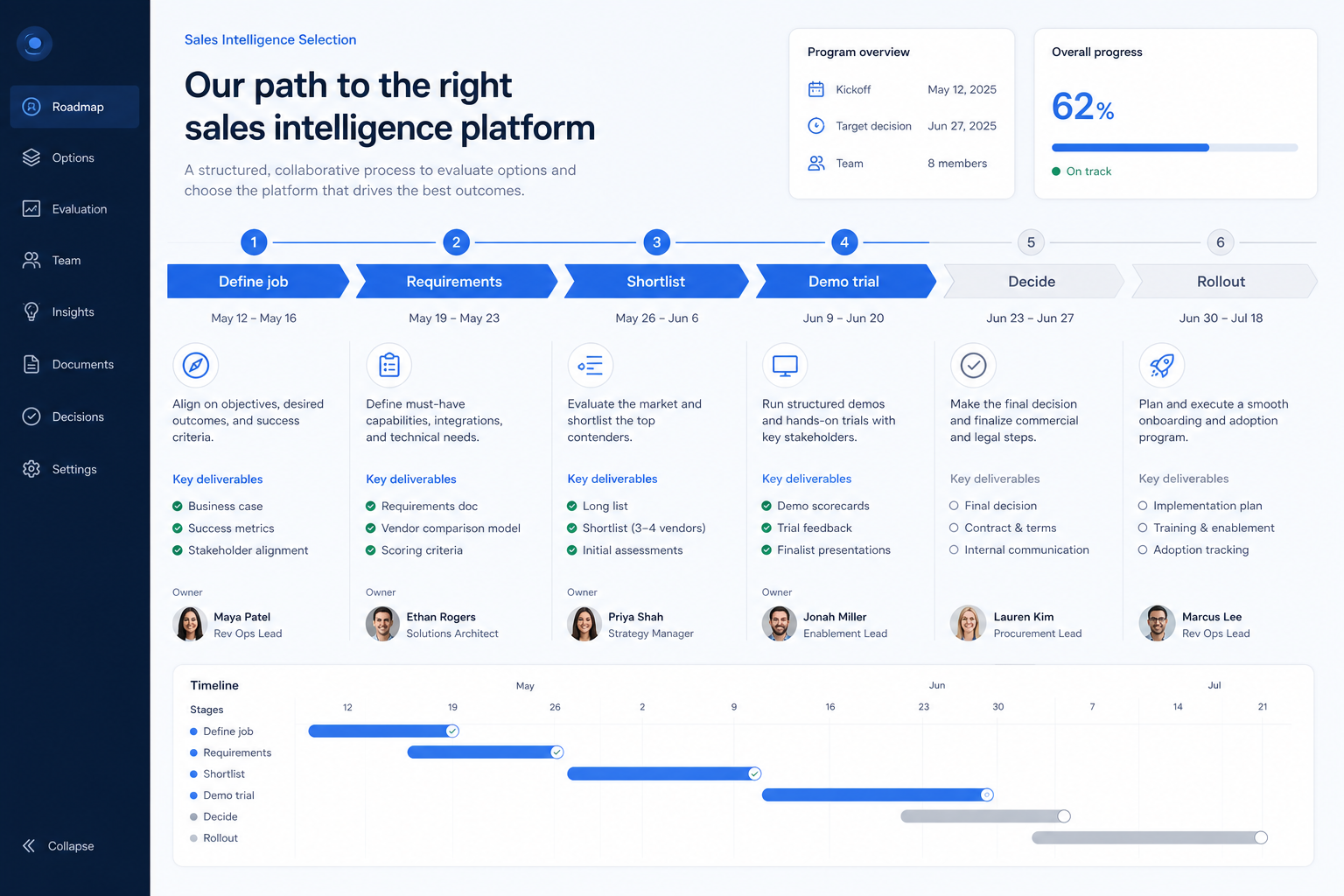
Run sales intelligence selection as a gated process — Define job → Requirements → Shortlist → Demo/trial → Decide → Rollout — with a named owner for each gate. Decision rule: do not advance stages until the gate artifact exists (primary job, requirements sheet, scored shortlist, decision memo); skipping gates is how teams buy from the last demo.
- Define job
- Requirements sheet
- Shortlist
- Demo & trial
- Decide
- Rollout plan
Key takeaways
- Process beats preference — A short RACI and timeline prevent endless demos and silent vetoes.
- Every gate needs an artifact — Job statement, sheet, scores, and a written decision keep the team aligned.
- Owners unblock speed — Ambiguous “the team will decide” stalls more buys than missing features.
- Rollout is part of selection — Who owns credits, sync, training, and hygiene should be named before signature.
Selection process stages
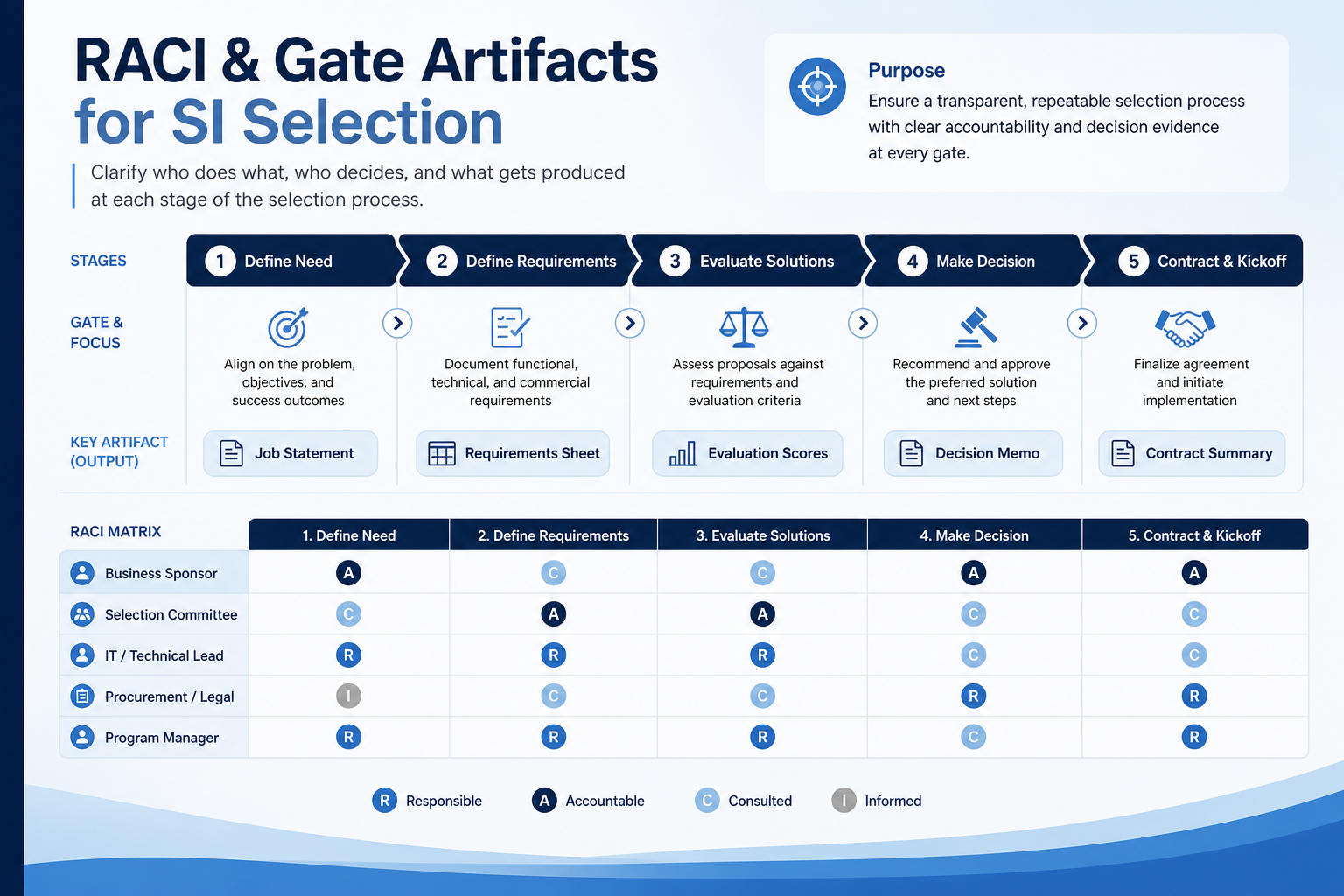
RACI / gate owners
1. Assign owners to each gate
Define
Confirm primary job (data / enrichment / engagement / dialer).
Requirements
RevOps owns must vs nice + credit/sync constraints.
Decide
One accountable person signs the memo from scores.
Map Responsible and Accountable people for Define, Requirements, Shortlist, Demo/trial, Decide, and Rollout. Consult SDRs early; keep one accountable decider.
Example: a 6-person outbound team sets RACI — founder Accountable for Decide; RevOps Responsible for requirements sheet and credit model; SDRs Responsible for trial scores; privacy Consulted on sourcing docs; finance Informed on budget posture. Gate rule: no vendor demo until primary job and must-haves are marked complete.
2. Set a realistic timeline
Too fast
Contract after one demo — no ICP sample or credit diligence.
Too slow
Months of demos with rotating stakeholders and no Accountable decider.
Healthy pace
Gates clear with artifacts; timeline has scoring and diligence days.
Small teams often finish Define through Decide in a few weeks if artifacts stay thin. Block calendar for scripted ICP trials; do not stack five demos in two days without scoring time.
Example: three-week calendar — week 1 Define + requirements, week 2 shortlist + two scripted trials, week 3 diligence questions + decision memo + rollout owner checklist. They refuse “just one more tool” after scores lock unless a hard constraint failed.
Gate checklist
0/5 dimensions noted — saved in this browser only.
Define gate
Requirements gate
Shortlist gate
Demo/trial gate
Decide gate
Process mistakes
Skipping the primary job
All-in-one shopping without a blocking job statement.
Demos before the sheet
Vendor theater defines success.
No rollout owners at signature
Credits and sync orphaned on day two.
Re-opening shortlist after scores
Preference dressed as “one more look.”
3. Shortlist only inside the same job cluster
Compare tools whose core product matches the weekly output you named. Adjacent tools can integrate later — they should not hijack the primary shortlist because of brand familiarity.
Worked example: A team that needs meeting transcripts shortlists Otter-class tools, not a general chat assistant, even if the chat tool also “does meetings.”
4. Trial the named workflow before signatures
Run the same script on two or three finalists. Success is a non-admin completing the weekly output without a rescue — not a polished vendor tour.
5. Use a one-page checklist before demos
For Sales Intelligence Selection Process, list must-haves, owners, integrations, and the weekly ritual this purchase must improve. Share the sheet with finance and IT before you schedule a second demo.
- Name the primary job in one sentence.
- List must-have gates (plans, SSO, data residency, usage caps).
- Name integrations that must work on day one.
- Assign an admin owner and a weekly user champion.
- Define non-admin proof — what a sceptic completes without rescue.
Worked example: Harbor Ops refuses demos until the checklist is signed — cutting evaluation time in half.
6. Avoid the usual buying mistakes
Common failures in sales-intelligence: buying for brand familiarity, comparing entry tiles across different usage units, skipping a fair trial script, and adding scope before adoption proves out.
Run one trial script on every finalist the same week. Score on the same card. Write a one-paragraph decision memo that names what you are not buying yet.
7. Hand off to the category shortlist
When assumptions are frozen, continue on /best/sales-intelligence-software/ with the same headcount, usage band, and must-have gates on every quote.
8. Use a one-page checklist before demos
For Sales Intelligence Selection Process, list must-haves, owners, integrations, and the weekly ritual this purchase must improve. Share the sheet with finance and IT before you schedule a second demo.
- Name the primary job in one sentence.
- List must-have gates (plans, SSO, data residency, usage caps).
- Name integrations that must work on day one.
- Assign an admin owner and a weekly user champion.
- Define non-admin proof — what a sceptic completes without rescue.
Worked example: Harbor Ops refuses demos until the checklist is signed — cutting evaluation time in half.
9. Avoid the usual buying mistakes
Common failures in sales-intelligence: buying for brand familiarity, comparing entry tiles across different usage units, skipping a fair trial script, and adding scope before adoption proves out.
Run one trial script on every finalist the same week. Score on the same card. Write a one-paragraph decision memo that names what you are not buying yet.
10. Hand off to the category shortlist
When assumptions are frozen, continue on /best/sales-intelligence-software/ with the same headcount, usage band, and must-have gates on every quote.
Frequently asked questions
How long should SI selection take?
Often a few weeks for small teams when artifacts stay thin and trials are scripted. Stretch for real security/privacy review — not for endless demos.
Who should be Accountable for Decide?
One person — usually the budget owner or sales leader — who signs the memo from scored evidence. Committees can Consult; they should not silently veto later.
What should I do next?
Write the primary job, complete the requirements sheet, then follow How to Choose and Trial Evaluation for fair evidence.
Was this article helpful?
Have more questions? Contact our support team.
Part of Software buying guides · How to Choose Sales Intelligence Software
Related guides
Supporting reading in this topic — not a generic related-posts dump.
- Sales Intelligence Selection MistakesAvoid regretted SI buys: missing primary job, opaque credits, skipped ICP trials, blind CRM sync, and unproven export — each with a fix artifact.
- Sales Intelligence Total Cost Guide: Beyond Seat PriceMap sales intelligence TCO categories — seats, credits, deliverability, sync admin time, training, and stack overlap — without inventing dollar totals.
- Sales Intelligence Trial EvaluationRun a scripted SI trial with a frozen ICP sample, non-admin testers, credit logging, and the same scorecard — so hands-on evidence replaces last-demo bias.
- Sales Intelligence Vendor QuestionsCopyable SI vendor questions for demos, trials, and diligence — credits, coverage, CRM sync, export, sourcing docs, and exit — without product score claims.
- Sales Intelligence ROI Guide: Value Without Fake NumbersFrame SI return as observable operational gains tied to 90-day outcomes — using formulas and your inputs only, never invented ROI percentages or dollar totals.
SoftwareGlimpse Updates
Want clearer software shortlists? Get buying guides and comparisons by email.
Newsletter coming soon.