SoftwareGlimpse
CRM Software

Pipedrive Migration: Move Data Without Losing the Thread

Pipedrive migration guide: inventory → rehearse → freeze → validate integrations — grounded in researched limitations and catalogue peers.

By Lee MeyeridricksUpdated Aug 14, 20265 min readFact-checked

Quick answer

Migrate to Pipedrive by inventorying legacy crm fields, mapping them to Pipedrive objects, rehearsing a freeze window, and validating Gmail, Slack, Microsoft Teams before reopening writes.

  • Inventory → map → rehearse → cut over → reopen
  • Highest risk: Lite lacks full email sync and workflow automation — most active sales teams need Growth or higher.
  • Success signal: contact management works for the pilot cohort

Pipedrive migration media

Import/data-move surfaces and vendor migration walkthroughs for Pipedrive when available — unrelated product tour footage is omitted.

Official Pipedrive migration walkthrough

Vendor walkthrough of data move / UI migration surfaces. Validate against your own export and mapping checklist.

This video is hosted on YouTube

This content is hosted by YouTube. The player loads only after you allow marketing cookies.

Official vendor tutorial

Importing Your Data - The Basics of Importing Spreadsheets

What this shows

  • Pipedrive spreadsheet import basics
  • data import workflow as presented by Pipedrive
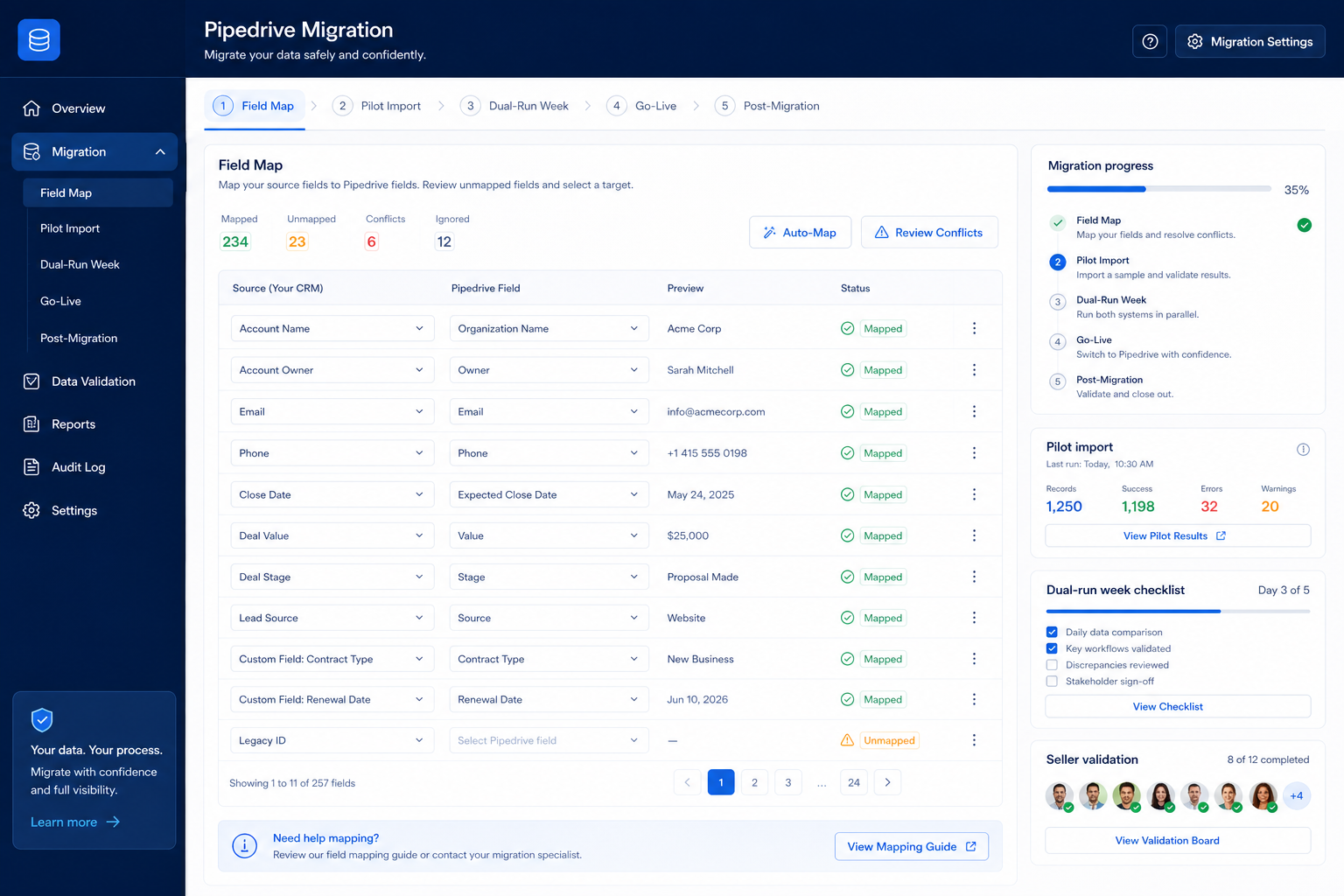
Full product screenshots and evidence live on the Pipedrive research page.

Pipedrive migration takeaways

  • Map to what this product supports — Pipedrive research supports contact management, lead management, pipeline management, and deal management — your object model has to land inside that, not inside your old CRM's shape.
  • Pilot beats big-bang — One successful Pipedrive import of a single owner's deals teaches more than a weekend bulk load.
  • Stage meaning is the real migration — Columns copy easily; “what qualified means” does not. Agree stage definitions before mapping.
  • Custom structure has limits — Custom fields is researched across every Pipedrive plan we snapshot.
  • Keep an exit copy — Retain source exports until Pipedrive passes seller spot-checks — and ask the export question before you sign, not at renewal.
  • Verify tooling, do not assume it — Import formats, record limits, and API behaviour belong in Pipedrive documentation. Our pricing snapshot records a 14-day trial on Lite, Growth, and Premium — confirm current terms on the Pipedrive pricing page before you build a schedule around it.

Pipedrive migration map

Pipedrive migration map diagram.
Prove mapping into Pipedrive before you move every historical activity.

Pipedrive checklist

Bring these questions to every demo

Ask vendors to show the workflow live, not just describe it.

  • 1Inventory sources and objectsCRM, sheets, mailboxes — must/later/archive.
  • 2Sign the field mapMeanings before bulk import.
  • 3Pilot 20–50 clean recordsSeller spot-check before scale.
  • 4Run a dual-run weekPipedrive as system of record; old system read-only.
  • 5Validate counts and samplesOpen deals and seller-critical records.

Frequently asked questions

  • Can we migrate everything into Pipedrive at once?

    You can, but you should not. Decision rule: pilot one owner's book, fix the map, then scale. Bulk-importing an unvalidated map is the most common reason a CRM rollout loses seller trust.

  • Which objects should we move first?

    Companies, then people, then open deals, then recent activities — parents before children. contact management, lead management, pipeline management, and deal management are the Pipedrive anchors in our research; old closed history can stay in an archive export.

  • How do we map custom fields into Pipedrive?

    Custom fields is researched across every Pipedrive plan we snapshot. Recreate a field only when someone can name the decision or report that depends on it; everything else goes to the archive CSV.

  • How long should the dual-run last?

    One week is usually right: long enough to catch mapping defects, short enough that people actually switch. Freeze the old system for edits during that week or you will migrate twice.

  • Who should own the migration?

    The Pipedrive admin owner runs the mechanics; a sales champion owns stage meaning; each seller validates their own book. Not an intern alone with a CSV.

  • What do we validate before cutting over to Pipedrive?

    Deal counts by owner, every open deal has an owner and stage, contacts resolve to companies, no duplicates in the top accounts, activity dates are real rather than import dates, and required fields are populated. Then seller sign-off.

  • What about getting data back out later?

    Ask before you sign: which objects export, in what format, whether notes and attachments come along, and what happens to data after cancellation. Keep your pre-migration exports either way.

  • What should I do next?

    Run the Pipedrive setup guide in parallel with the pilot so the target workspace is ready, then follow the implementation guide's 30/60/90 gates after cutover.

1. Pipedrive migration cutover playbook

  • Field inventory

    Export legacy fields that power contact management, lead management, pipeline management and mark must-map vs archive.

  • Rehearsal load

    Run a non-prod load into Pipedrive; measure match rates before the freeze.

  • Production freeze

    Freeze legacy writes; cut over; validate Gmail; then reopen.

Migrations fail from optimistic timelines — not from missing motivation.

Migrate to Pipedrive?

  1. 1Migrate when SMB and mid-market sales teams prioritizing pipeline visibility outweigh migration cost
  2. 2Delay if this limitation hits cutover: Lite lacks full email sync and workflow automation — most active sales teams need Growth or higher.
  3. 3If Pipedrive mapping is poor, compare destination fit with Freshsales before moving data twice

Pipedrive migration mistakes

  • No freeze window

    Dual-writing without a freeze creates irrevocable duplicates.

  • Integrations last

    Wire Gmail in rehearsal — not on Monday morning after cutover.

  • Data risk 1

    Lite lacks full email sync and workflow automation — most active sales teams need Growth or higher.

  • Data risk 2

    Campaigns and Web Visitors remain paid add-ons on all plans; LeadBooster/Projects/Smart Docs are add-ons below Premium.

  • Data risk 3

    Ultimate introduces explicit caps (e.g. custom fields, teams, reports) versus the older unlimited Enterprise packaging.

Pipedrive migration checklist

0/3 dimensions noted — saved in this browser only.

  • Mapping

  • Rehearsal

  • Cutover

Was this article helpful?

Have more questions? Contact our support team.

SoftwareGlimpse Updates

Want clearer software shortlists? Get buying guides and comparisons by email.

Newsletter coming soon.