Salesforce Account Engagement Setup: Day-Zero Path to a Working Pipeline
Set up Salesforce Account Engagement for day-zero selling — pipeline, users, email sync, and the first logged activity — before optional marketplace apps.
Quick answer
Set up Salesforce Account Engagement in this order: pick a plan that covers day-one needs, name one admin, configure one pipeline, invite daily users, connect email, then have a non-admin create a deal, log activity, and move a stage. You’re done when that walkthrough works — not when every module is switched on.
- Start on Enterprise
- Name one admin
- One pipeline only
- Connect email
- Invite daily users
- Prove a seller can run it
What matters in your Salesforce Account Engagement setup
- What Salesforce Account Engagement actually is — Salesforce Account Engagement (Pardot) is Salesforce’s B2B marketing automation product for lead nurture, scoring, and Sales Cloud-aligned campaigns — typically packaged with Salesforce editions via custom quote. Marketing is secondary to CRM-primary catalogue…
- Configure these first — Research lists contact management, lead management, pipeline management, and deal management as supported — that is your day-zero surface. Editorial key features: B2B marketing automation, Lead scoring and nurturing, Salesforce CRM sync, and Email and engagement.
- Check the gates before you promise — Our research does not flag plan-gated capabilities for Salesforce Account Engagement, but confirm your must-haves against the plan you actually intend to buy.
- Start on the right plan — Researched plans: Enterprise.
- Connect only what the loop needs — Our research does not name specific Salesforce Account Engagement integrations, so verify each connector you depend on in the vendor's integration directory before go-live.
- AI comes after habits — Salesforce Account Engagement research mentions AI assistance without naming capabilities. Research places AI assistance on Enterprise. Leave it off until the manual loop is boring and reliable.
Salesforce Account Engagement day-zero path
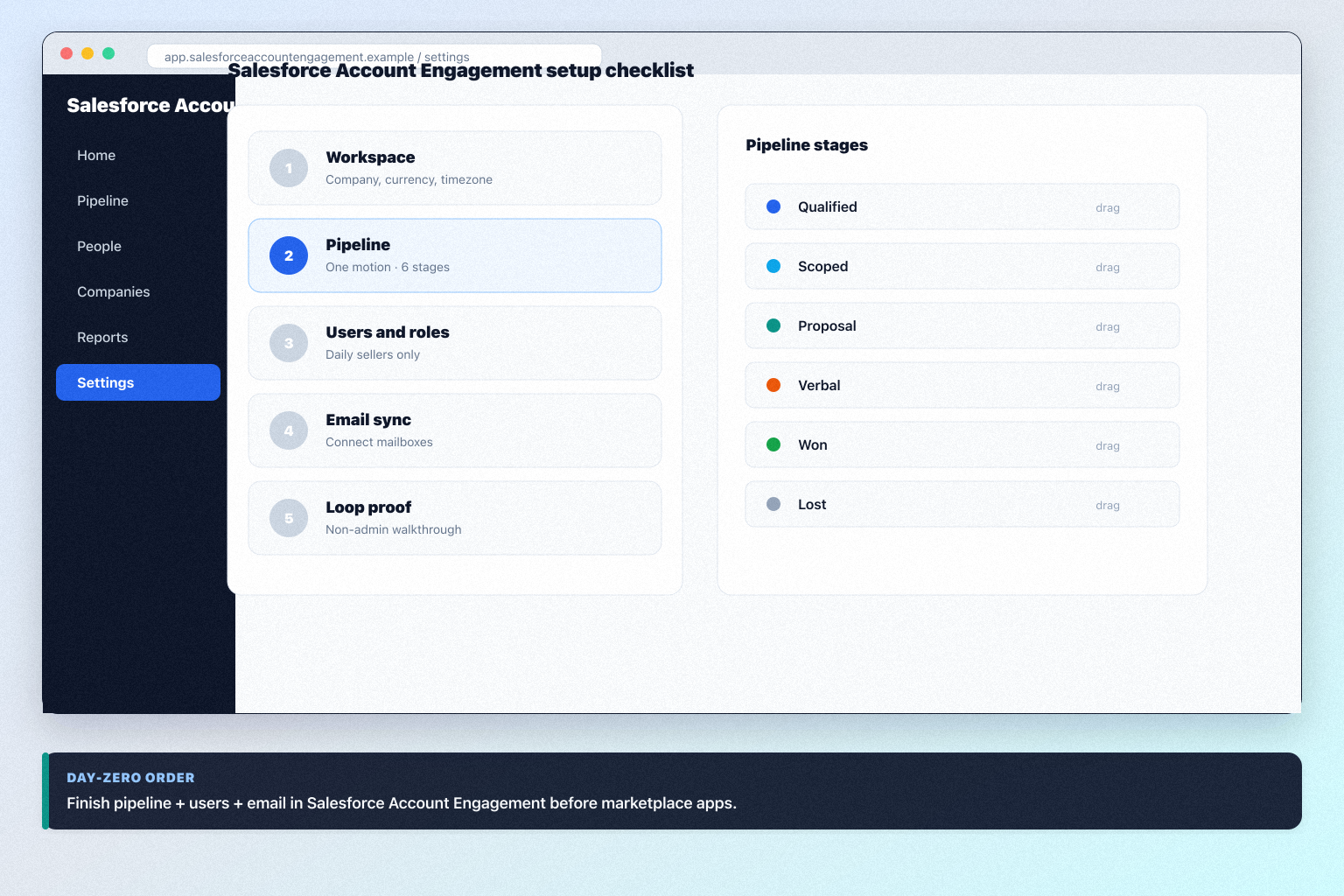
Salesforce Account Engagement setup walkthrough
Salesforce Account Engagement: must-have vs nice-to-have
- One pipeline + required fields
- email sync
- Non-admin loop proof
- workflow automation
- AI assistance
Salesforce Account Engagement checklist
Bring these questions to every demo
Ask vendors to show the workflow live, not just describe it.
- 1Qualify the Salesforce Account Engagement planDay-one must-haves on the cheapest researched tier.
- 2Name one admin ownerTwo hours a week for fields, users, hygiene.
- 3Configure one pipeline5–7 buyer-verifiable stages + required fields.
- 4Invite daily users onlyLeast privilege; spectators wait.
- 5Connect email and calendarPlus one daily tool — document the rest as gaps.
- 6Prove the non-admin loopCreate · log · move — then write the setup note.
1. Start on the Salesforce Account Engagement plan your must-haves need
Entry plan
Our snapshot lists no free Salesforce Account Engagement plan — Enterprise is the floor. Verify on the pricing page.
Qualifying paid plan
Paid tiers — stay on the cheapest one that clears every must-have gate.
Quote-only tier
Enterprise is contact-sales in research — get gates in writing before you design around it.
Write five day-one jobs, map each to a researched Salesforce Account Engagement plan, and pick the cheapest tier that covers all five.
- List the five things sellers must do on day one.
- Match each one to a researched Salesforce Account Engagement plan. Our research does not flag plan-gated capabilities for Salesforce Account Engagement, but confirm your must-haves against the plan you actually intend to buy.
- Pick the cheapest plan that covers all five.
- Check capacity, not just features. Confirm seat/record caps for Salesforce Account Engagement before inviting everyone.
Our snapshot records no trial length for Salesforce Account Engagement — ask for an evaluation window in writing before you commit seats.
Worked example: a 12-person B2B advisory team needs contact management, lead management, pipeline management, and deal management plus email sync on day one in Salesforce Account Engagement. They start on Enterprise and note which capabilities would force an upgrade.
2. Create the workspace and name one admin owner
Admin owner
Fields, users, integrations, and data hygiene in Salesforce Account Engagement.
Sales champion
Owns stage definitions and what “next step” means.
Executive sponsor
Clears blockers; does not redesign the data model midweek.
Name one admin — not a committee — before you invite sellers.
- Create the workspace with real company name, currency, and timezone.
- Name one admin with ~2 hours a week for fields, users, and hygiene.
- Agree: new fields and pipelines go through that admin only.
- In Salesforce Account Engagement, open workspace or account settings — confirm the current control labels in the product, docs, or trial.
Worked example: a 12-person B2B advisory team makes ops the Salesforce Account Engagement admin, writes the two-hour commitment into the week, and blocks everyone else from adding fields for 30 days.
3. Model your data and exactly one pipeline in Salesforce Account Engagement
One motion first
A second pipeline in Salesforce Account Engagement can wait until the first one is honest.
Required fields
Owner, next step, next-step date, expected close — that is it.
Archive, do not recreate
Legacy fields you will not use belong in an export, not the new workspace.
Research confirms contact management, lead management, pipeline management, and deal management for Salesforce Account Engagement — that is the surface you are configuring here.
- Decide what a company, a person, and a deal mean in your business, then mirror that in Salesforce Account Engagement. Contact management is researched across every Salesforce Account Engagement plan we snapshot.
- Build one pipeline for your main motion. Pipeline management is researched across every Salesforce Account Engagement plan we snapshot.
- Use five to seven stages named after buyer-verifiable events, not internal feelings.
- Add only the required fields Friday's review needs: owner, next step, next-step date, expected close.
- In Salesforce Account Engagement, open the objects, pipeline, or deal configuration area — confirm the current control labels in the product, docs, or trial.
Worked example: a 12-person B2B advisory team configures six stages in Salesforce Account Engagement (qualified, scoped, proposal, verbal, won, lost), makes “next step” required, and refuses every other custom field until after go-live.
4. Invite daily users and set least-privilege roles
Daily users in
Anyone who owns a deal or logs activity.
Viewers wait
Read-only curiosity is not worth a paid seat in week one.
Admin rights scarce
One or two admins maximum; everyone else requests changes.
Invite people who touch deals daily. Spectators can wait.
- Invite daily users only — viewers often burn paid seats.
- Sellers get standard access; admin stays with the owner from step 2.
- Count seats against research capacity. Confirm Salesforce Account Engagement seat caps before you invite.
- In Salesforce Account Engagement, open the members, users, or permissions area — confirm the current control labels in the product, docs, or trial.
- Log in as a non-admin and prove you can create a deal.
Worked example: a 12-person B2B advisory team invites eight sellers, two managers, and ops into Salesforce Account Engagement; part-time analysts wait until someone proves they need a seat.
5. Connect email, calendar, and the first integrations
Connect now
Email, calendar, and the one tool sellers open every day.
Connect later
Finance, document, and reporting tools after adoption holds.
Document the gap
Anything Salesforce Account Engagement research does not confirm goes on the risk list, not the launch deck.
- Connect email and calendar for the people who own deals. Email sync is researched across every Salesforce Account Engagement plan we snapshot.
- Our research does not name specific Salesforce Account Engagement integrations, so verify each connector you depend on in the vendor's integration directory before go-live.
- Connect nothing else. Every extra connector is another thing to debug during onboarding week.
- Write down what is not connected. A documented gap is fine; a pretended integration is not.
- In Salesforce Account Engagement, open the integrations or connected-apps area — confirm the current control labels in the product, docs, or trial.
Worked example: a 12-person B2B advisory team connects mailboxes and their calendar in Salesforce Account Engagement, then postpones accounting and document tools until the 30-day adoption review.
6. Prove the non-admin loop, then write the setup note
- Pick a seller who is not an admin. Watch them create a company and contact, create a deal on the pipeline, log a call or email, set a next step, and move a stage in Salesforce Account Engagement.
- Fix whatever they had to ask about — that friction is your real training backlog.
- Run the same loop on mobile if that matters. Mobile app is researched across every Salesforce Account Engagement plan we snapshot.
- Write a one-page setup note: plan, stage definitions, required fields, admin owner, sync status, known gaps.
- Hand that note to the Salesforce Account Engagement implementation guide and schedule training on the same pipeline.
Worked example: a 12-person B2B advisory team's founder completes the loop in Salesforce Account Engagement without ops help, ops writes the one-pager, and only then does the team announce go-live.
Salesforce Account Engagement setup mistakes
Installing integrations before the pipeline works
Connector logos are not a sales process. Get contact management, lead management, pipeline management, and deal management right in Salesforce Account Engagement first.
Copying a 20-stage template
Stages nobody can verify from the buyer's side become noise, then get ignored.
Testing only as an admin
Admin accounts hide the permission and visibility problems sellers hit on day one.
Configuring a capability your plan does not include
Our research does not flag plan-gated capabilities for Salesforce Account Engagement, but confirm your must-haves against the plan you actually intend to buy. Check the Salesforce Account Engagement plans guide before you design around a gated feature.
Inviting everyone at once
Seats and capacity are researched limits, not suggestions. Confirm caps on the pricing page before a bulk invite.
Designing around a known weak spot
Research flags: Pricing/packaging via Salesforce sales motion. Plan for it during setup instead of discovering it in month two.
Frequently asked questions
How do I set up Salesforce Account Engagement quickly?
Qualify the plan, create the workspace with one admin owner, model contact management, lead management, pipeline management, and deal management with a single pipeline, invite daily users, connect email and calendar, then prove the loop as a non-admin. Decision rule: no non-admin loop proof means setup is not finished.
Which Salesforce Account Engagement plan should I set up on?
Researched plans are Enterprise. Pick the cheapest one that carries every day-one must-have — Our research does not flag plan-gated capabilities for Salesforce Account Engagement, but confirm your must-haves against the plan you actually intend to buy. See the Salesforce Account Engagement plans guide for the full selection algorithm.
Does Salesforce Account Engagement email sync work on every plan?
Email sync is researched across every Salesforce Account Engagement plan we snapshot. Confirm current packaging on the pricing page before go-live.
How long should setup take?
A focused small team can finish this six-step path in days, not quarters — the delay is usually agreeing stage definitions, not clicking. Our snapshot records no trial length for Salesforce Account Engagement — ask for an evaluation window in writing before you commit seats.
Should we import all our data during setup?
No. Start with a small clean working set so you can prove the loop, then run the Salesforce Account Engagement migration guide's pilot before bulk import.
Which integrations should we connect first in Salesforce Account Engagement?
Our research does not name specific Salesforce Account Engagement integrations, so verify each connector you depend on in the vendor's integration directory before go-live. Connect email and calendar, plus the one tool sellers already open daily. Everything else waits for the 30-day review.
Should we turn on AI features while setting up Salesforce Account Engagement?
Salesforce Account Engagement research mentions AI assistance without naming capabilities. Research places AI assistance on Enterprise. Leave assistance off until the manual loop is reliable — otherwise you cannot tell whether the AI or the process caused a result.
What should I do next?
Continue with the Salesforce Account Engagement implementation guide for the 30/60/90 adoption gates, or the migration guide if you are moving history from another system.
Was this article helpful?
Have more questions? Contact our support team.
Part of Salesforce Account Engagement review · CRM hub
Related products
Related comparisons
Related resources
SoftwareGlimpse Updates
Want clearer software shortlists? Get buying guides and comparisons by email.
Newsletter coming soon.