What Is Email Marketing Software? Beginner’s Guide
What is email marketing software? A clear definition of permission-based ESPs — campaigns, newsletters, and automation — and how they differ from CRM and cold outreach.
Quick answer
Email marketing software (an ESP) creates, sends, and measures permission-based marketing email to subscriber lists — newsletters, campaigns, and automation workflows centered on email. Decision rule: if the blocking job this quarter is “reach people who opted in, with measurable campaigns,” you need email marketing; if the job is “find strangers’ work emails for outbound sales,” you need sales intelligence / outreach — not an ESP.
- Permission-based lists
- Campaigns & newsletters
- Automation workflows
- Segmentation & analytics
- Not a personal inbox
- Not cold-outreach SI
Key takeaways
- ESP ≠ CRM — CRM stores ownership, pipeline, and history. Email marketing sends and measures campaigns to subscribers — then may sync results back to CRM.
- Permission is the product boundary — Marketing email assumes opted-in (or otherwise lawfully grounded) contacts. Cold outbound sequencers sit in sales intelligence, not this category.
- Contact tiers decide commercial fit — Most ESPs price by subscribers or contacts. List size and send caps usually matter more than a marketing “from” tile.
- Automation depth varies widely — Simple newsletters, design-led campaigns, and multi-step journeys are different jobs under one label — name the job first.
Email marketing building blocks
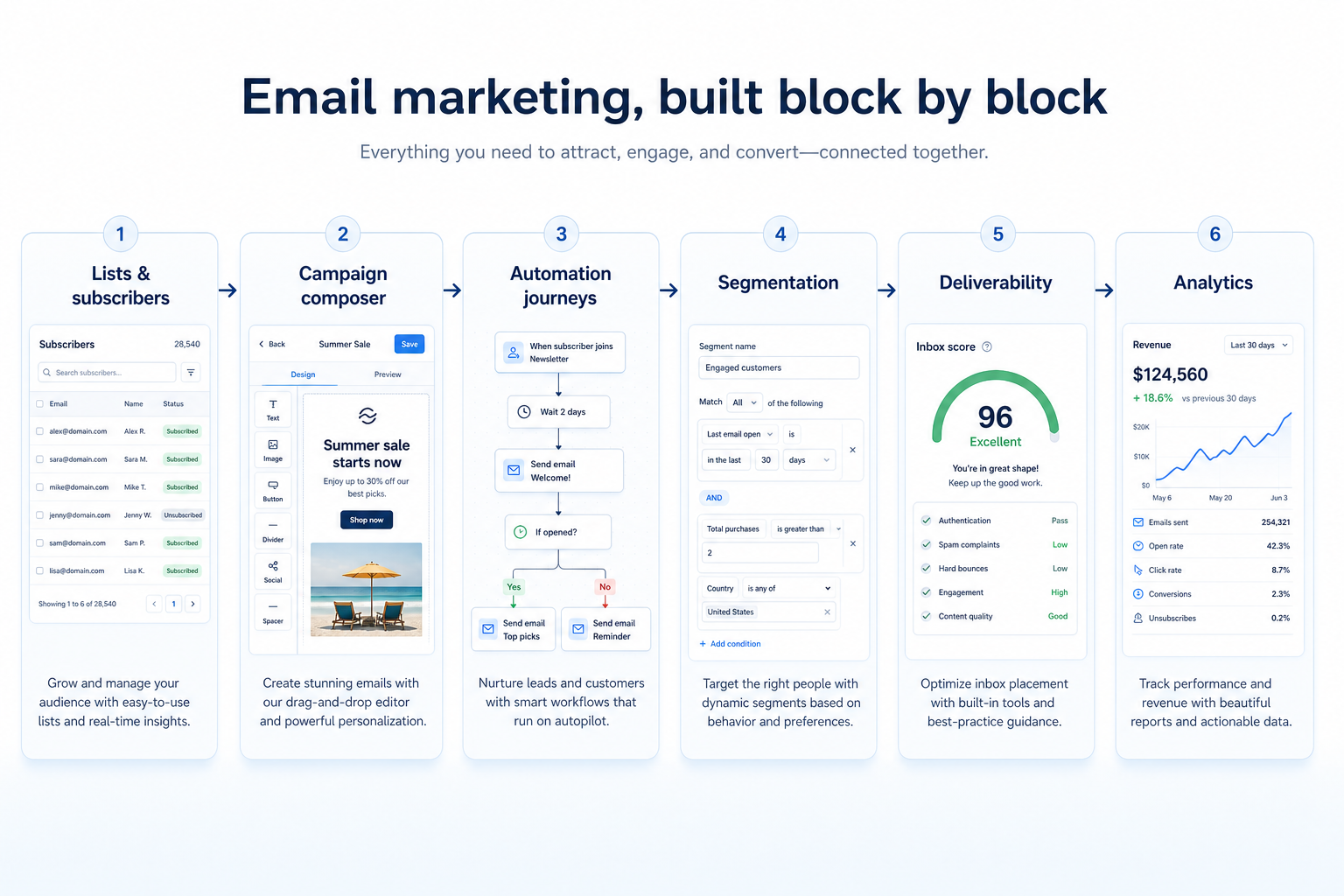
1. How does email marketing software work?
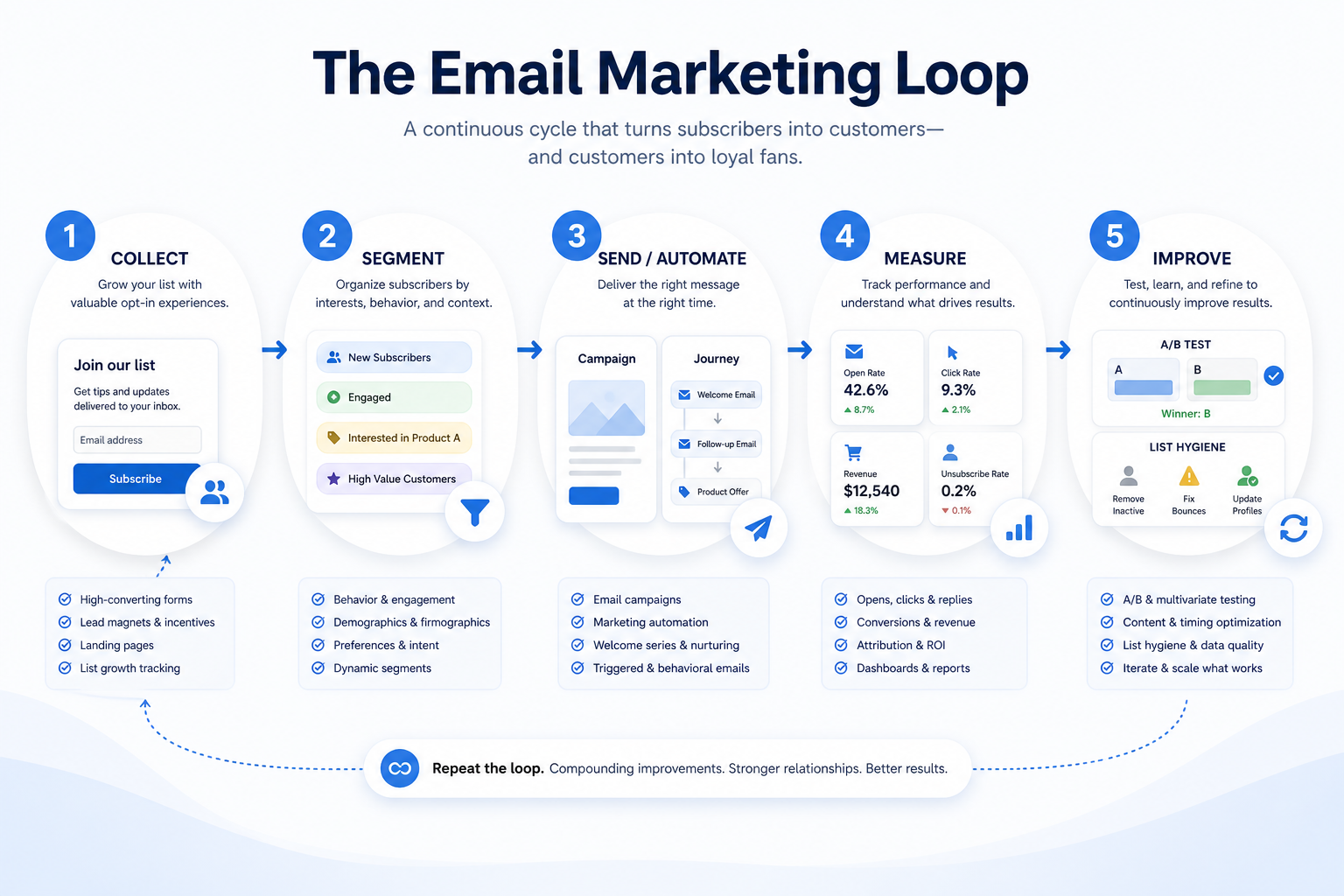
List
Capture subscribers with consent and keep suppression / unsubscribe handling honest.
Create
Compose with templates, drag-and-drop editors, or reusable design systems.
Segment
Target by attributes, behavior, and lists — not one blast to everyone.
Send
Run one-off campaigns, recurring newsletters, or multi-step automations.
Measure
Track delivery, engagement, and conversion signals your team will act on.
Most ESPs share a loop: grow and clean a subscriber list, compose with templates or a visual editor, segment who receives each message, send one-off campaigns or automated journeys, then measure opens, clicks, and conversions while protecting deliverability (domain auth, list hygiene).
Example: a three-person ecommerce team at Northline Goods (DTC accessories) runs a weekly newsletter plus cart-abandon journeys. They capture signups on landing pages, segment by purchase history, send campaigns from their ESP, and push revenue events back to analytics — without treating the ESP as their order system of record.
2. What email marketing typically includes
Core ESP products cover campaigns, newsletter tooling, templates, subscriber management, segmentation, and analytics. Many add automation workflows, landing pages, forms, A/B tests, and light AI for subject lines or copy. Deliverability aids and list verification are often adjacent — useful, but not a substitute for a campaign platform.
Catalogue examples (alphabetical, not a ranking): ActiveCampaign, AWeber, Campaign Monitor, GetResponse, and Mailchimp illustrate different mixes of automation depth, design focus, and freemium paths. Compare them by primary job and contact-tier fit — never by affiliate order or invented scores.
Common email marketing shapes (not rankings)
Newsletter / campaign ESP
Best for: Teams whose primary job is recurring newsletters and scheduled campaigns with solid templates.
Avoid when: You need deep multi-step journeys and behavioral branching as the core product job.
Automation-led ESP
Best for: Marketing-led teams that need multi-step workflows triggered by subscriber events.
Avoid when: You only need a simple weekly newsletter and will never use journeys.
Ecommerce-oriented email
Best for: Stores needing cart recovery, product blocks, and commerce integrations.
Avoid when: You have no storefront and only need editorial newsletters.
All-in-one creator / funnel platform
Best for: Creators consolidating email with landing pages, checkouts, or courses in one stack.
Avoid when: You only need a lightweight ESP and do not want suite complexity.
3. Name the job email marketing software should own
An ESP repeats a permission-based loop: grow and clean a subscriber list, compose, segment, send campaigns or automations, measure, then protect deliverability.
Example: Northline Goods (DTC accessories, three marketers) runs a Friday newsletter plus cart-abandon journeys. They capture signups on the store, segment by last purchase, and treat unsubscribes as a first-class list — not a CRM pipeline stage.
4. Next: freeze requirements and compare fairly
Move to /guides/how-to-choose-email-marketing/ once the job cluster is clear. Compare finalists with the same assumptions — not affiliate-ordered lists.
5. Use a one-page checklist before demos
For What Is Email Marketing Software? Beginner’s Guide, list must-haves, owners, integrations, and the weekly ritual this purchase must improve. Share the sheet with finance and IT before you schedule a second demo.
- Name the primary job in one sentence.
- List must-have gates (plans, SSO, data residency, usage caps).
- Name integrations that must work on day one.
- Assign an admin owner and a weekly user champion.
- Define non-admin proof — what a sceptic completes without rescue.
Worked example: Harbor Ops refuses demos until the checklist is signed — cutting evaluation time in half.
6. Avoid the usual buying mistakes
Common failures in email-marketing: buying for brand familiarity, comparing entry tiles across different usage units, skipping a fair trial script, and adding scope before adoption proves out.
Run one trial script on every finalist the same week. Score on the same card. Write a one-paragraph decision memo that names what you are not buying yet.
7. Hand off to the category shortlist
When assumptions are frozen, continue on /best/email-marketing-software/ with the same headcount, usage band, and must-have gates on every quote.
Frequently asked questions
Is email marketing the same as sales outreach email?
No. Email marketing targets permission-based subscribers with campaigns and journeys. Cold outbound to purchased or scraped contacts is a sales-intelligence / sequencing job with different compliance and product shape.
Do I need email marketing if I already have a CRM?
Often yes. CRM may log sales email; an ESP is built for list growth, campaign design, marketing automation, and deliverability tooling at list scale. Many teams connect both.
What should I do next?
If you confirmed permission-based campaigns are the job, use How to Choose Email Marketing and the Best Email Marketing Software shortlist — methodology-first, not affiliate-ordered.
Was this article helpful?
Have more questions? Contact our support team.
Part of Software buying guides · How to Choose Email Marketing Software: Job-First Framework
Related guides
Supporting reading in this topic — not a generic related-posts dump.
- Is InboxAlly Worth It? Fit Scenarios Before You BuyDecide if InboxAlly is worth it for your marketing team — fit scenarios, contact economics, and when to keep looking — without invented ROI percentages.
- Is Bouncer Worth It? Fit Scenarios Before You BuyDecide if Bouncer is worth it for your marketing team — fit scenarios, contact economics, and when to keep looking — without invented ROI percentages.
- Is AWeber Worth It? Fit Scenarios Before You BuyDecide if AWeber is worth it for your marketing team — fit scenarios, contact economics, and when to keep looking — without invented ROI percentages.
- Is Kit Worth It? Fit Scenarios Before You BuyDecide if Kit is worth it for your marketing team — fit scenarios, contact economics, and when to keep looking — without invented ROI percentages.
- Is ActiveCampaign Worth It? Fit Scenarios Before You BuyDecide if ActiveCampaign is worth it for your marketing team — fit scenarios, contact economics, and when to keep looking — without invented ROI percentages.
- ActiveCampaign Plans: Contacts, Sends, and Qualifying TiersChoose your ActiveCampaign plan by mapping must-haves to contact tiers, send limits, and qualifying features — not homepage “from” tiles — then confirm on the pricing page.
- AWeber Plans: Contacts, Sends, and Qualifying TiersChoose your AWeber plan by mapping must-haves to contact tiers, send limits, and qualifying features — not homepage “from” tiles — then confirm on the pricing page.
Related products
SoftwareGlimpse Updates
Want clearer software shortlists? Get buying guides and comparisons by email.
Newsletter coming soon.