Email Marketing Pricing Guide: Contact Tiers & First 90 Days
Learn how email marketing pricing works — contact tiers, send caps, feature gates, and how to compare written quotes for the first 90 days — without invented price tables.
Quick answer
Email marketing pricing is usually driven by contact or subscriber tiers — sometimes with monthly send caps, feature gates, and add-ons — so the headline “from” price rarely matches your first 90 days at real list size. Decision rule: do not compare tools on marketing starting prices; map must-have workflows to the qualifying plan, confirm what counts as a billable contact, then compare written quotes for the same list-size and send-volume assumptions.
- Contact / subscriber tiers
- Send caps vs unlimited
- Feature-gated plans
- What counts as a contact
- First-90-day quote compare
- No invented dollar totals
Key takeaways
- List size is the bill — Most ESPs charge by contacts. Inactive and suppressed contacts may still count — ask in writing.
- Send caps hide on cheap tiers — Lower plans often limit monthly emails even when contact floors look affordable.
- Automation sits behind gates — Journeys, branching, SMS, or dedicated IP often unlock above entry tiers.
- Bands beat fake precision — Use vendor pricing pages and written quotes; never invent market averages or totals in a memo.
Pricing literacy path
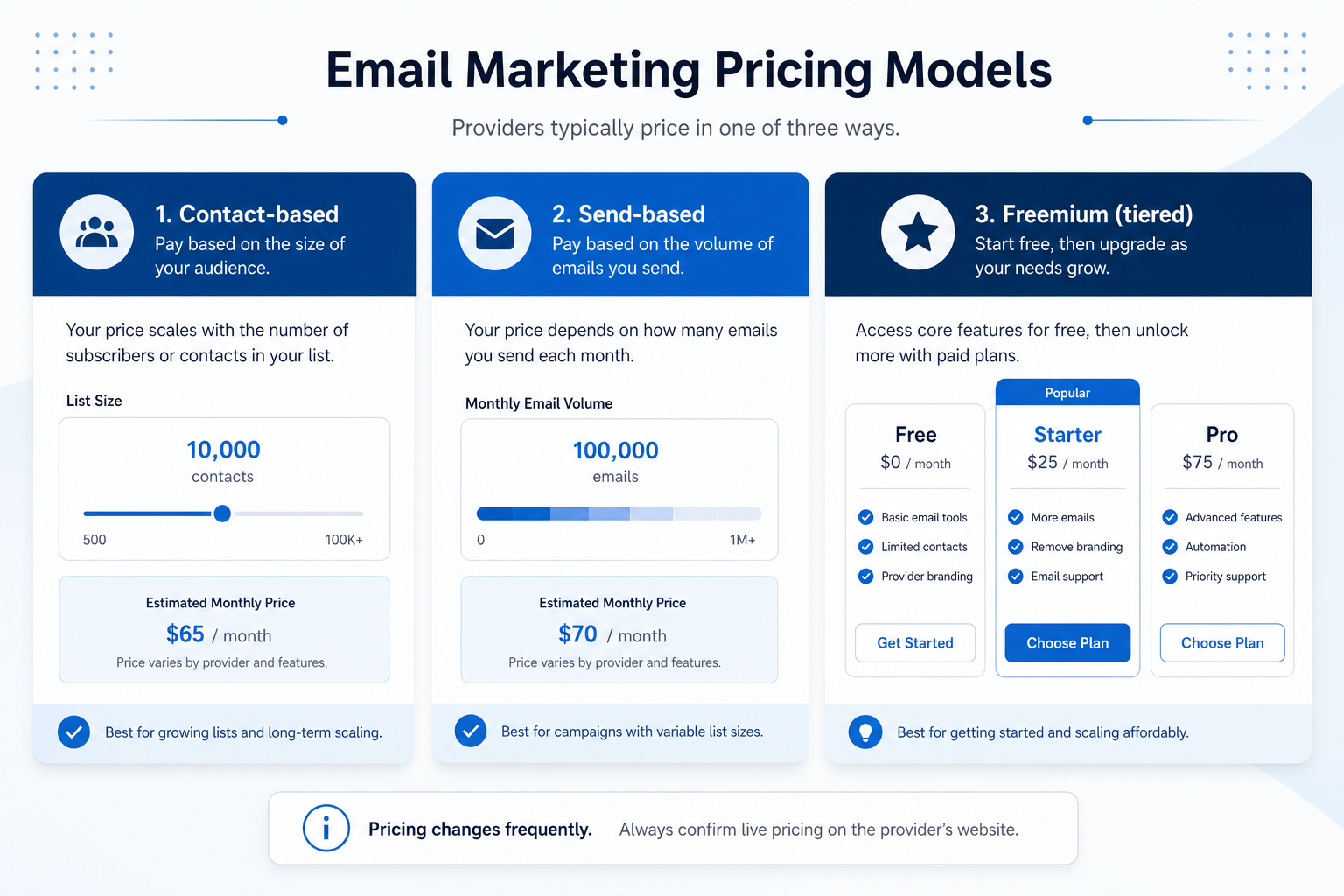
Common pricing models
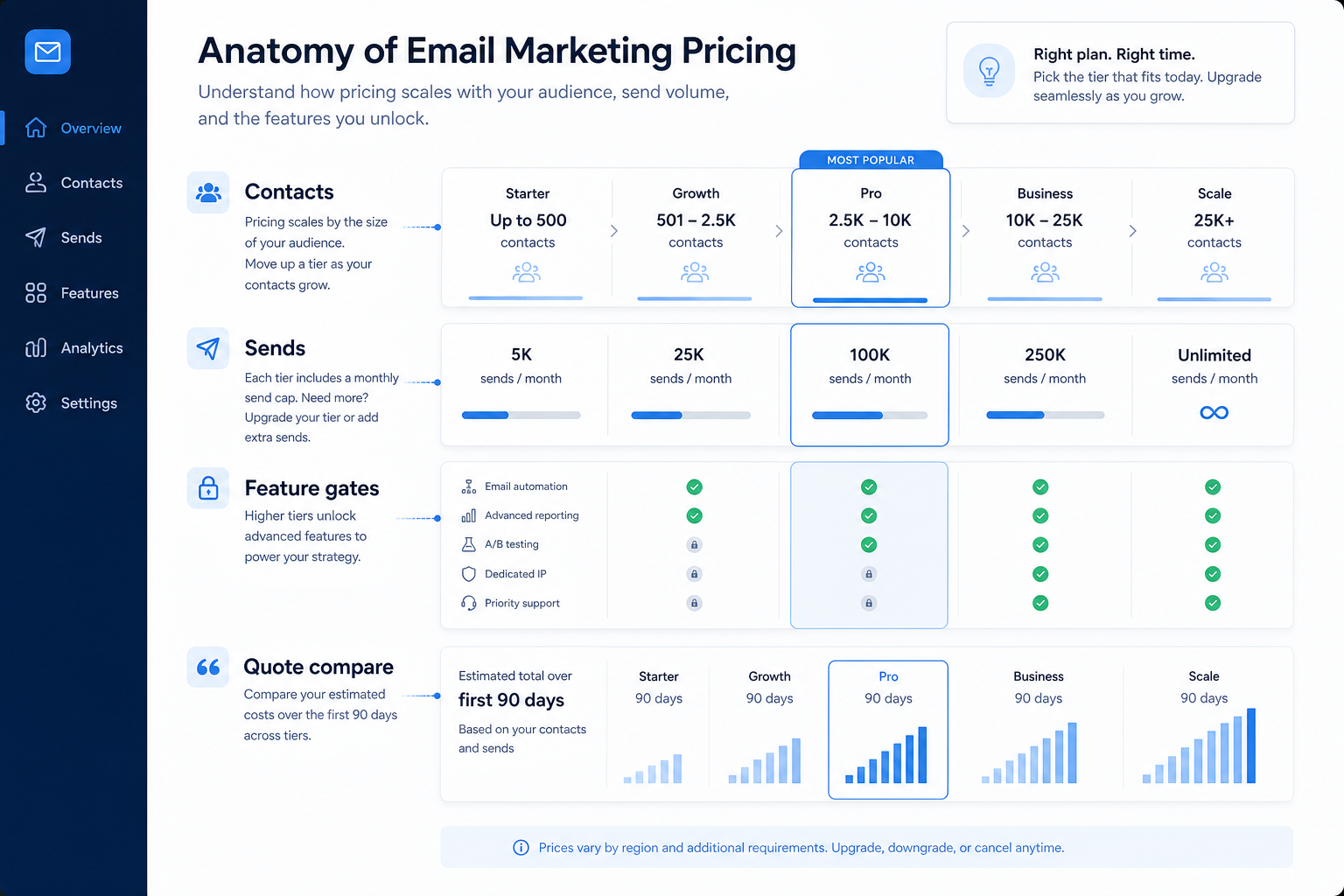
1. Recognize contact tiers, send caps, and feature gates
Contact-tier subscription
Ongoing programs: pay for list size; confirm inactive contact billing.
Send-capped entry
Cheap or free rungs may limit monthly emails — model real campaign cadence.
Feature gates
Must-have journeys or ecommerce tools may force an up-tier at the same contact band.
Most catalogue ESPs sell plan ladders keyed to contact counts. Some freemium plans cap monthly newsletters or contacts. Automation, landing pages, transactional email, SMS, or dedicated IP often sit above entry tiers — ask how those are licensed without claiming a specific product’s unpublished price as fact.
Example: a solo creator with ~800 subscribers often fits freemium or entry paid tiers (AWeber- or GetResponse-style packaging) if automation needs stay light. A marketing-led SMB running multi-step journeys usually needs the plan that unlocks automation — not the cheapest contact tile.
2. Compare first 90 days on the same volume sheet
For every finalist, fill one sheet: starting contacts, expected net-new per month, campaigns per week, one must-have automation, and required integrations. Ask each vendor (or read the pricing page) which plan qualifies — then compare those plans only.
Worked example: Northline Goods models 12,000 contacts and weekly promo + cart journeys. Vendor A’s entry tier fits contacts but locks cart automation; Vendor B’s mid tier clears both. The team compares mid-tier quotes, not entry tiles.
3. Compare written quotes on the same assumptions
Same headcount
Every quote uses the same people who need access — not a pilot subset.
Same usage band
Credits, tokens, GPU hours, or send caps modeled at realistic volume.
Same gates
SSO, agents, stealth modes, or automation depth unlock on named tiers.
For every finalist in email marketing software, fill one sheet: headcount or list size, must-have gates, usage units you will actually hit, and integrations that must work on day one. Ask each vendor which plan qualifies — then compare those plans only, not homepage tiles.
Worked example: Harbor Ops models the same seat count and credit band for three AI assistants. Vendor A’s personal tier looks cheaper until Business unlocks connectors; Vendor B’s team pack looks expensive until overage on Vendor A is included. The honest compare is qualifying configuration × usage — documented in writing.
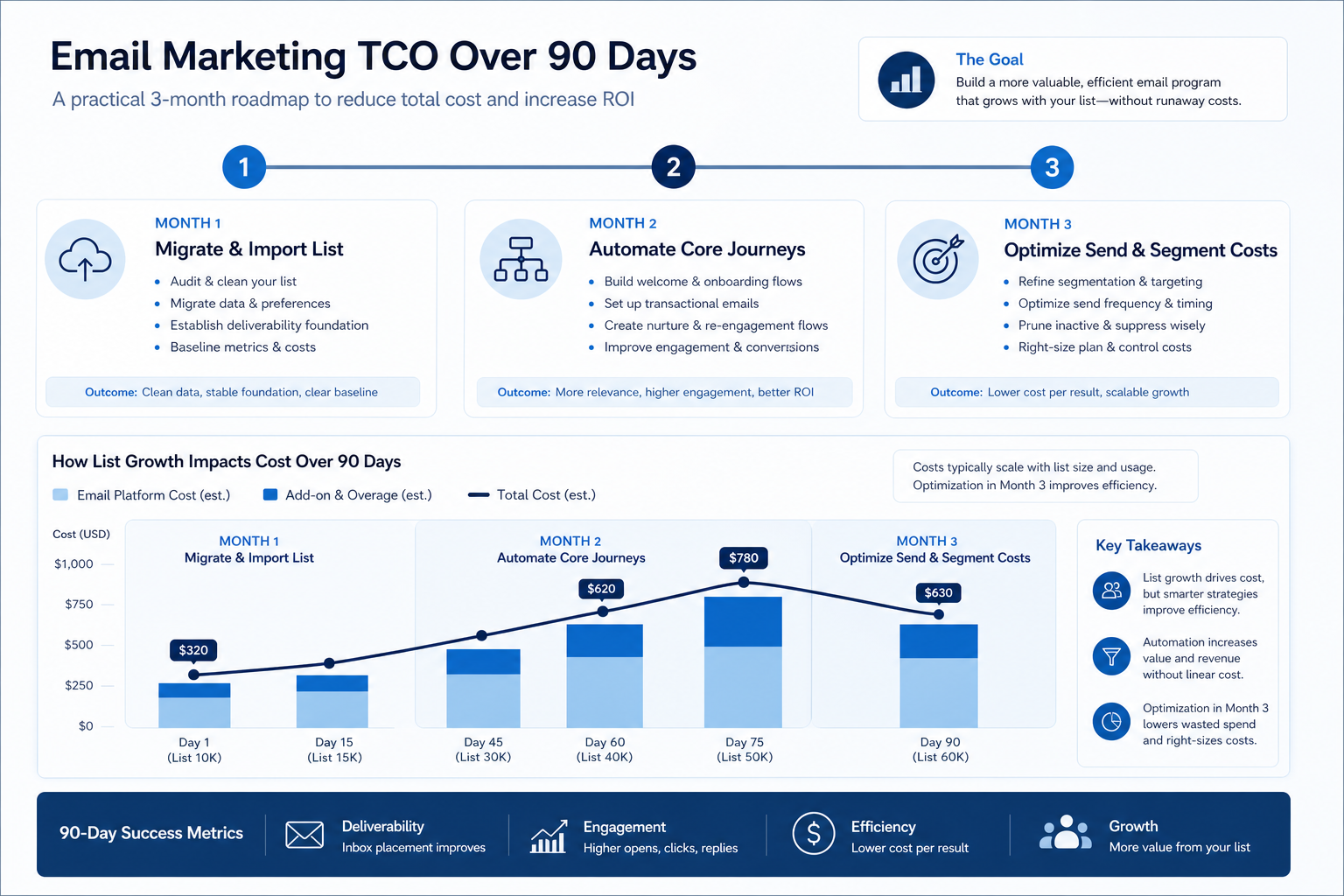
4. Budget the first quarter, not the teaser month
Starter tiles optimize for sign-up, not your first 90 days at real scale. Include list or seat growth, seasonal spikes, overage triggers, and add-on SKUs (Copilot layers, credit packs, dedicated IP) before you ask finance to approve spend.
Worked example: Northline Studio adds 20% buffer to image-credit usage for a campaign launch and keeps annual vs monthly side by side when GPU spikes are likely.
5. Hand off to selection with frozen assumptions
When quotes are comparable, move to the selection framework with must-haves frozen. Rank finalists on fit for the weekly job, governance, and the total you modeled — not affiliate availability or brand familiarity.
Next: /guides/how-to-choose-email-marketing/
6. Use a one-page checklist before demos
For Email Marketing Pricing Guide: Contact Tiers & First 90 Days, list must-haves, owners, integrations, and the weekly ritual this purchase must improve. Share the sheet with finance and IT before you schedule a second demo.
- Name the primary job in one sentence.
- List must-have gates (plans, SSO, data residency, usage caps).
- Name integrations that must work on day one.
- Assign an admin owner and a weekly user champion.
- Define non-admin proof — what a sceptic completes without rescue.
Worked example: Harbor Ops refuses demos until the checklist is signed — cutting evaluation time in half.
7. Avoid the usual buying mistakes
Common failures in email-marketing: buying for brand familiarity, comparing entry tiles across different usage units, skipping a fair trial script, and adding scope before adoption proves out.
Run one trial script on every finalist the same week. Score on the same card. Write a one-paragraph decision memo that names what you are not buying yet.
8. Hand off to the category shortlist
When assumptions are frozen, continue on /best/email-marketing-software/ with the same headcount, usage band, and must-have gates on every quote.
Frequently asked questions
Do unsubscribed contacts count toward pricing?
It depends on the vendor. Some bill only active subscribers; others count broader contact records. Confirm in writing for your shortlist.
Are free plans really free?
Forever-free and freemium plans exist on some ESPs, usually with contact and send caps and limited automation. Use them to learn — then map paid gates before you scale.
What should I do next?
Freeze must-haves, then shortlist on Best Email Marketing Software and run the evaluation guide’s trial script on qualifying plans only.
Was this article helpful?
Have more questions? Contact our support team.
Part of Software buying guides · How to Choose Email Marketing Software: Job-First Framework
Related guides
Supporting reading in this topic — not a generic related-posts dump.
- Is InboxAlly Worth It? Fit Scenarios Before You BuyDecide if InboxAlly is worth it for your marketing team — fit scenarios, contact economics, and when to keep looking — without invented ROI percentages.
- Is Bouncer Worth It? Fit Scenarios Before You BuyDecide if Bouncer is worth it for your marketing team — fit scenarios, contact economics, and when to keep looking — without invented ROI percentages.
- Is AWeber Worth It? Fit Scenarios Before You BuyDecide if AWeber is worth it for your marketing team — fit scenarios, contact economics, and when to keep looking — without invented ROI percentages.
- Is Kit Worth It? Fit Scenarios Before You BuyDecide if Kit is worth it for your marketing team — fit scenarios, contact economics, and when to keep looking — without invented ROI percentages.
- What Is Email Marketing Software? Beginner’s GuideWhat is email marketing software? A clear definition of permission-based ESPs — campaigns, newsletters, and automation — and how they differ from CRM and cold outreach.
- Is ActiveCampaign Worth It? Fit Scenarios Before You BuyDecide if ActiveCampaign is worth it for your marketing team — fit scenarios, contact economics, and when to keep looking — without invented ROI percentages.
- ActiveCampaign Plans: Contacts, Sends, and Qualifying TiersChoose your ActiveCampaign plan by mapping must-haves to contact tiers, send limits, and qualifying features — not homepage “from” tiles — then confirm on the pricing page.
- AWeber Plans: Contacts, Sends, and Qualifying TiersChoose your AWeber plan by mapping must-haves to contact tiers, send limits, and qualifying features — not homepage “from” tiles — then confirm on the pricing page.
Related products
SoftwareGlimpse Updates
Want clearer software shortlists? Get buying guides and comparisons by email.
Newsletter coming soon.