SoftwareGlimpse
Project Management & Productivity Software

Is Microsoft Project Worth It? Fit Scenarios Before You Buy

Decide if Microsoft Project is worth it for your team — job-cluster fit, trial proof, and packaging — without invented ROI percentages.

By Lee M.Updated Aug 18, 202611 min readFact-checked

Quick answer

Microsoft Project is worth it when your primary job is schedule-driven PMO planning, a non-admin can a planner updates percent-complete and a sponsor sees the shifted finish date on the package you will buy, and you can live with the researched tradeoffs. It is not worth stretching into a lightweight kanban or a docs wiki. Confirm workload and resources (Planner Plan 1+) and AI assistance (Planner Plan 1+) are on the package you will actually buy. If fit, proof, or packaging fails, keep looking — do not invent ROI to justify a shaky buy.

  • Fit the job cluster
  • Prove the core loop with a non-admin
  • Accept tradeoffs in writing
  • Confirm the qualifying package
  • Name an admin with weekly hours
  • Otherwise keep looking
Goals
Features
Integrations
Cost
Ease of use
Growth

See Microsoft Project before you decide

Core product overview media for a fit check — still not a substitute for the decision criteria on this page.

See Microsoft Project in action

Official product overview for a fit check — not scoring, pricing, or comparative superiority.

This video is hosted on YouTube

This content is hosted by YouTube. The player loads only after you allow marketing cookies.

Official vendor video

Overview of Microsoft Project

How Microsoft Project presents the product in an official vendor video.

What this shows

  • Microsoft Project product surfaces as shown in the official vendor video
  • UI/workflow layout marketed by the vendor

Product screenshots

Verified captures from Microsoft Project's product interface.

Microsoft Project overview interface

Product UI frame from the official Microsoft 365 “Overview of Microsoft Project” video.

Official Microsoft 365 YouTube thumbnail/frame (vendor channel) — not a SoftwareGlimpse capture

https://www.youtube.com/watch?v=1TyZCUNYZPE · Checked 2026-08-18

Full product screenshots and evidence live on the Microsoft Project research page.

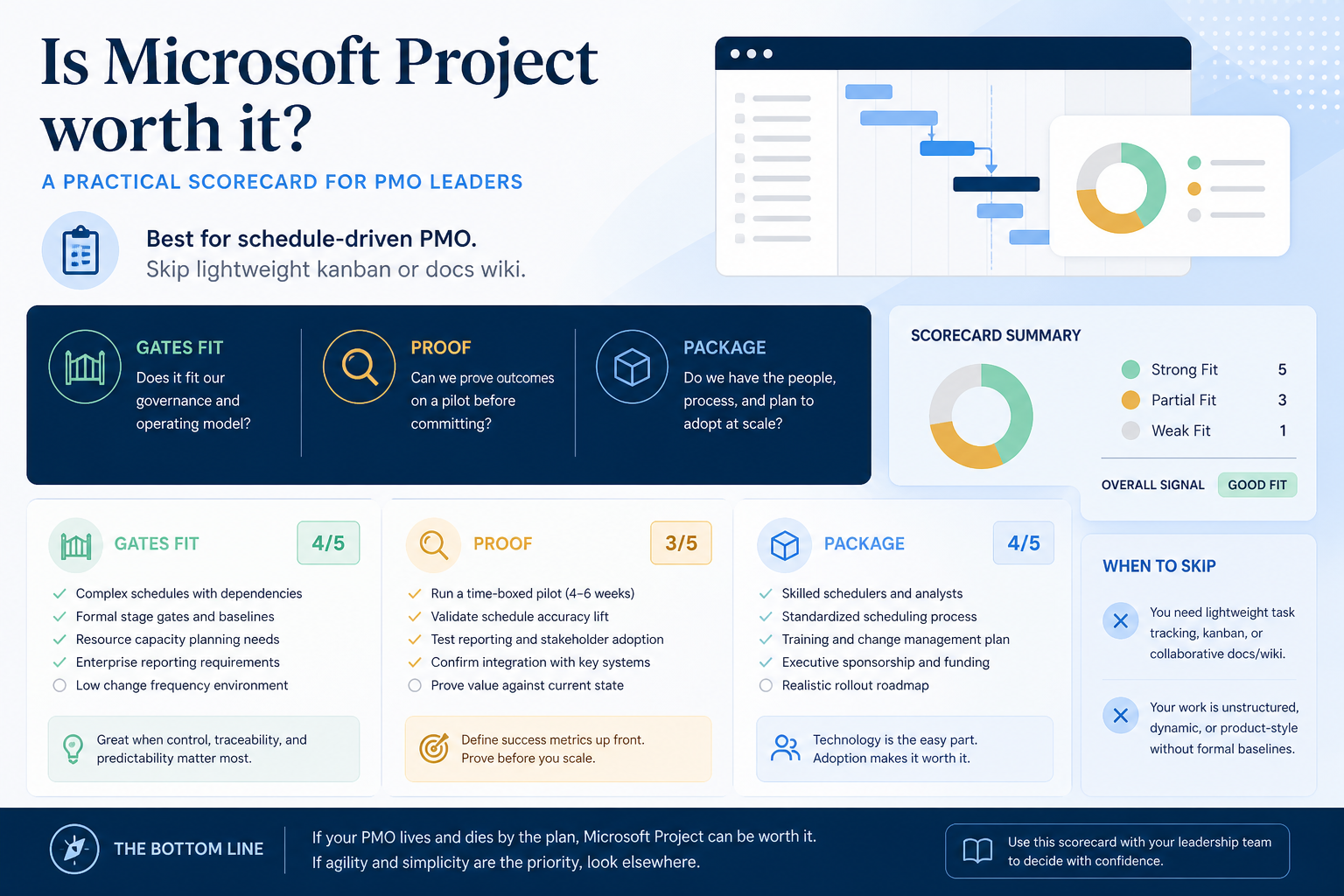
Is Microsoft Project worth it?

  • What it is Microsoft Project (with Planner) is the Microsoft 365 project-management ladder for task boards, Gantt schedules, resource management and portfolio views. Common published floors: Planner Plan 1 ~list price; Planner and Project Plan 3 ~list price; Plan 5 ~list…
  • Fit Best for: Microsoft 365 standardised orgs; Traditional PMO Gantt/resource needs; Enterprise portfolio planning on higher plans. Not ideal: Startups wanting modern Work OS UX; Lowest-cost task apps; Non-Microsoft stacks.
  • Proof Worth it only when Harbor PMO (construction-style schedule owners) can a planner updates percent-complete and a sponsor sees the shifted finish date.
  • Package Plan-gated in research: workload and resources (Planner Plan 1, Planner and Project Plan 3, Planner and Project Plan 5); AI assistance (Planner Plan 1, Planner and Project Plan 3, Planner and Project Plan 5).
  • No invented ROI Outcomes, usability, and qualifying cost either align or they don’t — affiliate economics are not a score.
  • Editorial verdict snapshot Microsoft Project: Choose Microsoft Project/Planner when Microsoft 365 is the system of work and traditional scheduling/portfolio depth matters — landscape on modern Work OS lists. Scores use the project-management editorial methodology from first-party research as of 2026-08-17 — not hands-on product testing.

Microsoft Project worth-it gates

  1. 1Job cluster
  2. 2Non-admin loop
  3. 3Accept?
  4. 4Qualifying hub
  5. 5Buy/pass

Microsoft Project fit / proof / package

Microsoft Project worth-it gates: fit, proof, package.
Microsoft Project is “worth it” when outcomes, usability, and qualifying cost align — not when a demo feels exciting.

Microsoft Project fit checklist

0/4 dimensions noted — saved in this browser only.

  • Primary job

  • Who updates weekly

  • Workspace owner

  • Visibility need

Do not buy the wrong work-management cluster

  • Work OS / collaborative projects

    Best for: Shared ownership, boards or action cards, manager visibility across functions.

    Avoid when: You actually need an engineering tracker, a Gantt slide, or a PDF editor.

  • Engineering issue tracking

    Best for: Issues, sprints/cycles, developer boards, release comments.

    Avoid when: Marketing campaigns and client proofing are the real job.

  • Spreadsheet PMO

    Best for: Dependencies, reports, and stakeholders who think in grids.

    Avoid when: You wanted a lightweight personal to-do list.

  • Docs + databases

    Best for: Project docs linked to task databases.

    Avoid when: You need a dedicated sprint tracker or Gantt presenter.

Microsoft Project must vs nice

Must-have
  • Job-cluster fit
  • Non-admin loop
  • Qualifying package
Nice-to-have
  • Demo excitement / brand preference

When Microsoft Project is the right size of tool

  1. 01

    Likely worth evaluating

    Your motion looks like schedule-driven PMO planning and someone will admin Microsoft Project weekly.

    • Microsoft 365 standardised orgs; Traditional PMO Gantt/resource needs; Enterprise portfolio planning on higher plans
  2. 02

    Borderline — trial hard

    Needs are real but admin capacity is thin, or one must-have sits on a higher hub.

    • Set a decide-by date
    • Prove the loop on the qualifying package
  3. 03

    Usually not worth it

    The blocking job is a lightweight kanban or a docs wiki, or nobody will update the board.

    • Startups wanting modern Work OS UX; Lowest-cost task apps; Non-Microsoft stacks

Microsoft Project connectors to verify in trial

Research names Microsoft Teams, Microsoft 365, Power Automate, and Azure Devops on the Microsoft Project side — confirm the connectors your work loop depends on.

  • Microsoft Teams
  • Microsoft 365
  • Power Automate
  • Azure Devops

Verify each workflow in a trial — marketplace logos are not proof of fit.

How to judge Microsoft Project against peers

  • Job-cluster match

    Does the product’s primary job match schedule-driven PMO planning?

    Weight 5
  • Non-admin loop

    a planner updates percent-complete and a sponsor sees the shifted finish date

    Weight 5
  • Manager visibility

    A lead can see status without a screenshot or side sheet.

    Weight 4
  • Qualifying packaging

    Must-haves on a real tier; guests/seats understood.

    Weight 4
  • Admin load

    Someone has weekly hours; hygiene is possible.

    Weight 3

Microsoft Project evaluation scorecard (no invented scores)

Weight the criteria; fill scores from your trial — SoftwareGlimpse does not invent a numeric ROI or a “worth it %.”

Criterion (weight)Microsoft ProjectSmartsheetWrike
Job-cluster fit ×5
Non-admin proof ×5
Qualifying package ×4
Admin capacity ×3
Accepted tradeoffs ×3
Weighted fit %0%0%0%

Scores are yours — not SoftwareGlimpse rankings. Affiliate status never changes this scorecard.

If fit fails, compare inside the same cluster

Do not rank Microsoft Project against a PDF editor or a remote-desktop tool. Stay in the same job cluster.

  • Smartsheet logo
    Smartsheet

    Spreadsheet-style work management with Gantt, portfolios and automation — Pro from $9/member/mo annual.

    View CRM profile
  • Wrike logo
    Wrike

    Enterprise/agency work management with proofing, intake and resourcing — Team from $10/user/mo annual.

    View CRM profile
  • monday.com logo
    monday.com

    Work OS / work management platform with boards, timelines, automations and AI credits — Basic from $9/seat/mo annual (3-seat minimum).

    View CRM profile
  • Asana logo
    Asana

    Cross-functional work management with goals, workflows and AI Studio — Starter from $10.99/user/mo annual.

    View CRM profile

Shortlist is cluster-matched from the catalogue — not an affiliate-ordered ranking and not a score.

Microsoft Project checklist

Bring these questions to every demo

Ask vendors to show the workflow live, not just describe it.

  • 1Match best-for scenariosYour motion should be schedule-driven PMO planning.
  • 2Prove the work loopa planner updates percent-complete and a sponsor sees the shifted finish date
  • 3Confirm seats and hubsMust-haves on a real tier before you call it a bargain.
  • 4Write buy · extend · passOne page, named reasons, no invented ROI.

1. Fit gate: does your motion match this job cluster?

Microsoft Project worth-it diagram 1.
Fit Microsoft Project to schedule-driven PMO planning before you talk ROI.
  • Strong fit

    Motion matches best-for; admin named; contributors will live in it.

  • Borderline

    Needs are real but admin capacity is thin — trial hard, set a decide-by date.

  • Poor fit

    Poor-fit patterns dominate — compare Smartsheet and monday.com inside the same cluster.

Answer yes or no. Four or more “no” answers means Microsoft Project is the wrong tool right now. 1. Is your primary job schedule-driven PMO planning — not a lightweight kanban or a docs wiki?

  1. Best for: Microsoft 365 standardised orgs; Traditional PMO Gantt/resource needs; Enterprise portfolio planning on higher plans.
  2. Not ideal: Startups wanting modern Work OS UX; Lowest-cost task apps; Non-Microsoft stacks.
  3. Will named contributors update Microsoft Project weekly?
  4. Is there an admin with ~2 hours a week? Worked example: Harbor PMO (construction-style schedule owners) scores Microsoft Project on schedule-driven PMO planning only — they refuse to treat it as a lightweight kanban or a docs wiki. A polished demo does not change the score.

2. Proof gate: scripted non-admin loop — not a guided demo

Microsoft Project worth-it diagram 2.
Microsoft Project is worth it only when your team can run the loop.
  • Trial pass

    Non-admin loop works; manager visibility works.

  • Trial ambiguous

    Extend once with one written question that would close it.

  • Trial fail

    Contributors need babysitting for basic updates — that does not improve after purchase.

Our snapshot flags a trial on Planner Plan 1, Planner and Project Plan 3, and Planner and Project Plan 5 without a published length — confirm the window on the Microsoft Project pricing page. Success: a planner updates percent-complete and a sponsor sees the shifted finish date. 1. Use real work, not sample data.

  1. Give the loop to the least enthusiastic contributor.
  2. A manager must see the result without an admin screenshot.
  3. Break something on purpose (reassign, filter, export) and time the recovery. Worked example: Harbor PMO (construction-style schedule owners) fails the gate when only an admin can complete the walkthrough; they extend trial and fix permissions before considering buy.

Microsoft Project evaluation script

  1. Day 1: Honest workspace

    • Confirm which Microsoft Project package the trial tenant is on
    • Stand up one project file, calendars, and who may publish vs view
    • Invite only weekly users plus one sceptic
  2. Day 3: Non-admin loop

    • a planner updates percent-complete and a sponsor sees the shifted finish date
    • Manager finds status without a screenshot
    • Write down every question asked
  3. Day 7: Weekly ritual

    • Run one status review entirely in Microsoft Project
    • Reassign an owner and check history
    • Test: task boards, timeline / Gantt, workload and resources, and automations and workflows
  4. Day 14: Decide

    • Score fit, proof, package, admin capacity
    • Confirm qualifying plan on /pricing/microsoft-project/
    • Write buy, extend (one condition), or pass

3. Tradeoff gate: label every watch-out

Microsoft Project worth-it diagram 3.
Accept Microsoft Project tradeoffs in writing — or keep looking.
  • Acceptable

    You can name why it does not hit your three outcomes.

  • Mitigable

    Owner, cost, and date attached — or it is not a mitigation.

  • Disqualifying

    It blocks the job — compare peers in the same cluster.

Strengths: Strong Gantt/resource planning; Native M365/Teams fit; Enterprise scale path; Planner entry rung. Watch-outs: Premium mid/high tiers; Steeper classic Project learning curve; SKU complexity; Not a modern Work OS peer. 1. Sort each watch-out: acceptable · mitigable (named owner + date) · disqualifying.

  1. Treat strengths as trial claims, not facts.
  2. If a disqualifier appears in trial, stop. Worked example: Harbor PMO (construction-style schedule owners) documents known gaps instead of pretending Microsoft Project covers every work-management job.

4. Package gate and write buy · extend · pass

Microsoft Project worth-it diagram 4.
Buy Microsoft Project only when fit, proof, and package gates agree.
  • Buy

    Fit, proof, package, and admin hours all written.

  • Extend

    One closing question and a date — not an open-ended demo.

  • Pass

    Wrong cluster or failed proof — that is a successful evaluation.

  1. Confirm must-haves on a qualifying package. Plan-gated in research: workload and resources (Planner Plan 1, Planner and Project Plan 3, Planner and Project Plan 5); AI assistance (Planner Plan 1, Planner and Project Plan 3, Planner and Project Plan 5).
  2. Never invent list prices here — confirm seats, hubs, and quote terms on /pricing/microsoft-project/.
  3. Name the admin and weekly hours.
  4. Buy only when fit + proof + package all say yes.
  5. Otherwise keep looking via how to choose project management software — teams often also evaluate Smartsheet, monday.com, and Asana. Worked example: Harbor PMO (construction-style schedule owners) clears fit and proof but pauses the buy until hub/seat rules are written. They do not invent an ROI percentage to unblock procurement.

Ways teams wrongly decide Microsoft Project is “worth it”

  • Inventing ROI in a spreadsheet

    SoftwareGlimpse does not publish a worth-it percentage. If fit, proof, or package fails, the honest answer is no.

  • Buying from a demo high

    Demos are run by people who live in the product. Your sceptic contributor is the test.

  • Stretching the job cluster

    Microsoft Project as a lightweight kanban or a docs wiki is how you end up with a second tool and a messy workspace.

  • Confusing sibling products

    Do not assume a similarly named Microsoft Project SKU is the same job cluster.

  • Skipping the qualifying hub

    If the loop only works on a plan you will not buy, it is not worth it at the tile you liked.

Commercial clarity without invented totals

Worth-it includes cost you can actually qualify. Confirm numbers on the pricing page.

  • Seats61%
  • Add-ons18%
  • Implementation12%
  • Training5%
  • Other4%
  • Qualifying seats

    Weekly updaters only.

  • Guests / viewers

    Confirm whether they bill as seats.

  • Hubs that unlock the loop

    Plan-gated in research: workload and resources (Planner Plan 1, Planner and Project Plan 3, Planner and Project Plan 5); AI assistance (Planner Plan 1, Planner and Project Plan 3, Planner and Project Plan 5).

  • Admin time

    ~2 hours/week is a real cost even when it is not on the invoice.

Open Microsoft Project pricing →

Frequently asked questions

  • Can we decide from a demo alone?

    No. Require non-admin proof that you can a planner updates percent-complete and a sponsor sees the shifted finish date on the package you will actually buy.

  • Does SoftwareGlimpse invent a score here?

    No. This page is a qualitative gate (fit, proof, package). Criterion scores live on the product review. We do not invent ROI percentages or affiliate-ordered rankings.

  • Is monday sales CRM the same product?

    Microsoft Project is evaluated here as schedule-driven PMO planning only. Check the product hub if a sibling SKU exists.

  • When should we walk away?

    When fit, trial proof, or written packaging fails — or when the real job is a lightweight kanban or a docs wiki. Walking away is a successful evaluation.

  • What if leadership already picked it?

    Still run the gates. A pre-chosen tool that fails non-admin proof becomes a status-meeting tax. Put the failed gate in writing.

  • How do we compare alternatives?

    Use how to choose project management software and stay inside the same job cluster. Teams often also evaluate Smartsheet, monday.com, and Asana. Do not rank a work OS against a PDF editor.

Was this article helpful?

Have more questions? Contact our support team.

SoftwareGlimpse Updates

Want clearer software shortlists? Get buying guides and comparisons by email.

Newsletter coming soon.