Is Hunter Worth It? Fit Scenarios Before You Buy
Is Hunter worth it? Domain-centric email finder and verifier with campaigns for light outbound — positioned as accessible sales intelligence for finding and contacting people at target companies, with Free through Scale published plans and Enterprise contact sales.. Strong when SMB and founder-led teams that need domain email finding, verification, and light campaigns. Weak when Contact data is email/domain-centric — weaker as a full phone+firmographic mega-database.
Quick answer
Hunter earns a yes only when researched fit beats researched limits — not when the brand is familiar.
- Commit when your weekly work needs contact data and SMB and founder-led teams that need domain email finding, verification, and light campaigns holds
- Walk when Contact data is email/domain-centric — weaker as a full phone+firmographic mega-database would block go-live
- Capability hinge: contact data
Is Hunter worth it?
- What it is — Domain-centric email finder and verifier with campaigns for light outbound — positioned as accessible sales intelligence for finding and contacting people at target companies, with Free through Scale published plans and Enterprise contact sales.
- Best for — SMB and founder-led teams that need domain email finding, verification, and light campaigns; Buyers who want transparent Free → Starter/Growth/Scale packaging; Outbound motions centered on email rather than phone or LinkedIn graph depth
- Not ideal for — Enterprise teams needing deep phone-verified mobiles and org charts; Buyers whose primary job is multichannel LinkedIn/call sequencing; Teams that need multi-provider enrichment waterfalls
- Commercial clarity — Researched plans: Free, Starter, Growth, Scale, Enterprise. Never invent list prices here — confirm seats, credits, and quote terms on /pricing/hunter/.
- Editorial verdict snapshot — Hunter: Choose Hunter when domain email finding, verification, and light campaigns with clear published pricing are the primary jobs. Scores use the sales-intelligence editorial methodology from first-party research as of 2026-08-17 — not hands-on product testing.
Hunter worth-it framework
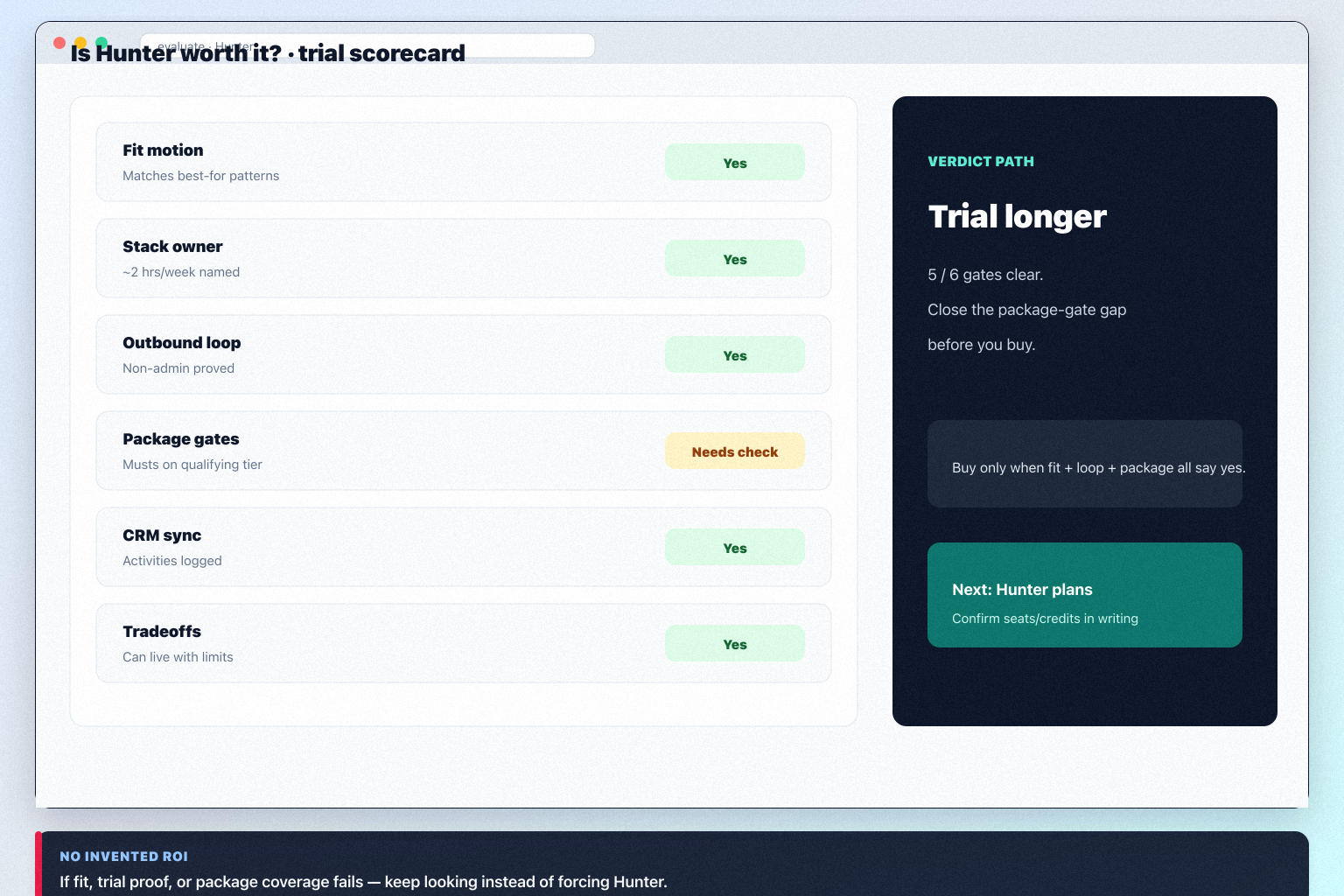
Hunter checklist
Bring these questions to every demo
Ask vendors to show the workflow live, not just describe it.
- 1Match best-for scenariosYour motion should resemble who the product serves well.
- 2Prove the outbound loopNon-admin list → outreach → CRM evidence.
- 3Confirm seats and creditsMust-haves on a real package before you call it a bargain.
Frequently asked questions
Can we decide from a demo alone?
No. Require non-admin proof of list → outreach → CRM logging on the package you will actually buy.
What if credits look cheap but seats are expensive?
Model the constraint you will hit first. Many pods exhaust credits before seats — confirm both on the pricing page.
When should we walk away?
When fit, trial proof, or written packaging fails. Keeping looking is cheaper than forcing Hunter into the wrong motion.
Hunter: buy when the operating loop matches
- 1Commit when your weekly work needs contact data and SMB and founder-led teams that need domain email finding, verification, and light campaigns holds
- 2Walk when Contact data is email/domain-centric — weaker as a full phone+firmographic mega-database would block go-live
- 3Only proceed if you accept: Data depth / intent specialization vs outreach execution built-in
- 4Deadlock breaker: same checklist on Hunter vs Apollo.io
1. Hunter evidence ledger (strengths, limits, value)
Strengths that actually show up in research
SMB and founder-led teams that need domain email finding, verification, and light campaigns; Buyers who want transparent Free → Starter/Growth/Scale packaging; Outbound motions centered on email rather than phone or LinkedIn graph depth
Limitations that change the deal
Contact data is email/domain-centric — weaker as a full phone+firmographic mega-database; Lead scoring is limited versus enterprise SI platforms; Enrichment depth is lighter than Clay/Clearbit-class waterfalls
Price / value hinge
Value usually hinges on needing Starter or Growth unlocks for contact data — not on brand familiarity.
Use researched signals for Hunter — not interchangeable “great CRM” prose.
Hunter capabilities that decide the purchase
- contact data
- prospecting
- data enrichment
- email outreach
- email sequences
- crm sync
- lead management
- reporting
If Hunter fails the checklist, try these peers
Same job-to-be-done — different researched tradeoffs.
- View CRM profile
 Apollo.io
CRM catalogue profile for use in your evaluation shortlist.
- View CRM profile
 Snov.io
Budget SMB email finder, verifier, and cold email sequencer — Free/trial entry; Starter from $39/mo.
- View CRM profile
 Lusha
LushaB2B data intelligence platform for verified contact/company data, enrichment, signals, and Engage outreach sequences.
- View CRM profile
 RocketReach
B2B contact database for finding professional emails, phone numbers, and company insights with prospecting automations.
Catalogue relationships only.
Hunter worth-it checklist
0/3 dimensions noted — saved in this browser only.
Fit signals
Avoid signals
Proof before commit
Was this article helpful?
Have more questions? Contact our support team.
Part of Hunter review · Sales Intelligence hub
Related guides
Supporting reading in this topic — not a generic related-posts dump.
- How to Choose Sales Intelligence SoftwareA decision framework for picking sales intelligence software by primary job — contact data, enrichment, engagement, or dialer — then testing coverage, credits, CRM sync, compliance, and rep workflow before you commit.
- Hunter Plans: Seats, Credits, and Qualifying TiersChoose your Hunter plan by mapping must-haves to seats, credits, and qualifying tiers — not homepage “from” tiles — then confirm on the pricing page.
- Sales Intelligence Evaluation Guide: Two-Week Trial ScorecardEvaluate sales intelligence options fairly with weighted criteria and a shared two-week trial — coverage sample, credit burn, CRM sync, and deliverability — so you compare evidence instead of demo theater.
Related products
Related comparisons
SoftwareGlimpse Updates
Want clearer software shortlists? Get buying guides and comparisons by email.
Newsletter coming soon.