Email Marketing Evaluation Guide: Two-Week Trial Scorecard
Evaluate email marketing options fairly with weighted criteria and a shared two-week trial — list import, campaign, must-have automation, domain auth, and reporting — without demo theater.
Quick answer
Evaluate email marketing options fairly with weighted criteria and a shared two-week trial — list import, one real campaign, one must-have automation, domain auth, and reporting — so you compare evidence instead of demo theater. Decision rule: freeze weights before demos; run the same script on every finalist; score with a non-admin marketer the same day each tool finishes.
- Freeze weights first
- Same two-week script
- List import + campaign
- Must-have journey test
- Domain auth check
- Non-admin scorecard
Key takeaways
- Demo theater lies — Vendors show polished templates; your import and journey expose friction.
- Plan gates decide the score — Test on the plan you will buy — not the unlimited enterprise sandbox.
- Non-admins must score — If only the vendor SE can build the journey, adoption will fail.
- Deliverability is part of evaluation — Domain auth and seed-send health belong on the card — not a post-purchase surprise.
Evaluation path
1. Freeze weighted criteria before any demo
Design-led team
Templates and editor quality dominate weights.
Automation-led team
Workflow depth and plan gates dominate.
Ecommerce team
Store sync and journey triggers dominate.
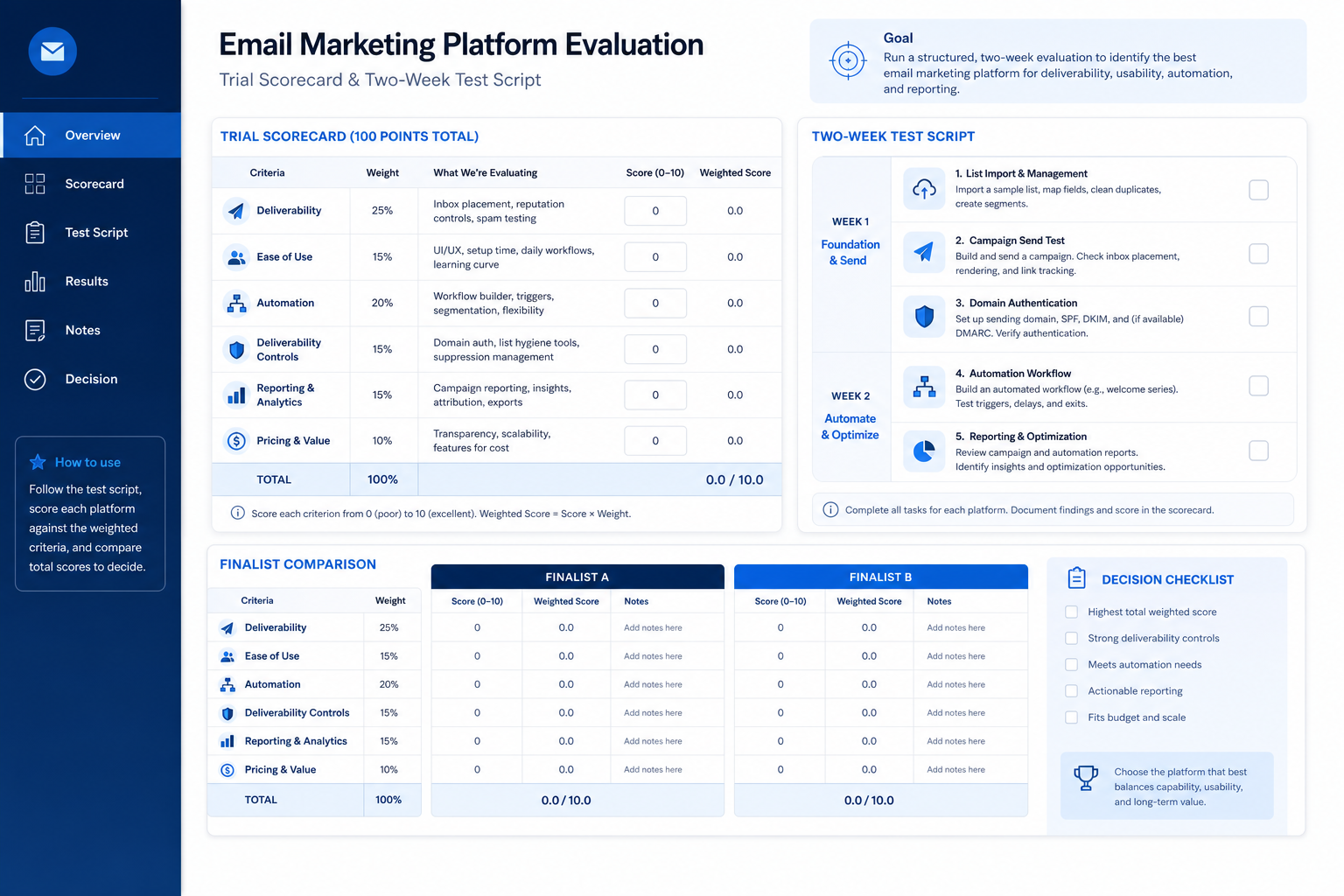
Agree weights for ease of building campaigns, automation depth on the target plan, segmentation, analytics you will use weekly, integrations, deliverability setup, and value relative to contact-tier cost. Do not change weights after a charming demo.
Example: Harbor Studio weights templates and multi-brand usability highest; Northline Goods weights ecommerce triggers and reporting. Same category, different cards — both legitimate if frozen early.
2. Run the same two-week trial script on every ESP
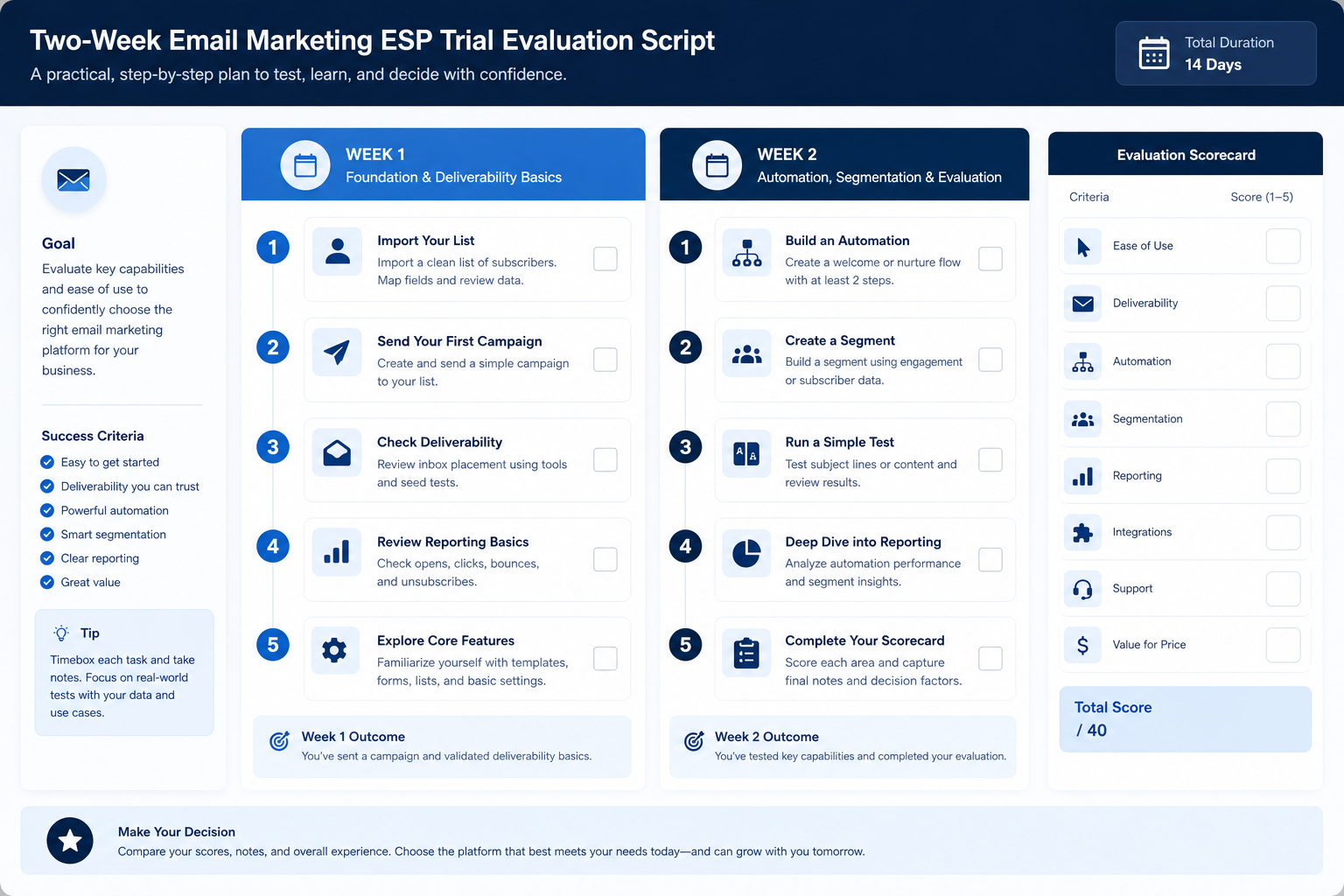
Week 1: import a sample list, authenticate sending domain, build one campaign that matches your brand basics, and log friction. Week 2: build the one must-have automation from your requirements sheet, send to a seed group, check reporting, and fill the shared scorecard the same day.
Example: three shortlisted tools. Tool A wins the polished editor demo but cannot complete cart triggers on the affordable plan. Tool B clears the journey with slower design. Tool C fails DMARC setup guidance and is dropped — all from the same card. Catalogue products such as GetResponse, Campaign Monitor, or ActiveCampaign are examples of tools you might put through this script — not ranked winners on this page.
Email marketing evaluation scorecard (weights)
Score each shortlisted tool 1–5 on the same criteria after the two-week script. Multiply by weight; compare totals — do not invent ROI percentages or affiliate-ordered rankings.
- Campaign / template creation (weight 5)
- Automation on target plan (weight 5)
- Segmentation usability (weight 4)
- Reporting you will use weekly (weight 3)
- CRM / shop / form integrations (weight 4)
- Auth & send hygiene setup (weight 4)
- Value vs contact-tier fit (weight 3)
Two-week trial plan (same for each tool)
Day 1: Setup & plan freeze
- Confirm the exact plan tier under evaluation
- Invite one non-admin marketer + ops observer
- Freeze the sample list and brand assets
Day 2: List import
- Import sample subscribers with required fields
- Verify unsubscribe / suppression handling
- Note import errors and duplicates
Day 3: Domain authentication
- Follow vendor SPF/DKIM/DMARC guidance
- Document blockers for your DNS owner
- Confirm sending domain status in-product
Day 4: Campaign build
- Build one newsletter or promo matching brand basics
- Time how long a non-admin needs
- Screenshot editor friction
Day 5: Week-1 score snapshot
- Fill creation + deliverability setup rows
- Do not change weights
- Capture plan-gate surprises
Day 8: Must-have journey
- Build the one automation from the requirements sheet
- Confirm it runs on the target plan
- Log branching / trigger gaps
Day 10: Seed send + reporting
- Send to a small seed group
- Check opens/clicks/conversion reports you will use weekly
- Note missing metrics
Day 14: Score & decide
- Non-admin completes the shared card
- Compare weighted totals
- Advance top scorer to diligence — or revisit requirements
3. Run one trial script on every finalist
Pick the workflow that blocked work last quarter. Run it on every shortlist tool the same week: same data shape, same users, same success criteria. Score completion, time-to-done, and where an admin had to rescue the task.
Worked example: Harbor Labs runs the same refactor ticket on three coding tools. Tool C fails SSO on the quoted tier and is dropped before a second meeting.
4. Score on one card the same day
Use the same rubric for every vendor: must-have gates, adoption risk, integration fit, and modeled total cost band. Record who attended and which plan tier was shown — demos often run above the tier you can afford.
5. Write a one-page decision memo
Name the primary job, the qualifying configuration, the winner, and what you are explicitly not buying yet. Link to pricing and requirements guides so finance can audit assumptions later.
Next: /guides/how-to-choose-email-marketing/
6. Use a one-page checklist before demos
For Email Marketing Evaluation Guide: Two-Week Trial Scorecard, list must-haves, owners, integrations, and the weekly ritual this purchase must improve. Share the sheet with finance and IT before you schedule a second demo.
- Name the primary job in one sentence.
- List must-have gates (plans, SSO, data residency, usage caps).
- Name integrations that must work on day one.
- Assign an admin owner and a weekly user champion.
- Define non-admin proof — what a sceptic completes without rescue.
Worked example: Harbor Ops refuses demos until the checklist is signed — cutting evaluation time in half.
7. Avoid the usual buying mistakes
Common failures in email-marketing: buying for brand familiarity, comparing entry tiles across different usage units, skipping a fair trial script, and adding scope before adoption proves out.
Run one trial script on every finalist the same week. Score on the same card. Write a one-paragraph decision memo that names what you are not buying yet.
8. Hand off to the category shortlist
When assumptions are frozen, continue on /best/email-marketing-software/ with the same headcount, usage band, and must-have gates on every quote.
Frequently asked questions
How long should an ESP trial be?
Two weeks is enough for import, one campaign, one must-have journey, and a seed send — if you freeze the script. Longer trials without a script just extend demo theater.
Should we evaluate on the free plan?
Only if free is what you will run. Otherwise evaluate on the paid tier that unlocks your must-haves — free-plan scores are not transferable.
What should I do next?
Move the top-scoring option into vendor diligence, or return to How to Choose Email Marketing and Best Email Marketing Software if you still need a constrained shortlist.
Was this article helpful?
Have more questions? Contact our support team.
Part of Software buying guides · Email Marketing Requirements Guide: Must-Haves, Consent & Stack Rules
Related guides
Supporting reading in this topic — not a generic related-posts dump.
- Is InboxAlly Worth It? Fit Scenarios Before You BuyDecide if InboxAlly is worth it for your marketing team — fit scenarios, contact economics, and when to keep looking — without invented ROI percentages.
- Is Bouncer Worth It? Fit Scenarios Before You BuyDecide if Bouncer is worth it for your marketing team — fit scenarios, contact economics, and when to keep looking — without invented ROI percentages.
- Is AWeber Worth It? Fit Scenarios Before You BuyDecide if AWeber is worth it for your marketing team — fit scenarios, contact economics, and when to keep looking — without invented ROI percentages.
- Is Kit Worth It? Fit Scenarios Before You BuyDecide if Kit is worth it for your marketing team — fit scenarios, contact economics, and when to keep looking — without invented ROI percentages.
- What Is Email Marketing Software? Beginner’s GuideWhat is email marketing software? A clear definition of permission-based ESPs — campaigns, newsletters, and automation — and how they differ from CRM and cold outreach.
- Is ActiveCampaign Worth It? Fit Scenarios Before You BuyDecide if ActiveCampaign is worth it for your marketing team — fit scenarios, contact economics, and when to keep looking — without invented ROI percentages.
- ActiveCampaign Plans: Contacts, Sends, and Qualifying TiersChoose your ActiveCampaign plan by mapping must-haves to contact tiers, send limits, and qualifying features — not homepage “from” tiles — then confirm on the pricing page.
- AWeber Plans: Contacts, Sends, and Qualifying TiersChoose your AWeber plan by mapping must-haves to contact tiers, send limits, and qualifying features — not homepage “from” tiles — then confirm on the pricing page.
SoftwareGlimpse Updates
Want clearer software shortlists? Get buying guides and comparisons by email.
Newsletter coming soon.