AI Software Pricing Guide
Budget LLM assistants, coding tools, image and video, meeting notes, and specialist AI by qualifying configuration — not the advertised starter tile.
Quick answer
AI software pricing is usually per seat, per credit or token pack, per GPU hour, per conversation or minute cap, or as an add-on Copilot SKU — plus overage. Decision rule: never compare the advertised starter tile; compare the total for your real headcount and usage on the configuration that unlocks your must-have models, agents, or commercial terms.
- Seats
- Credits / tokens
- GPU hours
- Conversation / minute caps
- Add-on Copilot SKUs
- Annual vs monthly
Key takeaways
- Gates are part of the price — A cheap tile that blocks custom GPTs, stealth stills, video credits, or SSO forces an upgrade — budget the qualifying tier.
- Units are not comparable on a tile alone — Per-seat LLM assistants, GPU-hour image tools, credit-priced video, and Copilot add-on SKUs need a volume model for the same team.
- Credits stack on the core — Token packs, GPU hours, and minute caps can exceed seat cost. Treat usage as a line item, not a free checkbox.
- Copilot SKUs are different purchases — Microsoft 365 Copilot is an add-on to Microsoft 365. GitHub Copilot is a coding seat. Do not compare those tiles to ChatGPT Plus as if they were the same SKU.
Pricing path
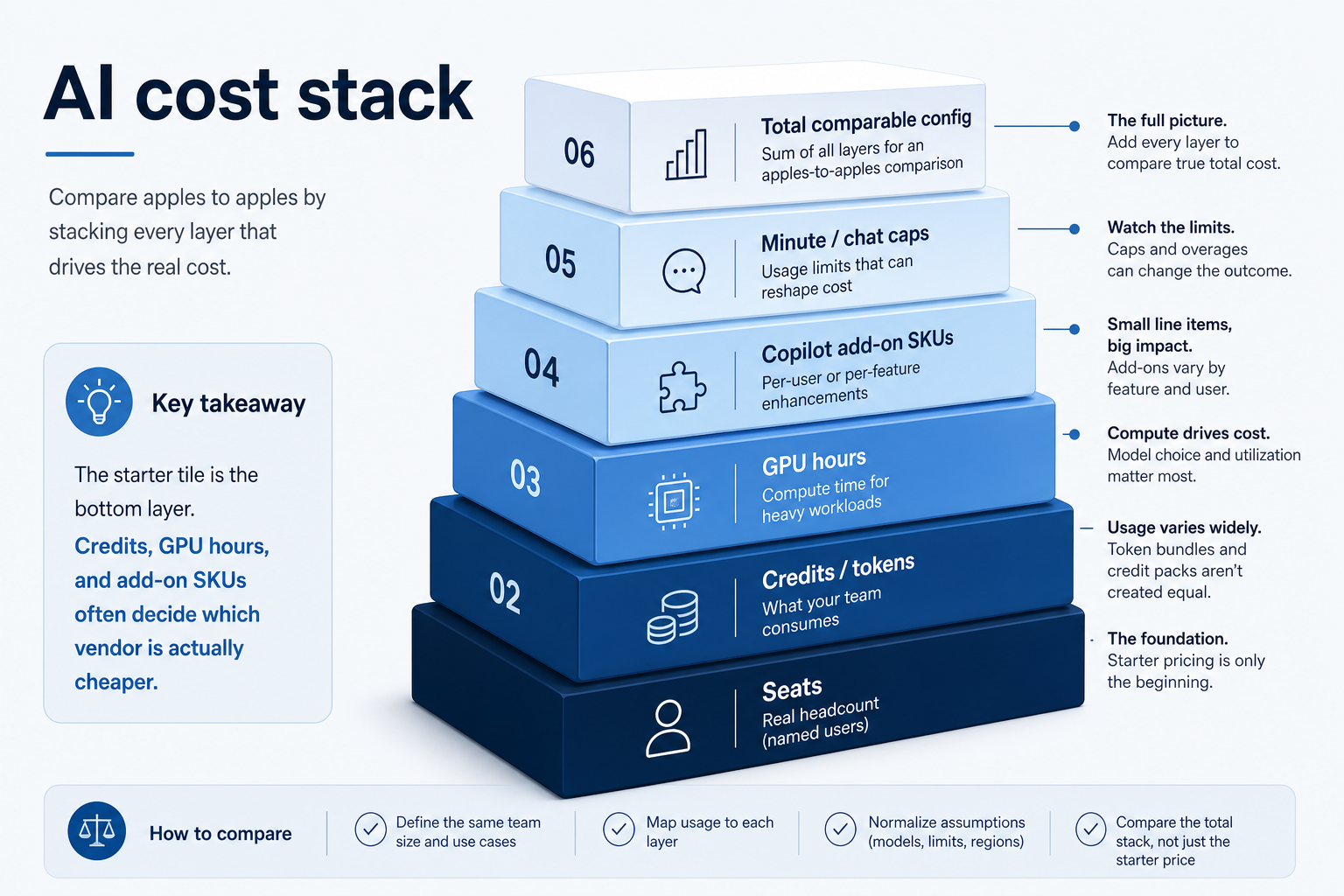
1. Build one comparable total per vendor
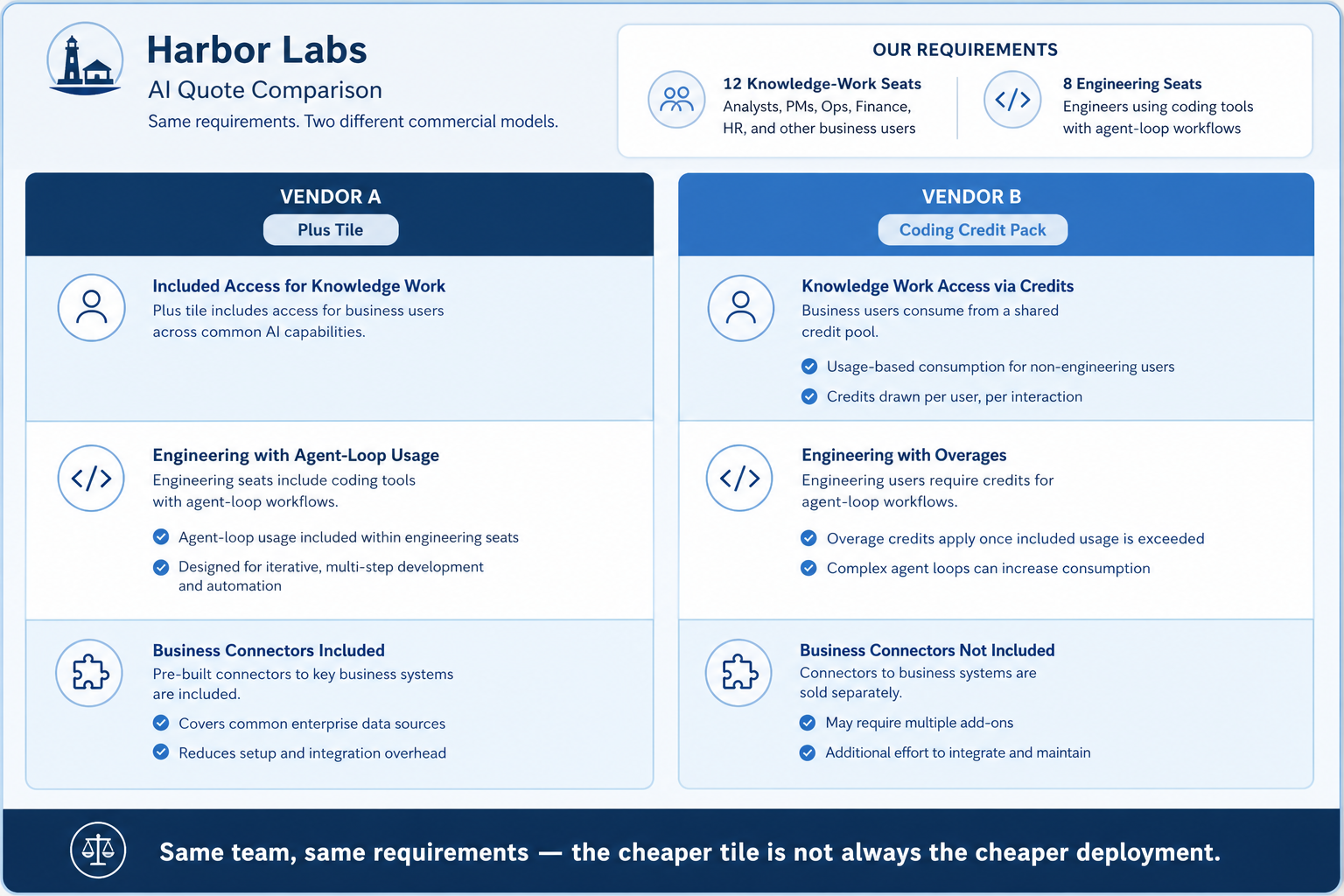
Use one assumption set: people who need access, monthly tokens or credits, GPU hours or video minutes, must-have models or agents, and whether a Copilot add-on is in scope. Total the qualifying configuration.
Worked example: Harbor Labs needs 12 knowledge-work seats plus 8 engineering seats with agent-loop usage. Vendor A’s Plus tile looks cheaper until Business connectors unlock; Vendor B’s coding credit pack looks expensive until you include overage. The honest comparison is qualifying config × usage, not the homepage tile.
2. Compare written quotes on the same assumptions
Same headcount
Every quote uses the same people who need access — not a pilot subset.
Same usage band
Credits, tokens, GPU hours, or send caps modeled at realistic volume.
Same gates
SSO, agents, stealth modes, or automation depth unlock on named tiers.
For every finalist in AI software, fill one sheet: headcount or list size, must-have gates, usage units you will actually hit, and integrations that must work on day one. Ask each vendor which plan qualifies — then compare those plans only, not homepage tiles.
Worked example: Harbor Ops models the same seat count and credit band for three AI assistants. Vendor A’s personal tier looks cheaper until Business unlocks connectors; Vendor B’s team pack looks expensive until overage on Vendor A is included. The honest compare is qualifying configuration × usage — documented in writing.
3. Budget the first quarter, not the teaser month
Starter tiles optimize for sign-up, not your first 90 days at real scale. Include list or seat growth, seasonal spikes, overage triggers, and add-on SKUs (Copilot layers, credit packs, dedicated IP) before you ask finance to approve spend.
Worked example: Northline Studio adds 20% buffer to image-credit usage for a campaign launch and keeps annual vs monthly side by side when GPU spikes are likely.
4. Hand off to selection with frozen assumptions
When quotes are comparable, move to the selection framework with must-haves frozen. Rank finalists on fit for the weekly job, governance, and the total you modeled — not affiliate availability or brand familiarity.
Next: /guides/how-to-choose-ai-software/
5. Use a one-page checklist before demos
For AI Software Pricing Guide, list must-haves, owners, integrations, and the weekly ritual this purchase must improve. Share the sheet with finance and IT before you schedule a second demo.
- Name the primary job in one sentence.
- List must-have gates (plans, SSO, data residency, usage caps).
- Name integrations that must work on day one.
- Assign an admin owner and a weekly user champion.
- Define non-admin proof — what a sceptic completes without rescue.
Worked example: Harbor Ops refuses demos until the checklist is signed — cutting evaluation time in half.
6. Avoid the usual buying mistakes
Common failures in ai: buying for brand familiarity, comparing entry tiles across different usage units, skipping a fair trial script, and adding scope before adoption proves out.
Run one trial script on every finalist the same week. Score on the same card. Write a one-paragraph decision memo that names what you are not buying yet.
7. Hand off to the category shortlist
When assumptions are frozen, continue on /best/ai-software/ with the same headcount, usage band, and must-have gates on every quote.
Frequently asked questions
How much does AI software cost?
Models vary: free caps, published personal seats, credit or token packs, GPU-hour image plans, minute-capped meeting tools, and quote-led Copilot add-ons. Exact floors change — confirm live vendor pricing.
Should I pay annually?
Annual billing is usually discounted but locks seats and credit pools. If campaign or launch spikes drive GPU or video usage, price both annual and overage.
Do affiliate deals change our advice?
No. SoftwareGlimpse methodology excludes affiliate economics from rankings and pricing guidance.
Was this article helpful?
Have more questions? Contact our support team.
Part of Software buying guides · What Is AI Software?
Related guides
Supporting reading in this topic — not a generic related-posts dump.
- Rank Prompt Plans: Seats, Credits, and Qualifying TiersChoose your Rank Prompt plan by mapping must-haves to qualifying tiers — seats, credits, usage packs, and add-ons — not homepage “from” tiles.
- Is AdCreative.ai Worth It? Fit Scenarios Before You BuyDecide if AdCreative.ai is worth it for your team — job-cluster fit, trial proof, and packaging — without invented ROI percentages.
- Is AI InteleKt Worth It? Fit Scenarios Before You BuyDecide if AI InteleKt is worth it for your team — job-cluster fit, trial proof, and packaging — without invented ROI percentages.
- Is Aira Worth It? Fit Scenarios Before You BuyDecide if Aira is worth it for your team — job-cluster fit, trial proof, and packaging — without invented ROI percentages.
- Is ElevenLabs Worth It? Fit Scenarios Before You BuyDecide if ElevenLabs is worth it for your team — job-cluster fit, trial proof, and packaging — without invented ROI percentages.
- AdCreative.ai Plans: Seats, Credits, and Qualifying TiersChoose your AdCreative.ai plan by mapping must-haves to qualifying tiers — seats, credits, usage packs, and add-ons — not homepage “from” tiles.
- AI InteleKt Plans: Seats, Credits, and Qualifying TiersChoose your AI InteleKt plan by mapping must-haves to qualifying tiers — seats, credits, usage packs, and add-ons — not homepage “from” tiles.
SoftwareGlimpse Updates
Want clearer software shortlists? Get buying guides and comparisons by email.
Newsletter coming soon.