AI InteleKt Plans: Seats, Credits, and Qualifying Tiers
AI InteleKt cost guide: researched plan structure, who each tier suits, cost scenarios, and value tradeoffs — no invented prices.
Quick answer
AI InteleKt pricing is plan-gated across 1 researched tiers. No free plan confirmed in SoftwareGlimpse research. No free/trial flag confirmed in SG data — budget a paid pilot. Compare seat/capacity gates and unlocks — not list-price folklore.
- Free plan: not confirmed in SG data
- No free/trial flag confirmed in SG data — budget a paid pilot
- Entry paid tier researched: Custom
AI InteleKt packaging rules
- Tiles are the bottom layer — Researched plans: Custom.
- Gates change the bill — Our research does not flag plan-gated capabilities for AI InteleKt, but confirm your must-haves — including seats, credits, and add-ons — against the packaging you actually intend to buy.
- Free is a proving ground — Our snapshot records no trial length for AI InteleKt — ask for an evaluation window in writing before you commit seats.
- Wrong cluster, wrong comparison — Do not compare AI InteleKt (AI assistant for a specific job cluster) to a different AI job cluster on a single price tile.
AI InteleKt qualifying configuration
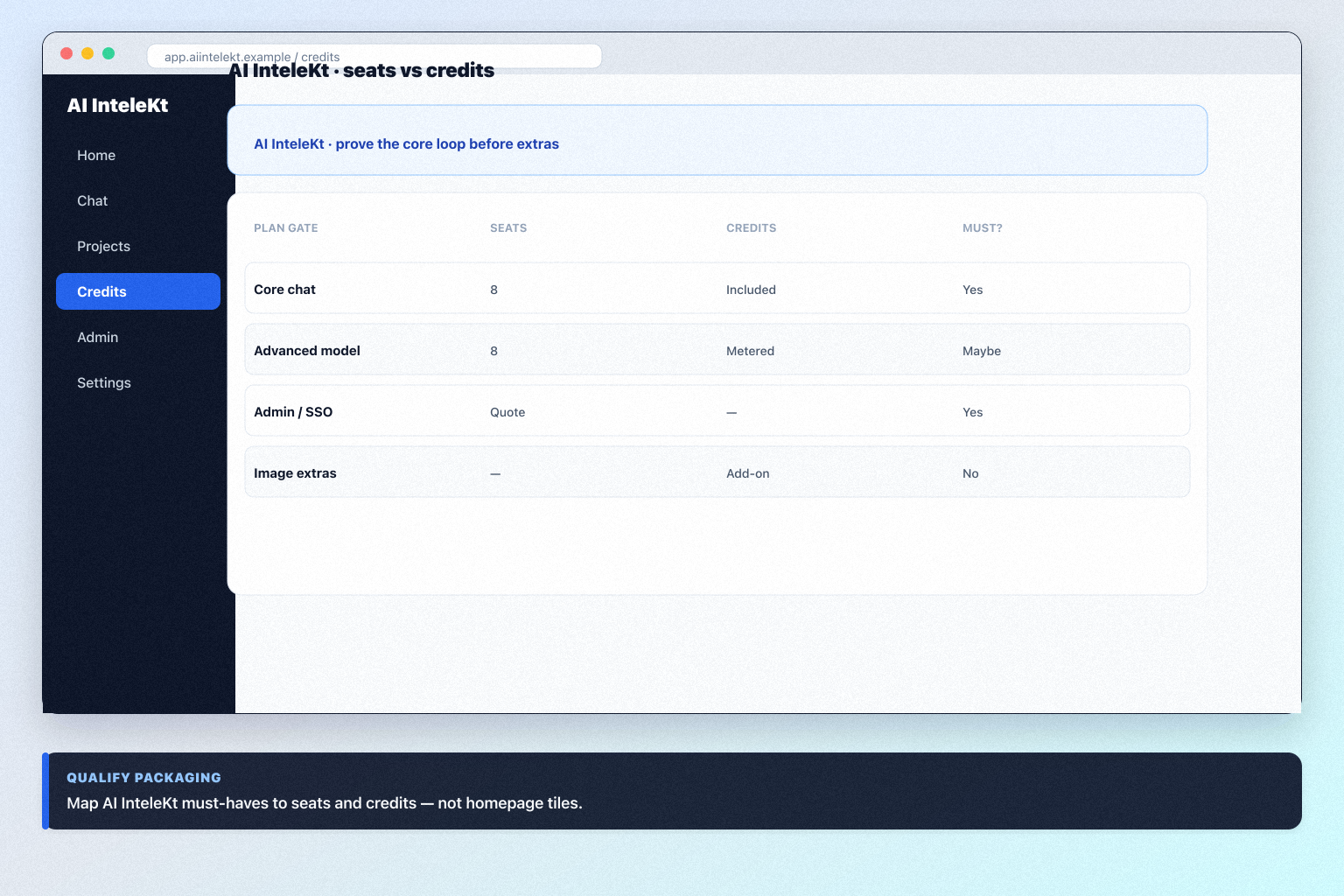
AI InteleKt must vs nice
- Core job on entry plan
- Gated capabilities
- Enterprise / extra credits
AI InteleKt checklist
Bring these questions to every demo
Ask vendors to show the workflow live, not just describe it.
- 1List day-one must-havesFeatures that must ship without an unused enterprise tier.
- 2Map to a qualifying planUse researched plan names — not marketing starting tiles.
- 3Get the qualifying quote in writingSeats, credits, add-ons, and implementation fees.
Frequently asked questions
Does a free AI InteleKt plan count?
Our snapshot records no trial length for AI InteleKt — ask for an evaluation window in writing before you commit seats.
Should we pay annually?
Only after the qualifying configuration is written. Annual discounts do not fix the wrong hub.
AI InteleKt plan matrix and who each tier suits
Structure and trial/free flags come from SoftwareGlimpse pricing research. Dollar amounts appear only when verified — never invent list prices.
- Seats61%
- Add-ons18%
- Implementation12%
- Training5%
- Other4%
Custom
Contact sales · Suits: teams that need custom procurement
1. AI InteleKt cost scenarios to pressure-test
Lean team / free-or-trial first
Scope a time-boxed pilot; No free/trial flag confirmed in SG data — budget a paid pilot.
Growing team with gated workflows
Map must-have workflows (LLM chat and assistants, agent / app builder) to plan unlocks before expanding seats.
Hidden / extra cost watch
Budget risk: Confirm integrations for POS, web, and mobile sources. Also check add-ons, overages, and admin time outside the sticker plan.
Price AI InteleKt against how you actually buy seats and unlocks — not against a competitor's homepage headline.
AI InteleKt value rule
AI InteleKt cost mistakes to avoid
Cost trap 1
Confirm integrations for POS, web, and mobile sources
Cost trap 2
Schedule a demo for live packaging and pricing
Cost trap 3
Teams needing ChatGPT-style writing assistants
Cost trap 4
Buyers who require transparent self-serve pricing today
Cost trap 5
Pure helpdesk or CRM pipeline purchases
Cheaper or clearer alternatives to pressure-test
Compare total cost of ownership vs AI InteleKt on identical constraints.
- View CRM profileWritesonic
AI search growth (GEO/AEO) and content platform — free trial on paid tiers; Starter $79/mo annual ($199 Basic, $399 Growth); Enterprise custom.
- View CRM profile
 Gamma
GammaAI presentation and document generator — Free; Plus $8/mo annual ($10 monthly).
Catalogue peers only — not commission-ranked.
AI InteleKt pricing checklist
0/3 dimensions noted — saved in this browser only.
Plan gates you must unlock
Trial / free proof
TCO extras
Was this article helpful?
Have more questions? Contact our support team.
Part of AI InteleKt review · AI Software hub
Related guides
Supporting reading in this topic — not a generic related-posts dump.
- AI Software Pricing GuideBudget LLM assistants, coding tools, image and video, meeting notes, and specialist AI by qualifying configuration — not the advertised starter tile.
- How to Choose AI Software: Job-First FrameworkChoose AI software by primary job — LLM assistant, coding, image, video, meeting notes, or agents — then map plan gates, usage units, SKU identity, and a shared trial script.
- Is AI InteleKt Worth It? Fit Scenarios Before You BuyDecide if AI InteleKt is worth it for your team — job-cluster fit, trial proof, and packaging — without invented ROI percentages.
Related products
Related comparisons
SoftwareGlimpse Updates
Want clearer software shortlists? Get buying guides and comparisons by email.
Newsletter coming soon.