AI Software Evaluation Guide
A practical evaluation script for LLM assistants, AI coding, image and video, meeting notes, writing, voice, decks, sites, ads, and agents.
Quick answer
Evaluate AI software with one shared script per job cluster: run a real research thread, complete a multi-file refactor, generate a campaign still, transcribe a real meeting, or ship a prompt-to-deck — on the qualifying plan. Decision rule: finalists only advance if the weekly ritual stays accurate after three days of real use.
- Shared trial script
- Qualifying plan / usage only
- One real workflow
- Admin / privacy check
- Integration smoke test
- Three-day accuracy check
Key takeaways
- Demos are not trials — Vendor tours skip plan gates, credit overage, and messy prompts. Score the configuration you will buy.
- Accuracy beats beauty — A pretty chat UI that drops connectors or overages after three days fails the evaluation.
- Include a sceptical user — Adoption risk shows up when a reluctant engineer tries the agent loop, or a designer hits GPU-hour caps.
1. Run the same script on every finalist
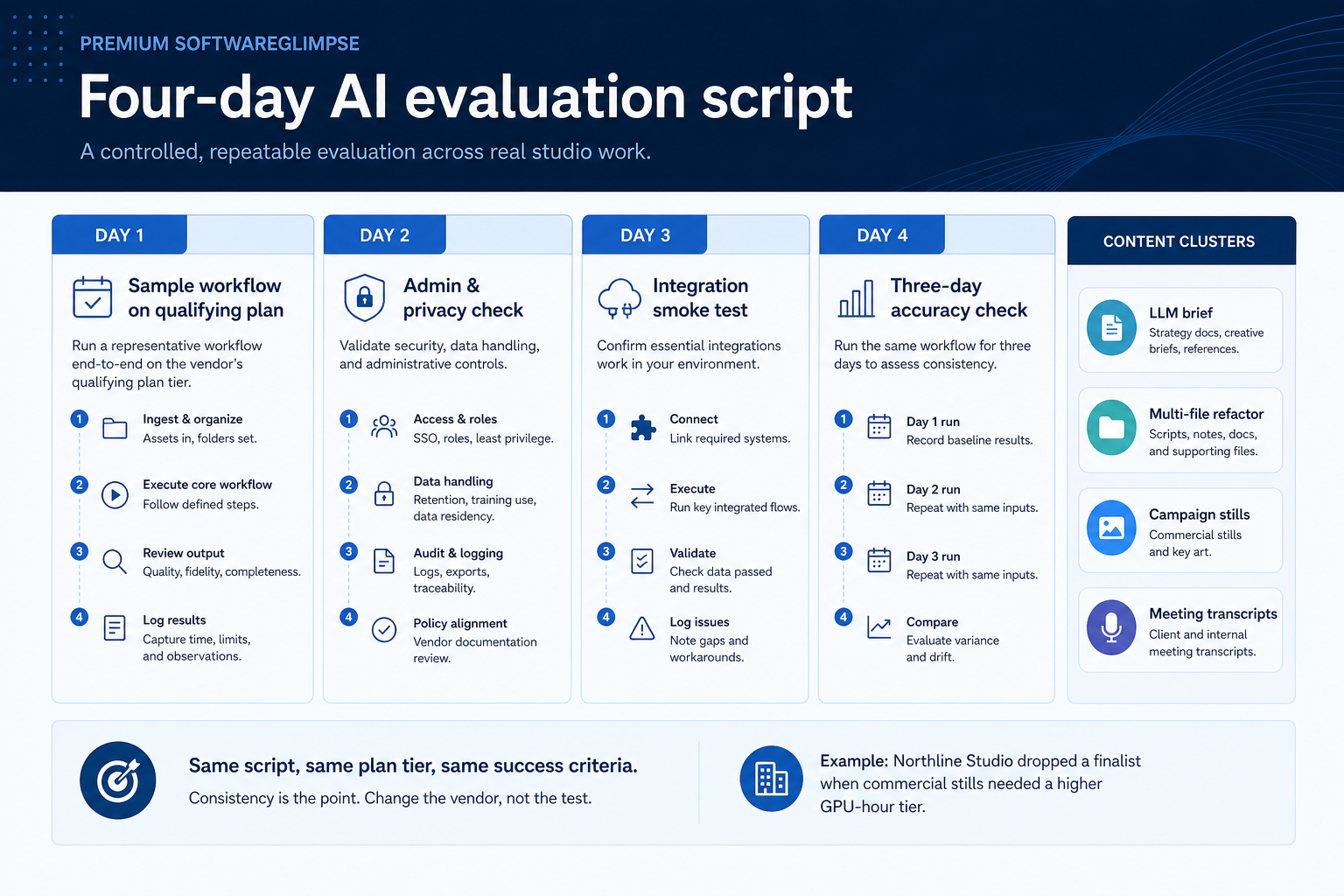
Pick one script for your cluster. LLM assistant: one real brief with projects and a connector. AI coding: one multi-file refactor on the qualifying seat. Image: three campaign stills with the IP terms you need. Video: one short clip against the credit pack. Meeting: three days of transcripts. Writing/voice/decks/sites/ads/agents: one artefact you would actually ship.
Worked example: Northline Studio eliminated a finalist when commercial-use stills only worked on a higher GPU-hour tier than the quote assumed.
2. Decide with methodology, not affiliate pressure
Inside each job cluster, weigh ease of use, AI job fit, workflow depth, integrations, admin/privacy, scalability, value, and assistance quality — the SoftwareGlimpse ai-editorial criteria. Do not reorder finalists by commission. Do not rank an LLM assistant against an image generator, or GitHub Copilot against Microsoft 365 Copilot.
3. Run one trial script on every finalist
Pick the workflow that blocked work last quarter. Run it on every shortlist tool the same week: same data shape, same users, same success criteria. Score completion, time-to-done, and where an admin had to rescue the task.
Worked example: Harbor Labs runs the same refactor ticket on three coding tools. Tool C fails SSO on the quoted tier and is dropped before a second meeting.
4. Score on one card the same day
Use the same rubric for every vendor: must-have gates, adoption risk, integration fit, and modeled total cost band. Record who attended and which plan tier was shown — demos often run above the tier you can afford.
5. Write a one-page decision memo
Name the primary job, the qualifying configuration, the winner, and what you are explicitly not buying yet. Link to pricing and requirements guides so finance can audit assumptions later.
Next: /guides/how-to-choose-ai-software/
6. Use a one-page checklist before demos
For AI Software Evaluation Guide, list must-haves, owners, integrations, and the weekly ritual this purchase must improve. Share the sheet with finance and IT before you schedule a second demo.
- Name the primary job in one sentence.
- List must-have gates (plans, SSO, data residency, usage caps).
- Name integrations that must work on day one.
- Assign an admin owner and a weekly user champion.
- Define non-admin proof — what a sceptic completes without rescue.
Worked example: Harbor Ops refuses demos until the checklist is signed — cutting evaluation time in half.
7. Avoid the usual buying mistakes
Common failures in ai: buying for brand familiarity, comparing entry tiles across different usage units, skipping a fair trial script, and adding scope before adoption proves out.
Run one trial script on every finalist the same week. Score on the same card. Write a one-paragraph decision memo that names what you are not buying yet.
8. Hand off to the category shortlist
When assumptions are frozen, continue on /best/ai-software/ with the same headcount, usage band, and must-have gates on every quote.
9. Use a one-page checklist before demos
For AI Software Evaluation Guide, list must-haves, owners, integrations, and the weekly ritual this purchase must improve. Share the sheet with finance and IT before you schedule a second demo.
- Name the primary job in one sentence.
- List must-have gates (plans, SSO, data residency, usage caps).
- Name integrations that must work on day one.
- Assign an admin owner and a weekly user champion.
- Define non-admin proof — what a sceptic completes without rescue.
Worked example: Harbor Ops refuses demos until the checklist is signed — cutting evaluation time in half.
10. Avoid the usual buying mistakes
Common failures in ai: buying for brand familiarity, comparing entry tiles across different usage units, skipping a fair trial script, and adding scope before adoption proves out.
Run one trial script on every finalist the same week. Score on the same card. Write a one-paragraph decision memo that names what you are not buying yet.
11. Hand off to the category shortlist
When assumptions are frozen, continue on /best/ai-software/ with the same headcount, usage band, and must-have gates on every quote.
Frequently asked questions
How long should a trial last?
Two weeks is enough for most SMB/mid teams if you run a fixed script. Longer trials help when credit overage or change management is the risk.
What if hands-on testing is not available?
SoftwareGlimpse disclosures note research-grounded editorial judgment when handsOnTesting is false — still demand a vendor trial for your own purchase decision.
Was this article helpful?
Have more questions? Contact our support team.
Part of Software buying guides · What Is AI Software?
Related guides
Supporting reading in this topic — not a generic related-posts dump.
- Rank Prompt Plans: Seats, Credits, and Qualifying TiersChoose your Rank Prompt plan by mapping must-haves to qualifying tiers — seats, credits, usage packs, and add-ons — not homepage “from” tiles.
- Is AdCreative.ai Worth It? Fit Scenarios Before You BuyDecide if AdCreative.ai is worth it for your team — job-cluster fit, trial proof, and packaging — without invented ROI percentages.
- Is AI InteleKt Worth It? Fit Scenarios Before You BuyDecide if AI InteleKt is worth it for your team — job-cluster fit, trial proof, and packaging — without invented ROI percentages.
- Is Aira Worth It? Fit Scenarios Before You BuyDecide if Aira is worth it for your team — job-cluster fit, trial proof, and packaging — without invented ROI percentages.
- Is ElevenLabs Worth It? Fit Scenarios Before You BuyDecide if ElevenLabs is worth it for your team — job-cluster fit, trial proof, and packaging — without invented ROI percentages.
- AdCreative.ai Plans: Seats, Credits, and Qualifying TiersChoose your AdCreative.ai plan by mapping must-haves to qualifying tiers — seats, credits, usage packs, and add-ons — not homepage “from” tiles.
- AI InteleKt Plans: Seats, Credits, and Qualifying TiersChoose your AI InteleKt plan by mapping must-haves to qualifying tiers — seats, credits, usage packs, and add-ons — not homepage “from” tiles.
SoftwareGlimpse Updates
Want clearer software shortlists? Get buying guides and comparisons by email.
Newsletter coming soon.