Ocean.io Implementation: 30/60/90 Outbound Rollout That Sticks
contact data; prospecting; data enrichment; email outreach. Credits (yearly minimum) · contact data | Custom. HubSpot, Salesforce. GTM teams whose primary job is finding lookalike / similar companies to best customers; Buyers comparing Ocean to Clay-style creative prospecting when lookalike matching is the bottleneck; Teams willing to model credit minimums (~9k) and yearly packaging. Sales intelligence platform centered on lookalike and similar-company prospecting — finding companies like your best customers — monetized via a credit model with a published per-c Buyer question: should you pay for Ocean.io when GTM teams whose primary job is finding lookalike / similar companies to best customers is the job — and skip when Buyers who need a full contact database + sequencer as the primary seat? Evaluator rule: Ocean.io is best for GTM teams whose primary job is finding lookalike / similar companies to best customers; Buyers comparing Ocean to Clay-style creative prospecting when lookalike matching is the bottleneck; Teams willing to model credit minimums (~9k) and yearly packaging. Poor fit when Buyers who need a full contact database + sequencer as the primary seat; Teams that only need occasional named-prospect email lookups; Enterprise ABM buyers whose primary job is predictive intent orchestration. Pricing threshold: move off trial when contact data blocks prospecting.
Quick answer
contact data decides whether Ocean.io implementation is a one-team pilot or a specialist project — confirm unlocks for must-have capabilities before invites.
- Start with: prospecting
- Gate check: confirm paid unlocks before go-live
- Integrate after: data quality pass on HubSpot
Ocean.io rollout takeaways
- Implementation is habit work — Sales intelligence platform centered on lookalike and similar-company prospecting — finding companies like your best customers — monetized via a credit model with a published per-credit rate and yearly minimum packaging. None of that helps until the weekly outbound loop is boring.
- Sequence features to plan gates — Our research does not flag plan-gated capabilities for Ocean.io, but confirm your must-haves — including credits and seats — against the packaging you actually intend to buy.
- Enable in this order — Days 1–30: contact data, prospecting, data enrichment, and email outreach. Days 31–60: reporting and email sequences. Days 61–90: data enrichment, AI assistance, and second ICP list.
- Measure usage, not configuration — Count meetings booked, reply/connect rates, credits used per meeting, and CRM-logged activities from Ocean.io — not modules enabled.
- Know what you inherited — Research watch-outs to plan around: Not a full contact mega-database or email sequencer; Credit minimums raise the floor versus tiny SMB seats; CRM sync and reporting are secondary.
Ocean.io implementation walkthrough
Ocean.io must vs nice
- Logged CRM activities from outreach
- Weekly list / sequence review
- data enrichment
- AI assistance
Ocean.io checklist
Bring these questions to every demo
Ask vendors to show the workflow live, not just describe it.
- 1Freeze three 90-day outcomesMeetings, coverage, or reply goals with owners.
- 2Day 30: live outbound loopEvery active rep runs list → outreach → CRM weekly.
- 3Day 60: usage reviewCredits per meeting and sequence hygiene on the agenda.
- 4Day 90: expand only gapsAdd channels or packs that still miss an outcome.
Frequently asked questions
What if credits run out before day 30?
Pause new list builds, tighten ICP filters, and review who is exporting vs outreaching. Do not buy a larger pack until the stack owner can explain credit-per-meeting for the last two weeks. Confirm pack options on the pricing page.
When should we add a second outreach channel?
After the first channel produces CRM-logged activity and a weekly review rhythm. Parallel channels on day one usually double noise without doubling meetings.
Who should own Ocean.io?
One stack owner with calendar time — usually RevOps or sales ops — not a rotating AE committee.
1. Ocean.io day-zero to steady-state sequence
Day zero — objects and owners
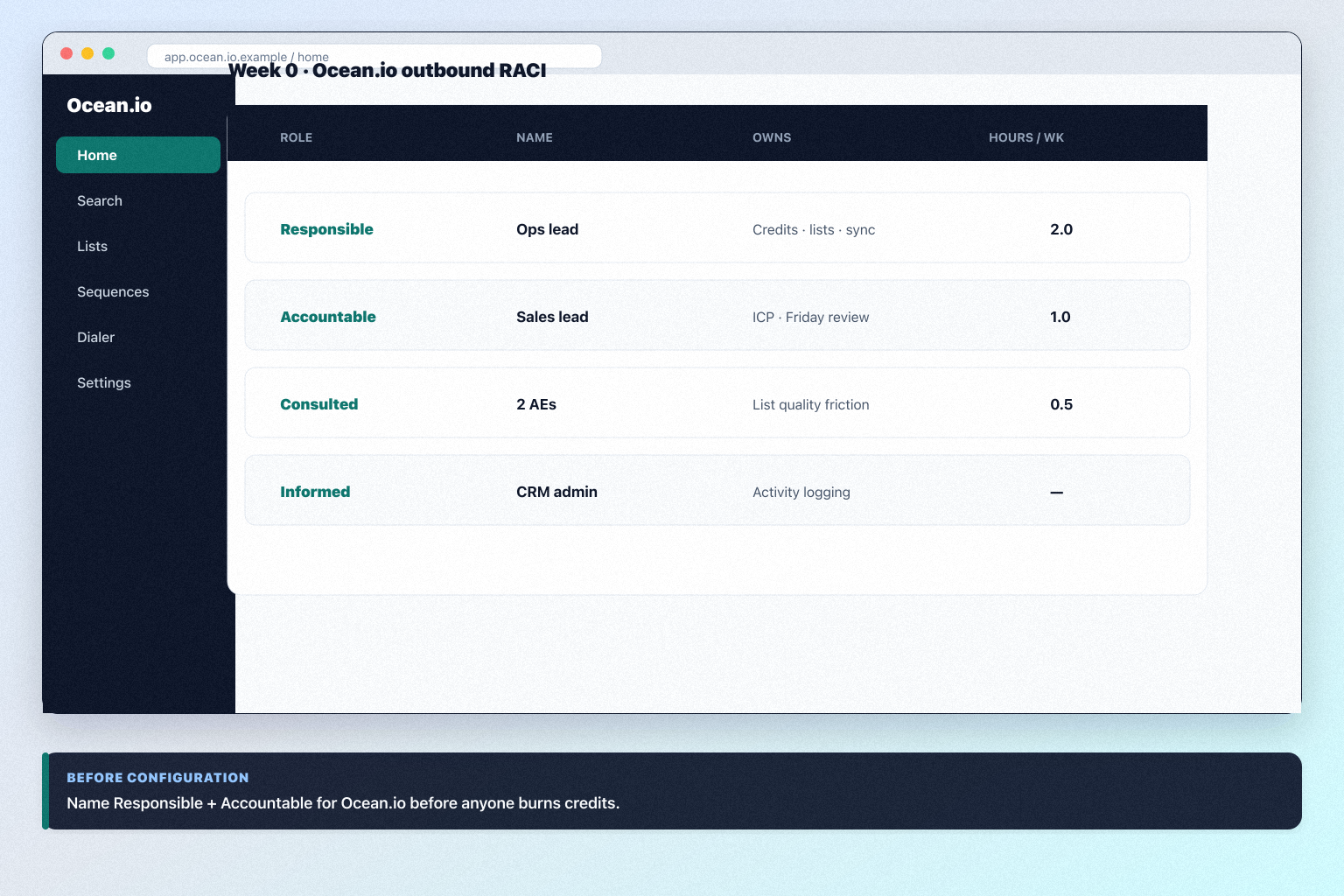
Define owners for prospecting, data enrichment, email sequences before inviting the whole org.
SMB pilot
One pipeline / one team proves GTM teams whose primary job is finding lookalike / similar companies to best customers before company-wide seats.
Cutover
Freeze legacy writes briefly; validate HubSpot and Salesforce before reopen.
Treat Ocean.io setup as a controlled rollout — not a weekend dump of CSV files.
Ocean.io implementation go / no-go
Ocean.io implementation mistakes
Mistake 1
Lookalike/similar-company specialist — not a full contact mega-database or sequencer
Mistake 2
Credit minimums and yearly packaging require modeling before comparing to seat tools
Mistake 3
Native email outreach/sequencing depth is limited
Mistake 4
CRM sync depth is secondary to lookalike prospecting workflows
Big-bang invite
Inviting every user before object design creates junk data that is expensive to unwind.
Ocean.io plan gates that affect rollout
Implementation fails when unlocks needed for go-live sit on a higher tier than budgeted.
- Seats61%
- Add-ons18%
- Implementation12%
- Training5%
- Other4%
Credits (yearly minimum)
Trial available · Unlocks: contact data, prospecting, data enrichment · Suits: teams whose must-have gates appear on this tier
Custom
Contact sales · Suits: teams that need custom procurement
Ocean.io implementation checklist
0/3 dimensions noted — saved in this browser only.
Prep
Pilot
Scale
Was this article helpful?
Have more questions? Contact our support team.
Part of Ocean.io review · Sales Intelligence hub
Related guides
Supporting reading in this topic — not a generic related-posts dump.
- Ocean.io Migration: Move Lists Without Losing TrustMigrate into Ocean.io with a list inventory, field map, pilot export/import, dual-run week, and CRM sync validation — so sequences keep firing and sellers trust the data.
- Ocean.io Setup: Day-Zero Path to a Working Outbound LoopSet up Ocean.io for day-zero outbound — seats/credits, one ICP list, sequences or dialer, and CRM sync — before optional enrichment packs.
- Sales Intelligence Implementation Guide: Week 0–4Roll out sales intelligence in a gated Week 0–4 path — owners, CRM field map, credit budget, pilot pod, and success metrics before firm-wide seats.
Related products
Related comparisons
SoftwareGlimpse Updates
Want clearer software shortlists? Get buying guides and comparisons by email.
Newsletter coming soon.