Wati Plans: Seats, Numbers, and Qualifying Tiers
Wati cost guide: researched plan structure, free/trial flags, who each tier suits, cost scenarios, and value tradeoffs — no invented prices.
Quick answer
Wati pricing is plan-gated across 4 researched tiers. No free plan confirmed in SoftwareGlimpse research. 7-day trial documented. Compare seat/capacity gates and unlocks — not list-price folklore.
- Free plan: not confirmed in SG data
- 7-day trial documented
- Entry paid tier researched: Growth
Wati plans takeaways
- Packaging is often usage-shaped — Researched plans: Growth, Pro, Business, Enterprise. Confirm credit and seat limits in writing.
- Must-haves set the tier — Plan-gated in research: sms messaging (Growth, Pro, Business, Enterprise); CRM CTI (Growth, Pro, Business, Enterprise).
- No invented totals — Never invent list prices here — confirm seats, numbers/minutes, and quote terms on /pricing/wati/.
- Seat discipline still matters — Count who prospects or dials weekly — not the whole org chart — before you compare Wati packages.
Wati plan anatomy
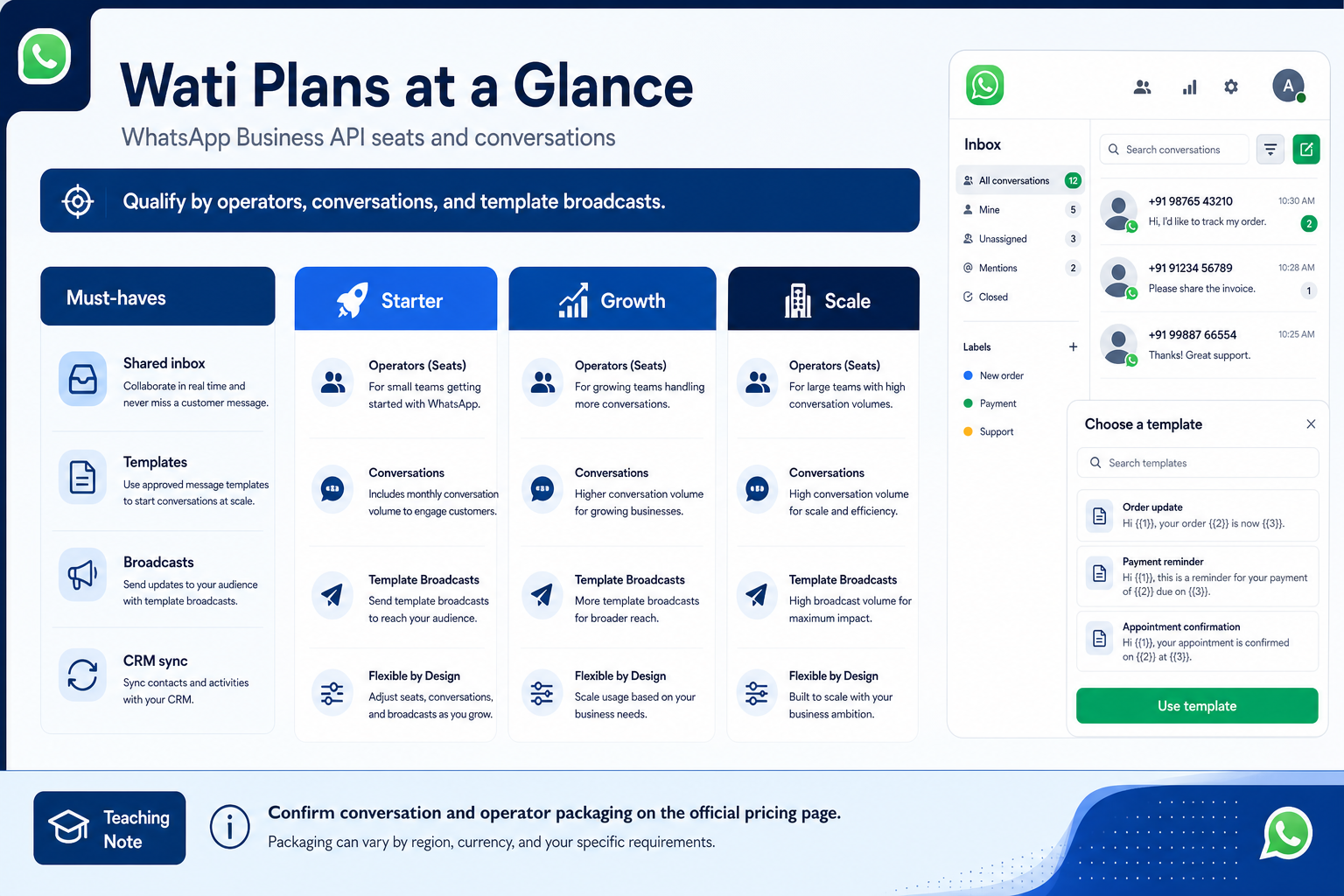
Wati must vs nice
- Calls + CRM CTI / call logging
- Softphone or IVR / routing
- Extra optional add-ons
- AI assistance
Wati checklist
Bring these questions to every demo
Ask vendors to show the workflow live, not just describe it.
- 1List day-one must-havesData, calling, sync that must ship without unused enterprise.
- 2Map seats and numbersUse researched plan names — not marketing tiles.
- 3Confirm on pricing pageList price and seat or number-pack upgrades live there — not in this guide.
Frequently asked questions
Why don’t you list dollar prices here?
Never invent list prices here — confirm seats, numbers/minutes, and quote terms on /pricing/wati/.
What if there is no public plan matrix?
Common for business communications. Compare with a written must-have sheet and quote diligence — not blog “starting at” figures.
Seats or seats/numbers — which matters more?
Whichever your day-one jobs consume. Many teams under-buy seats/numbers and over-buy spectator seats — reverse that.
Wati plan matrix and who each tier suits
Structure and trial/free flags come from SoftwareGlimpse pricing research. Dollar amounts appear only when verified — never invent list prices.
- Seats61%
- Add-ons18%
- Implementation12%
- Training5%
- Other4%
Growth
7-day trial · Unlocks: cloud phone, call routing, sms messaging · Suits: teams whose must-have gates appear on this tier
Pro
7-day trial · Suits: teams whose must-have gates appear on this tier
Business
7-day trial · Suits: teams whose must-have gates appear on this tier
Enterprise
Contact sales · Suits: teams that need custom procurement
1. Wati cost scenarios to pressure-test
Lean team / free-or-trial first
Scope a time-boxed pilot; 7-day trial documented.
Growing team with gated workflows
Map must-have workflows (cloud phone, call routing, WhatsApp Business) to plan unlocks before expanding seats.
Hidden / extra cost watch
Budget risk: Platform subscription is only part of the bill — Meta per-message charges vary by template category and recipient country. Also check add-ons, overages, and admin time outside the sticker plan.
Price Wati against how you actually buy seats and unlocks — not against a competitor's homepage headline.
Wati value rule
- 1Pay up when Ecommerce and D2C teams that sell and support on WhatsApp requires a paid unlock you will use weekly
- 2Do not overbuy if this limitation dominates: Platform subscription is only part of the bill — Meta per-message charges vary by template category and recipient country
- 3Side-by-side cost with Aircall on the same seat count
Wati cost mistakes to avoid
Cost trap 1
Platform subscription is only part of the bill — Meta per-message charges vary by template category and recipient country
Cost trap 2
Growth includes 3 users and does not allow additional users at all
Cost trap 3
Additional users cost list pricenth on Pro and list pricenth on Business
Cost trap 4
HubSpot integration starts on Pro and Salesforce on Business; Growth has only 2 integrations
Cost trap 5
Platform-fee dollars render by region on the pricing page — treat published bands as unconfirmed
Cheaper or clearer alternatives to pressure-test
Compare total cost of ownership vs Wati on identical constraints.
- View CRM profile
 Aircall
Mid-market cloud phone and customer-conversation platform with deep CRM/helpdesk CTI, IVR, power dialer on Professional, and paid AI add-ons — 3-licence minimum.
- View CRM profile
 CallHippo
SMB cloud phone system with a $0 starter rung, Starter from $18/user/month annual (2-user minimum), call recording and IVR from Professional, plus a separate call-centre plan ladder.
Catalogue peers only — not commission-ranked.
Wati pricing checklist
0/3 dimensions noted — saved in this browser only.
Plan gates you must unlock
Trial / free proof
TCO extras
Was this article helpful?
Have more questions? Contact our support team.
Part of Wati review · Business Communications hub
Related guides
Supporting reading in this topic — not a generic related-posts dump.
- Business Communications Pricing Guide: Seats, Minutes & Message FeesHow business communications pricing really works — per-seat licences, licence minimums, number rental, calling minutes, and WhatsApp conversation fees — with a method for building comparable totals.
- How to Choose Business Communications Software: Job-First FrameworkChoose business communications software by primary job — business phone, support routing, outbound calling, or customer messaging — then map seats, number coverage, feature gates, and a shared trial script.
- Is Wati Worth It? Fit Scenarios Before You BuyDecide if Wati is worth it for your sales and support team — fit scenarios, seat/number economics, and when to keep looking — without invented ROI percentages.
Related products
Related comparisons
SoftwareGlimpse Updates
Want clearer software shortlists? Get buying guides and comparisons by email.
Newsletter coming soon.