AppDynamics Setup: Day-Zero Path to a Working IT Loop
incident management; infrastructure monitoring; APM and distributed tracing; log management. Aws, Azure, Slack. Cisco-aligned estates that will model vCPU Premium list price (not list price infra-only) as APM TCO; APM buyers comparing AppDynamics to Dynatrace DPS and Datadog modules; Teams already in a Cisco EA who will not self-serve Datadog tiles. AppDynamics is Cisco’s application-performance and observability platform (APM, infra, business iQ). Observability Cloud-style public list: Infrastructure from about list price/vCP Buyer question: for incident management teams, is AppDynamics worth the paid tier unlock, or does Does not outrank Datadog (8.6) kill the rollout? ROI gate: AppDynamics is worth the paid tier spend if incident management + infrastructure monitoring are weekly; not worth buying when Does not outrank Datadog (8.6).
Quick answer
incident management decides whether AppDynamics setup is a one-team pilot or a specialist project — confirm unlocks for must-have capabilities before invites.
- Start with: incident management
- Gate check: confirm paid unlocks before go-live
- Integrate after: data quality pass on Aws
What matters in your AppDynamics setup
- What AppDynamics actually is — AppDynamics is Cisco’s application-performance and observability platform (APM, infra, business iQ). Observability Cloud-style public list: Infrastructure from about list price/vCPU/month; Premium (infrastructure plus applications) from list price/vCPU/month b…
- Configure these first — Research lists incident management, infrastructure monitoring, APM and distributed tracing, and log management as supported — that is your day-zero surface.
- Do not treat it as every IT job — AppDynamics is IT operations or development platform. It is not a substitute for a different IT job cluster.
- Prove with a real workflow — Worked example: Harbor IT (weekly operators) is done when they can finish the loop without an admin — not after a vendor tour.
AppDynamics day-zero path
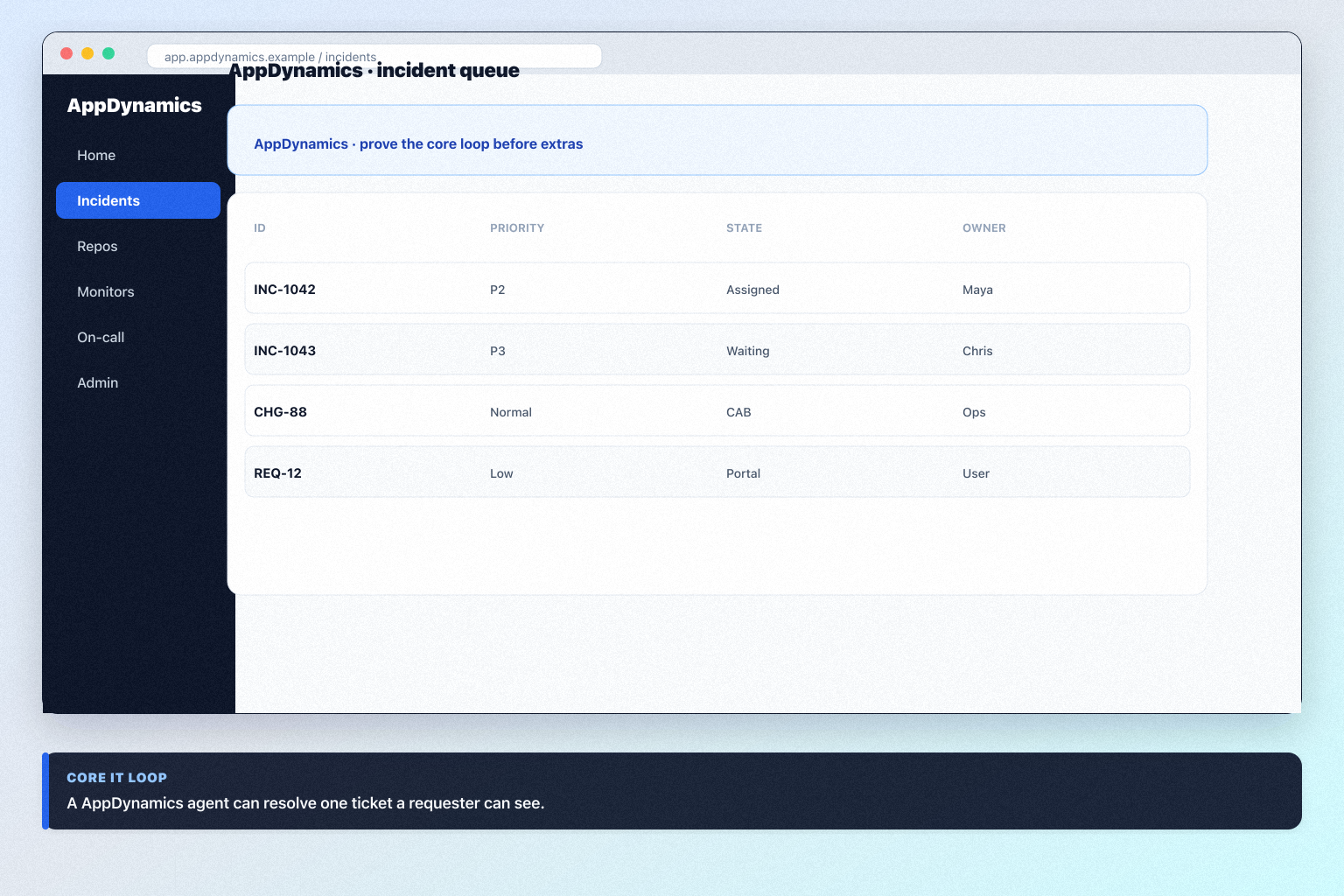
AppDynamics must vs nice
- Core job loop
- Plan / hub gates
- Integrations
- AI extras
AppDynamics checklist
Bring these questions to every demo
Ask vendors to show the workflow live, not just describe it.
- 1Name an IT/ops ownerFields, users, and hygiene need a responsible party.
- 2Configure one core loopseats or hosts for weekly operators, one core loop, and a required integration
- 3Complete non-admin prooffinish the loop without an admin
Frequently asked questions
When is setup actually done?
When a non-admin can finish the loop without an admin on the package you will buy.
Should we turn on every AppDynamics hub on day one?
No. Extra modules hide whether the core IT operations or development platform loop works.
1. AppDynamics day-zero to steady-state sequence
Day zero — objects and owners
Define owners for incident management, infrastructure monitoring, APM and distributed tracing before inviting the whole org.
SMB pilot
One pipeline / one team proves Cisco-aligned estates that will model vCPU Premium list price (not list price infra-only) as APM TCO before company-wide seats.
Cutover
Freeze legacy writes briefly; validate Aws and Azure before reopen.
Treat AppDynamics setup as a controlled rollout — not a weekend dump of CSV files.
AppDynamics implementation go / no-go
AppDynamics implementation mistakes
Mistake 1
Does not outrank Datadog (8.6)
Mistake 2
list price/vCPU Infrastructure is not the APM-relevant floor — Premium list price is
Mistake 3
Cisco EA quotes often replace public vCPU tiles
Mistake 4
Medium pricing confidence versus Datadog’s published host SKU
Big-bang invite
Inviting every user before object design creates junk data that is expensive to unwind.
AppDynamics implementation checklist
0/3 dimensions noted — saved in this browser only.
Prep
Pilot
Scale
Was this article helpful?
Have more questions? Contact our support team.
Part of AppDynamics review · IT & Development hub
Related guides
Supporting reading in this topic — not a generic related-posts dump.
- AppDynamics Implementation: 30/60/90 IT Rollout That SticksPlan a practical AppDynamics rollout — owners, core IT loop, training, and adoption checkpoints — so the product becomes how the team actually operates.
- IT & Development Software Requirements GuideA practical requirements sheet for ITSM, observability, incident/on-call, source control, hosting panels, and web-data purchases.
Related products
Related comparisons
SoftwareGlimpse Updates
Want clearer software shortlists? Get buying guides and comparisons by email.
Newsletter coming soon.