IT & Development Software Requirements Guide
A practical requirements sheet for ITSM, observability, incident/on-call, source control, hosting panels, and web-data purchases.
Quick answer
Write IT requirements as jobs and evidence, not feature wishlists: primary job (ITSM vs observability vs on-call vs source control vs hosting vs web data), must-have workflows, usage unit, integrations, admin/security, and who operates it weekly. Decision rule: every must-have must map to a weekly ritual and a plan, host pack, ingest GB, git seat, panel licence, or proxy GB you are willing to buy.
- Primary job statement
- Must-have workflows
- Usage unit (agent / host / GB)
- Integrations list
- Admin / security gates
- Roles & permissions
Key takeaways
- Separate must from nice — If the team still operates without it for 90 days, it is nice-to-have.
- Requirements own plan gates — CMDB, APM, paging policies, and Web Host licences imply a qualifying configuration — write that explicitly.
- Clusters need their own sheet — ITSM, observability, and on-call requirements should not pollute a single undifferentiated RFP.
1. Write three job statements
Capture: (1) who updates tickets, dashboards, or repos, (2) who needs visibility or on-call, (3) which stack tools must sync — identity, cloud, or git.
Worked example: Harbor Ops wrote “Agents resolve employee incidents with CMDB context; SRE needs a service map without chasing Slack; the on-call needs a page that is not a metrics tile.”
2. Build a one-page score sheet
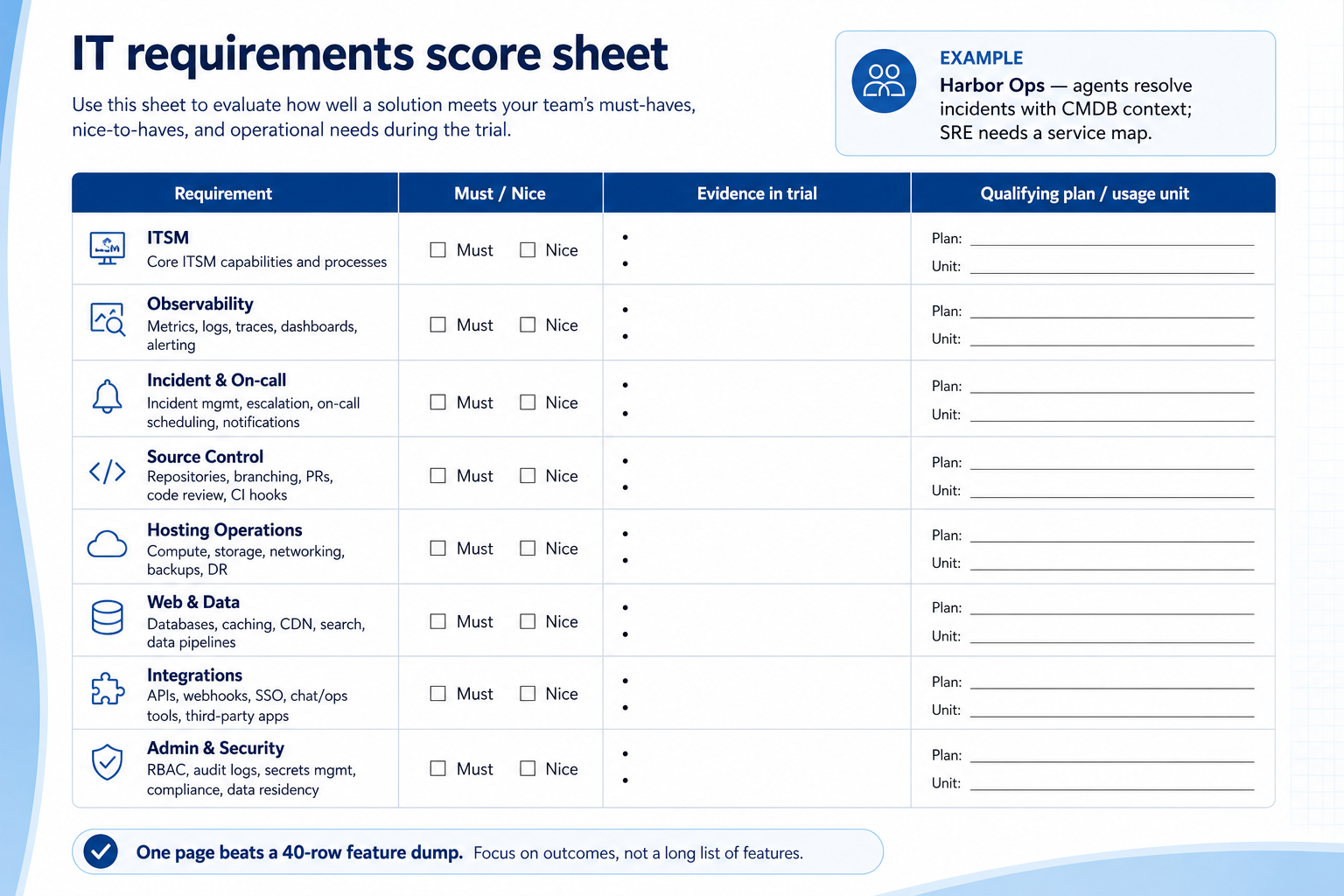
Columns: requirement, must/nice, evidence to collect in trial, qualifying plan/usage unit. Rows for ITSM, observability, incident/on-call, source control, hosting operations, web-data collection, integrations, admin/security.
This guide is the requirements surface for IT & development buyers on SoftwareGlimpse.
3. Split must-haves from nice-to-haves in writing
List day-one workflows for IT and development software in two columns: must work before go-live vs can wait until adoption proves out. Must-haves drive plan gates and integrations; nice-to-haves belong on a phase-two sheet so demos do not inflate scope.
Worked example: Harbor People Ops marks SSO and audit logs as must-have, AI summaries as phase-two. Demos that skip the must column get cut from the shortlist early.
4. Map integrations and data boundaries
Name systems that must sync or stay out of scope: identity, payroll, CRM, ecommerce, chat, or data warehouse. For each integration, note whether it is native, API, or manual export — and who owns the connection when it breaks.
Worked example: Northline Finance requires HRIS sync to payroll and refuses tools that need nightly CSV babysitting unless IT signs off.
5. Get a one-page sign-off before trials
Share the must-have sheet with finance, IT, and the team lead who owns the weekly job. Trials should test the signed sheet — not a fresh wishlist from each demo.
Next: /guides/how-to-choose-it-development-software/
6. Use a one-page checklist before demos
For IT & Development Software Requirements Guide, list must-haves, owners, integrations, and the weekly ritual this purchase must improve. Share the sheet with finance and IT before you schedule a second demo.
- Name the primary job in one sentence.
- List must-have gates (plans, SSO, data residency, usage caps).
- Name integrations that must work on day one.
- Assign an admin owner and a weekly user champion.
- Define non-admin proof — what a sceptic completes without rescue.
Worked example: Harbor Ops refuses demos until the checklist is signed — cutting evaluation time in half.
7. Avoid the usual buying mistakes
Common failures in it-development: buying for brand familiarity, comparing entry tiles across different usage units, skipping a fair trial script, and adding scope before adoption proves out.
Run one trial script on every finalist the same week. Score on the same card. Write a one-paragraph decision memo that names what you are not buying yet.
8. Hand off to the category shortlist
When assumptions are frozen, continue on /best/it-development-software/ with the same headcount, usage band, and must-have gates on every quote.
9. Use a one-page checklist before demos
For IT & Development Software Requirements Guide, list must-haves, owners, integrations, and the weekly ritual this purchase must improve. Share the sheet with finance and IT before you schedule a second demo.
- Name the primary job in one sentence.
- List must-have gates (plans, SSO, data residency, usage caps).
- Name integrations that must work on day one.
- Assign an admin owner and a weekly user champion.
- Define non-admin proof — what a sceptic completes without rescue.
Worked example: Harbor Ops refuses demos until the checklist is signed — cutting evaluation time in half.
10. Avoid the usual buying mistakes
Common failures in it-development: buying for brand familiarity, comparing entry tiles across different usage units, skipping a fair trial script, and adding scope before adoption proves out.
Run one trial script on every finalist the same week. Score on the same card. Write a one-paragraph decision memo that names what you are not buying yet.
11. Hand off to the category shortlist
When assumptions are frozen, continue on /best/it-development-software/ with the same headcount, usage band, and must-have gates on every quote.
Frequently asked questions
Should requirements include scores?
No invented product scores. Capture evidence against your jobs; use Best page methodology for cluster editor’s picks.
How many must-haves is too many?
If more than roughly eight items are must-haves, you are still in wishlist mode — force a ranking.
Was this article helpful?
Have more questions? Contact our support team.
Part of Software buying guides · What Is IT & Development Software?
Related guides
Supporting reading in this topic — not a generic related-posts dump.
- ThorData Plans: Seats, Hosts, and Qualifying TiersChoose your ThorData plan by mapping must-haves to qualifying tiers — seats, hosts, ingest, and add-ons — not homepage “from” tiles.
- Bright Data Plans: Seats, Hosts, and Qualifying TiersChoose your Bright Data plan by mapping must-haves to qualifying tiers — seats, hosts, ingest, and add-ons — not homepage “from” tiles.
- Is Bright Data Worth It? Fit Scenarios Before You BuyDecide if Bright Data is worth it for your team — job-cluster fit, trial proof, and packaging — without invented ROI percentages.
- Is ThorData Worth It? Fit Scenarios Before You BuyDecide if ThorData is worth it for your team — job-cluster fit, trial proof, and packaging — without invented ROI percentages.
- IT & Development Software Evaluation GuideA practical evaluation script for ITSM, observability, incident/on-call, source control, hosting panels, and web-data tools.
- IT & Development Software Pricing GuideBudget ITSM, observability, on-call, source control, hosting panels, and web-data tools by qualifying configuration — not the advertised starter tile.
SoftwareGlimpse Updates
Want clearer software shortlists? Get buying guides and comparisons by email.
Newsletter coming soon.