AppDynamics Implementation: 30/60/90 IT Rollout That Sticks
incident management; infrastructure monitoring; APM and distributed tracing; log management. Aws, Azure, Slack. Cisco-aligned estates that will model vCPU Premium list price (not list price infra-only) as APM TCO; APM buyers comparing AppDynamics to Dynatrace DPS and Datadog modules; Teams already in a Cisco EA who will not self-serve Datadog tiles. AppDynamics is Cisco’s application-performance and observability platform (APM, infra, business iQ). Observability Cloud-style public list: Infrastructure from about list price/vCP Buyer question: does paid tier gating incident management change the AppDynamics decision before seats scale? Decision thesis: unlike a generic it-development shortlist, AppDynamics is worth it if Cisco-aligned estates that will model vCPU Premium list price (not list price infra-only) as APM TCO outweighs Does not outrank Datadog (8.6) — trade-off accepted before seats scale.
Quick answer
incident management decides whether AppDynamics implementation is a one-team pilot or a specialist project — confirm unlocks for must-have capabilities before invites.
- Start with: incident management
- Gate check: confirm paid unlocks before go-live
- Integrate after: data quality pass on Aws
AppDynamics rollout rules
- Job cluster first — AppDynamics is IT operations or development platform. Do not implement it as a different IT job cluster.
- Adoption before add-ons — If Harbor IT will not open the product weekly, extra modules will not save the rollout.
- Integrations are a phase — Research names Aws, Azure, Slack, and API access on the AppDynamics side — confirm the connectors your IT loop depends on.
- AI is optional — Research lists AI assistant, AI assistant, AI automation, and AI recommendations for AppDynamics.
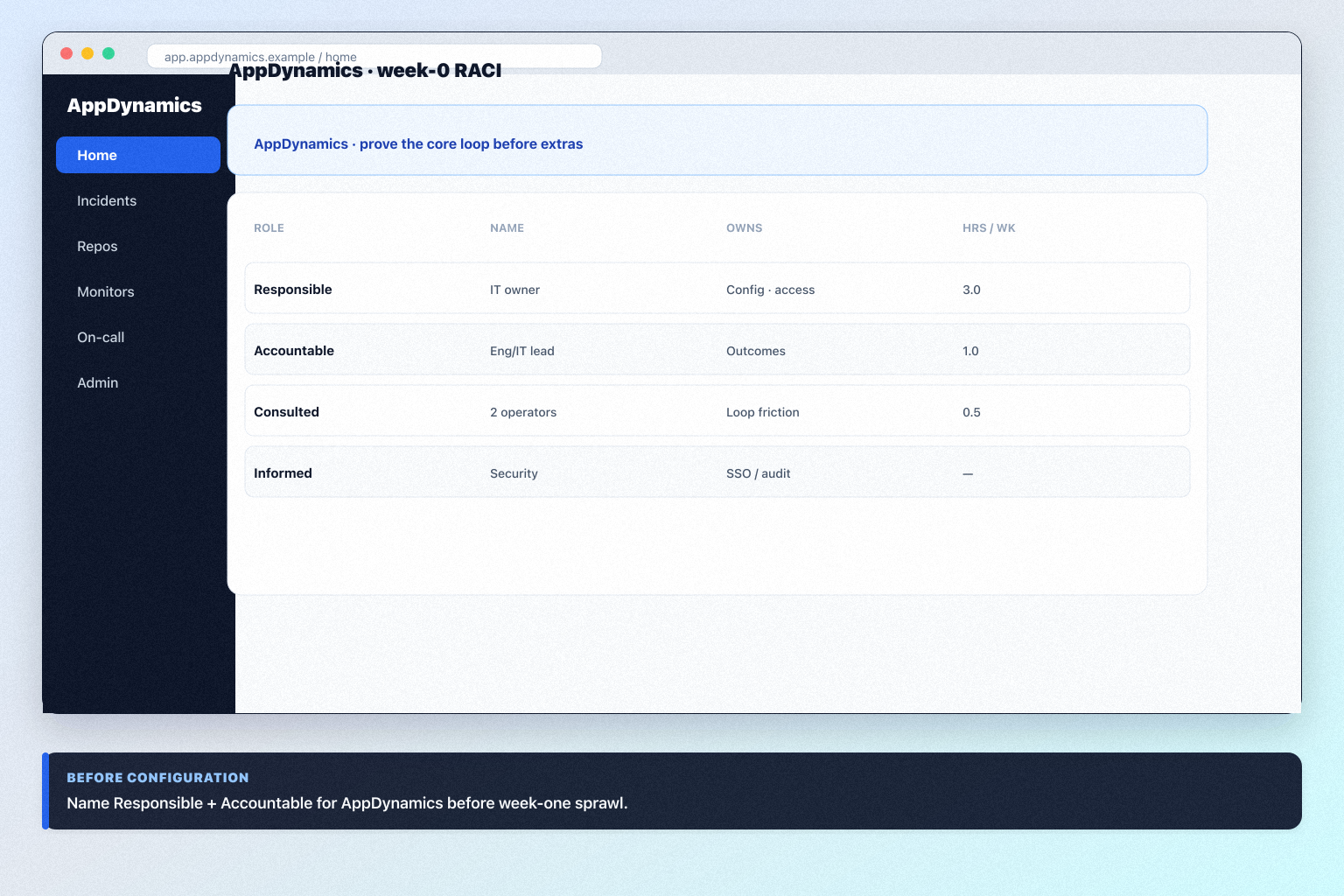
AppDynamics 30/60/90
AppDynamics checklist
Bring these questions to every demo
Ask vendors to show the workflow live, not just describe it.
- 1Freeze 90-day outcomesMust-haves for IT operations or development platform before configuration sprawl.
- 2Name an admin ownerFields, users, and hygiene need a responsible party.
- 3Schedule adoption reviewCheck core-loop usage before adding automations.
Frequently asked questions
How long should rollout take?
Ninety days is enough for most SMB/mid teams if you freeze the job and defer extras. Longer programmes help when change management is the risk.
What if we also need a different IT job?
Buy the second job as a second product (or a later wave). AppDynamics should not be stretched into a different IT job cluster.
1. AppDynamics day-zero to steady-state sequence
Day zero — objects and owners
Define owners for incident management, infrastructure monitoring, APM and distributed tracing before inviting the whole org.
SMB pilot
One pipeline / one team proves Cisco-aligned estates that will model vCPU Premium list price (not list price infra-only) as APM TCO before company-wide seats.
Cutover
Freeze legacy writes briefly; validate Aws and Azure before reopen.
Treat AppDynamics setup as a controlled rollout — not a weekend dump of CSV files.
AppDynamics implementation go / no-go
AppDynamics implementation mistakes
Mistake 1
Does not outrank Datadog (8.6)
Mistake 2
list price/vCPU Infrastructure is not the APM-relevant floor — Premium list price is
Mistake 3
Cisco EA quotes often replace public vCPU tiles
Mistake 4
Medium pricing confidence versus Datadog’s published host SKU
Big-bang invite
Inviting every user before object design creates junk data that is expensive to unwind.
AppDynamics implementation checklist
0/3 dimensions noted — saved in this browser only.
Prep
Pilot
Scale
Was this article helpful?
Have more questions? Contact our support team.
Part of AppDynamics review · IT & Development hub
Related guides
Supporting reading in this topic — not a generic related-posts dump.
- AppDynamics Migration: Move Tickets and Repos Without Losing TrustMigrate into AppDynamics with an inventory, field map, pilot import, dual-run week, and validation — so history survives and operators trust the new system.
- AppDynamics Setup: Day-Zero Path to a Working IT LoopSet up AppDynamics for day-zero work — seats or hosts, one core loop, required integrations, and non-admin proof — before optional modules.
Related products
Related comparisons
SoftwareGlimpse Updates
Want clearer software shortlists? Get buying guides and comparisons by email.
Newsletter coming soon.