Zoom Setup: Day-Zero Path to a Working Call Loop
Set up Zoom for day-zero calling — seats, one number, routing, softphone, and CRM CTI — before optional marketplace apps.
Quick answer
Set up Zoom in this order: qualify seats and numbers for day-one calling, name one communications owner, build one call queue / IVR route, connect CRM CTI / call logging, enable softphone or IVR / routing, then have a non-admin provision a number, set a route, place a softphone call, and confirm CRM logging. Confirm call recording (Workplace+) and power dialer (Workplace+) are on the package you will actually buy. You’re done when that walkthrough works — not when every optional add-on is switched on.
- Start on Workplace Free
- Name one communications owner
- One call queue / IVR route only
- Connect CRM CTI / call logging
- Softphone or IVR / routing
- Prove an agent can run it
What matters in your Zoom setup
- What Zoom actually is — Zoom combines Zoom Workplace (meetings, chat, whiteboard) with Zoom Phone for cloud PBX. Free Workplace meetings/chat exist, but business phone is a paid Zoom Phone add-on or bundle (US/CA Unlimited research floor ~list price–16; Pro Plus ~list price / Busines…
- Configure these first — Research lists cloud phone, call routing, call recording, and power dialer as supported — that is your day-zero surface.
- Check gates and usage — Plan-gated in research: call recording (Workplace Free, Zoom Phone US/CA Unlimited, Workplace Pro Plus, Workplace Business Plus); power dialer (Workplace Free, Zoom Phone US/CA Unlimited, Workplace Pro Plus, Workplace Business Plus); CRM CTI (Workplace Free, Zoom Phone US/CA Unlimited, Workplace Pro Plus, Workplace Business Plus).
- Start on the right package — Researched plans: Workplace Free, Zoom Phone US/CA Unlimited, Workplace Pro Plus, Workplace Business Plus. Never invent list prices here — confirm seats, numbers/minutes, and quote terms on /pricing/zoom/.
- Sync only what the loop needs — Research names Salesforce, HubSpot, Microsoft Teams, Slack, and Google Workspace on the Zoom side — confirm the connectors your call and messaging loop depends on.
- AI comes after habits — Research lists AI assistant, AI summaries, AI transcription, and additional AI features for Zoom. Research places AI assistance on Workplace Free, Zoom Phone US/CA Unlimited, Workplace Pro Plus, and Workplace Business Plus. Leave it off until the manual communications loop is boring and reliable.
Zoom day-zero path
Zoom setup walkthrough
Zoom must vs nice
- One call queue / IVR route + do-not-call numbers
- cloud phone
- CRM CTI for logged calls
- call recording
- call routing
- AI assistance
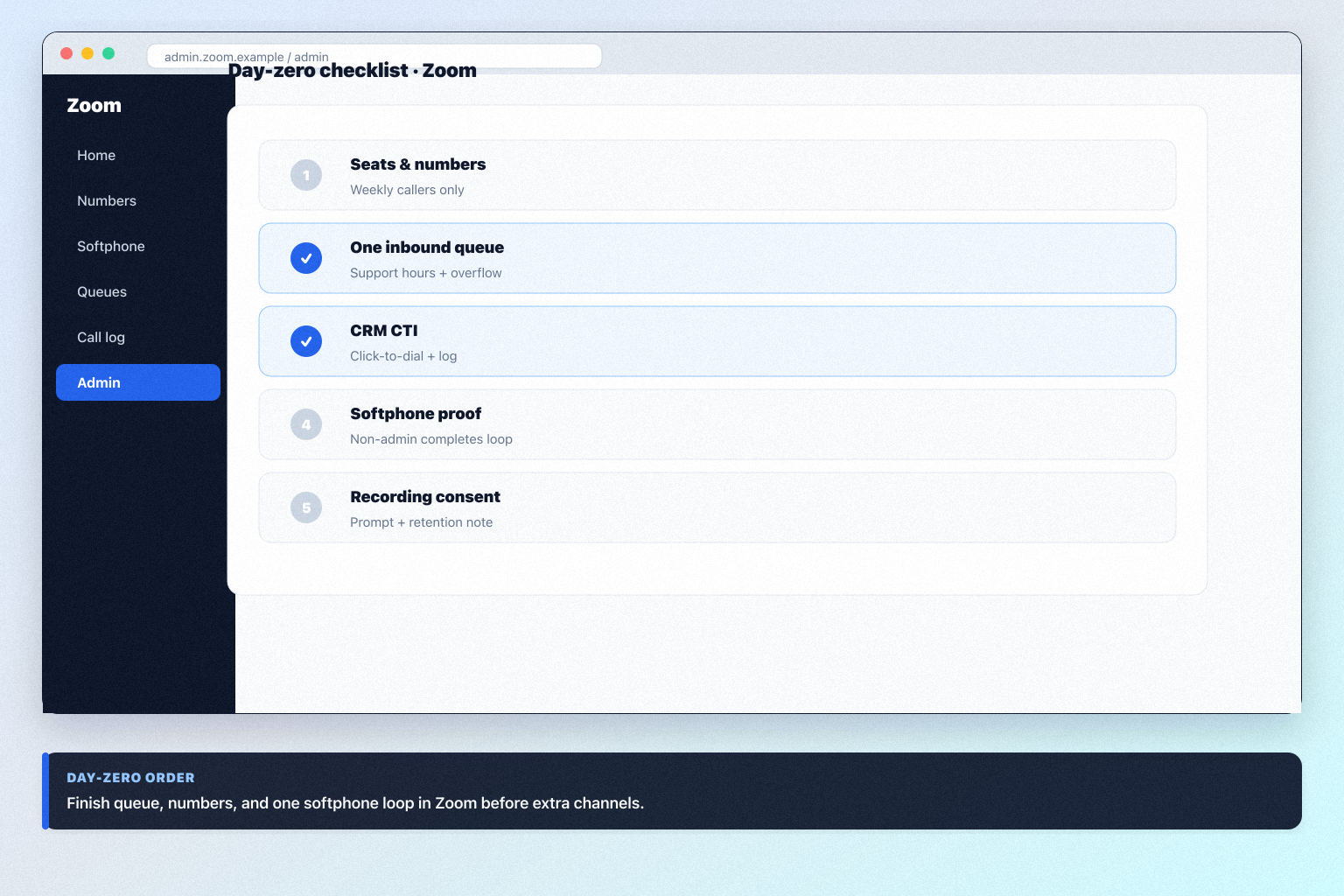
Zoom checklist
Bring these questions to every demo
Ask vendors to show the workflow live, not just describe it.
- 1Qualify Zoom contacts and minute/number limitsDay-one must-haves on the cheapest researched package.
- 2Name one communications ownerMinutes/contacts, numbers, sync, and hygiene need an owner.
- 3Build one call queue / IVR routeFilters match how you prospect in the next 90 days.
- 4Connect CRM CTI / call loggingPlus form capture or routing — document other gaps.
- 5Enable one voice channelCall or routing — not both on day zero.
- 6Prove the non-admin loopProvision · route · softphone · CRM log — then write the setup note.
1. Start on the Zoom package your must-haves need
Write five day-one jobs, map each to researched Zoom packaging, and pick the cheapest tier that covers all five — including seats/numbers if usage-based. 1. List the five things the sales + support team must do on day one.
- Match each one to researched Zoom packaging. Plan-gated in research: call recording (Workplace Free, Zoom Phone US/CA Unlimited, Workplace Pro Plus, Workplace Business Plus); power dialer (Workplace Free, Zoom Phone US/CA Unlimited, Workplace Pro Plus, Workplace Business Plus); CRM CTI (Workplace Free, Zoom Phone US/CA Unlimited, Workplace Pro Plus, Workplace Business Plus).
- Pick the cheapest package that covers all five.
- Check contacts and minute/number limits, not just feature checkmarks. Confirm seat/number caps for Zoom before inviting everyone. Our snapshot flags a trial on Zoom Phone US/CA Unlimited, Workplace Pro Plus, and Workplace Business Plus without a published length — confirm the window on the Zoom pricing page. Never invent list prices here — confirm seats, numbers/minutes, and quote terms on /pricing/zoom/. Worked example: an 8-person sales + support team needs cloud phone, call routing, call recording, and shared inbox plus CRM CTI / call logging on day one in Zoom. They start on Workplace Free and note which capabilities would force an upgrade.
2. Create the workspace and name one communications owner
Name one communications owner — not a committee — before you invite the sales + support team. 1. Create the workspace with real company identity and timezone.
- Name one owner with ~2 hours a week for seats, numbers, users, and CTI hygiene.
- Agree: new numbers, IVR / routing, and seat or number-pack upgrades go through that owner only.
- In Zoom, open admin console, numbers, or users settings — confirm the current control labels in the product, docs, or trial. Worked example: an 8-person sales + support team makes ops the Zoom communications owner, writes the two-hour commitment into the week, and blocks everyone else from buying seat or number-pack upgrades for 30 days.
3. Build one call queue / IVR route — not five experiments
Configure one call queue / IVR route that matches how you actually route and answer for the next 90 days. 1. Freeze audience definition, personas, and exclusions in writing.
- Build one saved queue / IVR route in Zoom. cloud phone is researched across every Zoom plan we snapshot
- Add do-not-call numbers (do-not-call, blocked numbers, competitors).
- Spot-check 20 records for number quality, routing fit, and ownership. Worked example: an 8-person sales + support team builds one mid-market inbound queue in Zoom, suppresses do-not-call and blocked numbers, and rejects the queue until 18 of 20 spot-checks look call-ready.
4. Connect CRM, enable one channel, prove the non-admin loop
Finish day-zero by proving a agent can run the loop without screenshots of another tool. 1. Connect CRM CTI / call logging for contacts and activities. Research names Salesforce, HubSpot, Microsoft Teams, Slack, and Google Workspace on the Zoom side — confirm the connectors your call and messaging loop depends on.
- Enable one voice channel — calls or IVR / routing, not both. call recording is researched on Workplace Free, Zoom Phone US/CA Unlimited, Workplace Pro Plus, and Workplace Business Plus only and team messaging is researched across every Zoom plan we snapshot
- Have a non-admin: place or take a softphone call and confirm the activity landed in CRM.
- Write a one-page setup note: package, owner, list, channel, known gaps. Worked example: an 8-person sales + support team connects HubSpot, turns on a basic inbound IVR in Zoom, and only invites the rest of the sales + support team after Priya completes dial → route → softphone → CRM log without help.
Frequently asked questions
How long should Zoom setup take?
A focused team can finish day-zero setup in one working day if seats/numbers, call queue / IVR route, CRM CTI / call logging, and one voice channel are already decided. Multi-week “setup” usually means undecided packaging or missing ownership.
Do we need every routing feature on day one?
No. Prove provision → route → softphone → CRM log first. Add optional add-ons only when a named decision depends on them.
Where do we confirm contacts and minute/number limits?
Never invent list prices here — confirm seats, numbers/minutes, and quote terms on /pricing/zoom/.
Was this article helpful?
Have more questions? Contact our support team.
SoftwareGlimpse Updates
Want clearer software shortlists? Get buying guides and comparisons by email.
Newsletter coming soon.