Zoom Implementation: 30/60/90 Communications Rollout That Sticks
Plan a practical Zoom rollout — phone admin, number provisioning, routing, softphone, and CRM CTI — so communications becomes a repeatable motion.
Quick answer
Roll out Zoom in three phases: days 1–30 get numbers live with number and routing hygiene and CRM sync, days 31–60 make weekly queue and call reviews run from Zoom, and days 61–90 add only IVR / routing or queues that still aren’t working. Confirm call recording (Workplace+) and power dialer (Workplace+) are on the package you will actually buy. If agents still route to unowned queues without a CRM sync or do-not-call hygiene by week two, pause new features and fix that first.
- Freeze 3 outcomes
- Name a communications owner
- Day 30: live communications loop
- Day 60: channel rhythm
- Day 90: expand carefully
- Usage before features
Zoom rollout takeaways
- Implementation is habit work — Zoom combines Zoom Workplace (meetings, chat, whiteboard) with Zoom Phone for cloud PBX. Free Workplace meetings/chat exist, but business phone is a paid Zoom Phone add-on or bundle (US/CA Unlimited research floor ~list price–16; Pro Plus ~list price / Busines… None of that helps until the weekly communications loop is boring.
- Gate features to plan tiers — Plan-gated in research: call recording (Workplace Free, Zoom Phone US/CA Unlimited, Workplace Pro Plus, Workplace Business Plus); power dialer (Workplace Free, Zoom Phone US/CA Unlimited, Workplace Pro Plus, Workplace Business Plus); CRM CTI (Workplace Free, Zoom Phone US/CA Unlimited, Workplace Pro Plus, Workplace Business Plus).
- Enable in this order — Days 1–30: cloud phone, call routing, call recording, and power dialer. Days 31–60: weekly usage review and call recording. Days 61–90: call routing, AI assistance, and second call queue / IVR route.
- Measure usage, not configuration — Count answer rates, missed-call rates, minutes used per queue, and CRM-logged calls from Zoom — not modules enabled.
- Know what you inherited — Research watch-outs to plan around: Full business phone is paid — free tier is not Zoom Phone; Phone seat floors and bundles need live confirmation (medium confidence); Call recording and Power Pack dialer gated/add-on.
Zoom 30/60/90 path
Zoom implementation walkthrough
Zoom must vs nice
- Logged CRM activities from calling
- Weekly list / sequence review
- call routing
- AI assistance
Zoom checklist
Bring these questions to every demo
Ask vendors to show the workflow live, not just describe it.
- 1Freeze three 90-day outcomesMeetings, coverage, or reply goals with owners.
- 2Day 30: live communications loopEvery active rep runs number → softphone → CRM log weekly.
- 3Day 60: usage reviewMinutes/contacts per meeting and sequence hygiene on the agenda.
- 4Day 90: expand only gapsAdd channels or packs that still miss an outcome.
1. Freeze outcomes and RACI before you configure Zoom
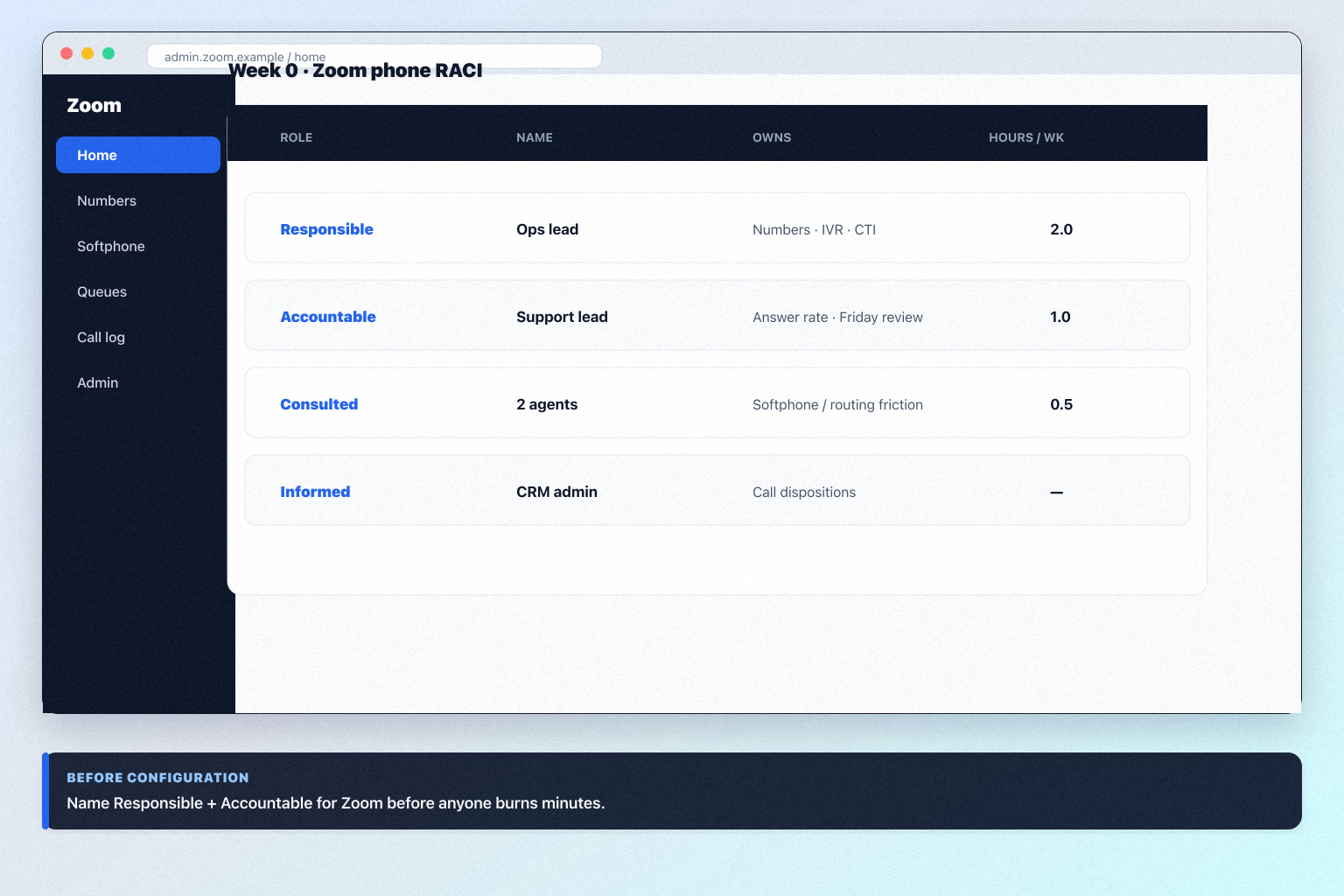
Lock three 90-day outcomes and name Responsible / Accountable before anyone burns seats/numbers. 1. Write exactly three 90-day outcomes in business language (engagement, coverage and answer-rate, routing coverage).
- Assign RACI — Responsible: Zoom communications owner; Accountable: sales/support lead; Consulted: two agents; Informed: Ops / CRM admin.
- Write the “not now” list for channels and packs not tied to the three outcomes.
- Book the day-30 and day-60 reviews in the calendar now. Worked example: an 8-person sales + support team freezes three outcomes for Zoom, gives ops two hours a week as Responsible, and defers call routing and AI assistance to day 61.
2. Days 1–30: get the communications loop live
Days 1–30 are for cloud phone, call routing, call recording, and power dialer — not marketplace browsing. 1. Finish setup: one call queue / IVR route, CRM CTI / call logging, one voice channel.
- Invite only daily users; spectators wait.
- Run a mid-month spot-check: 20 random callinges must show a CRM activity.
- Kill shadow spreadsheets that still hold “the real list.” Worked example: an 8-person sales + support team runs Zoom as the only place new contacts enter calls, and by day 30 every open routing step has an owner and a CRM log.
3. Days 31–60: install the weekly rhythm
Make Friday (or Monday) reviews run from Zoom. 1. Agenda: minutes used vs answered calls, routing quality flags, answer and handle times, CRM CTI / call logging errors.
- Add light routing only where a human already does the same step weekly. call recording is researched on Workplace Free, Zoom Phone US/CA Unlimited, Workplace Pro Plus, and Workplace Business Plus only
- Retrain anyone still exporting numbers to personal call logs.
- Re-measure adoption before unlocking day-61 packs. Worked example: an 8-person sales + support team finds two agents still keeping “private” call sheets; they pause new calls until those numbers are suppressed or imported into Zoom.
4. Days 61–90: expand only where outcomes still miss
- Re-read the three outcomes. Expand only where an outcome is still missing.
- Then, in this order: second call queue / IVR route, call routing, remaining IVR / routing, remaining integrations. Research lists AI assistant, AI summaries, AI transcription, and additional AI features for Zoom. Research places AI assistance on Workplace Free, Zoom Phone US/CA Unlimited, Workplace Pro Plus, and Workplace Business Plus.
- Write down what you chose not to do and why. That list is your renewal-time evidence.
- Never invent list prices here — confirm seats, numbers/minutes, and quote terms on /pricing/zoom/. Worked example: an 8-person sales + support team adds a second Zoom list for after-hours overflow, enables one optional add-on for shared inbox rules, and leaves AI call summaries off because nobody could name the answer-rate decision it would change.
Frequently asked questions
What if seats/numbers run out before day 30?
Pause new number provisioning, tighten routing filters, and review who is shadow-logging vs callinging. Do not buy a larger pack until the communications owner can explain cost-per-answered-call or handle time for the last two weeks. Confirm pack options on the pricing page.
When should we add a second voice channel?
After the first channel produces CRM-logged activity and a weekly review rhythm. Parallel channels on day one usually double noise without doubling meetings.
Who should own Zoom?
One communications owner with calendar time — usually Ops or ops — not a rotating agent committee.
Was this article helpful?
Have more questions? Contact our support team.
SoftwareGlimpse Updates
Want clearer software shortlists? Get buying guides and comparisons by email.
Newsletter coming soon.