When to Replace Sales Intelligence: Optimize vs Switch
Decide whether to optimize your current sales intelligence tool or replace it — using coverage, credit, sync/write, and deliverability/exit signals — then shortlist with How to Choose / Best SI only after the decision.
Quick answer
Replace a sales intelligence tool only when optimize-in-place cannot clear the blockers that make it unusable as a prospecting data layer. Decision rule: if coverage on your ICP is dead, credit burn is unpredictable, CRM sync/write rules fail, or deliverability/exit pain is blocking outbound — and a 30–60 day optimize sprint still fails — then replace; otherwise fix ownership, saved searches, write rules, and rituals first.
- Try optimize first
- Coverage dead?
- Credit chaos?
- Sync / write fail?
- Deliverability / exit?
- Then shortlist
Key takeaways
- Replace is a last-mile decision — Most “bad SI” pain is process, write-rule debt, or plan-tier credit gates — not the logo on the login screen.
- Four signal clusters matter — ICP coverage dead, credit chaos, sync/write failure, and deliverability/exit pain — score them honestly.
- Optimize sprint before shopping — A time-boxed fix of searches, credits, write rules, and suppression proves whether the product can still work.
- Shortlist after the decision — How to Choose and Best SI come after you decide replace — this page does not rank products.
Optimize vs replace path
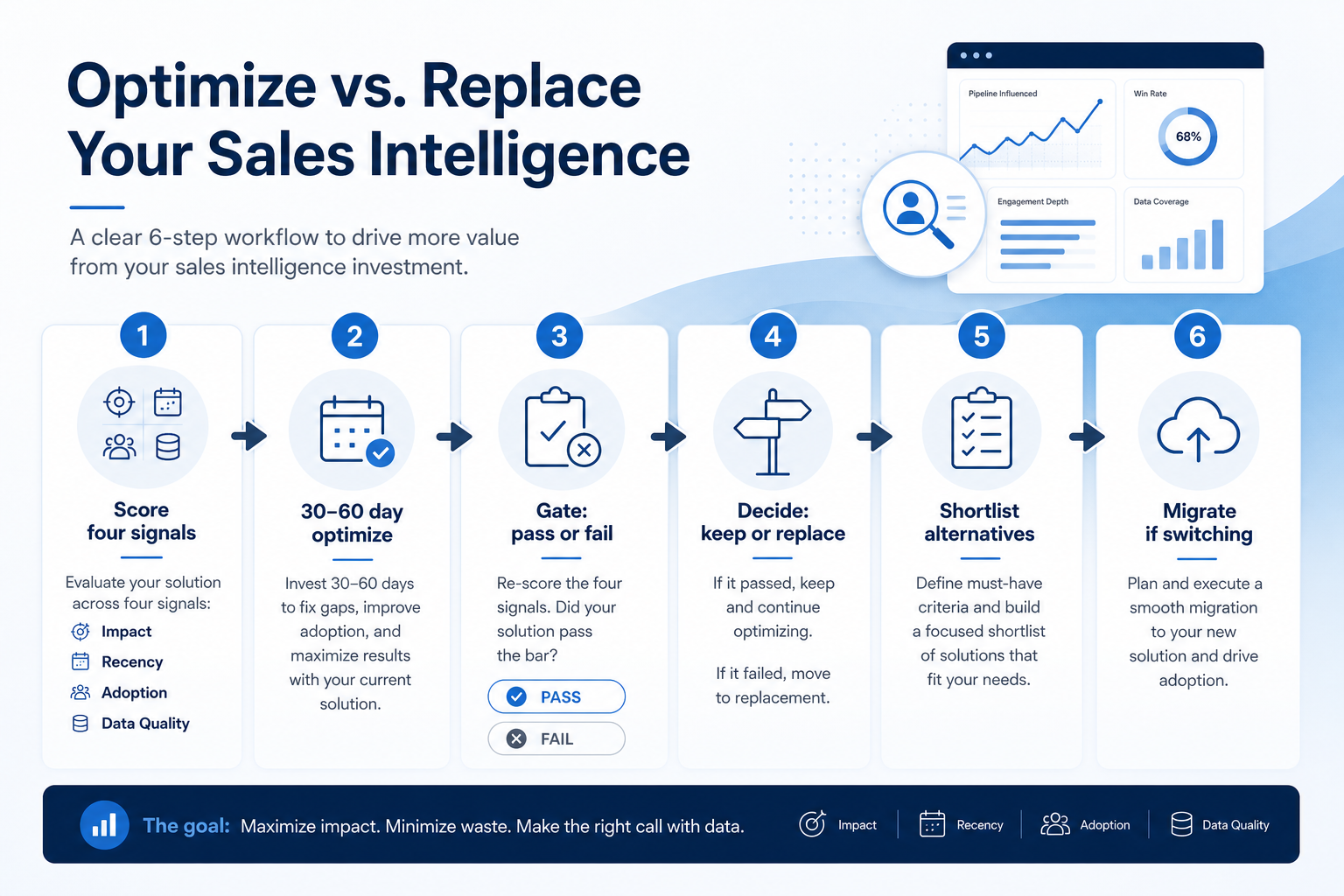
Optimize-in-place vs replace
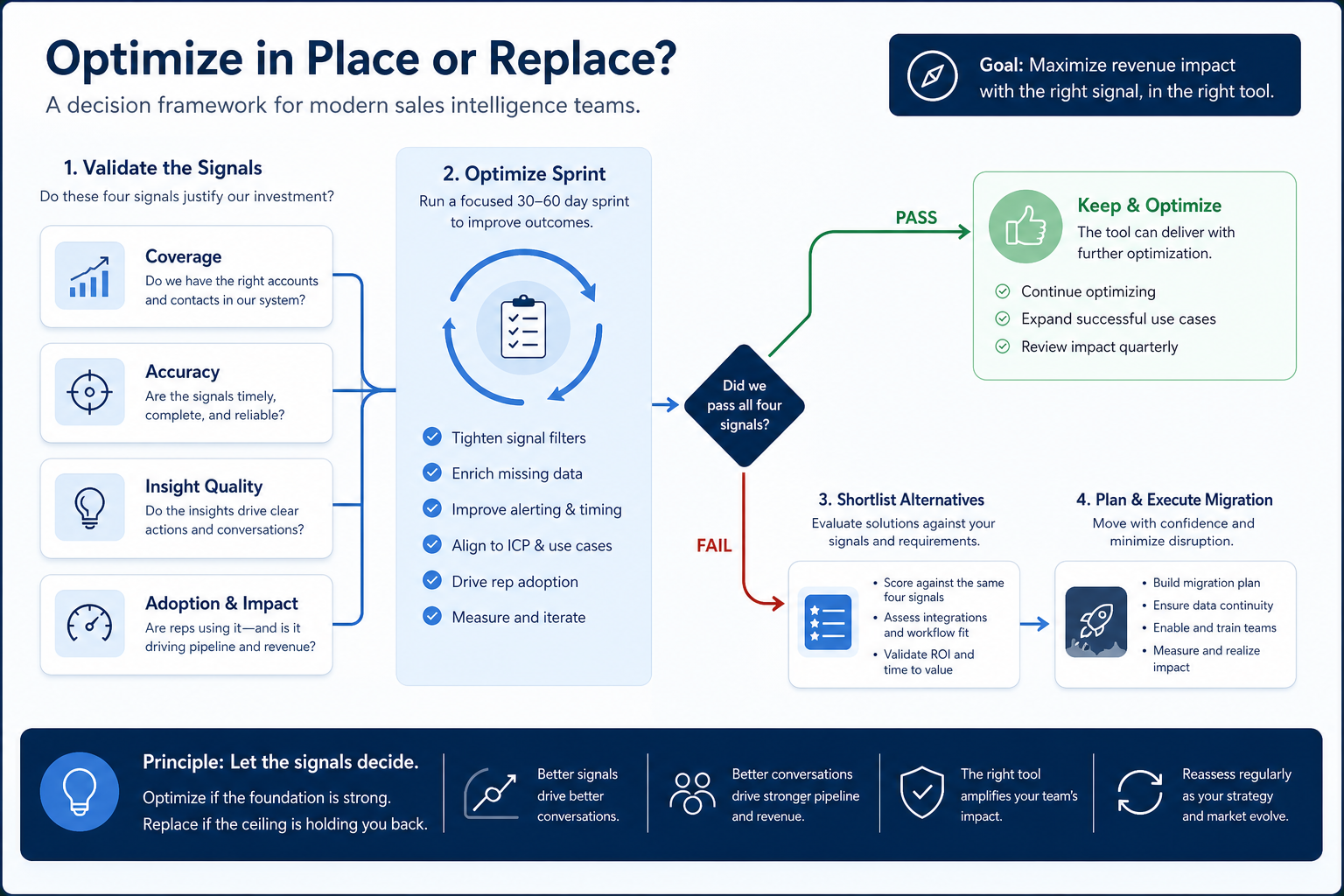
Replace-readiness checklist
Bring these questions to every demo
Ask vendors to show the workflow live, not just describe it.
- 1Four signal clusters scored in writingCoverage, credits, sync/write, deliverability/exit.
- 2Optimize sprint scoped with ownersSearches, credits, write rules, suppression — dated end.
- 3Sprint evidence reviewedPass/fail against pre-written criteria.
- 4Export / exit path proved on current toolSample export before you commit to leave.
- 5Must-haves + constraints frozen for shortlistSheet ready before How to Choose / Best.
- 6No affiliate-ordered “best SI” list used as decisionEvidence over marketing order.
1. Score the four replace signals
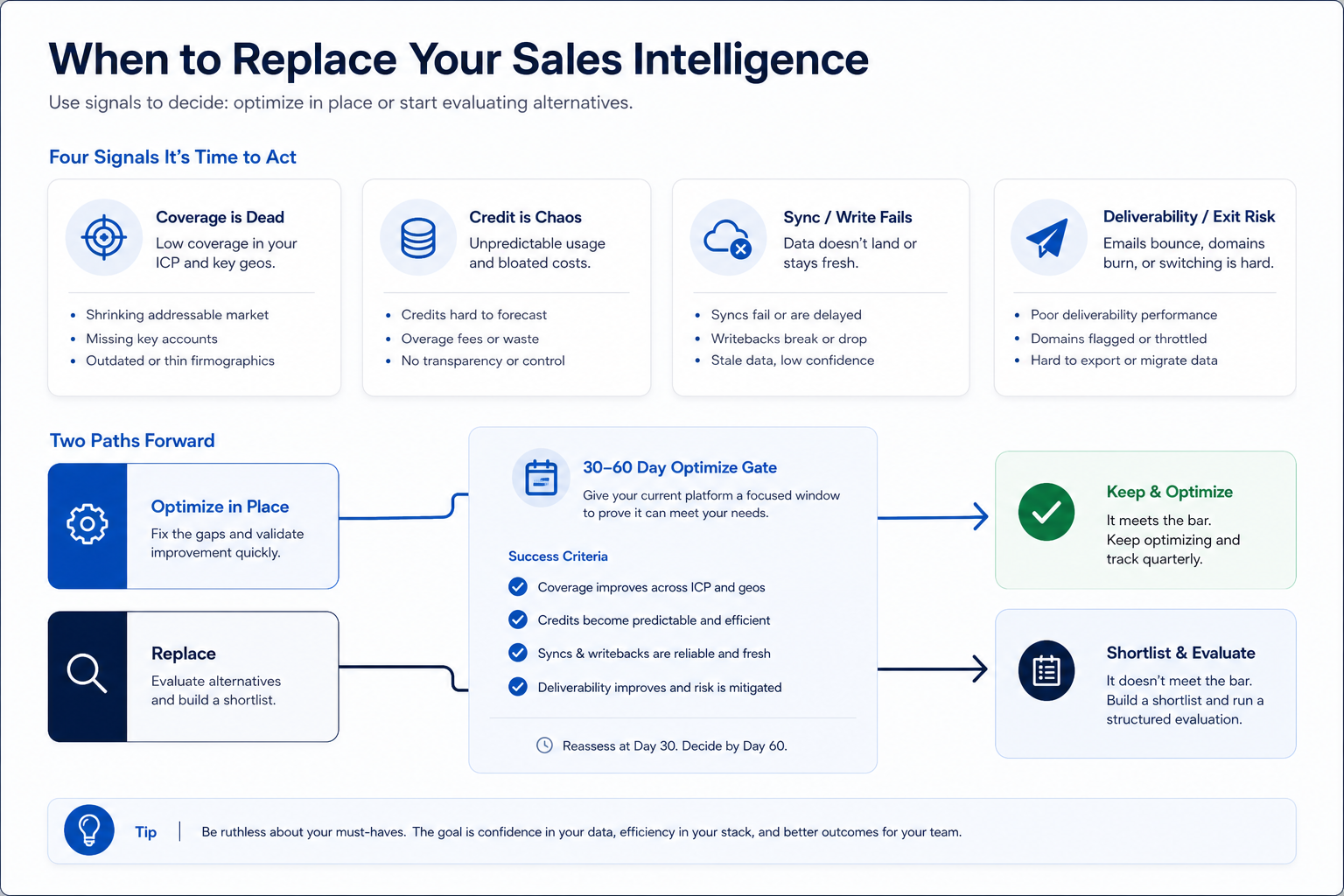
Coverage dead
ICP sample fails usable-email/phone bar after honest refresh.
Credit / sync pain
Burn unpredictable; write rules fail on realistic plans.
Deliverability / exit
Sends unsafe, or export fails usable tests.
Write evidence for each cluster — not vibes. Coverage dead: the same 200 ICP accounts return thin usable emails/phones after refresh. Credit chaos: nobody can predict burn for a normal week; top-ups or plan gates block outbound. Sync/write fail: duplicates, overwritten owners, or impossible field mapping on a realistic plan. Deliverability/exit: test sends tank domains, suppression fails, or you cannot export usable history.
Example: Northwind Outbound, an 8-person B2B pod, scored their SI tool after two failed “cleanup Mondays.” Coverage: usable email rate on their ICP sample stayed below a pre-written bar. Credits: a normal list week emptied the pool with no rollover. Sync: Owner was overwritten twice on bulk push. Exit: CSV export worked for emails but phone credits could not be re-exported. Signals were real — but they still ran an optimize sprint before shopping.
2. Run a 30–60 day optimize-in-place sprint
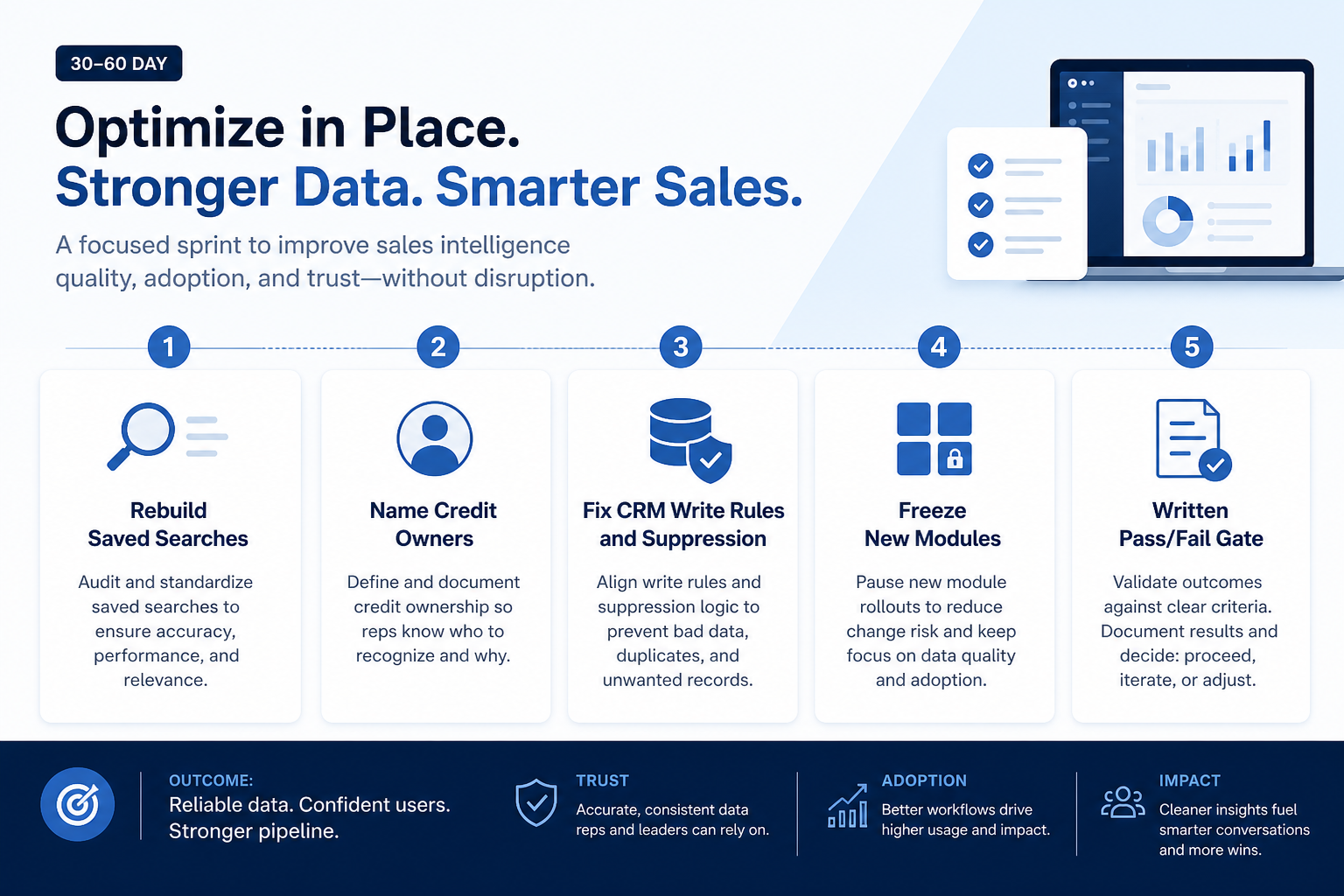
Pass
Coverage and sync trusted; keep and adjust plan if needed.
Partial
Process fixed but hard coverage/plan gaps remain — decide consciously.
Fail
Same debt after the sprint — proceed to replace gates.
Before any vendor bake-off, time-box a fix: freeze new modules, name R/A for credits and CRM write rules, rebuild saved searches for the true ICP, enforce suppression, push only with overwrite rules, and force Monday list review from the tool. Write pass criteria up front (for example: usable-email rate on the 200-account sample clears the bar; credit burn predictable for a normal week; Owner never overwritten on a 50-record push).
Example: Northwind’s RevOps lead ran 45 days: cut unused intent widgets, rebuilt three saved searches, capped unlocks per rep, fixed match keys, and moved Monday lists off Sheets. By day 45, sync recovered — but coverage on their niche ICP still failed the bar on a realistic plan. They treated “upgrade in place vs replace” as a commercial and coverage decision, not a feature tour.
3. When replace wins — and what to do next
Structural coverage gap
ICP usable-rate impossible on any realistic plan.
Exit / compliance gap
Cannot prove usable export or suppression needs.
Trust collapse
Pod refuses the same system after a fair optimize try.
Replace when the optimize gate fails and at least one structural blocker remains: product cannot clear ICP coverage on a realistic credit plan; CRM write rules impossible; vendor roadmap/support is a dead end; exit/export risk is already materializing; or trust is so broken that the pod will not re-engage the same system. Then freeze a requirements sheet, shortlist via How to Choose Sales Intelligence and Best Sales Intelligence Software (constraints first), and run the same two-week evaluation script on finalists.
Example: after the sprint, Northwind’s pod trusted sync again — but usable coverage on their niche ICP still failed, and the qualifying credit tier sat outside budget. They froze must-haves, used the Best page methodology for a constrained shortlist (no invented ranking on this guide), and scored two finalists with the Evaluation Guide script. Catalogue names that appear in research (for example Apollo.io, Lusha, Amplemarket) are examples only — not winners declared here.
4. When keeping (and optimizing) is the right call
Process debt only
Keep; run ownership + suppression fixes.
Plan-tier credit gap only
Price the qualifying plan before a full switch.
Sync hygiene
Fix match keys and overwrite rules before blaming the database.
Keep when the sprint restores coverage rituals, credit visibility, and CRM write fidelity, and remaining gaps are plan upgrades, training, or integration hygiene — not platform replacement. Replacing to escape missing ownership usually relocates the debt. Use Requirements, Evaluation, and CRM data hygiene guides to keep improving.
Example: a sibling 5-person studio scored “replace” after one burned credit month. Their optimize sprint (saved searches, unlock caps, write rules) cleared Monday lists in 30 days. They bought a documented credit top-up instead of migrating. Three months later the same tool ran without a shadow Sheet — replace would have burned a quarter for no decision-quality gain.
Replace-decision mistakes
Shopping before an optimize sprint
Demos feel productive; they hide whether the current tool could still clear your ICP sample.
Treating seat logins as adoption
Replace will not fix empty Monday lists or Sheet-based contact truth.
Using affiliate “best SI” order as the decision
Constraints and must-haves shortlist tools — marketing order does not.
Ignoring exit proof until after signature
Prove export on the way out of the current system and into the next.
Inventing switch-cost dollar totals
List effort categories (re-verify, remap, retrain, dual-run) — do not invent fake budgets.
Replacing to escape missing credit ownership
Without R/A for unlocks and write rules, the next tool becomes the same burn with new UI.
Frequently asked questions
When should we replace our sales intelligence tool?
After an honest optimize-in-place sprint fails and structural blockers remain — ICP coverage that will not recover, credit chaos without owners, hard sync/write failures, or deliverability/exit pain. Decision rule: no replace shortlist until the optimize gate is written and reviewed.
How do we know it is process vs product?
If a 30–60 day sprint restores saved-search discipline, predictable burn, and CRM write fidelity, the pain was mostly process. If usable coverage on your ICP sample remains impossible on a realistic plan after that sprint, product/plan fit is in play.
Should we replace because a competitor uses another tool?
No. Peer logos are not your ICP, credits, or admin capacity. Freeze your sheet, then shortlist — do not copy a stack for status.
What comes after we decide to replace?
Freeze requirements, shortlist with How to Choose Sales Intelligence and Best Sales Intelligence Software, compare finalists with the two-week Evaluation Guide script, then plan cutover (export → re-verify sample → remap write rules → dual-run → cutover).
How long should an optimize sprint last?
Long enough to change habits and prove coverage + sync — typically 30–60 days with a fixed end date and pass criteria. Shorter “cleanup weekends” rarely change Monday rituals.
Can we upgrade our plan instead of replacing?
Yes when the sprint restores process and the remaining gap is a documented credit or feature gate. Price the qualifying plan against switch effort categories before you assume migration is cheaper.
What should I do next?
Score the four signals, run or finish the optimize sprint, then — only if replace wins — open How to Choose Sales Intelligence with frozen constraints and the Best Sales Intelligence Software shortlist.
Was this article helpful?
Have more questions? Contact our support team.
Part of Software buying guides · Sales Intelligence Evaluation Guide: Two-Week Trial Scorecard
Related guides
Supporting reading in this topic — not a generic related-posts dump.
- CRM Data Hygiene: Weekly Ops That Prevent DecayRun CRM data hygiene as a weekly operating rhythm with named owners, SLAs, and decay-prevention rules — not a one-time cleanup project.
- How to Choose Sales Intelligence SoftwareA decision framework for picking sales intelligence software by primary job — contact data, enrichment, engagement, or dialer — then testing coverage, credits, CRM sync, compliance, and rep workflow before you commit.
- Sales Intelligence Requirements Guide: Must-Haves, Compliance & CRM Write RulesWrite demo-ready sales intelligence requirements from the primary job, must vs nice features, compliance posture, and CRM write rules — without feature-wishlist shopping.
- When to Adopt Sales Intelligence: Timing, Pilot & ExpandLearn when to adopt sales intelligence software — after list or enrichment pain appears and owners agree, pilot with real ICP accounts, then expand — without waiting for a perfect persona deck or delaying until CSV chaos piles up.
SoftwareGlimpse Updates
Want clearer software shortlists? Get buying guides and comparisons by email.
Newsletter coming soon.