Otter.ai Migration: Move Projects Without Losing Context
Migrate into Otter.ai with an inventory, field map, pilot import, dual-run week, and validation — so prompts, projects, and files survive and operators trust the new system.
Quick answer
Migrate into Otter.ai with an inventory of conversations, workspaces, and speaker labels, a field map, a pilot import, a dual-run week, and validation with the people who live in the data — so history survives and the team trusts the new system.
- Inventory source objects
- Map fields before bulk load
- Pilot one site / one role / one team
- Dual-run for a week
- Validate with sceptic users
Otter.ai migration rules
- Inventory first — Typical objects: conversations, workspaces, and speaker labels.
- Pilot beats big-bang — Prove a small Otter.ai import before you move everything.
- Integrations after the pilot — Research names Slack, Microsoft Teams, Google Workspace, and Zapier on the Otter.ai side — confirm the connectors your AI loop depends on.
- Do not migrate the wrong job — Otter.ai is AI meeting notes and transcription. Do not import a meeting-notes bot or an image studio and expect it to become AI meeting notes and transcription.
Otter.ai migration map
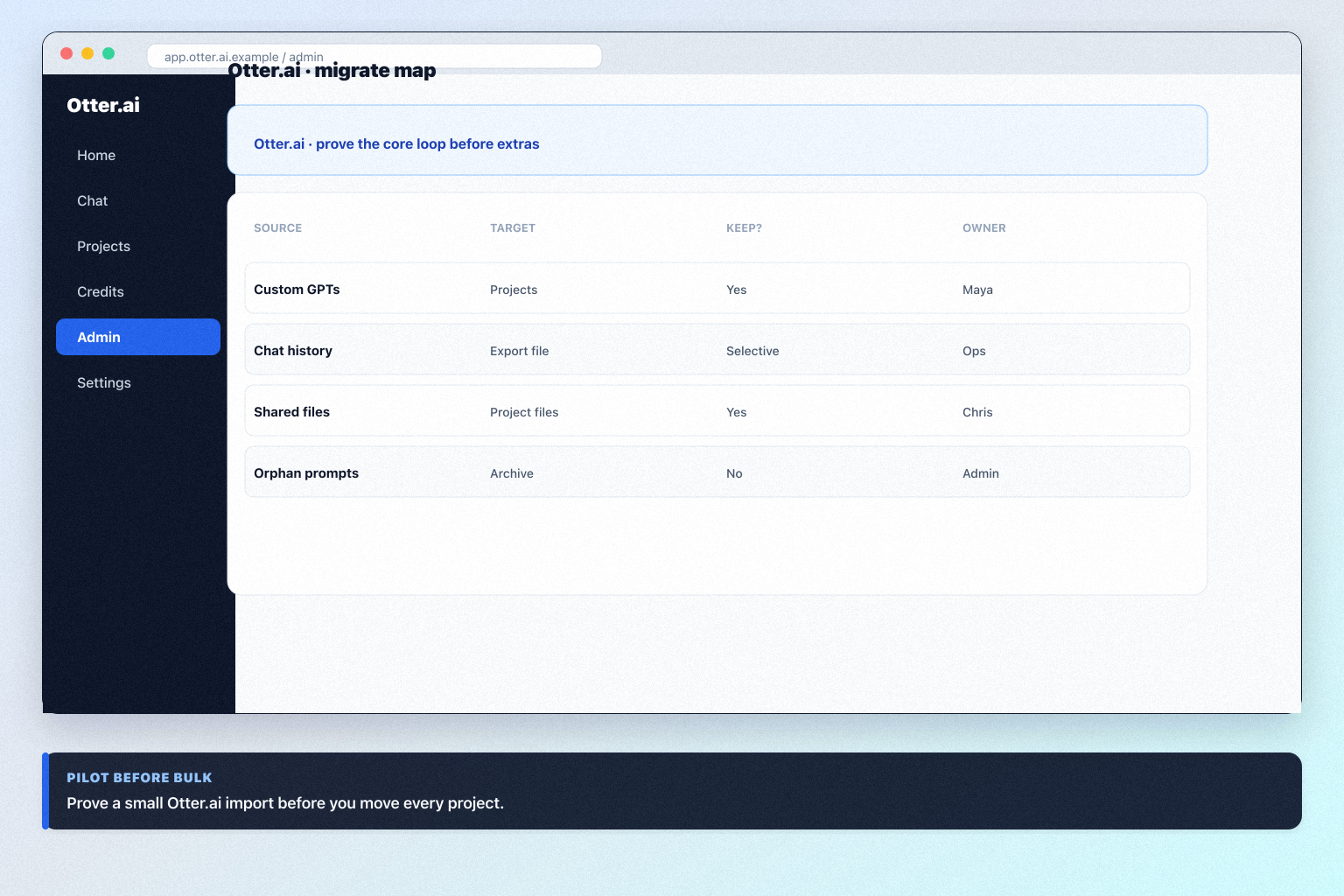
1. Inventory and map
List conversations, workspaces, and speaker labels. Map required fields and owners. Never invent list prices here — confirm seats, credits, and quote terms on /pricing/otter-ai/. Worked example: Harbor Sales (discovery calls) discovers duplicate employee IDs in the spreadsheet before the first import — and fixes identity before volume.
2. Pilot import
Import one site, one role, or one team. Run record or join one meeting, produce a transcript with action items, and share it with a sceptic attendee on the pilot set. Worked example: Harbor Sales (discovery calls) will not schedule a cutover until the pilot can finish a meeting with searchable notes a manager can open without Otter admin help.
3. Dual-run and cutover
Run old and new in parallel for a week. Spot-check records sceptic users care about, then freeze the legacy source. Worked example: Harbor Sales (discovery calls) keeps the old export for prompts or files until Otter.ai matches for seven consecutive days.
Otter.ai checklist
Bring these questions to every demo
Ask vendors to show the workflow live, not just describe it.
- 1Inventory source objectsconversations, workspaces, and speaker labels
- 2Run a pilot importOne segment first; fix mapping before bulk.
- 3Validate with operatorsSpot-check records they care about before cutover.
4. Inventory what must move into Otter.ai
List users, historical records, templates, and integrations that must survive migration. Mark nice-to-have exports you can leave behind.
Worked example: Individuals drowning in meeting notes migrates active records only and archives the rest as read-only exports.
5. Run parallel cutover with a rollback path
Keep the old system read-only until Otter.ai passes non-admin proof. Name a rollback owner and maximum parallel window.
Worked example: Individuals drowning in meeting notes caps parallel run at two weeks with daily checkpoint notes.
6. Verify counts and permissions after import
Reconcile user counts, role permissions, and a sample of migrated records. Research lists Slack, Microsoft Teams, Google Workspace, and Zapier for Otter.ai. Confirm which are native vs API before go-live.
7. Inventory what must move into Otter.ai
List users, historical records, templates, and integrations that must survive migration. Mark nice-to-have exports you can leave behind.
Worked example: Individuals drowning in meeting notes migrates active records only and archives the rest as read-only exports.
8. Run parallel cutover with a rollback path
Keep the old system read-only until Otter.ai passes non-admin proof. Name a rollback owner and maximum parallel window.
Worked example: Individuals drowning in meeting notes caps parallel run at two weeks with daily checkpoint notes.
9. Verify counts and permissions after import
Reconcile user counts, role permissions, and a sample of migrated records. Research lists Slack, Microsoft Teams, Google Workspace, and Zapier for Otter.ai. Confirm which are native vs API before go-live.
10. Inventory what must move into Otter.ai
List users, historical records, templates, and integrations that must survive migration. Mark nice-to-have exports you can leave behind.
Worked example: Individuals drowning in meeting notes migrates active records only and archives the rest as read-only exports.
11. Run parallel cutover with a rollback path
Keep the old system read-only until Otter.ai passes non-admin proof. Name a rollback owner and maximum parallel window.
Worked example: Individuals drowning in meeting notes caps parallel run at two weeks with daily checkpoint notes.
12. Verify counts and permissions after import
Reconcile user counts, role permissions, and a sample of migrated records. Research lists Slack, Microsoft Teams, Google Workspace, and Zapier for Otter.ai. Confirm which are native vs API before go-live.
13. Before you sign with Otter.ai
Confirm the qualifying plan, non-admin proof, and integration owners in writing. Store quotes next to /pricing/otter-ai/ and the evaluation scorecard so finance can audit the same assumptions at renewal.
14. Write the decision memo
Name the job, the qualifying Otter.ai configuration, and what you are not buying yet. If stakeholders cannot explain why an alternative lost, the trial was not fair.
Frequently asked questions
Can we skip the dual-run?
Only if the dataset is tiny and reversible. Most SMB/mid teams regret skipping a week of parallel use.
What if history will not map cleanly?
Import active records first. Archive messy history as files rather than poisoning the new system of record.
Was this article helpful?
Have more questions? Contact our support team.
SoftwareGlimpse Updates
Want clearer software shortlists? Get buying guides and comparisons by email.
Newsletter coming soon.