Linear Setup: Day-Zero Path to a Working Work Loop
task boards; timeline / Gantt; workload and resources; automations and workflows. Free · free · task boards | Basic | Business. Product/engineering teams wanting modern UX; Startups replacing Jira complexity; Issue-centric software delivery. Linear is a fast, opinionated issue tracker for software product teams (cycles, projects, roadmaps). Free covers limited issues/members; Basic/Standard ~list price–list price annua Buyer question: for task boards teams, is Linear worth the Basic unlock, or does Not for company-wide marketing/ops Work OS kill the rollout? ROI gate: Linear is worth the Basic spend if task boards + timeline / Gantt are weekly; not worth buying when Not for company-wide marketing/ops Work OS.
Quick answer
task boards decides whether Linear setup is a one-team pilot or a specialist project — confirm unlocks for must-have capabilities before invites.
- Start with: task boards
- Gate check: confirm paid unlocks before go-live
- Integrate after: data quality pass on systems of record
What matters in your Linear setup
- What Linear actually is — Linear is a fast, opinionated issue tracker for software product teams (cycles, projects, roadmaps). Free covers limited issues/members; Basic/Standard ~list price–list price annual; Business/Plus ~list price–list price; Enterprise custom. Landscape peer to Ji…
- Configure these first — Research lists task boards, timeline / Gantt, workload and resources, and automations and workflows as supported — that is your day-zero surface. Core loop: task boards, timeline / Gantt, workload and resources, and automations and workflows.
- Do not treat it as every work-management job — Linear is fast engineering issue tracking. It is not a substitute for a cross-functional marketing work OS or a spreadsheet PMO.
- Start on the right package — Researched plans: Free, Basic, Business, Enterprise. Never invent list prices here — confirm seats, hubs, and quote terms on /pricing/linear/.
- Connect only what the loop needs — Research names Zapier on the Linear side — confirm the connectors your work loop depends on.
- AI comes after habits — Research lists AI assistant, AI summaries, AI automation, and AI recommendations for Linear. Research places AI assistance on Free, Basic, Business, and Enterprise. Leave it off until the manual loop is boring.
Linear day-zero path
Linear must vs nice
- task boards
- Named owners on live work
- timeline / Gantt
- Slack / calendar / files for the loop
- automations and workflows
- AI assistance
Linear day-zero connectors
Connect only what file an issue, cycle it, and ship with a changelog a PM can read needs. Extra apps hide whether the core loop works.
 Zapier
 Slack
Slack- Google Calendar / Outlook
- Google Drive / OneDrive
Verify each workflow in a trial — marketplace logos are not proof of fit.
Linear checklist
Bring these questions to every demo
Ask vendors to show the workflow live, not just describe it.
- 1Qualify Linear seats and hubsDay-one must-haves on the cheapest researched package.
- 2Name one workspace ownerBoards, users, and hygiene need ~2 hours a week.
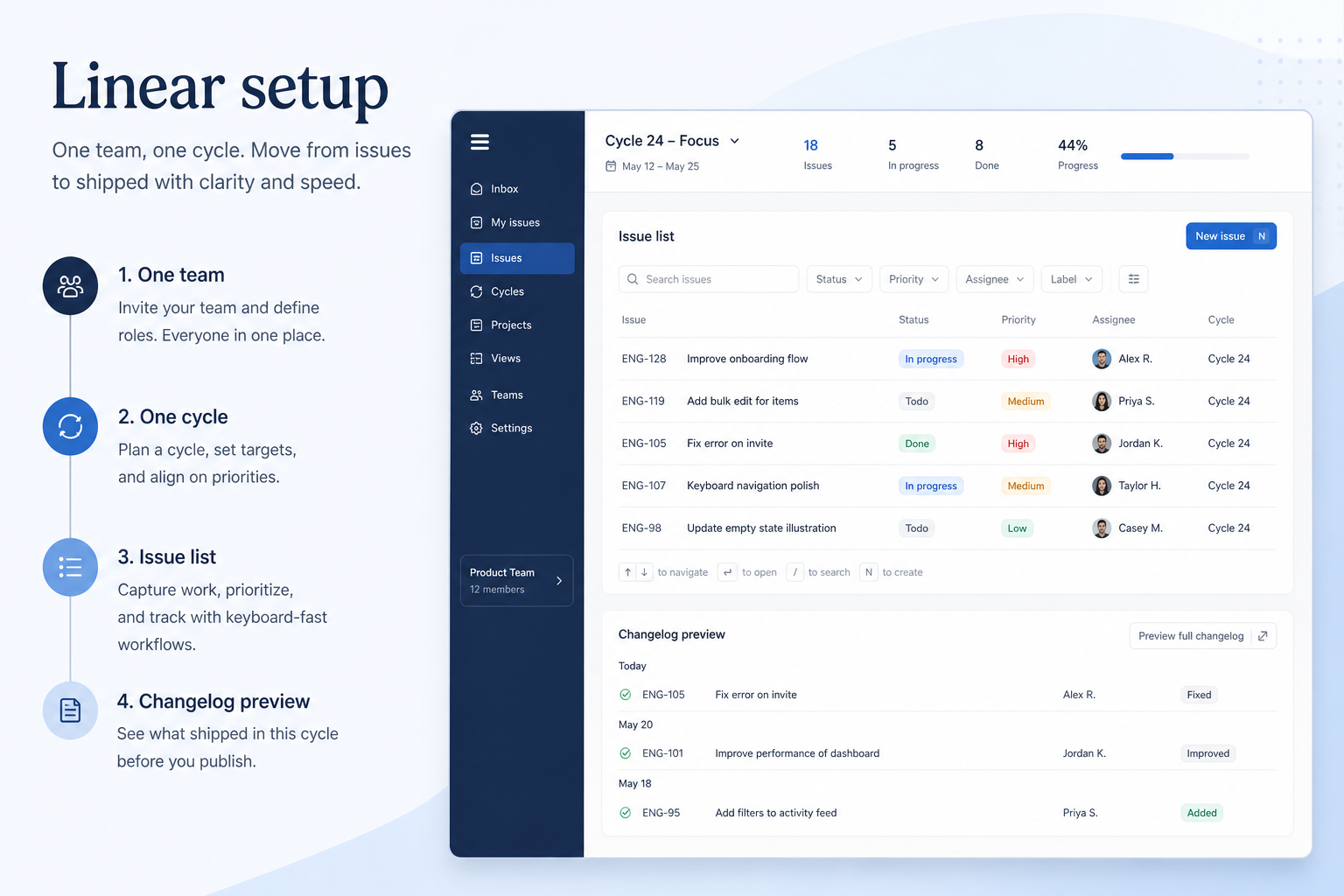
- 3Configure one core loopone team, one cycle, and issue labels you will actually search
- 4Invite weekly users onlyRoles before a company-wide invite.
- 5Connect Slack / calendar / filesDocument other gaps instead of wiring everything.
- 6Complete non-admin proofan engineer closes an issue in a cycle and a PM sees it without a Linear admin
Frequently asked questions
When is setup actually done?
When a non-admin can an engineer closes an issue in a cycle and a PM sees it without a Linear admin on the package you will buy, and you have a named owner with weekly hours. A decorated workspace is not done.
Should we turn on every Linear hub on day one?
No. Extra hubs hide whether the core fast engineering issue tracking loop works. Add views and automations after a week of real updates.
How long should day-zero take?
A focused team can finish in one working day if package, owner, and the first board are already decided. Multi-week “setup” usually means undecided packaging or missing ownership.
Do we need Slack connected on day one?
Only if the work loop depends on it. Research names Zapier on the Linear side — confirm the connectors your work loop depends on. Document gaps instead of wiring a marketplace zoo.
Where do we confirm seats and hubs?
Never invent list prices here — confirm seats, hubs, and quote terms on /pricing/linear/.
Is Linear the same as monday sales CRM?
Linear is evaluated here as fast engineering issue tracking. Do not assume a sibling product (CRM, ITSM, or docs) is the same workspace.
1. Linear day-zero to steady-state sequence
Day zero — objects and owners
Define owners for task boards, timeline / Gantt, workload and resources before inviting the whole org.
SMB pilot
One pipeline / one team proves Product/engineering teams wanting modern UX before company-wide seats.
Cutover
Freeze legacy writes briefly; validate priority integrations before reopen.
Treat Linear setup as a controlled rollout — not a weekend dump of CSV files.
Linear implementation go / no-go
Linear implementation mistakes
Mistake 1
Not for company-wide marketing/ops Work OS
Mistake 2
Leaner automation than Jira Enterprise
Mistake 3
Limited non-eng collaboration surfaces
Mistake 4
Insights ≠ PMO portfolio reporting
Big-bang invite
Inviting every user before object design creates junk data that is expensive to unwind.
Linear plan gates that affect rollout
Implementation fails when unlocks needed for go-live sit on a higher tier than budgeted.
- Seats61%
- Add-ons18%
- Implementation12%
- Training5%
- Other4%
Free
Free plan · Unlocks: task boards, timeline / Gantt, workload and resources · Suits: explore before committing seats
Basic
Trial available · Suits: teams whose must-have gates appear on this tier
Business
Trial available · Suits: teams whose must-have gates appear on this tier
Enterprise
Contact sales · Suits: teams that need custom procurement
Linear implementation checklist
0/3 dimensions noted — saved in this browser only.
Prep
Pilot
Scale
Was this article helpful?
Have more questions? Contact our support team.
Part of Linear review · Project Management & Productivity hub
Related guides
Supporting reading in this topic — not a generic related-posts dump.
- Linear Implementation: 30/60/90 Rollout That SticksPlan a practical Linear rollout — owners, core work loop, training, and adoption checkpoints — so the product becomes how the team actually ships work.
- Project Management Requirements GuideA practical requirements sheet for work OS and adjacent productivity purchases.
Related products
Related comparisons
SoftwareGlimpse Updates
Want clearer software shortlists? Get buying guides and comparisons by email.
Newsletter coming soon.