Hive Plans: Seats, Guests, and Qualifying Tiers
Choose your Hive plan by mapping must-haves to qualifying tiers — seats, guests, views, and add-ons — not homepage “from” tiles.
Quick answer
Choose a Hive plan by mapping must-haves for collaborative project hub to a qualifying tier — seats, guests, views, and add-ons included — not by comparing homepage “from” tiles. Never invent list prices here — confirm seats, hubs, and quote terms on /pricing/hive/.
- List day-one must-haves for the job cluster
- Map each to a researched qualifying plan
- Price guests / viewers separately from full seats
- Confirm trial or free proving ground
- Get the qualifying configuration in writing
- Never invent a spreadsheet total in this guide
Hive packaging rules
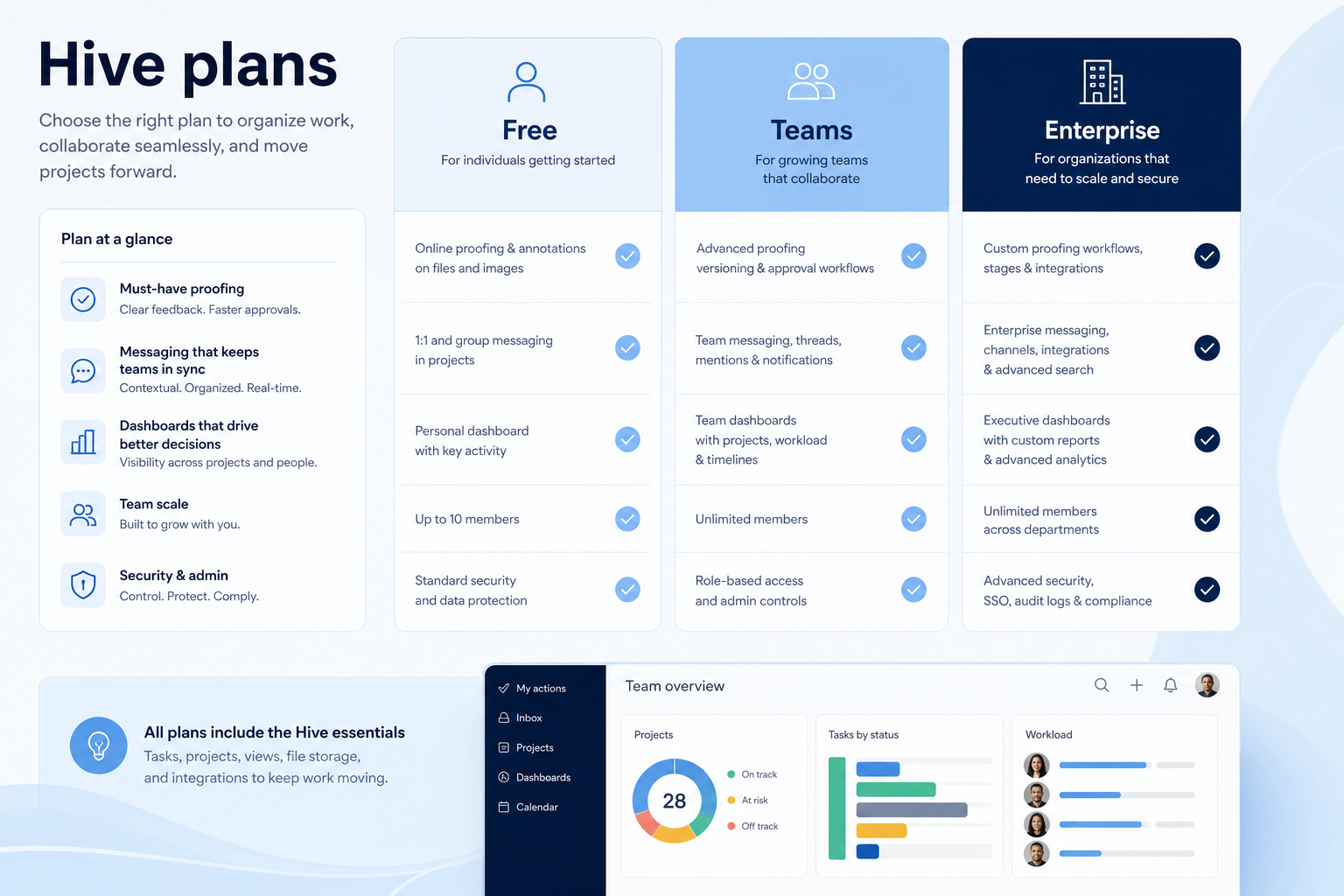
- Tiles are the bottom layer — Researched plans: Free, Starter, Teams, Enterprise.
- Gates change the bill — Our research does not flag plan-gated capabilities for Hive, but confirm your must-haves — including seats, hubs, and add-ons — against the packaging you actually intend to buy.
- Prove on the package you will buy — Our pricing snapshot records a 14-day trial on Starter and Teams — confirm current terms on the Hive pricing page before you build a schedule around it.
- Job cluster first — Must-haves should match create one project, assign actions, and prove status is visible in chat or proofing without a side spreadsheet. Do not pay for hubs that serve the heaviest enterprise work OS or a Gantt slide tool.
Hive plan path
Hive plan anatomy
What actually shapes a Hive bill
We do not invent list prices here. Use this anatomy, then confirm live numbers on the Hive pricing page.
- Seats61%
- Add-ons18%
- Implementation12%
- Training5%
- Other4%
Full seats
People who create and update work weekly — not everyone in Slack.
Guests / viewers
Clients and execs often need a cheaper or free viewer path. Confirm whether they count as seats.
Feature gates / hubs
Our research does not flag plan-gated capabilities for Hive, but confirm your must-haves — including seats, hubs, and add-ons — against the packaging you actually intend to buy.
Add-ons and AI
Research lists AI assistant, AI summaries, AI automation, and AI recommendations for Hive. Research places AI assistance on Free, Starter, Teams, and Enterprise.
Implementation time
Internal owner hours plus any vendor onboarding — get fees in writing; do not invent them.
Who Hive packaging usually fits
- 01
Small crew (about 5–15 weekly users)
Fits when collaborative project hub is the job and you can live without enterprise portfolio controls.
- One workspace owner
- One live board or project
- Guests only if the plan allows
- 02
Cross-functional team (about 15–50)
Fits when managers need a second view and you will admin the tool weekly.
- Named admin hours
- Intake or automations on a qualifying hub
- Stop shadow spreadsheets
- 03
Portfolio / multi-team
Fits only if Hive is still collaborative project hub at that scale — not if you actually needed the heaviest enterprise work OS or a Gantt slide tool.
- Written qualifying configuration
- Guest vs seat rules
- Adoption review before more hubs
Hive must vs nice
- Core loop on the qualifying plan
- Seats for weekly users
- task boards, timeline / Gantt, workload and resources, and automations and workflows
- AI / extra hubs
1. List day-one must-haves for this job cluster
Honest musts
Five jobs, all used weekly.
Wishlist
Twelve musts including unused AI — cut to five.
Wrong job
If musts describe the heaviest enterprise work OS or a Gantt slide tool, this product’s packaging will not save you.
Must-haves should match create one project, assign actions, and prove status is visible in chat or proofing without a side spreadsheet. Research-supported features include task boards, timeline / Gantt, workload and resources, and automations and workflows. 1. Write five things the team must do in week one.
- Mark each must vs nice.
- Drop anything that is actually the heaviest enterprise work OS or a Gantt slide tool. Worked example: Northline Ops (SMB delivery team replacing Slack archaeology) drops a cheaper tile when the must-have workflow unlocks only on a higher hub.
2. Map must-haves to a researched qualifying plan
Mapped
Every must-have has a researched plan name.
Tile shopping
You compared “from” prices across vendors — restart from must-haves.
Quote-only
If there is no public matrix, get the configuration in writing before you call it cheap.
Researched plans: Free, Starter, Teams, Enterprise. 1. For each must-have, write the lowest researched Hive plan that includes it. Our research does not flag plan-gated capabilities for Hive, but confirm your must-haves — including seats, hubs, and add-ons — against the packaging you actually intend to buy.
- The highest plan on that list is the qualifying tier — not the homepage starter tile.
- Check guests and view-only seats separately. Never invent list prices here — confirm seats, hubs, and quote terms on /pricing/hive/. Worked example: Northline Ops (SMB delivery team replacing Slack archaeology) discovers timeline or automations force a higher hub than the tile they screenshotted, so they re-qualify before a trial.
3. Prove the loop on the package you will buy
Honest trial
Loop works on the hub you will pay for.
Inflated trial
Ask the vendor which package the tenant is on, in writing.
Free-plan trap
Free is a proving ground only if must-haves actually live there.
Our pricing snapshot records a 14-day trial on Starter and Teams — confirm current terms on the Hive pricing page before you build a schedule around it. 1. Run a sceptic contributor updates an action and a lead sees it in the project home on the qualifying hub — not a demo enterprise workspace.
- Confirm guest/viewer behaviour if clients or execs must see status.
- Write the configuration: seats, hubs, add-ons, billing term. Worked example: Northline Ops (SMB delivery team replacing Slack archaeology) fails the gate when the trial ran Pro features they will not purchase. They restart the trial on the written package.
4. Get the qualifying configuration in writing
Written
Seats, guests, hubs, term — attached to the decision.
Verbal extra
If a feature was “included in the demo,” it is not included until it is written.
Walk
If packaging stays vague, keep looking via how to choose project management software.
- Seats (weekly users only).
- Guests/viewers.
- Hubs and add-ons the trial proved.
- Implementation or onboarding fees if any — do not invent them.
- Annual vs monthly only after the configuration is frozen. Worked example: Northline Ops (SMB delivery team replacing Slack archaeology) will not sign until the qualifying hub and guest rules are in an email they can attach to the buy decision.
Hive checklist
Bring these questions to every demo
Ask vendors to show the workflow live, not just describe it.
- 1List day-one must-havesFeatures that must ship without an unused enterprise tier.
- 2Map to a qualifying planUse researched plan names — not marketing starting tiles.
- 3Get the qualifying quote in writingSeats, guests, add-ons, and implementation fees.
Frequently asked questions
Does a free Hive plan count?
Our pricing snapshot records a 14-day trial on Starter and Teams — confirm current terms on the Hive pricing page before you build a schedule around it.
Should we pay annually?
Only after the qualifying configuration is written. Annual discounts do not fix the wrong hub.
How do we treat guests?
Count people who must log in weekly as seats. Confirm whether clients and execs are guests, viewers, or billable users on the pricing page.
Can we compare “from” prices across tools?
Not usefully. Compare qualifying configurations for the same must-haves. Tiles omit gates.
Where are the actual numbers?
Never invent list prices here — confirm seats, hubs, and quote terms on /pricing/hive/.
Was this article helpful?
Have more questions? Contact our support team.
SoftwareGlimpse Updates
Want clearer software shortlists? Get buying guides and comparisons by email.
Newsletter coming soon.