GoTo Connect Migration: Move Numbers Without Losing Trust
Migrate into GoTo Connect with a number inventory, route map, pilot cutover, dual-run week, and CRM CTI validation — so calls keep routing and agents trust the logs.
Quick answer
Migrate into GoTo Connect with a list inventory, field map, pilot import, dual-run week, and CRM CTI / call logging validation — then cut over only when the sales + support team trusts the contacts. Confirm power dialer (Phone+) and WhatsApp Business (Phone+) are on the package you will actually buy. Prove one queue before you move the whole book of numbers and IVR / routing.
- Inventory numbers and IVR / routing
- Map fields and owners
- Pilot one queue
- Dual-run one week
- Validate CRM CTI / call logging
- Then cut over
GoTo Connect migration takeaways
- Numbers are the product — GoTo Connect is a cloud business phone / UCaaS platform (evolved from Jive) aimed at remote and multi-location teams: softphones, unlimited auto attendants and queues, video meetings (up to 250), team messaging, SMS, and optional CX / Contact Center ladders wi… A migration that moves rows but breaks do-not-call numbers or owners will burn seats/numbers and trust.
- Pilot before bulk — One agent’s book or one priority queue first — fix mapping before volume.
- CRM stays the system of record — Research names Salesforce, Microsoft Teams, Zendesk, Servicenow, and Google Workspace on the GoTo Connect side — confirm the connectors your call and messaging loop depends on.
- Watch packaging during cutover — Researched plans: Phone System, Customer Experience (CX), CX Complete, Contact Center. Never invent list prices here — confirm seats, numbers/minutes, and quote terms on /pricing/goto-connect/.
GoTo Connect migration path
GoTo Connect migration map
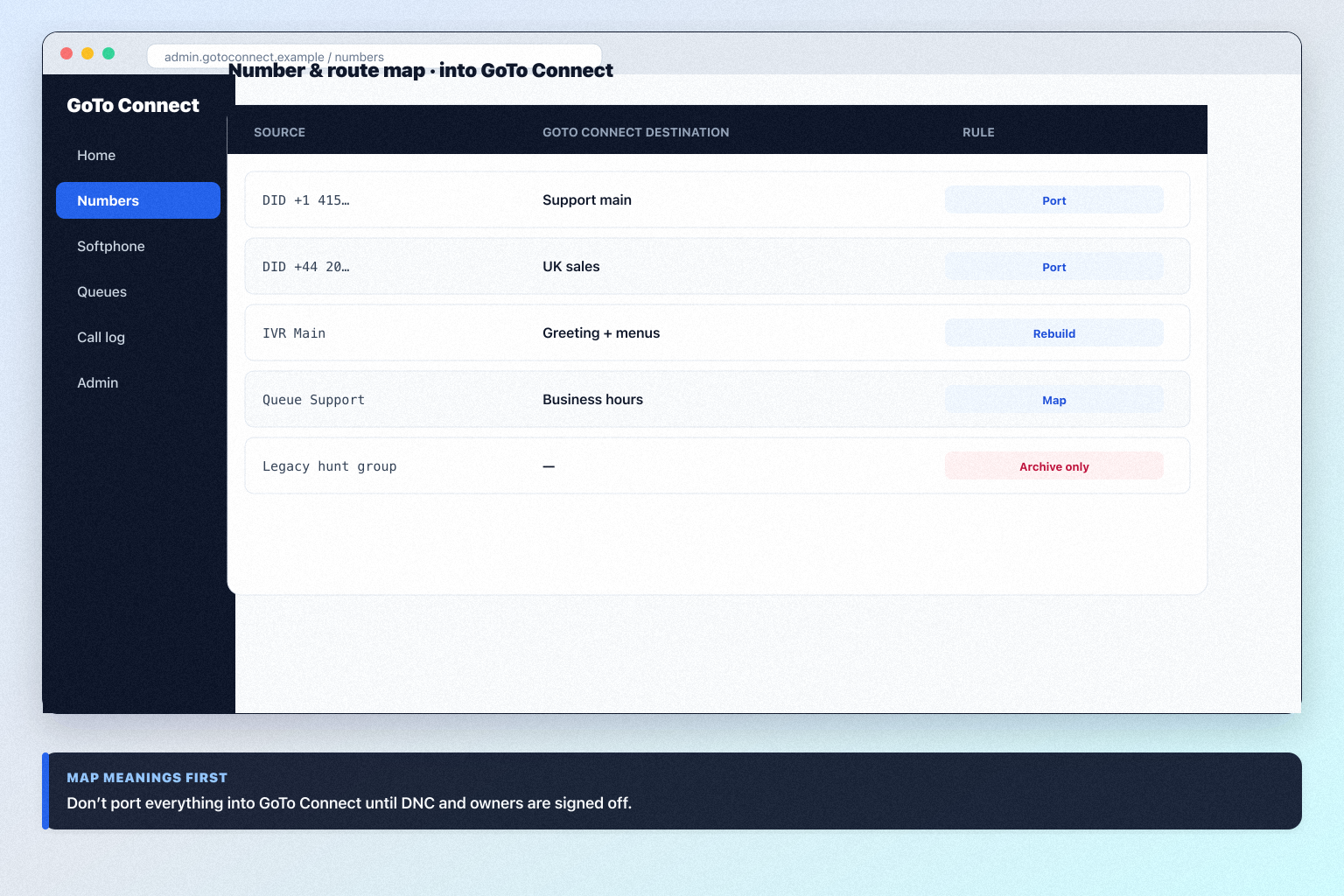
GoTo Connect checklist
Bring these questions to every demo
Ask vendors to show the workflow live, not just describe it.
- 1Inventory source objectsNumbers, IVR / routing, routing books, do-not-call numbers, owners.
- 2Sign off the field mapTitles, emails, phones, owners, do-not-contact.
- 3Run a pilot importOne queue; fix mapping before bulk.
- 4Dual-run one weekGoTo Connect is write-path; old tool is read-only.
- 5Validate with the sales + support teamSpot-check contacts and CRM CTI / call logging before cutover.
1. Inventory numbers and map fields before any import
- Inventory contacts, queues, calls, routing workflows, do-not-call numbers, and owners in the source tool.
- Map each critical field to GoTo Connect (and to CRM where sync will write).
- Decide archive-only fields — do not invent destinations for junk.
- Remap departed owners to living users before volume. Worked example: an 8-person sales + support team discovers 14% of open routing steps still owned by a departed agent; they remap those owners in the sheet before any GoTo Connect import.
2. Pilot one queue — then scale
- Choose one agent’s book or one priority queue (tens to low hundreds of records).
- Import into GoTo Connect, then spot-check numbers, routes, owners, and do-not-call numbers.
- Run one softphone and routing session from the pilot set.
- Confirm CRM received the activities before approving bulk. Worked example: an 8-person sales + support team pilots Sam’s mid-market queue into GoTo Connect, finds two title mappings wrong, fixes the map, and only then schedules the full import.
3. Dual-run one week with a hard write rule
- Declare GoTo Connect the write path for new numbers and calling.
- Old tool becomes read-only history — no new live traffic there.
- If anyone starts new live traffic in the old tool, restart the dual-run week.
- End the week with agent sign-off on 20 random contacts. Worked example: an 8-person sales + support team prints the rule on Slack: “New live calls only in GoTo Connect.” Two violations restart the clock; week two is clean and they cut over.
4. Cut over after CRM CTI / call logging and team validation
- Validate CRM CTI for call creates and activity logging.
- Freeze legacy write access.
- Archive or export legacy numbers you still need for audit.
- Schedule the first post-cutover usage review. Worked example: an 8-person sales + support team cutovers only after Priya and Sam each confirm five contacts and their last calling appear correctly in CRM from GoTo Connect.
5. Inventory what must move into GoTo Connect
List users, historical records, templates, and integrations that must survive migration. Mark nice-to-have exports you can leave behind.
Worked example: Remote and multi-location teams wanting phone + meetings + messaging from one vendor migrates active records only and archives the rest as read-only exports.
6. Run parallel cutover with a rollback path
Keep the old system read-only until GoTo Connect passes non-admin proof. Name a rollback owner and maximum parallel window.
Worked example: Remote and multi-location teams wanting phone + meetings + messaging from one vendor caps parallel run at two weeks with daily checkpoint notes.
7. Verify counts and permissions after import
Reconcile user counts, role permissions, and a sample of migrated records. Research lists Salesforce, Microsoft Teams, Zendesk, and Servicenow for GoTo Connect. Confirm which are native vs API before go-live.
8. Inventory what must move into GoTo Connect
List users, historical records, templates, and integrations that must survive migration. Mark nice-to-have exports you can leave behind.
Worked example: Remote and multi-location teams wanting phone + meetings + messaging from one vendor migrates active records only and archives the rest as read-only exports.
9. Run parallel cutover with a rollback path
Keep the old system read-only until GoTo Connect passes non-admin proof. Name a rollback owner and maximum parallel window.
Worked example: Remote and multi-location teams wanting phone + meetings + messaging from one vendor caps parallel run at two weeks with daily checkpoint notes.
10. Verify counts and permissions after import
Reconcile user counts, role permissions, and a sample of migrated records. Research lists Salesforce, Microsoft Teams, Zendesk, and Servicenow for GoTo Connect. Confirm which are native vs API before go-live.
Frequently asked questions
Should we migrate every historical sequence?
Usually no. Migrate active IVR / routing and do-not-call numbers first. Archive cold history unless a compliance need says otherwise.
What breaks most often?
Owner remaps, phone/email field meanings, and CRM CTI / call logging direction. Pilot those three before bulk.
How do seats/numbers factor into migration?
Bulk imports during migration can trip spam traps. Cap the pilot import, then confirm pack limits on the pricing page.
Was this article helpful?
Have more questions? Contact our support team.
SoftwareGlimpse Updates
Want clearer software shortlists? Get buying guides and comparisons by email.
Newsletter coming soon.