Types of IT And Development Software
The product shapes inside IT and development software — pick the job first, then the vendor.
Quick answer
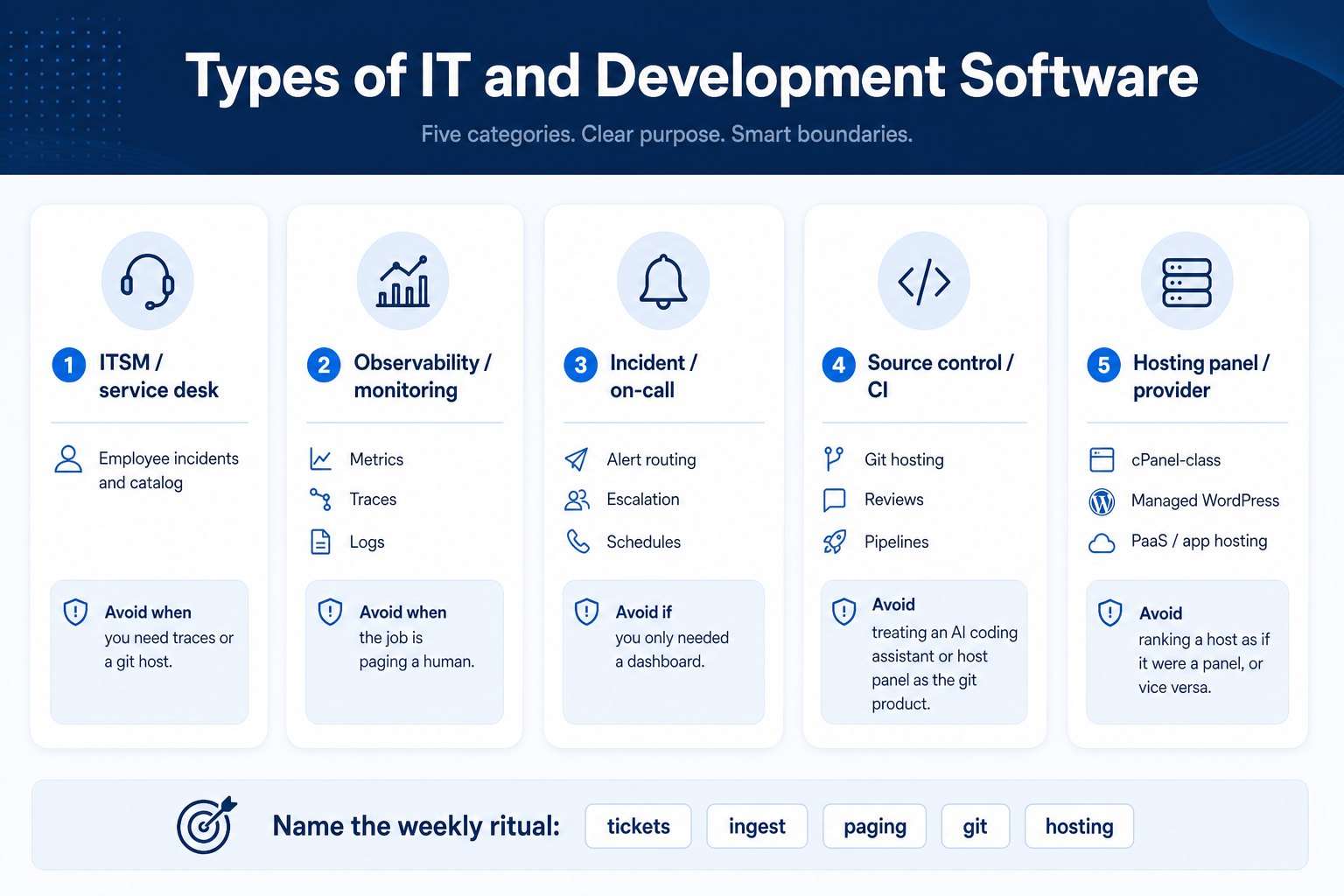
“Types of IT and development software” means different product shapes that share a category label but fail for different reasons. Decision rule: name the one job blocking work this quarter, then shortlist only tools whose core product is that shape.
- ITSM / service desk
- Observability / monitoring
- Incident / on-call
- Source control / CI
- Hosting panel / provider
Key takeaways
- Shape before brand — A specialist that matches the job beats an all-in-one you will not run.
- Hybrids still need a primary job — Buying a bundle because it “does everything” usually means you under-test the one job you need.
- Catalogue examples are not rankings — Named products below are illustrations from the published SoftwareGlimpse catalogue — not a #1 list.
- Confirm live packaging — Plan gates and add-ons change which shape you can actually buy.
Modern IT and development software shapes (not rankings)
ITSM / service desk
Best for: Employee incidents, changes, and a catalog.
Avoid when: You need traces and logs, or a git host.
Observability / monitoring
Best for: Metrics, traces, logs, or error monitoring.
Avoid when: The job is paging a human or an ITIL desk.
Incident / on-call
Best for: Routing alerts to a human with escalation.
Avoid when: You only needed a dashboard and bought an on-call suite.
Source control / CI
Best for: Git hosting, reviews, and pipelines.
Avoid when: You treat GitHub Copilot or a host panel as the git product.
Hosting panel / provider
Best for: cPanel-class panels or managed WordPress / PaaS.
Avoid when: You rank WP Engine as if it were Plesk, or vice versa.
1. Pick a shape before a vendor demo
Example: Harbor Platform pages on-call for checkout 5xx. Datadog-class observability is not a substitute for PagerDuty-class paging, and Jira Service Management is not Jira Software.
Catalogue illustrations (alphabetical, not a ranking): apify, appdynamics, azure-devops, bitbucket, bmc-helix.
Common mistakes
One shortlist for unlike jobs
If products fail for different reasons, split the RFP.
Feature grids without a weekly outcome
If you cannot test it in two weeks, it is not a must-have.
2. Pick the shape that matches the blocking job
Common shapes in IT and development software:
- ITSM / service desk: best when Employee incidents, changes, and a catalog. Avoid when You need traces and logs, or a git host.
- Observability / monitoring: best when Metrics, traces, logs, or error monitoring. Avoid when The job is paging a human or an ITIL desk.
- Incident / on-call: best when Routing alerts to a human with escalation. Avoid when You only needed a dashboard and bought an on-call suite.
- Source control / CI: best when Git hosting, reviews, and pipelines. Avoid when You treat GitHub Copilot or a host panel as the git product.
3. Prove the shape with one workflow
Run a single real workflow that only that shape should solve. If the workflow spans two shapes, split the purchase decision.
4. Use a one-page checklist before demos
For Types of IT And Development Software, list must-haves, owners, integrations, and the weekly ritual this purchase must improve. Share the sheet with finance and IT before you schedule a second demo.
- Name the primary job in one sentence.
- List must-have gates (plans, SSO, data residency, usage caps).
- Name integrations that must work on day one.
- Assign an admin owner and a weekly user champion.
- Define non-admin proof — what a sceptic completes without rescue.
Worked example: Harbor Ops refuses demos until the checklist is signed — cutting evaluation time in half.
5. Avoid the usual buying mistakes
Common failures in it-development: buying for brand familiarity, comparing entry tiles across different usage units, skipping a fair trial script, and adding scope before adoption proves out.
Run one trial script on every finalist the same week. Score on the same card. Write a one-paragraph decision memo that names what you are not buying yet.
6. Hand off to the category shortlist
When assumptions are frozen, continue on /best/it-development-software/ with the same headcount, usage band, and must-have gates on every quote.
7. Use a one-page checklist before demos
For Types of IT And Development Software, list must-haves, owners, integrations, and the weekly ritual this purchase must improve. Share the sheet with finance and IT before you schedule a second demo.
- Name the primary job in one sentence.
- List must-have gates (plans, SSO, data residency, usage caps).
- Name integrations that must work on day one.
- Assign an admin owner and a weekly user champion.
- Define non-admin proof — what a sceptic completes without rescue.
Worked example: Harbor Ops refuses demos until the checklist is signed — cutting evaluation time in half.
8. Avoid the usual buying mistakes
Common failures in it-development: buying for brand familiarity, comparing entry tiles across different usage units, skipping a fair trial script, and adding scope before adoption proves out.
Run one trial script on every finalist the same week. Score on the same card. Write a one-paragraph decision memo that names what you are not buying yet.
9. Hand off to the category shortlist
When assumptions are frozen, continue on /best/it-development-software/ with the same headcount, usage band, and must-have gates on every quote.
10. Use a one-page checklist before demos
For Types of IT And Development Software, list must-haves, owners, integrations, and the weekly ritual this purchase must improve. Share the sheet with finance and IT before you schedule a second demo.
- Name the primary job in one sentence.
- List must-have gates (plans, SSO, data residency, usage caps).
- Name integrations that must work on day one.
- Assign an admin owner and a weekly user champion.
- Define non-admin proof — what a sceptic completes without rescue.
Worked example: Harbor Ops refuses demos until the checklist is signed — cutting evaluation time in half.
11. Avoid the usual buying mistakes
Common failures in it-development: buying for brand familiarity, comparing entry tiles across different usage units, skipping a fair trial script, and adding scope before adoption proves out.
Run one trial script on every finalist the same week. Score on the same card. Write a one-paragraph decision memo that names what you are not buying yet.
12. Hand off to the category shortlist
When assumptions are frozen, continue on /best/it-development-software/ with the same headcount, usage band, and must-have gates on every quote.
Frequently asked questions
Can one vendor cover every type?
Sometimes as adjacent modules — still score the primary job. Do not invent a universal winner.
Where are editor’s picks?
Best IT and development software groups products by job cluster with disclosed methodology.
Was this article helpful?
Have more questions? Contact our support team.
Part of Software buying guides · How IT And Development Software Works
Related guides
Supporting reading in this topic — not a generic related-posts dump.
- IT And Development Software vs Project Management SoftwareIT and development software owns service desks, observability, on-call, git/CI, and hosting. Project management software owns work boards, dates, and delivery — including Jira Software, which is not Jira Service Management.
- What Is IT & Development Software?A clear definition of ITSM, observability, incident/on-call, source control, hosting panels, and web-data tools — and why they are not one ranking.
Related products
SoftwareGlimpse Updates
Want clearer software shortlists? Get buying guides and comparisons by email.
Newsletter coming soon.