WP Engine Setup: Day-Zero Path to a Working IT Loop
Set up WP Engine for day-zero work — seats or hosts, one core loop, required integrations, and non-admin proof — before optional modules.
Quick answer
Set up WP Engine in this order: qualify seats for the people who will actually open it, name one IT/ops owner, configure seats or hosts for weekly operators, one core loop, and a required integration, connect the identity/monitoring/ticketing you depend on, then have a non-admin run finish the loop without an admin. You’re done when that walkthrough works — not when every optional module is switched on.
- Start on the entry package on the pricing page
- Name one IT / ops owner
- seats or hosts for weekly operators, one core loop, and a required integration
- Connect required identity / monitoring / ticketing
- Prove a non-admin can run the loop
What matters in your WP Engine setup
- What WP Engine actually is — WP Engine is a managed WordPress hosting platform (WordPress-specialist, not a multi-app cloud console and not a Plesk/cPanel licence). Essential plans on wpengine.com/plans (2026-08-18): Startup list price*, Professional list price Growth list price Scale lis…
- Configure these first — Research lists infrastructure monitoring, log management, CI/CD and automation, and hosting control panel as supported — that is your day-zero surface.
- Do not treat it as every IT job — WP Engine is IT operations or development platform. It is not a substitute for a different IT job cluster.
- Prove with a real workflow — Worked example: Harbor IT (weekly operators) is done when they can finish the loop without an admin — not after a vendor tour.
WP Engine day-zero path
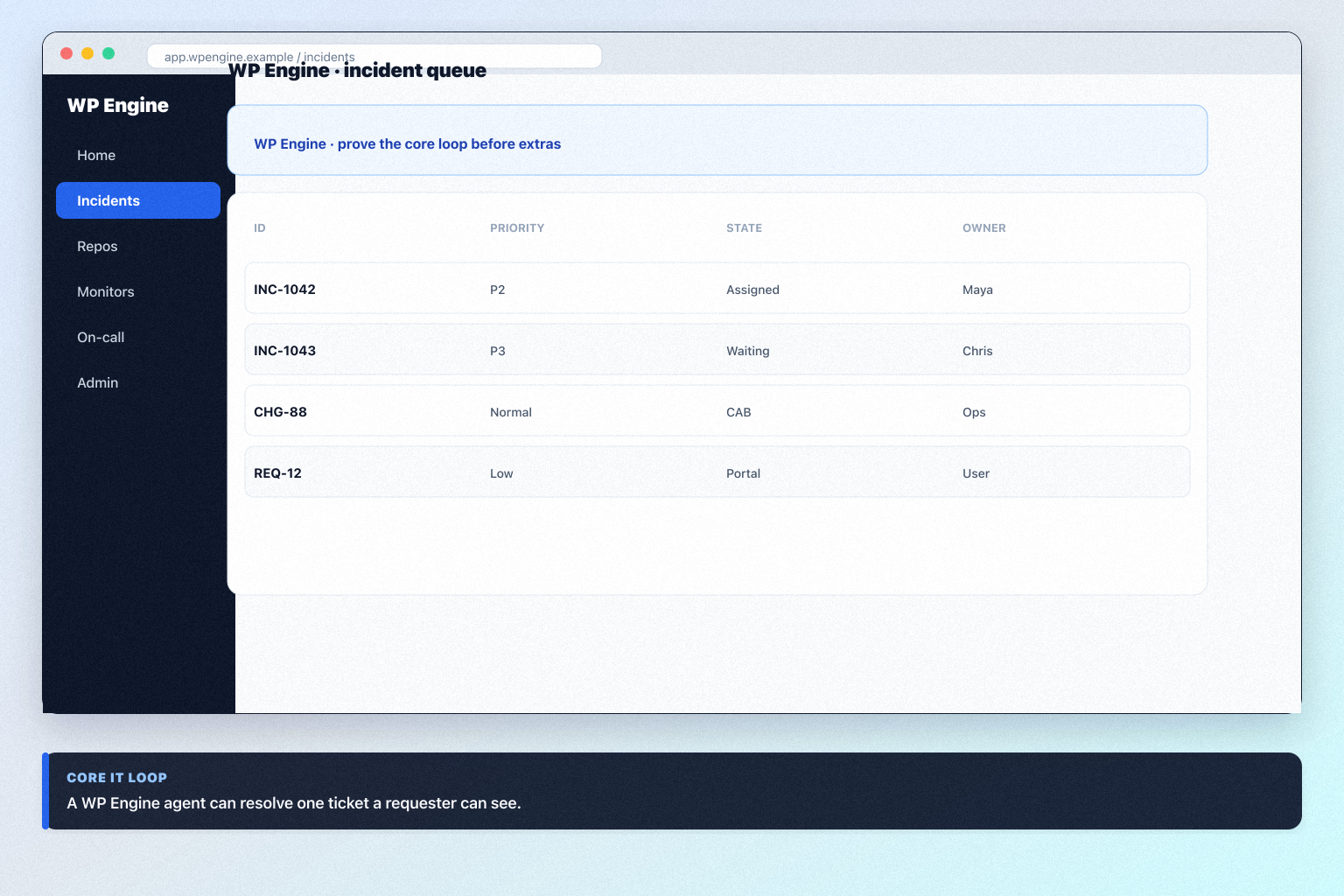
WP Engine must vs nice
- Core job loop
- Plan / hub gates
- Integrations
- AI extras
1. Qualify seats and packaging
WP Engine is often sold on seats, hosts, ingest, or quote packaging in our snapshot — treat homepage tiles as marketing, not a bill of materials. Confirm live packaging on the pricing page. Never invent list prices here — confirm seats, hosts, ingest, and quote terms on /pricing/wp-engine/. Worked example: Harbor IT (weekly operators) lists everyone who must log in weekly before they invite “the whole company.”
2. Configure one core loop
Configure seats or hosts for weekly operators, one core loop, and a required integration. Research-supported surfaces include infrastructure monitoring, log management, CI/CD and automation, and hosting control panel. Worked example: Harbor IT (weekly operators) refuses optional modules until finish the loop without an admin.
3. Non-admin proof
Our snapshot records no trial length for WP Engine — ask for an evaluation window in writing before you commit seats. Success: finish the loop without an admin. Worked example: Harbor IT (weekly operators) records a 10-minute loom of the walkthrough for stakeholders who skip hands-on time.
WP Engine checklist
Bring these questions to every demo
Ask vendors to show the workflow live, not just describe it.
- 1Name an IT/ops ownerFields, users, and hygiene need a responsible party.
- 2Configure one core loopseats or hosts for weekly operators, one core loop, and a required integration
- 3Complete non-admin prooffinish the loop without an admin
4. Connect the integrations WP Engine must have on day one
Native connector
Prefer OAuth paths IT can audit.
API / webhook
Name an owner when the sync breaks.
Manual export
Accept only for low-volume, low-risk data.
Research lists WordPress and API access for WP Engine. Confirm which are native vs API before go-live.
- Pick one identity or SSO path if required.
- Connect one operational integration the weekly users touch daily.
- Document anything left as manual export.
Worked example: Teams whose only hosting job is managed WordPress connects the one integration that prevents double entry before inviting the full team.
5. Train weekly users — not a one-time all-hands
Train the people who must open WP Engine every week. Cover: login, the core loop (infrastructure monitoring, log management, and CI/CD and automation), and where to log blockers.
Worked example: Teams whose only hosting job is managed WordPress runs a 30-minute working session on live data and includes one sceptic who will actually use the tool.
6. Write the setup note stakeholders can audit
Document plan tier, admin owner, integrations live, and the non-admin proof (infrastructure monitoring, log management, and CI/CD and automation). Link to /pricing/wp-engine/ for commercial detail.
Worked example: Teams whose only hosting job is managed WordPress stores a one-page note finance and IT can read without joining another demo.
7. Connect the integrations WP Engine must have on day one
Native connector
Prefer OAuth paths IT can audit.
API / webhook
Name an owner when the sync breaks.
Manual export
Accept only for low-volume, low-risk data.
Research lists WordPress and API access for WP Engine. Confirm which are native vs API before go-live.
- Pick one identity or SSO path if required.
- Connect one operational integration the weekly users touch daily.
- Document anything left as manual export.
Worked example: Teams whose only hosting job is managed WordPress connects the one integration that prevents double entry before inviting the full team.
8. Train weekly users — not a one-time all-hands
Train the people who must open WP Engine every week. Cover: login, the core loop (infrastructure monitoring, log management, and CI/CD and automation), and where to log blockers.
Worked example: Teams whose only hosting job is managed WordPress runs a 30-minute working session on live data and includes one sceptic who will actually use the tool.
9. Write the setup note stakeholders can audit
Document plan tier, admin owner, integrations live, and the non-admin proof (infrastructure monitoring, log management, and CI/CD and automation). Link to /pricing/wp-engine/ for commercial detail.
Worked example: Teams whose only hosting job is managed WordPress stores a one-page note finance and IT can read without joining another demo.
Frequently asked questions
When is setup actually done?
When a non-admin can finish the loop without an admin on the package you will buy.
Should we turn on every WP Engine hub on day one?
No. Extra modules hide whether the core IT operations or development platform loop works.
Was this article helpful?
Have more questions? Contact our support team.
SoftwareGlimpse Updates
Want clearer software shortlists? Get buying guides and comparisons by email.
Newsletter coming soon.