What Is HR Software?
A clear definition of ATS, frontline WFM, time & attendance, SOP training, and employee LMS — and how they differ from CRM.
Quick answer
HR software helps teams hire, schedule and coordinate frontline workers, track time & attendance, document SOPs, or deliver employee learning — not CRM pipelines or project work boards. Decision rule: if the blocking job is “we need a hiring pipeline,” buy an ATS; if it is shifts and deskless comms, buy frontline WFM; if it is clock-in accuracy, buy time & attendance; if it is playbooks and role paths, buy SOP training; if it is a course academy, shortlist an LMS — do not force those jobs into one undifferentiated ranking.
- ATS / recruiting
- Frontline WFM
- Time & attendance
- SOP / training paths
- Employee LMS
- Not a CRM or Work OS
Key takeaways
- The category holds several jobs — ATS, frontline WFM, time clocks, SOP docs, and LMS academies fail for different reasons. Naming the job first prevents most bad shortlists.
- HR software is not a CRM — CRMs own customer pipeline. HR tools own hiring, workforce coordination, attendance, or training — then integrate with payroll/HRIS when needed.
- Plan gates and hubs change TCO — Free tiers, multi-hub packs, add-ons, and implementation fees often matter more than the starter tile.
- LMS commerce is a different purchase — Course-commerce LMS products can support employee academies, but they should not be ranked as if they were ATS or WFM peers.
HR software building blocks
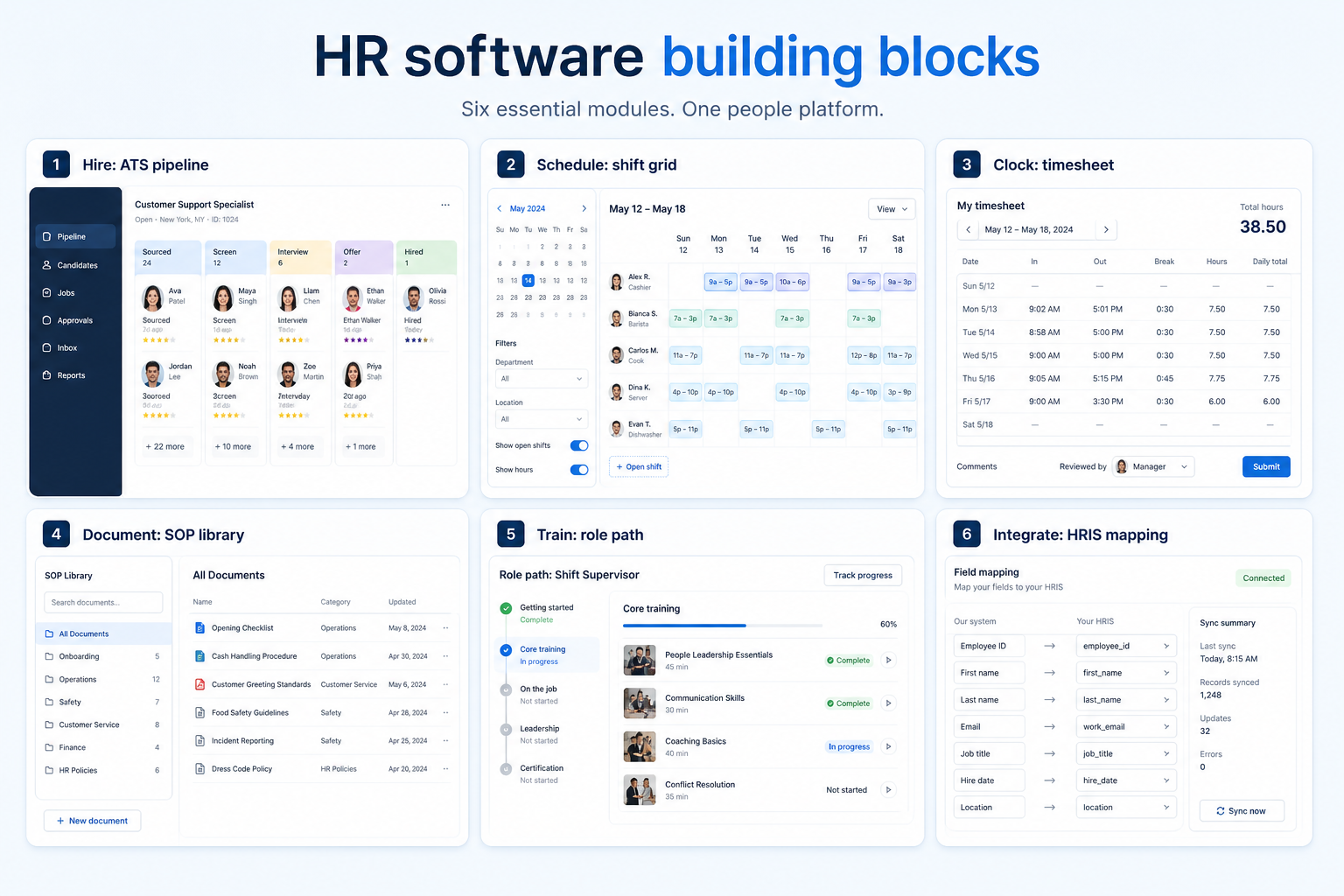
1. How does HR software work?
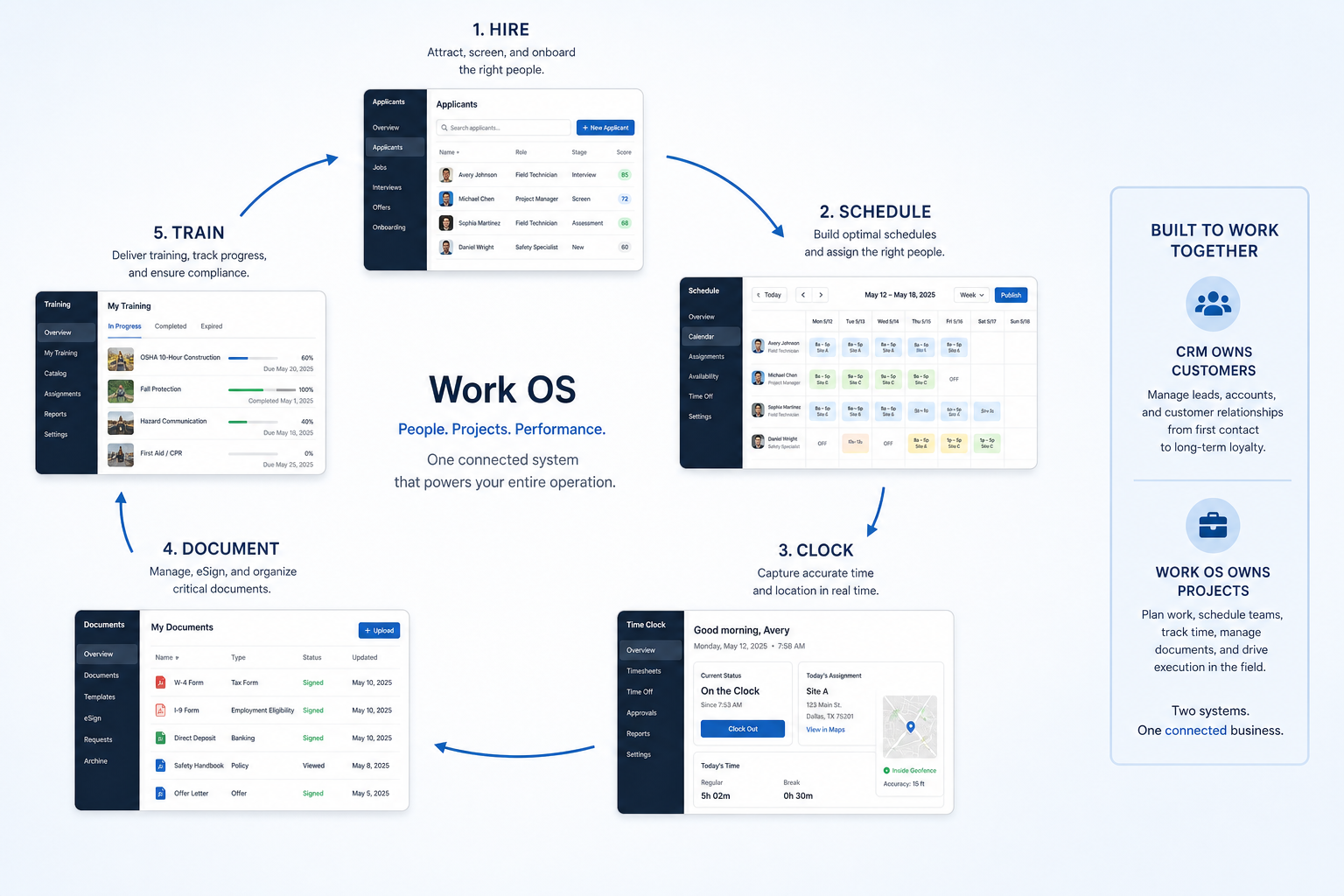
Hire
Candidates move through owned pipeline stages.
Schedule
Shifts are planned, published, and covered.
Clock
Attendance is captured with policies you can defend.
Document
SOPs are searchable and assigned by role.
Train
Paths complete with evidence managers can review.
Most HR platforms specialise: ATS products move candidates through stages; frontline apps publish shifts and mobile tasks; time clocks capture attendance; SOP tools store playbooks with completion tracking; LMS products deliver courses.
Example: Harbor Retail, a 40-person multi-site shop, starts with a time clock for GPS clock-in, then adds frontline scheduling when managers still rebuild weeks in spreadsheets — without buying an ATS they do not need yet.
2. What HR software typically includes
Depending on job cluster: applicant tracking and career sites; workforce scheduling and frontline chat; GPS/geofence clock-in and timesheets; SOP knowledge bases and training paths; or LMS course builders for academies.
Job clusters matter more than brand names: ATS peers, frontline WFM, time & attendance, SOP training, and LMS shapes rarely belong on the same undifferentiated shortlist. Catalogue examples are shapes to compare by primary job — not a ranking.
Common HR software shapes (not rankings)
ATS / recruiting
Best for: Teams that need candidate pipelines, career sites, and interview workflows.
Avoid when: Your primary job is shift scheduling or GPS clock-in.
Frontline workforce management
Best for: Deskless teams that need scheduling, mobile communications, and ops hubs.
Avoid when: You only need a dedicated ATS or a pure time clock.
Time & attendance
Best for: Hourly and field teams that need accurate clock-in and timesheets.
Avoid when: Full frontline scheduling + comms is the blocking need.
SOP training / employee LMS
Best for: Teams documenting playbooks or running role training and academies.
Avoid when: Hiring pipeline or time-clock accuracy is the real purchase.
3. Name the job HR software should own
HR platforms specialise inside a people loop: attract and stage candidates, keep an employee record, run payroll/benefits, publish shifts, capture attendance, and deliver training.
Example: Harbor Retail (40 people, three sites) starts with GPS clock-in because managers still rebuild weeks in spreadsheets — then adds scheduling. They do not buy an ATS until hiring volume actually blocks them.
4. Next: freeze requirements and compare fairly
Move to /guides/how-to-choose-hr-software/ once the job cluster is clear. Compare finalists with the same assumptions — not affiliate-ordered lists.
5. Use a one-page checklist before demos
For What Is HR Software?, list must-haves, owners, integrations, and the weekly ritual this purchase must improve. Share the sheet with finance and IT before you schedule a second demo.
- Name the primary job in one sentence.
- List must-have gates (plans, SSO, data residency, usage caps).
- Name integrations that must work on day one.
- Assign an admin owner and a weekly user champion.
- Define non-admin proof — what a sceptic completes without rescue.
Worked example: Harbor Ops refuses demos until the checklist is signed — cutting evaluation time in half.
6. Avoid the usual buying mistakes
Common failures in hr: buying for brand familiarity, comparing entry tiles across different usage units, skipping a fair trial script, and adding scope before adoption proves out.
Run one trial script on every finalist the same week. Score on the same card. Write a one-paragraph decision memo that names what you are not buying yet.
7. Hand off to the category shortlist
When assumptions are frozen, continue on /best/hr-software/ with the same headcount, usage band, and must-have gates on every quote.
Frequently asked questions
Is HR software the same as a CRM?
No. CRM systems track customers and revenue. HR software tracks hiring, workforce coordination, attendance, or training — though stacks often integrate.
Do I need one suite or specialist tools?
Buy for the job that creates the most rework this quarter. Suites help when hubs are truly used; specialists win when one job dominates.
Where do Breezy, Connecteam, Jibble, and Trainual fit?
They are Wave-1 cluster leaders for ATS, frontline WFM, time & attendance, and SOP training respectively. Compare inside those jobs — see Best HR software for methodology-based editor’s picks.
Was this article helpful?
Have more questions? Contact our support team.
Part of Software buying guides · How to Choose HR Software
Related guides
Supporting reading in this topic — not a generic related-posts dump.
- Is Rippling Worth It? Fit Scenarios Before You BuyDecide if Rippling is worth it for your team — job-cluster fit, trial proof, and packaging — without invented ROI percentages.
- Is Carepatron Worth It? Fit Scenarios Before You BuyDecide if Carepatron is worth it for your team — job-cluster fit, trial proof, and packaging — without invented ROI percentages.
- Is Bolt for Business Worth It? Fit Scenarios Before You BuyDecide if Bolt for Business is worth it for your team — job-cluster fit, trial proof, and packaging — without invented ROI percentages.
- Rippling Plans: Seats, Hubs, and Qualifying TiersChoose your Rippling plan by mapping must-haves to qualifying tiers — seats, hubs, pools, and add-ons — not homepage “from” tiles.
- HR Software Pricing GuideBudget ATS, frontline WFM, time clocks, SOP training, and LMS tools by qualifying configuration — not the advertised starter tile.
- HR Software Requirements GuideA practical requirements sheet for ATS, frontline WFM, time & attendance, SOP training, and LMS purchases.
- ADP Workforce Now Plans: Seats, Hubs, and Qualifying TiersChoose your ADP Workforce Now plan by mapping must-haves to qualifying tiers — seats, hubs, pools, and add-ons — not homepage “from” tiles.
- BambooHR Plans: Seats, Hubs, and Qualifying TiersChoose your BambooHR plan by mapping must-haves to qualifying tiers — seats, hubs, pools, and add-ons — not homepage “from” tiles.
- Bolt for Business Plans: Seats, Hubs, and Qualifying Tiersfr009-backfill:guide_overlay→injection
SoftwareGlimpse Updates
Want clearer software shortlists? Get buying guides and comparisons by email.
Newsletter coming soon.