SoftwareGlimpse
Sales Intelligence Software

Is Clay Worth It? Fit Scenarios Before You Buy

Decide if Clay is worth it for your outbound pod — fit scenarios, credit economics, and when to keep looking — without invented ROI percentages.

By Lee M.Updated Aug 17, 20266 min readFact-checked

Quick answer

Clay is worth it when your outbound motion matches who it serves well, a non-admin can prove list → outreach → CRM logging in trial, and seats/credits on a real package clear your must-haves — confirmed on the pricing page. If fit, proof, or packaging fails, keep looking instead of forcing a buy.

  • Match best-for scenarios
  • Prove the outbound loop
  • Accept known tradeoffs
  • Confirm seats/credits
  • No invented ROI
  • Keep looking if gates fail
Goals
Features
Integrations
Cost
Ease of use
Growth

See Clay before you decide

Core product overview media for a fit check — still not a substitute for the decision criteria on this page.

See Clay in action

Official product overview for a fit check — not scoring, pricing, or comparative superiority.

This video is hosted on YouTube

This content is hosted by YouTube. The player loads only after you allow marketing cookies.

Official vendor video

What is Clay?

What this shows

  • Clay product overview and GTM positioning
  • Enrichment and table-based workflow framing
Product screenshots

Product screenshots coming soon

We only publish verified captures from Clay's product interface — never stock images, mockups, or teaching diagrams. Screenshots appear here once editorial review confirms them.

Full product screenshots and evidence live on the Clay research page.

Is Clay worth it?

  • What it is Go-to-market data and enrichment platform that lets growth and RevOps teams build multi-provider waterfall workflows (Claygent AI research, enrichment, outreach prep) with Free, Launch, Growth, and Enterprise plans.
  • Best for GTM engineers and RevOps teams building multi-provider enrichment waterfalls; Growth teams that want Claygent-style AI research inside prospecting workflows; Buyers consolidating many data vendors into one orchestration layer
  • Not ideal for Non-technical teams that need a simple Chrome contact lookup only; Buyers who want a native enterprise ABM analytics suite; Teams unwilling to govern multi-provider credit spend
  • Commercial clarity Researched plans: Free, Launch, Growth, Enterprise. Never invent list prices here — confirm seats, credits, and quote terms on /pricing/clay/.
  • Editorial verdict snapshot Clay: Choose Clay when multi-provider enrichment waterfalls and AI research workflows are the primary job and you have GTM/RevOps capacity to operate them. Scores use the sales-intelligence editorial methodology from first-party research as of 2026-08-17 — not hands-on product testing.

Clay worth-it gates

  1. 1Motion
  2. 2Trial
  3. 3Accept?
  4. 4Credits
  5. 5Buy/pass

Clay worth-it framework

Clay worth-it framework diagram.
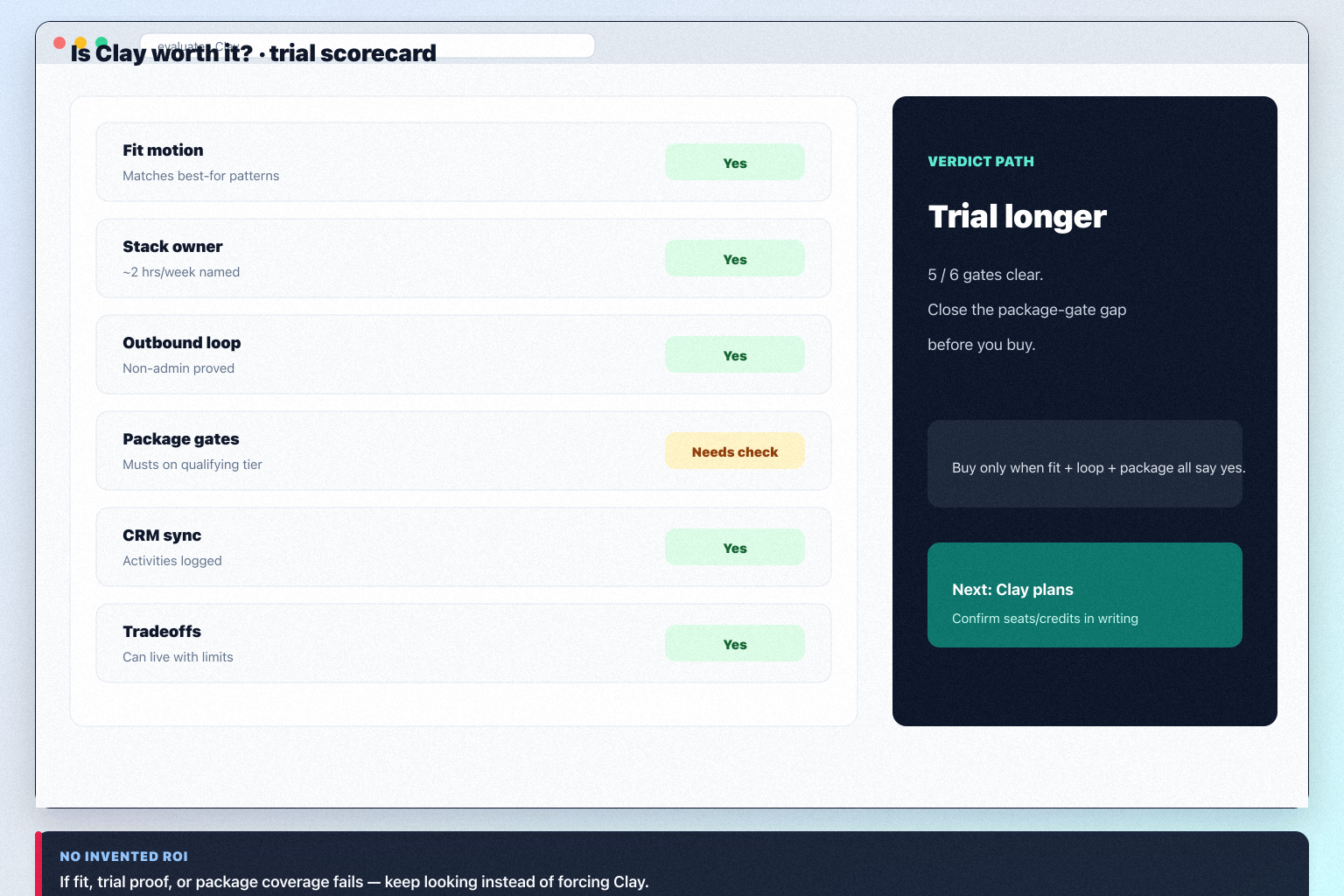
Clay is “worth it” when fit, trial proof, and qualifying cost align.

Clay checklist

Bring these questions to every demo

Ask vendors to show the workflow live, not just describe it.

  • 1Match best-for scenariosYour motion should resemble who the product serves well.
  • 2Prove the outbound loopNon-admin list → outreach → CRM evidence.
  • 3Confirm seats and creditsMust-haves on a real package before you call it a bargain.

1. Fit gate: does your motion match?

Clay worth-it diagram 1.
Fit Clay to your outbound motion before you talk ROI.

Compare your ICP, channels, and admin capacity to researched best-for / not-ideal patterns. Best for: GTM engineers and RevOps teams building multi-provider enrichment waterfalls; Growth teams that want Claygent-style AI research inside prospecting workflows; Buyers consolidating many data vendors into one orchestration layer. Not ideal: Non-technical teams that need a simple Chrome contact lookup only; Buyers who want a native enterprise ABM analytics suite; Teams unwilling to govern multi-provider credit spend. Worked example: an 8-person B2B outbound pod needs mid-market contact data and sequences with CRM logging. They score Clay on fit only after reading those patterns — not after a polished demo.

2. Proof gate: non-admin outbound loop

Clay worth-it diagram 2.
Clay is worth it only when your pod can run the loop.
  1. A non-admin builds or uses an ICP list in Clay.
  2. Enrichment (if needed) produces a usable email or phone.
  3. Sequence or dialer step completes.
  4. Activity appears in CRM without an admin screenshot. Our pricing snapshot records a 14-day trial on Launch and Growth — confirm current terms on the Clay pricing page before you build a schedule around it. Worked example: an 8-person B2B outbound pod fails the gate when email never lands on the CRM contact; they extend trial, fix sync, and only then reconsider buy.

3. Tradeoff gate: can you live with the limits?

Clay worth-it diagram 3.
Accept Clay tradeoffs in writing — or keep looking.

Read strengths and weaknesses before you negotiate. Strengths: Best-in-class multi-provider enrichment and waterfall flexibility; Claygent AI web research agent for creative GTM workflows; Free plan plus published Launch/Growth headline pricing; Strong HubSpot/Salesforce and provider ecosystem connections. Watch-outs: Steeper learning curve than simple contact databases; Credits across providers can surprise budgets; Reporting is lighter than ABM platforms; Native sequencing is limited. Worked example: an 8-person B2B outbound pod accepts known data coverage gaps for their secondary geo, documents them, and refuses to pretend Clay is universal coverage.

4. Package gate and decide

Clay worth-it diagram 4.
Buy Clay only when fit, proof, and package gates agree.
  1. Confirm must-haves on a qualifying package. Our research does not flag plan-gated capabilities for Clay, but confirm your must-haves — including credits and seats — against the packaging you actually intend to buy.
  2. Never invent list prices here — confirm seats, credits, and quote terms on /pricing/clay/.
  3. Buy only when fit + proof + package all say yes.
  4. Otherwise keep looking via how to choose sales intelligence — teams often also evaluate Apollo.io, Clearbit, and ZoomInfo. Worked example: an 8-person B2B outbound pod clears fit and proof but fails package clarity; they pause the buy until credit exhaustion rules are written, instead of inventing an ROI percentage.

5. Decide if Clay fits the primary job

Choose Clay when multi-provider enrichment waterfalls and AI research workflows are the primary job and you have GTM/RevOps capacity to operate them.

6. Compare finalists in the same cluster

  • Strong fit

    GTM engineers and RevOps teams building multi-provider enrichment waterfalls

  • Weak fit

    Non-technical teams that need a simple Chrome contact lookup only

Peer alternatives to compare: Apollo.io, Clearbit, ZoomInfo, and Seamless.AI. Run the same trial script on each before you decide.

7. Write the decision in one paragraph

Name the job, the qualifying Clay configuration, and what you are not buying yet. Link /software/clay/ for product detail and /pricing/clay/ for commercial assumptions.

Frequently asked questions

  • Can we decide from a demo alone?

    No. Require non-admin proof of list → outreach → CRM logging on the package you will actually buy.

  • What if credits look cheap but seats are expensive?

    Model the constraint you will hit first. Many pods exhaust credits before seats — confirm both on the pricing page.

  • When should we walk away?

    When fit, trial proof, or written packaging fails. Keeping looking is cheaper than forcing Clay into the wrong motion.

Was this article helpful?

Have more questions? Contact our support team.

SoftwareGlimpse Updates

Want clearer software shortlists? Get buying guides and comparisons by email.

Newsletter coming soon.