Cursor Setup: Day-Zero Path to a Working AI Loop
LLM chat and assistants; reasoning / advanced models; writing and paraphrasing; agent / app builder. Hobby · free · LLM chat and assistants | Pro | Teams Standard. Developers who want an AI-native editor rather than a plugin; Teams running Agent-heavy refactors with MCP/tools; Orgs ready for Teams SSO and privacy modes. Cursor is an AI-native code editor (VS Code fork) with Tab completions, Agent, Cloud Agents, and MCP/skills. Hobby is free with limited Agent/Tab. Pro is list price. Teams Standard Buyer question: choose Cursor only if Developers who want an AI-native editor rather than a plugin outweighs Switching editors is a real adoption cost vs Copilot-in-VS-Code — otherwise keep researching. Verdict shape: yes for teams built around Developers who want an AI-native editor rather than a plugin; Teams running Agent-heavy refactors with MCP/tools; Orgs ready for Teams SSO and privacy modes; no when Teams that refuse to leave VS Code/JetBrains + Copilot plugin; Procurement that only wants GitHub Enterprise Copilot SKUs; Non-coding LLM chat (ChatGPT / Perplexity) — LLM chat and assistants is the hinge, not brand familiarity.
Quick answer
LLM chat and assistants decides whether Cursor setup is a one-team pilot or a specialist project — confirm unlocks for must-have capabilities before invites.
- Start with: LLM chat and assistants
- Gate check: confirm paid unlocks before go-live
- Integrate after: data quality pass on systems of record
What matters in your Cursor setup
- What Cursor actually is — Cursor is an AI-native code editor (VS Code fork) with Tab completions, Agent, Cloud Agents, and MCP/skills. Hobby is free with limited Agent/Tab. Pro is list price. Teams Standard is list price (about list price annual). Heavier Pro+/Ultra and Teams Premium S…
- Configure these first — Research lists LLM chat and assistants, reasoning / advanced models, writing and paraphrasing, and agent / app builder as supported — that is your day-zero surface.
- Do not treat it as every AI job — Cursor is AI-native code editor. It is not a substitute for GitHub Copilot as a plugin-only add-on, or ChatGPT in a browser tab.
- Prove with a real workflow — Worked example: Northline Product (small product-engineering team) is done when they can a developer completes an in-editor agent task without an admin — not after a vendor tour.
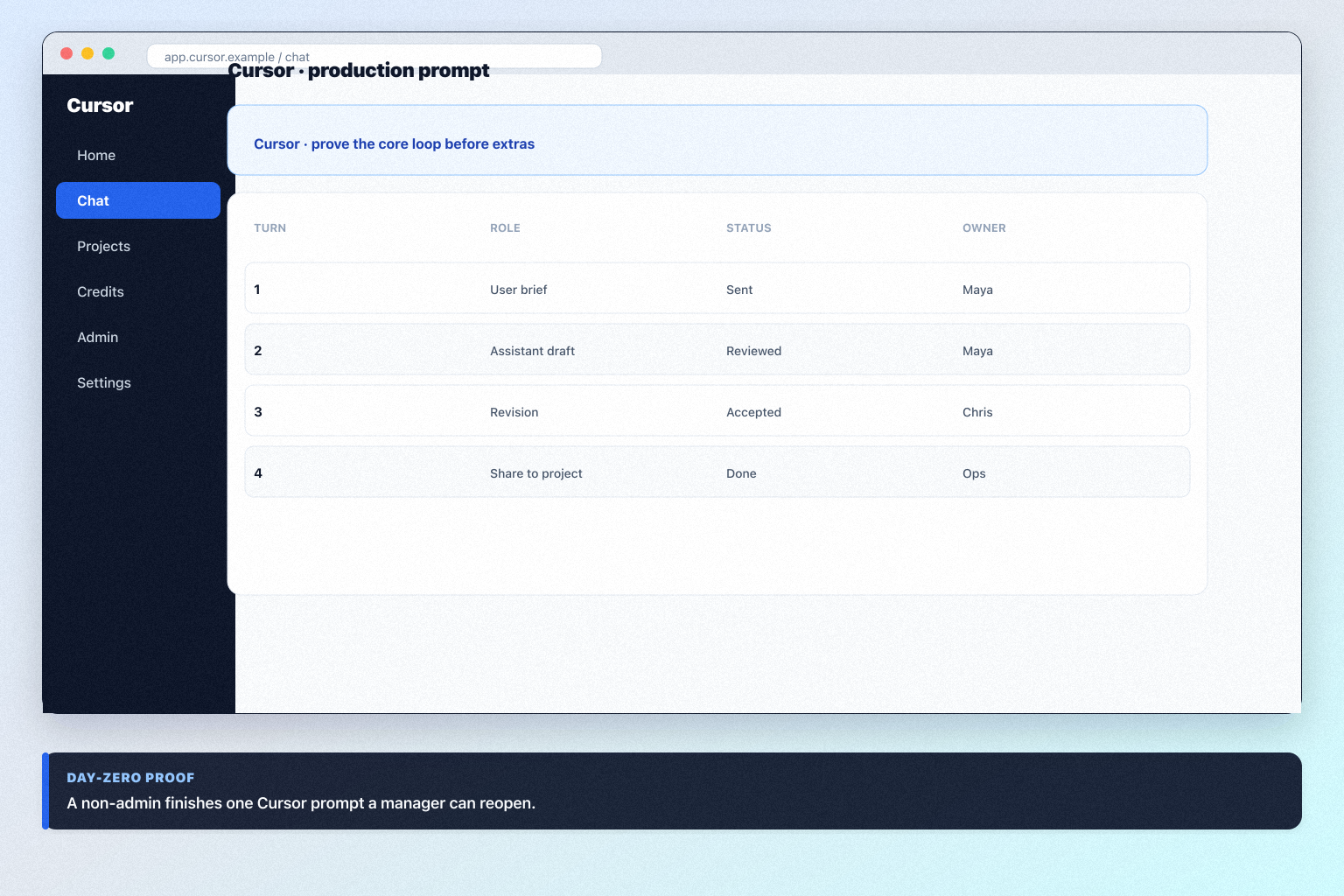
Cursor day-zero path
Cursor must vs nice
- Core job loop
- Plan / hub gates
- Integrations
- AI extras
Cursor checklist
Bring these questions to every demo
Ask vendors to show the workflow live, not just describe it.
- 1Name an AI/ops ownerFields, users, and hygiene need a responsible party.
- 2Configure one core loopone team or Pro plan, one repo opened in Cursor, and usage credits you will actually buy
- 3Complete non-admin proofa developer completes an in-editor agent task without an admin
Frequently asked questions
When is setup actually done?
When a non-admin can a developer completes an in-editor agent task without an admin on the package you will buy.
Should we turn on every Cursor hub on day one?
No. Extra add-ons hide whether the core AI-native code editor loop works.
1. Cursor day-zero to steady-state sequence
Day zero — objects and owners
Define owners for LLM chat and assistants, reasoning / advanced models, writing and paraphrasing before inviting the whole org.
SMB pilot
One pipeline / one team proves Developers who want an AI-native editor rather than a plugin before company-wide seats.
Cutover
Freeze legacy writes briefly; validate priority integrations before reopen.
Treat Cursor setup as a controlled rollout — not a weekend dump of CSV files.
Cursor implementation go / no-go
Cursor implementation mistakes
Mistake 1
Switching editors is a real adoption cost vs Copilot-in-VS-Code
Mistake 2
Usage overage on Agent/frontier models can exceed list price Pro
Mistake 3
Enterprise controls are sales-gated
Mistake 4
Not a general LLM research assistant
Big-bang invite
Inviting every user before object design creates junk data that is expensive to unwind.
Cursor plan gates that affect rollout
Implementation fails when unlocks needed for go-live sit on a higher tier than budgeted.
- Seats61%
- Add-ons18%
- Implementation12%
- Training5%
- Other4%
Hobby
Free plan · Unlocks: LLM chat and assistants, reasoning / advanced models, writing and paraphrasing · Suits: explore before committing seats
Pro
Suits: teams whose must-have gates appear on this tier
Teams Standard
Suits: teams whose must-have gates appear on this tier
Enterprise
Contact sales · Suits: teams that need custom procurement
Cursor implementation checklist
0/3 dimensions noted — saved in this browser only.
Prep
Pilot
Scale
Was this article helpful?
Have more questions? Contact our support team.
Part of Cursor review · AI Software hub
Related guides
Supporting reading in this topic — not a generic related-posts dump.
- AI Software Requirements GuideA practical requirements sheet for LLM assistants, AI coding, image and video, meeting notes, writing, voice, decks, sites, ads, and agents.
- Cursor Implementation: 30/60/90 AI Rollout That SticksPlan a practical Cursor rollout — owners, core AI loop, training, and adoption checkpoints — so the product becomes how the team actually works.
Related products
Related comparisons
SoftwareGlimpse Updates
Want clearer software shortlists? Get buying guides and comparisons by email.
Newsletter coming soon.