Vonage Implementation: 30/60/90 Communications Rollout That Sticks
Plan a practical Vonage rollout — phone admin, number provisioning, routing, softphone, and CRM CTI — so communications becomes a repeatable motion.
Quick answer
Roll out Vonage in three phases: days 1–30 get numbers live with number and routing hygiene and CRM sync, days 31–60 make weekly queue and call reviews run from Vonage, and days 61–90 add only IVR / routing or queues that still aren’t working. Confirm call recording (Mobile+) and video meetings (Mobile+) are on the package you will actually buy. If agents still route to unowned queues without a CRM sync or do-not-call hygiene by week two, pause new features and fix that first.
- Freeze 3 outcomes
- Name a communications owner
- Day 30: live communications loop
- Day 60: channel rhythm
- Day 90: expand carefully
- Usage before features
Vonage rollout takeaways
- Implementation is habit work — Vonage Business Communications (VBC) is an SMB/mid-market cloud phone system: unlimited US/Canada calling and SMS under fair use, softphone apps, team messaging, video meetings on Premium+, and CRM connectors on higher tiers. First-party pricing on vonage.com/… None of that helps until the weekly communications loop is boring.
- Gate features to plan tiers — Plan-gated in research: call recording (Mobile, Premium, Advanced); video meetings (Mobile, Premium, Advanced); CRM CTI (Mobile, Premium, Advanced).
- Enable in this order — Days 1–30: cloud phone, call routing, call recording, and sms messaging. Days 31–60: weekly usage review and call recording. Days 61–90: call routing, AI assistance, and second call queue / IVR route.
- Measure usage, not configuration — Count answer rates, missed-call rates, minutes used per queue, and CRM-logged calls from Vonage — not modules enabled.
- Know what you inherited — Research watch-outs to plan around: Taxes/fees inflate real line cost; Recording and deeper CRM gated to higher tiers; Thin AI versus modern SMB phones.
Vonage 30/60/90 path
Vonage implementation walkthrough
Vonage must vs nice
- Logged CRM activities from calling
- Weekly list / sequence review
- call routing
- AI assistance
Vonage checklist
Bring these questions to every demo
Ask vendors to show the workflow live, not just describe it.
- 1Freeze three 90-day outcomesMeetings, coverage, or reply goals with owners.
- 2Day 30: live communications loopEvery active rep runs number → softphone → CRM log weekly.
- 3Day 60: usage reviewMinutes/contacts per meeting and sequence hygiene on the agenda.
- 4Day 90: expand only gapsAdd channels or packs that still miss an outcome.
1. Freeze outcomes and RACI before you configure Vonage
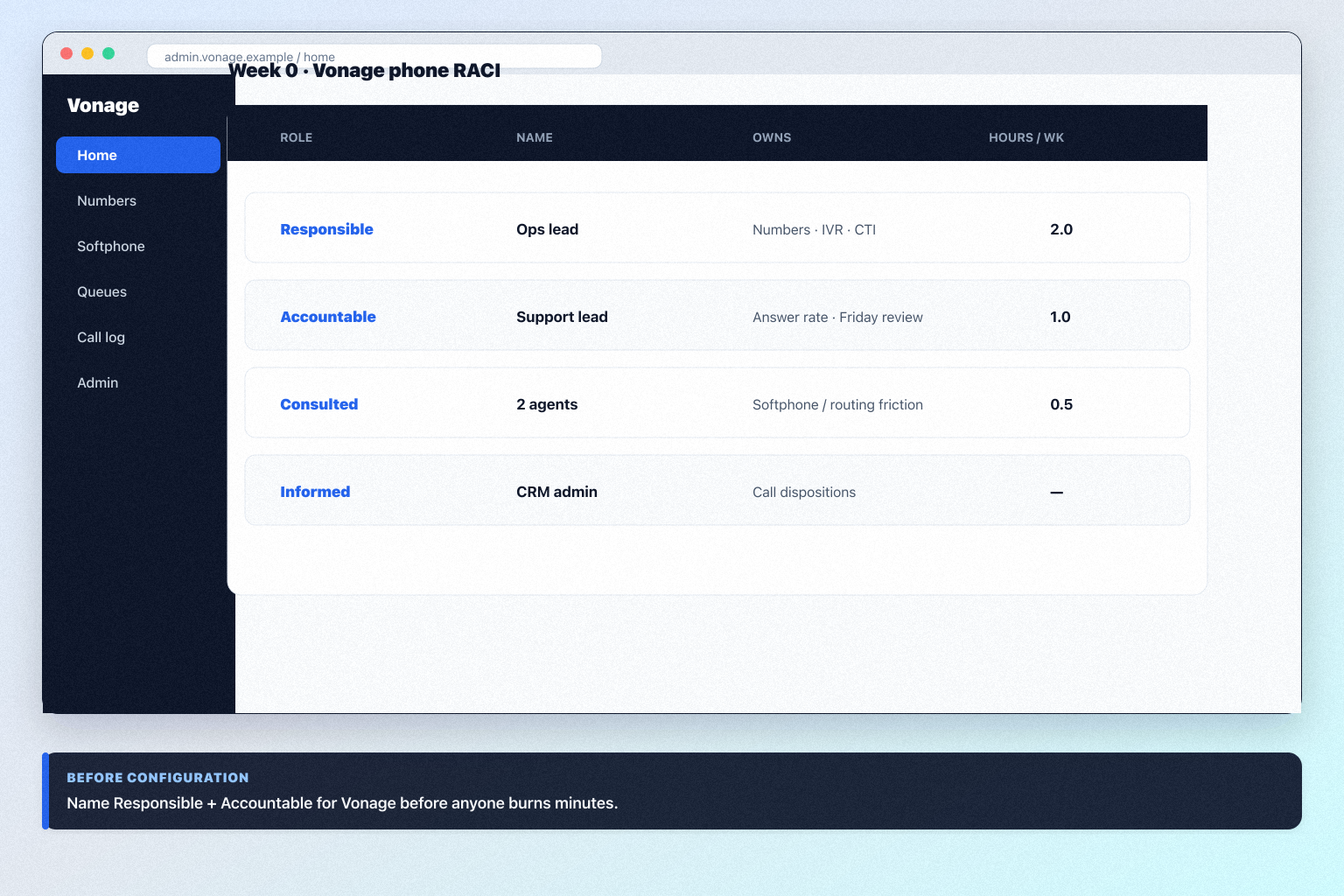
Lock three 90-day outcomes and name Responsible / Accountable before anyone burns seats/numbers. 1. Write exactly three 90-day outcomes in business language (engagement, coverage and answer-rate, routing coverage).
- Assign RACI — Responsible: Vonage communications owner; Accountable: sales/support lead; Consulted: two agents; Informed: Ops / CRM admin.
- Write the “not now” list for channels and packs not tied to the three outcomes.
- Book the day-30 and day-60 reviews in the calendar now. Worked example: an 8-person sales + support team freezes three outcomes for Vonage, gives ops two hours a week as Responsible, and defers call routing and AI assistance to day 61.
2. Days 1–30: get the communications loop live
Days 1–30 are for cloud phone, call routing, call recording, and sms messaging — not marketplace browsing. 1. Finish setup: one call queue / IVR route, CRM CTI / call logging, one voice channel.
- Invite only daily users; spectators wait.
- Run a mid-month spot-check: 20 random callinges must show a CRM activity.
- Kill shadow spreadsheets that still hold “the real list.” Worked example: an 8-person sales + support team runs Vonage as the only place new contacts enter calls, and by day 30 every open routing step has an owner and a CRM log.
3. Days 31–60: install the weekly rhythm
Make Friday (or Monday) reviews run from Vonage. 1. Agenda: minutes used vs answered calls, routing quality flags, answer and handle times, CRM CTI / call logging errors.
- Add light routing only where a human already does the same step weekly. call recording is researched on Mobile, Premium, and Advanced only
- Retrain anyone still exporting numbers to personal call logs.
- Re-measure adoption before unlocking day-61 packs. Worked example: an 8-person sales + support team finds two agents still keeping “private” call sheets; they pause new calls until those numbers are suppressed or imported into Vonage.
4. Days 61–90: expand only where outcomes still miss
- Re-read the three outcomes. Expand only where an outcome is still missing.
- Then, in this order: second call queue / IVR route, call routing, remaining IVR / routing, remaining integrations. Research lists AI transcription for Vonage. Research places AI assistance on Mobile, Premium, and Advanced.
- Write down what you chose not to do and why. That list is your renewal-time evidence.
- Never invent list prices here — confirm seats, numbers/minutes, and quote terms on /pricing/vonage/. Worked example: an 8-person sales + support team adds a second Vonage list for after-hours overflow, enables one optional add-on for shared inbox rules, and leaves AI call summaries off because nobody could name the answer-rate decision it would change.
5. Lock plan gates before phase two
Feature gates researched on Vonage: call recording (Mobile, Premium, Advanced), video meetings (Mobile, Premium, Advanced), and CRM CTI (Mobile, Premium, Advanced). Map each must-have to the plan that unlocks it.
Worked example: SMB and mid-market teams wanting published per-line VoIP with SMS freezes must-haves on the qualifying tier before adding automations.
6. Measure adoption on the core loop only
Track weekly completion of the primary workflow — not logins alone. If Vonage is empty after 30 days, pause new modules and fix the ritual.
Worked example: SMB and mid-market teams wanting published per-line VoIP with SMS reviews completion rates before enabling AI add-ons.
7. Expand scope only after 90-day proof
AI surfaces on Vonage include AI transcription on Mobile, Premium, and Advanced. Turn on AI only after the core loop works without it.
Add automations, secondary hubs, or advanced reporting only after the core loop survives a full quarter.
Worked example: SMB and mid-market teams wanting published per-line VoIP with SMS schedules a 90-day review before buying add-on seats.
Frequently asked questions
What if seats/numbers run out before day 30?
Pause new number provisioning, tighten routing filters, and review who is shadow-logging vs callinging. Do not buy a larger pack until the communications owner can explain cost-per-answered-call or handle time for the last two weeks. Confirm pack options on the pricing page.
When should we add a second voice channel?
After the first channel produces CRM-logged activity and a weekly review rhythm. Parallel channels on day one usually double noise without doubling meetings.
Who should own Vonage?
One communications owner with calendar time — usually Ops or ops — not a rotating agent committee.
Was this article helpful?
Have more questions? Contact our support team.
SoftwareGlimpse Updates
Want clearer software shortlists? Get buying guides and comparisons by email.
Newsletter coming soon.