SoftwareGlimpse
HR, Workforce & Training Software

Is Homebase Worth It? Fit Scenarios Before You Buy

Decide if Homebase is worth it for your team — job-cluster fit, trial proof, and packaging — without invented ROI percentages.

By Lee M.Updated Aug 18, 20266 min readFact-checked

Quick answer

Homebase is worth it when your primary job is applicant tracking / recruiting, a non-admin can a hiring manager moves a candidate and leaves feedback without an admin on the package you will buy, and you can live with the researched tradeoffs. It is not worth stretching into frontline scheduling or a GPS time clock.

  • Fit the job cluster
  • Prove the core loop
  • Accept tradeoffs in writing
  • Confirm the qualifying package
  • Otherwise keep looking
Goals
Features
Integrations
Cost
Ease of use
Growth

See Homebase before you decide

Core product overview media for a fit check — still not a substitute for the decision criteria on this page.

See Homebase in action

Official product overview for a fit check — not scoring, pricing, or comparative superiority.

This video is hosted on YouTube

This content is hosted by YouTube. The player loads only after you allow marketing cookies.

Official vendor video

Homebase — the all-in-one team management app for small businesses

What this shows

  • Homebase all-in-one team management app overview
  • Scheduling, time clocks, and hourly team tools
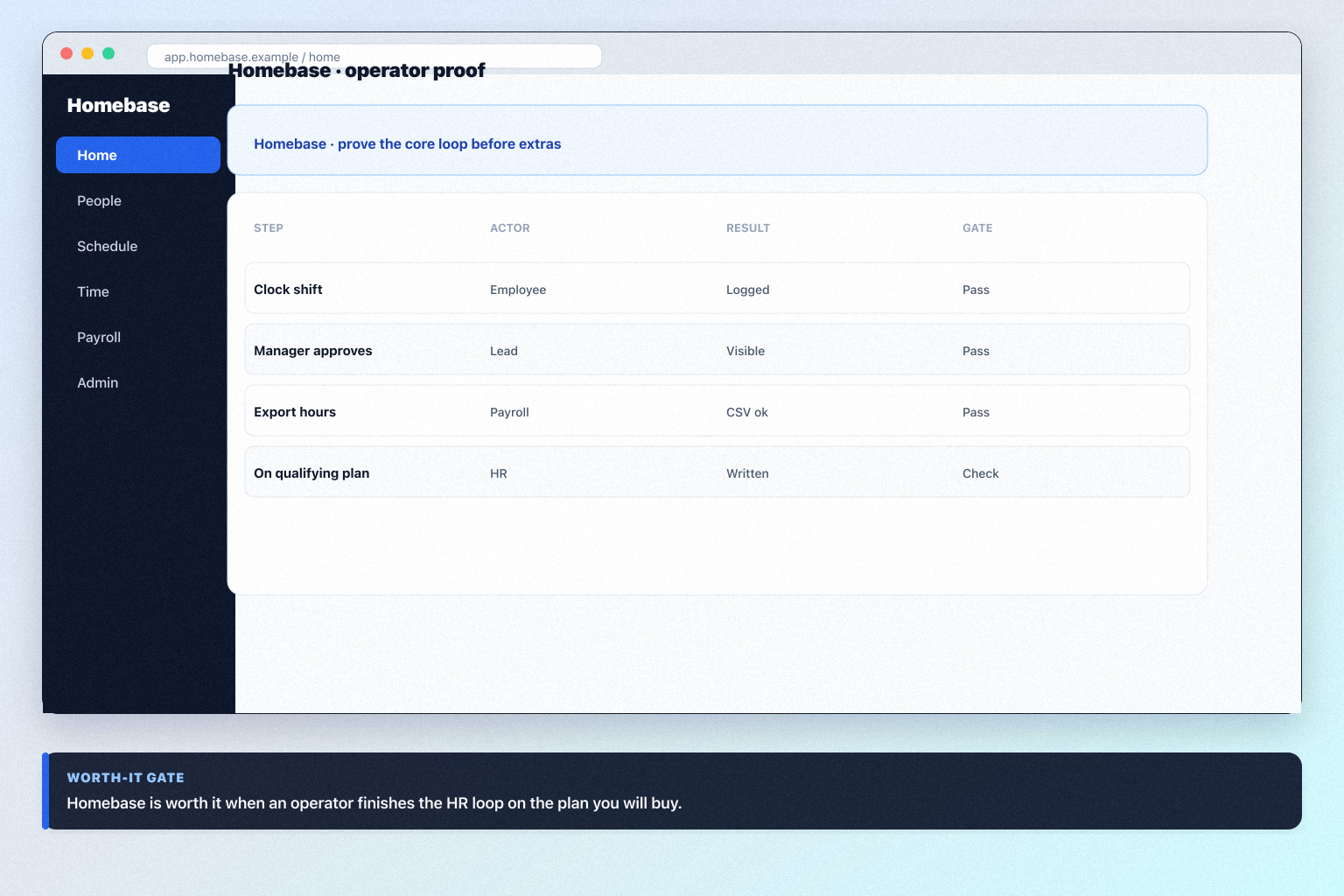
Full product screenshots and evidence live on the Homebase research page.

Is Homebase worth it?

  • Fit Best for: Small hourly businesses (retail, cafes, local services) that need scheduling + time in one app; Teams that want a free ≤10-employee starter before paying per location; Operators who may add payroll later rather than buying Gusto first. Not ideal: Restaurant groups standardised on 7shifts; Multi-entity mid-market WFM (Deputy) or deskless comms hubs (Connecteam); Buyers whose primary job is core HRIS or structured ATS.
  • Proof Worth it only when Harbor Retail (two recruiters and eight hiring managers) can a hiring manager moves a candidate and leaves feedback without an admin.
  • Package Plan-gated in research: payroll processing (Basic, Essentials, Plus, All-in-One).
  • No invented ROI Outcomes, usability, and qualifying cost either align or they don’t — affiliate economics are not a score.

Homebase fit / proof / package

Homebase worth-it gates: fit, proof, package.
Homebase is “worth it” when outcomes, usability, and qualifying cost align — not when a demo feels exciting.

1. Fit gate: does your motion match?

Compare your job to researched best-for / not-ideal patterns. Best for: Small hourly businesses (retail, cafes, local services) that need scheduling + time in one app; Teams that want a free ≤10-employee starter before paying per location; Operators who may add payroll later rather than buying Gusto first. Not ideal: Restaurant groups standardised on 7shifts; Multi-entity mid-market WFM (Deputy) or deskless comms hubs (Connecteam); Buyers whose primary job is core HRIS or structured ATS. Worked example: Harbor Retail (two recruiters and eight hiring managers) scores Homebase on applicant tracking / recruiting only — they refuse to treat it as frontline scheduling or a GPS time clock.

2. Proof gate: non-admin loop

Our pricing snapshot records a 14-day trial on Essentials, Plus, and All-in-One — confirm current terms on the Homebase pricing page before you build a schedule around it. Success: a hiring manager moves a candidate and leaves feedback without an admin. Worked example: Harbor Retail (two recruiters and eight hiring managers) fails the gate when only an admin can complete the walkthrough; they extend trial and fix permissions before considering buy.

3. Tradeoff gate: can you live with the limits?

Strengths: Free Basic for tiny hourly teams; Clear per-location Essentials/Plus/All-in-One ladder; Scheduling + time + light hiring in one SMB app; 14-day All-in-One trial. Watch-outs: Per-location pricing multiplies with sites; Payroll and hiring boosts are add-ons; Free cap of 10 employees / 1 location; Not hospitality-specialist or enterprise WFM. Worked example: Harbor Retail (two recruiters and eight hiring managers) documents known gaps instead of pretending Homebase covers every HR job.

4. Package gate and decide

  1. Confirm must-haves on a qualifying package. Plan-gated in research: payroll processing (Basic, Essentials, Plus, All-in-One).
  2. Never invent list prices here — confirm seats, hubs, and quote terms on /pricing/homebase/.
  3. Buy only when fit + proof + package all say yes.
  4. Otherwise keep looking via how to choose HR software — teams often also evaluate Connecteam, When I Work, and Deputy. Worked example: Harbor Retail (two recruiters and eight hiring managers) clears fit and proof but pauses the buy until hub/seat rules are written.

Homebase checklist

Bring these questions to every demo

Ask vendors to show the workflow live, not just describe it.

  • 1Match best-for scenariosYour motion should be applicant tracking / recruiting.
  • 2Prove the HR loopa hiring manager moves a candidate and leaves feedback without an admin
  • 3Confirm seats and hubsMust-haves on a real tier before you call it a bargain.

5. Decide if Homebase fits the primary job

Choose Homebase when SMB hourly scheduling and time clocks priced per location is the job — not when you need restaurant-only WFM, multi-entity Deputy, or a core HRIS.

6. Compare finalists in the same cluster

  • Strong fit

    Small hourly businesses (retail, cafes, local services) that need scheduling + time in one app

  • Weak fit

    Restaurant groups standardised on 7shifts

Peer alternatives to compare: Connecteam, When I Work, and Deputy. Run the same trial script on each before you decide.

7. Write the decision in one paragraph

Name the job, the qualifying Homebase configuration, and what you are not buying yet. Link /software/homebase/ for product detail and /pricing/homebase/ for commercial assumptions.

8. Decide if Homebase fits the primary job

Choose Homebase when SMB hourly scheduling and time clocks priced per location is the job — not when you need restaurant-only WFM, multi-entity Deputy, or a core HRIS.

9. Compare finalists in the same cluster

  • Strong fit

    Small hourly businesses (retail, cafes, local services) that need scheduling + time in one app

  • Weak fit

    Restaurant groups standardised on 7shifts

Peer alternatives to compare: Connecteam, When I Work, and Deputy. Run the same trial script on each before you decide.

10. Write the decision in one paragraph

Name the job, the qualifying Homebase configuration, and what you are not buying yet. Link /software/homebase/ for product detail and /pricing/homebase/ for commercial assumptions.

Frequently asked questions

  • Can we decide from a demo alone?

    No. Require non-admin proof that you can a hiring manager moves a candidate and leaves feedback without an admin on the package you will actually buy.

  • When should we walk away?

    When fit, trial proof, or written packaging fails — or when the real job is frontline scheduling or a GPS time clock.

Was this article helpful?

Have more questions? Contact our support team.

SoftwareGlimpse Updates

Want clearer software shortlists? Get buying guides and comparisons by email.

Newsletter coming soon.