Is Chronosphere Worth It? Fit Scenarios Before You Buy
Decide if Chronosphere is worth it for your team — job-cluster fit, trial proof, and packaging — without invented ROI percentages.
Quick answer
Chronosphere is worth it when your primary job is IT operations or development platform, a non-admin can finish the loop without an admin on the package you will buy, and you can live with the researched tradeoffs. It is not worth stretching into a different IT job cluster.
- Fit the job cluster
- Prove the core loop
- Accept tradeoffs in writing
- Confirm the qualifying package
- Otherwise keep looking
Is Chronosphere worth it?
- Fit — Best for: SRE teams drowning in Prometheus cardinality who will run a 2–3 week pilot; Buyers comparing Chronosphere control-plane quotes to Datadog module TCO; Estates that already speak PromQL rather than host-map onboarding. Not ideal: SMBs that need Datadog’s published list price/host Infrastructure Pro tile; High-cardinality event/trace specialists whose job is Honeycomb; ITSM or cloud PaaS purchases.
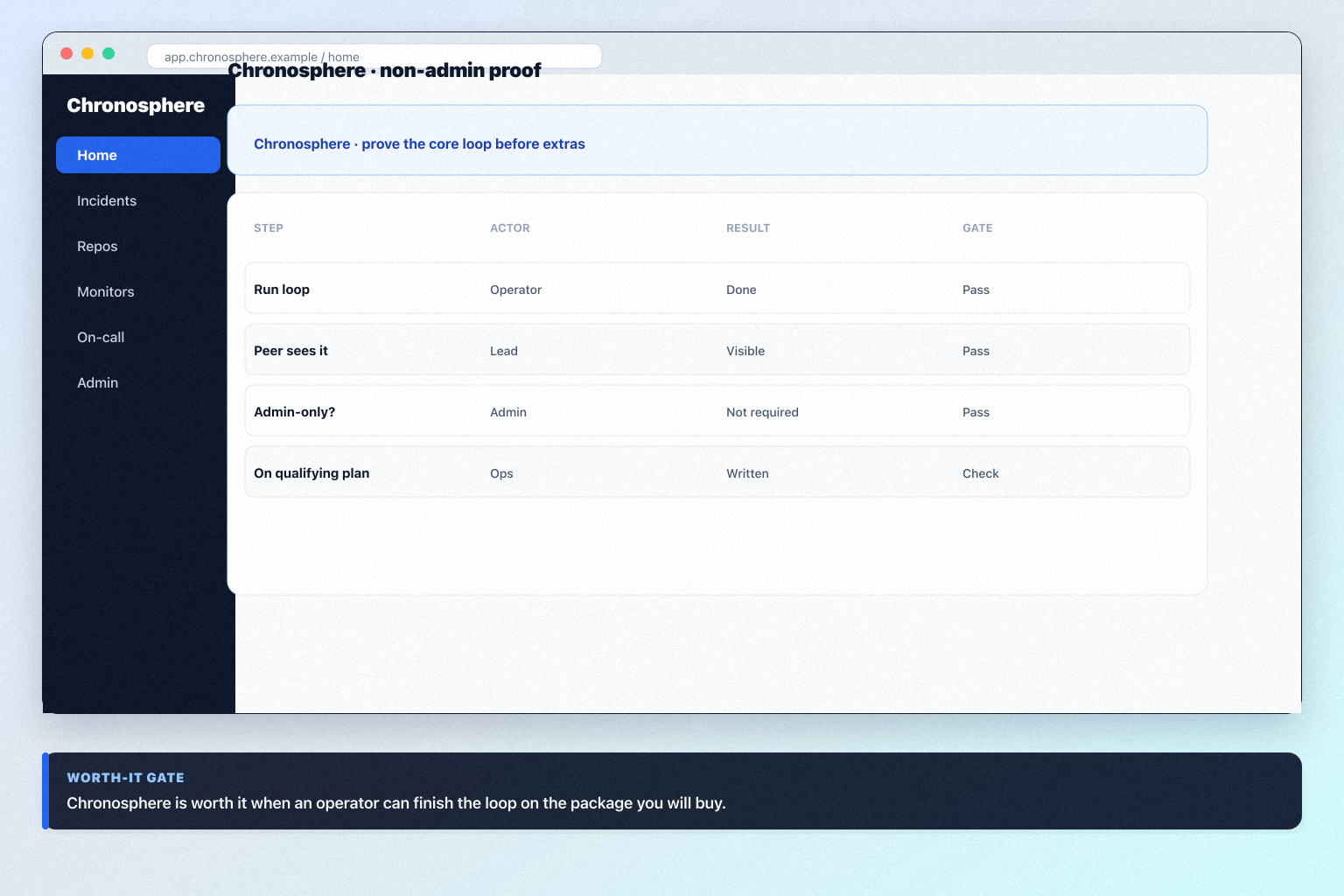
- Proof — Worth it only when Harbor IT (weekly operators) can finish the loop without an admin.
- Package — Our research does not flag plan-gated capabilities for Chronosphere, but confirm your must-haves — including seats, hosts, ingest, and add-ons — against the packaging you actually intend to buy.
- No invented ROI — Outcomes, usability, and qualifying cost either align or they don’t — affiliate economics are not a score.
Chronosphere fit / proof / package
1. Fit gate: does your motion match?
Compare your job to researched best-for / not-ideal patterns. Best for: SRE teams drowning in Prometheus cardinality who will run a 2–3 week pilot; Buyers comparing Chronosphere control-plane quotes to Datadog module TCO; Estates that already speak PromQL rather than host-map onboarding. Not ideal: SMBs that need Datadog’s published list price/host Infrastructure Pro tile; High-cardinality event/trace specialists whose job is Honeycomb; ITSM or cloud PaaS purchases. Worked example: Harbor IT (weekly operators) scores Chronosphere on IT operations or development platform only — they refuse to treat it as a different IT job cluster.
2. Proof gate: non-admin loop
Our pricing snapshot records a 14-day trial on Pilot — confirm current terms on the Chronosphere pricing page before you build a schedule around it. Success: finish the loop without an admin. Worked example: Harbor IT (weekly operators) fails the gate when only an admin can complete the walkthrough; they extend trial and fix permissions before considering buy.
3. Tradeoff gate: can you live with the limits?
Strengths: Prometheus-scale cardinality control; Pilot path (typically 2–3 weeks); Clear observability cluster fit; Scale story versus SMB tiles. Watch-outs: Does not outrank Datadog; No public list; Heavier than host-module UX; AI is not the product. Worked example: Harbor IT (weekly operators) documents known gaps instead of pretending Chronosphere covers every IT job.
4. Package gate and decide
- Confirm must-haves on a qualifying package. Our research does not flag plan-gated capabilities for Chronosphere, but confirm your must-haves — including seats, hosts, ingest, and add-ons — against the packaging you actually intend to buy.
- Never invent list prices here — confirm seats, hosts, ingest, and quote terms on /pricing/chronosphere/.
- Buy only when fit + proof + package all say yes.
- Otherwise keep looking via how to choose IT development software — teams often also evaluate Datadog and Honeycomb. Worked example: Harbor IT (weekly operators) clears fit and proof but pauses the buy until hub/seat rules are written.
Chronosphere checklist
Bring these questions to every demo
Ask vendors to show the workflow live, not just describe it.
- 1Match best-for scenariosYour motion should be IT operations or development platform.
- 2Prove the IT loopfinish the loop without an admin
- 3Confirm seats and hostsMust-haves on a real tier before you call it a bargain.
5. Decide if Chronosphere fits the primary job
Choose Chronosphere when Prometheus-scale cardinality control via a pilot/quote is the job — not Datadog host modules by default.
6. Compare finalists in the same cluster
Strong fit
SRE teams drowning in Prometheus cardinality who will run a 2–3 week pilot
Weak fit
SMBs that need Datadog’s published list price/host Infrastructure Pro tile
Peer alternatives to compare: Datadog and Honeycomb. Run the same trial script on each before you decide.
7. Write the decision in one paragraph
Name the job, the qualifying Chronosphere configuration, and what you are not buying yet. Link /software/chronosphere/ for product detail and /pricing/chronosphere/ for commercial assumptions.
8. Decide if Chronosphere fits the primary job
Choose Chronosphere when Prometheus-scale cardinality control via a pilot/quote is the job — not Datadog host modules by default.
9. Compare finalists in the same cluster
Strong fit
SRE teams drowning in Prometheus cardinality who will run a 2–3 week pilot
Weak fit
SMBs that need Datadog’s published list price/host Infrastructure Pro tile
Peer alternatives to compare: Datadog and Honeycomb. Run the same trial script on each before you decide.
10. Write the decision in one paragraph
Name the job, the qualifying Chronosphere configuration, and what you are not buying yet. Link /software/chronosphere/ for product detail and /pricing/chronosphere/ for commercial assumptions.
Frequently asked questions
Can we decide from a demo alone?
No. Require non-admin proof that you can finish the loop without an admin on the package you will actually buy.
When should we walk away?
When fit, trial proof, or written packaging fails — or when the real job is a different IT job cluster.
Was this article helpful?
Have more questions? Contact our support team.
SoftwareGlimpse Updates
Want clearer software shortlists? Get buying guides and comparisons by email.
Newsletter coming soon.