Hootsuite Plans: Seats, Channels, and Qualifying Tiers
Choose your Hootsuite plan by mapping must-haves to seats, channels, and qualifying features — not homepage “from” tiles — then confirm on the pricing page.
Quick answer
Choose a Hootsuite package by listing day-one must-haves, mapping them to contacts and send limits on researched tiers, and picking the cheapest package that clears every gate — then confirm list price on the pricing page. Homepage “from” tiles are not a bill of materials.
- List day-one must-haves
- Map contacts and send limits
- Highest gate sets the tier
- Soft-check usage limits
- Confirm on pricing page
- Defer unused packs
Hootsuite plans takeaways
- Packaging is often usage-shaped — Hootsuite is often sold on seats, contacts, channels, or contact-sales packaging in our snapshot — treat homepage tiles as marketing, not a bill of materials. Confirm live packaging on the pricing page. Confirm credit and seat limits in writing.
- Must-haves set the tier — Our research does not flag plan-gated capabilities for Hootsuite, but confirm your must-haves — including contact tiers and send limits — against the packaging you actually intend to buy.
- No invented totals — Never invent list prices here — confirm seats, contacts/channels, and quote terms on /pricing/hootsuite/.
- Seat discipline still matters — Count who prospects or dials weekly — not the whole org chart — before you compare Hootsuite packages.
Hootsuite plan path
Hootsuite plan anatomy
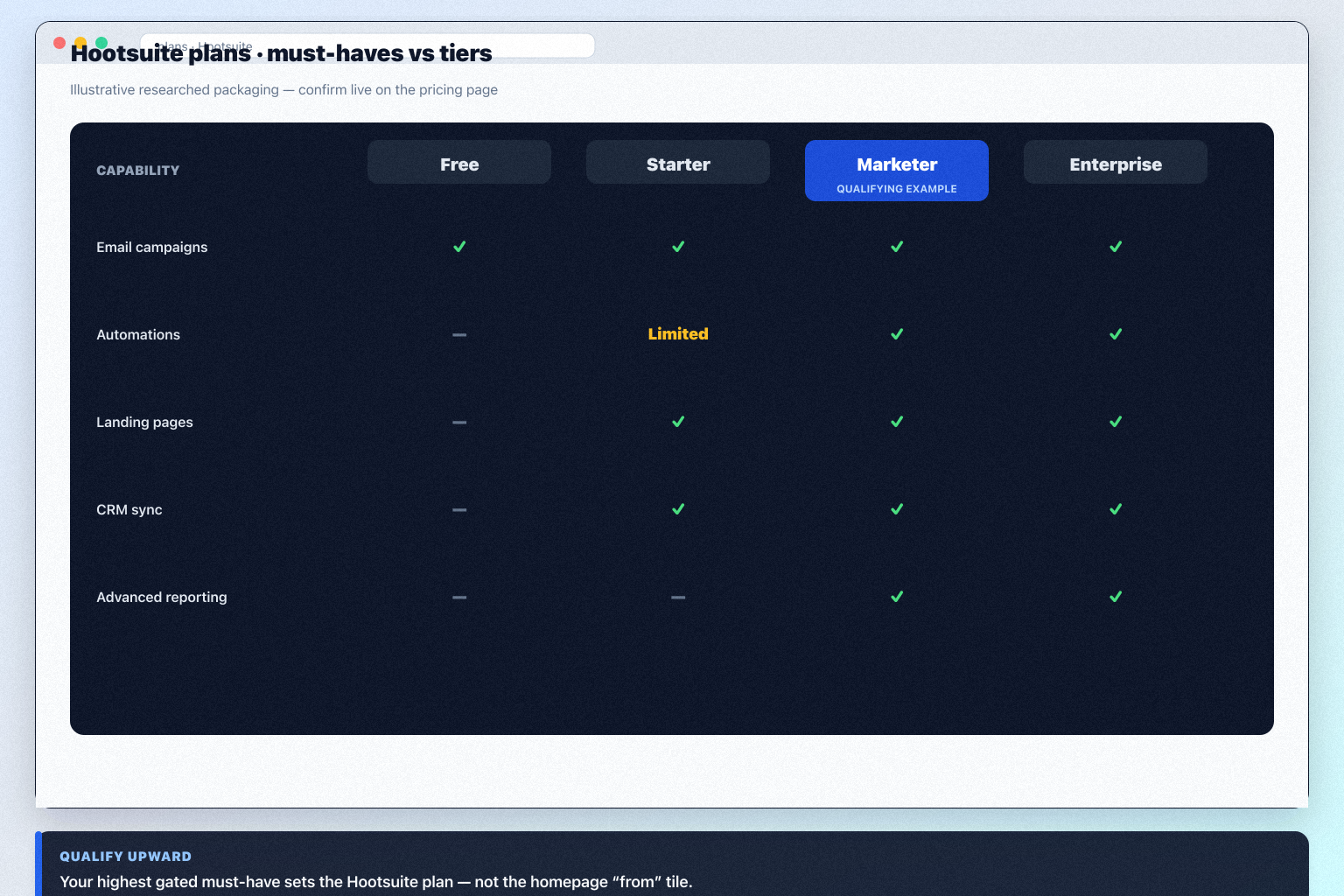
Hootsuite must vs nice
- Campaigns + marketing ↔ CRM sync
- Campaigns or automations
- Extra optional add-ons
- AI assistance
Hootsuite checklist
Bring these questions to every demo
Ask vendors to show the workflow live, not just describe it.
- 1List day-one must-havesData, outreach, sync that must ship without unused enterprise.
- 2Map contacts and send limitsUse researched plan names — not marketing tiles.
- 3Confirm on pricing pageList price and contact-tier upgrades live there — not in this guide.
1. List day-one must-haves before you open pricing tiles
- Write five day-one jobs for the marketing team.
- Mark which require seats vs contacts/channels vs add-on packs.
- Circle the highest gated must-have — that sets the floor tier.
- Our research does not flag plan-gated capabilities for Hootsuite, but confirm your must-haves — including contact tiers and send limits — against the packaging you actually intend to buy. Worked example: a 6-person growth marketing team needs campaigns, marketing ↔ CRM sync, and automations on day one in Hootsuite. Extra segmentation and AI are nice later, so they refuse to let those upsells set the package.
2. Count weekly users and expected credit burn
- Count who builds campaigns, segments, or automations weekly — not headcount.
- Estimate list builds and campaigns per week (orders of magnitude, not fake precision).
- Check researched capacity notes. Confirm contact/send caps for Hootsuite on the pricing page.
- Never invent list prices here — confirm seats, contacts/channels, and quote terms on /pricing/hootsuite/. Worked example: a 6-person growth marketing team counts 6 daily users and 2 managers, defers view-only execs, and refuses any package that cannot explain contact-tier renewals in writing.
3. When packaging is opaque, demand written gates
Our snapshot has no public plan matrix for Hootsuite — treat sales claims as unconfirmed until written. 1. Named SKUs / editions on the quote.
- Seat definition (full vs light) and contact/send definition.
- What happens when contacts/channels exhaust mid-month.
- Exit / export rights for lists you built. Worked example: a 6-person growth marketing team delays shortlisting Hootsuite until send/contact exhaustion behavior and export rights appear in writing.
4. Defer unused packs; confirm the live price last
- Buy contacts/sends required for the day-one loop.
- Defer AI packs, extra channels, and unused add-ons until day 30+ evidence.
- Annualize only after you have written terms — never invent monthly×12 from a marketing tile.
- Final check: /pricing/hootsuite/ Worked example: a 6-person growth marketing team scopes the first Hootsuite invoice to seats + core contact tiers, parks the AI add-on, and only revisits packs after two Friday reviews.
5. Map must-haves to plan names in writing
Map must-have workflows to the Hootsuite plan that unlocks them — demos often run above the tier you can afford.
Compare published tiers on the same headcount assumption.
Worked example: Mid-market/enterprise teams needing a full social suite screenshots the plan shown in demo and matches it to /pricing/hootsuite/.
6. Model seats, usage, and add-ons together
Build one sheet: seats, usage units, add-on SKUs, and overage triggers for Hootsuite. Compare totals — not entry tiles.
7. Get a written quote on the qualifying configuration
Ask Hootsuite for a quote that names plan, seats, usage band, and add-ons. Store it next to alternatives with the same assumptions.
Worked example: Mid-market/enterprise teams needing a full social suite files quotes in the same folder with identical date and headcount headers.
8. Map must-haves to plan names in writing
Map must-have workflows to the Hootsuite plan that unlocks them — demos often run above the tier you can afford.
Compare published tiers on the same headcount assumption.
Worked example: Mid-market/enterprise teams needing a full social suite screenshots the plan shown in demo and matches it to /pricing/hootsuite/.
9. Model seats, usage, and add-ons together
Build one sheet: seats, usage units, add-on SKUs, and overage triggers for Hootsuite. Compare totals — not entry tiles.
10. Get a written quote on the qualifying configuration
Ask Hootsuite for a quote that names plan, seats, usage band, and add-ons. Store it next to alternatives with the same assumptions.
Worked example: Mid-market/enterprise teams needing a full social suite files quotes in the same folder with identical date and headcount headers.
Frequently asked questions
Why don’t you list dollar prices here?
Never invent list prices here — confirm seats, contacts/channels, and quote terms on /pricing/hootsuite/.
What if there is no public plan matrix?
Common for marketing. Compare with a written must-have sheet and quote diligence — not blog “starting at” figures.
Seats or contacts/channels — which matters more?
Whichever your day-one jobs consume. Many teams under-buy contacts/channels and over-buy spectator seats — reverse that.
Was this article helpful?
Have more questions? Contact our support team.
SoftwareGlimpse Updates
Want clearer software shortlists? Get buying guides and comparisons by email.
Newsletter coming soon.